
If you want your website to rank, convert, and stay competitive in 2026, you can’t ignore performance. Search engines are no longer just evaluating content quality. They are deeply focused on how users experience your website.
That’s where a core web vitals audit becomes essential.
When users visit your site, they expect it to load quickly, respond instantly, and remain visually stable. If your site fails in any of these areas, you risk losing both rankings and conversions. Today, performance is not just a technical factor. It is a direct business driver.
Table of Contents
What is a Core Web Vitals Audit?
A core web vitals audit is a structured process of analyzing your website’s performance based on three key metrics: loading speed, interactivity, and visual stability.
Instead of guessing what might be slowing your website down, this audit gives you clear, data-backed insights. It helps you identify exactly where your site is underperforming and what needs to be fixed.
When aligned with Technical SEO, it ensures that your website is not only visible to search engines but also optimized for real users.
Core Web Vitals Metrics Explained (2026 Update)
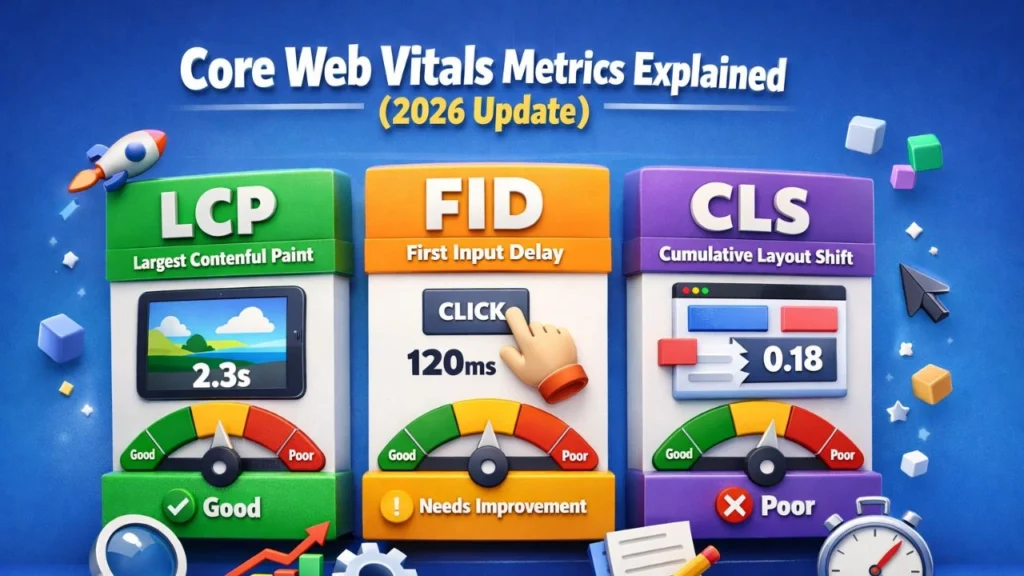
To perform an effective core web vitals audit, you need to understand the three core metrics.
Largest Contentful Paint (LCP)
This measures how fast the main content of a page loads. Ideally, it should be under 2.5 seconds. Slow server response, heavy images, and unoptimized code can delay LCP.
Interaction to Next Paint (INP)
INP measures how quickly your website responds to user interactions. It replaces older metrics and focuses on real responsiveness. If your site feels sluggish when users click or scroll, your INP needs improvement.
INP Replaces FID:
One major update in recent years is the shift from First Input Delay (FID) to Interaction to Next Paint (INP).
Unlike FID, INP measures the overall responsiveness of a page throughout the user session, not just the first interaction. This makes it a more accurate reflection of real user experience.
If your core web vitals audit still focuses only on FID, you may be missing critical performance issues.
INP vs FID (Key Difference)
| Factor | FID (Old Metric) | INP (New Metric) |
|---|---|---|
| Scope | First interaction only | All interactions during session |
| Accuracy | Limited | More comprehensive |
| User Experience Insight | Partial | Complete responsiveness |
| Current Relevance | Deprecated | Official Core Web Vitals metric |
Cumulative Layout Shift (CLS)
CLS tracks visual stability. If elements on your page shift unexpectedly while loading, users get frustrated. This directly impacts user experience and trust.
Core Web Vitals Benchmarks (2026 Updated)
Core Web Vitals benchmarks have evolved, and understanding the latest thresholds is critical for a successful core web vitals audit.
| Metric | Good Score | What It Measures |
|---|---|---|
| LCP | ≤ 2.5s | Loading performance |
| INP | ≤ 200ms | Interactivity |
| CLS | ≤ 0.1 | Visual stability |
These benchmarks define whether your website delivers a smooth user experience. If your site falls outside these ranges, it directly impacts rankings, engagement, and conversions.
Why Core Web Vitals Impact Rankings and AI Search?
Search engines prioritize websites that deliver smooth and fast experiences. A core web vitals audit helps ensure your site meets these expectations.
But it goes beyond traditional rankings.
AI-powered search systems and answer engines prefer websites that are fast, structured, and user-friendly, making Core Web Vitals optimization a crucial factor. When your pages load quickly and behave predictably, they are more likely to be selected for featured snippets, voice answers, and AI-generated summaries.
Even in modern search ecosystems influenced by RAG in SEO, performance plays a critical role in content retrieval and usability.
Core Web Vitals Audit Checklist (Step-by-Step)
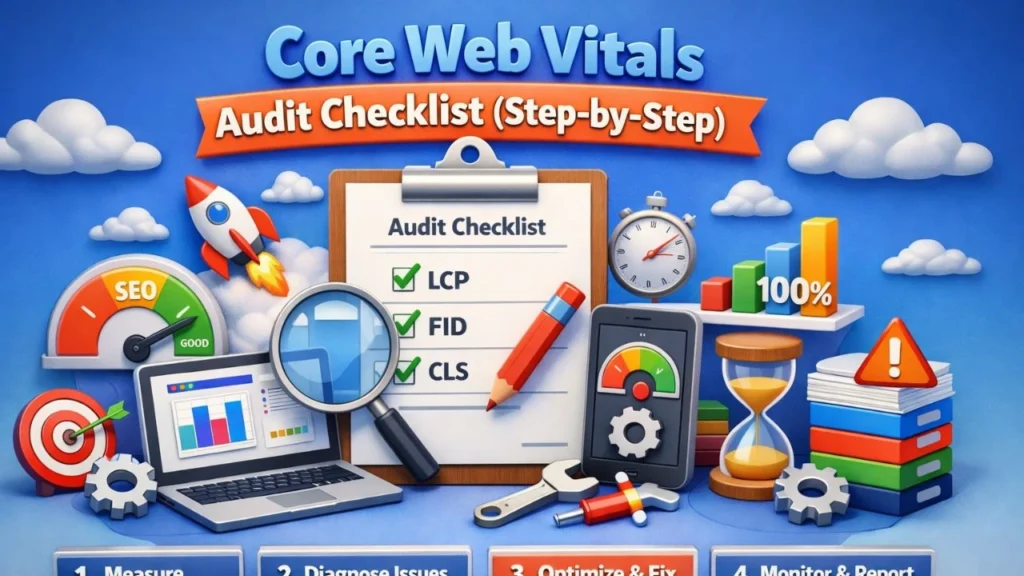
Let’s break down a practical checklist you can follow.
Step 1: Measure Current Performance
Start by analyzing your website using performance tools. Identify pages with poor metrics. Focus on high-traffic and conversion pages first.
Step 2: Analyze Page Speed Issues
Check server response time, large resources, and render-blocking elements. These are often the root causes of poor performance.
Step 3: Optimize Loading Performance
Compress images, enable lazy loading, and use modern formats. A CDN can significantly improve load times across locations.
Step 4: Improve Interactivity
Reduce JavaScript execution time. Break large scripts into smaller chunks. This improves responsiveness and INP.
Step 5: Fix Layout Shifts
Always define width and height for images and ads. Avoid inserting content dynamically above existing elements.
Step 6: Mobile Performance Optimization
Your site must perform well on mobile devices. Optimize layouts, fonts, and touch interactions for smaller screens.
Step 7: Continuous Monitoring
A core web vitals audit is not a one-time task. Track performance regularly using real user data.
Advanced Core Web Vitals Optimization Techniques
Once the basics are covered, you can go deeper.
- Implement code splitting to load only necessary scripts
- Preload critical resources for faster rendering
- Use edge caching for global performance
- Choose server-side rendering when needed
- Set performance budgets to control resource usage
These advanced strategies help you stay ahead of competitors.
Technical SEO and Core Web Vitals: The Connection
| Technical SEO Element | Impact on Core Web Vitals | What It Affects | Optimization Action |
|---|---|---|---|
| Site Architecture | Improves crawl efficiency and load distribution | LCP, INP | Use a clean, logical structure with shallow depth |
| Server Response Time | Faster initial loading of content | LCP | Optimize hosting, use CDN, reduce TTFB |
| JavaScript Optimization | Reduces main thread blocking | INP | Minify, defer, and split JavaScript files |
| Image Optimization | Speeds up content rendering | LCP | Use modern formats, compress images, lazy load |
| CSS Optimization | Prevents render-blocking issues | LCP, CLS | Inline critical CSS and remove unused styles |
| Mobile Optimization | Enhances mobile user experience | LCP, INP, CLS | Use responsive design and optimize mobile assets |
| Structured Data | Improves search understanding (indirect impact) | Overall UX | Implement schema for better indexing and display |
| Internal Linking | Distributes page authority and improves navigation | INP | Use contextual links for better user flow |
| Lazy Loading | Reduces initial page load size | LCP | Load images and videos only when needed |
| Font Optimization | Prevents layout shifts during load | CLS | Use font-display swap and preload fonts |
| Third-Party Scripts | Can slow down performance significantly | LCP, INP | Limit and asynchronously load external scripts |
| Caching Strategy | Improves repeat visit performance | LCP | Use browser caching and server-side caching |
Pro Tip: To maximize results, combine Technical SEO improvements with a consistent core web vitals audit. This ensures your website stays fast, stable, and optimized for both users and search engines.
Performance and Technical SEO go hand in hand.
A fast website improves crawl efficiency. Search engines can index more pages in less time. It also enhances user engagement, which indirectly impacts rankings.
A well-structured site with optimized performance signals sends strong quality indicators to search engines.
This is also where strategies like GEO optimization services come into play, ensuring your website is aligned with modern search behaviors.
Common Mistakes in Core Web Vitals Audit
Many websites struggle because they make avoidable mistakes.
- Ignoring mobile performance
- Using too many third-party scripts
- Relying only on lab data instead of real user data
- Not prioritizing critical pages
- Delaying optimization fixes
Avoiding these mistakes can significantly improve your results.
Tools for Core Web Vitals Audit (2026 Edition)
You don’t need to do everything manually.
Use tools that provide insights into your website’s performance. These tools help you measure, analyze, and improve your metrics effectively.
They also help you understand how your site performs in google search and how users experience your pages in real-world scenarios.
How Core Web Vitals Affect Conversion Rates?
Performance directly impacts your bottom line.
If your site loads slowly, users leave. If it feels unresponsive, they lose trust. A core web vitals audit helps you eliminate these friction points.
Faster websites keep users engaged, reduce bounce rates, and increase conversions. Even small improvements in load time can lead to noticeable gains.
Future of Core Web Vitals and SEO
The future is moving toward predictive and AI-driven optimization.
Search engines are becoming smarter. They evaluate not just speed but overall user satisfaction. Automation tools will soon handle much of the optimization process.
But one thing remains constant. Websites that prioritize performance will always have an advantage.
Voice Search & AEO Optimization for Core Web Vitals

Voice search is growing rapidly. Users expect instant answers.
To optimize for voice and AEO:
- Use clear and concise language
- Structure content with questions and answers
- Ensure fast-loading pages
- Focus on direct and actionable information
A well-executed core web vitals audit supports all these elements.
Quick Summary: Core Web Vitals Audit Checklist
- Measure LCP, INP, and CLS
- Fix loading speed issues
- Optimize scripts and resources
- Improve visual stability
- Focus on mobile performance
- Monitor continuously
Google AI & Core Web Vitals Connection
Modern search systems increasingly rely on AI to evaluate website quality. Performance signals such as loading speed, responsiveness, and stability play a crucial role in how content is selected for AI-generated answers.
| Factor | Core Web Vitals Role | Impact on AI Search & Visibility |
|---|---|---|
| Page Load Speed (LCP) | Measures how quickly main content loads | Faster pages are more likely to be selected for AI-generated answers and summaries |
| Interactivity (INP) | Tracks responsiveness to user actions | Smooth interactions improve user experience signals, increasing chances of AI prioritization |
| Visual Stability (CLS) | Ensures layout does not shift unexpectedly | Stable pages enhance readability, making content easier for AI to extract and present |
| Crawl Efficiency | Improved by optimized performance | Faster sites are crawled more efficiently, helping AI systems index content quickly |
| Content Accessibility | Enhanced by structured and fast pages | AI systems prefer content that loads quickly and is easy to parse |
| User Engagement Signals | Influenced by performance metrics | Better engagement (low bounce rate, longer sessions) signals quality to AI systems |
| Mobile Performance | Core Web Vitals heavily impact mobile UX | AI search and voice assistants prioritize mobile-friendly, fast-loading pages |
| Answer Engine Selection | Dependent on clarity and speed | Well-optimized pages are more likely to be featured in answer engines and voice results |
A well-optimized website is:
- Easier to crawl and interpret
- More likely to be featured in answer engines
- Better aligned with voice search queries
This is why a core web vitals audit is no longer just about rankings. It is about visibility across AI-driven search ecosystems.
Final Thoughts
If you want to stay competitive in today’s evolving search landscape, you need more than just good content. You need a fast, responsive, and stable website.
A well-executed core web vitals audit ensures your website meets modern performance standards and delivers a seamless experience to users.
FAQs
What is a core web vitals audit?
A core web vitals audit evaluates your website’s performance based on speed, responsiveness, and visual stability.
How often should you perform a core web vitals audit?
You should perform it regularly, especially after updates or redesigns.
Do Core Web Vitals affect rankings?
Yes, they are a confirmed ranking factor and impact user experience significantly.
What is the fastest way to improve Core Web Vitals?
Optimize images, reduce JavaScript, and improve server response time.
Why is INP important in 2026?
INP measures real user interaction, making it crucial for modern performance evaluation.
Your website performance directly impacts your rankings and revenue.
👉 Request Performance Audit and discover what’s holding your website back.