If you still think Link Building is just about getting more backlinks than your competitors, 2026 is going to feel frustrating.
Search has changed. Google still uses links to understand page relevance and to discover pages, but the standard is much higher now. A page does not become more trustworthy simply because it has more links. It performs better when those links are relevant, editorially earned, and connected to content people actually want to reference. At the same time, AI-driven search experiences are expanding beyond purely informational queries, which means your content needs to work for traditional rankings, AI summaries, and voice-led discovery at the same time.
That is why the best link building strategies in 2026 are not based on shortcuts. They are based on authority, topical relevance, strong assets, and consistent Off-Page SEO execution. Backlink studies still show a powerful relationship between rankings and backlinks, with Backlinko reporting that the number one result in Google tends to have far more backlinks than lower-ranking pages, while roughly 95% of pages have no backlinks at all. That gap is exactly why smart brands still invest in Link Building.
If you want your website to compete in search, AI search tools, and voice-style queries, you need a strategy that earns links because your page deserves them, not because you forced them. And if you want expert help doing that at scale, Get Link Building Quote.
Table of Contents
Why link building still matters in 2026
Some marketers keep asking whether backlinks still matter. The better question is this: what kind of backlinks still matter?
Google’s own documentation is clear that links help Google determine the relevance of pages and help it find new pages to crawl. That alone tells you Link Building is still important. But Google is just as clear that manipulative link schemes, paid links intended to pass ranking value, excessive link exchanges, and automated link creation violate its spam policies. So yes, links still matter, but low-quality shortcuts can work against you.
In practical terms, this means link building strategies only work when the rest of your foundation is strong. If your content is thin, your page experience is poor, or your site does not give people a real reason to cite you, then even aggressive outreach will struggle. Google’s people-first content guidance reinforces that content created mainly to manipulate rankings is less likely to perform well over time.
What the data says about link building in 2026
Before getting into tactics, it helps to look at what recent data is telling us.
| Data point | What it suggests for your strategy |
| The top-ranking result tends to have far more backlinks than lower positions | Authority still matters |
| Around 95% of pages have zero backlinks | Most pages never build enough trust to compete |
| 68% of used content marketing for links | Link earning starts with assets, not email templates |
| 54% used competitor analysis and 47% used guest posting | Competitive research and selective outreach still matter |
| Link building 7.8 out of 10 for ranking impact | The channel remains influential |
| 49% said impact is often seen in 1 to 3 months | Good link acquisition is not instant, but it is measurable |
| 53% use rankings as a main KPI and 36% use search visibility | Real outcomes matter more than vanity metrics |
| AI Overview triggers became less purely informational during 2025 | Your content should target mixed intent, not only top-of-funnel queries |
The data points above are drawn from Google Search Central, Backlinko, and Semrush research. Together they show that link building strategies still influence visibility, but they work best when tied to valuable content, measurable search outcomes, and intent-aware page design.
The link building strategies that actually work in 2026
Now let us get into the part that matters most: what you should actually do.
1. Build link-worthy assets before you start outreach
This is where many campaigns fail. They start with outreach instead of value.
The strongest link building strategies begin with something useful enough to cite. That can be an original data page, a benchmark report, a definitive guide, a glossary, a calculator, a checklist, or a research-backed resource. Since content marketing remains the most widely used link acquisition method It is clear that asset quality is still the engine behind strong link campaigns.
If your page says the same thing as ten other pages, why would anyone link to you? But when your page organizes information better, updates old information, includes original observations, or gives readers something practical they can reuse, you create a real editorial reason to earn links.
2. Use digital PR with original data
One of the most effective link building strategies in 2026 is digital PR built around data.
Journalists, bloggers, analysts, and industry writers need statistics, commentary, trends, and clear source pages. If your site publishes original research, industry surveys, pricing benchmarks, or market trends, you are no longer just asking for a link. You are giving publishers something useful to cite. That is a big difference.
This also helps with GEO and AEO because AI systems and summary-driven search experiences tend to favor pages that present clear facts, concise explanations, and recognizable source value. Semrush’s AI Overviews research suggests that AI search visibility is no longer limited to purely informational keywords, which means well-structured, citeable commercial content is becoming more important.
3. Find competitor backlink gaps
If you want faster wins, study the pages already earning links in your space.
Competitor backlink analysis works because it reduces guesswork. Instead of asking, “Who might link to us?” you ask, “Who already links to pages like ours?” Competitor analysis remains one of the most widely used approaches in link acquisition, and that makes sense because it helps you spot patterns in topics, formats, and publisher types that already work.
This tactic becomes even stronger when you combine it with better content. Do not copy your competitor’s page. Build a page that is more current, more complete, easier to scan, or more helpful for a specific audience segment.
4. Reclaim unlinked brand mentions
This is one of the simplest link building strategies and one of the most overlooked.
If your brand, founder, product, or research has already been mentioned online without a link, you are halfway there. A polite outreach message asking the publisher to add the source link often performs better than cold outreach because they already know who you are and have already referenced you.
This strategy is especially valuable for brands with growing awareness, recurring PR coverage, or active content marketing efforts.
5. Earn links through expert-led guest contributions
Guest posting is not dead. Low-quality guest posting is the problem.
Google’s spam policies warn against large-scale link abuse, which means guest content should never be treated like a mass-production anchor-text game. But thoughtful guest contributions on relevant, trusted websites can still support Off-Page SEO when the content stands on its own and genuinely helps the publisher’s audience. Guest posting among the most-used tactics, which tells you it remains useful when quality controls are high.
The winning approach in 2026 is simple: contribute only where your expertise fits, write something worth publishing even without the link, and keep anchor text natural.
6. Build resource-page and reference-page links
Some of the best link building strategies are not flashy at all. They are practical.
Resource pages, recommended tools pages, curated reading lists, and educational hubs still attract and place relevant links because they are built to help users discover useful references. If you publish a genuinely strong guide, glossary, study, or template, these pages can become a steady source of quality backlinks.
This works particularly well when your content solves one very clear problem.
7. Create tools, templates, and calculators
If you want repeatable link attraction, create assets that save people time.
A well-made tool or template can earn links for months or years because people keep referencing it in blog posts, comparison pages, and community recommendations. This approach also supports voice-style queries because users often search in a practical, question-based way, such as “how do I calculate SEO ROI” or “what checklist should I use for backlinks.”
That is where content and utility meet, and that combination is powerful.
Which link building tactics are losing value?
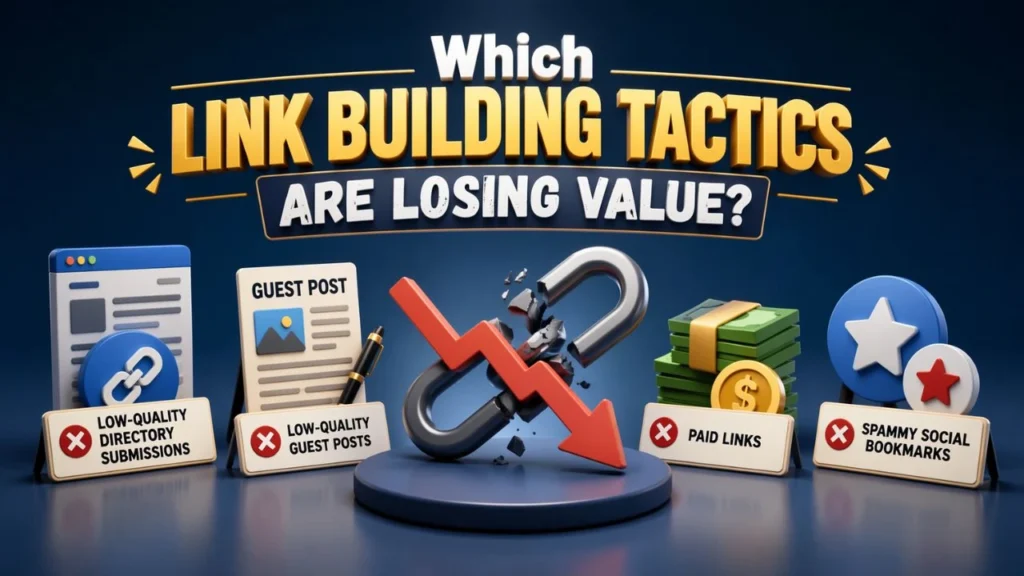
Not every tactic deserves your time in 2026.
| Tactic | 2026 verdict | Why |
| Paid links for ranking manipulation | Avoid | Violates Google spam policies |
| Excessive link exchanges | Avoid | Easy spam signal |
| Automated link creation | Avoid | Low trust, high risk |
| Low-quality directory submissions | Avoid | Weak relevance and weak editorial value |
| Mass guest posting | Avoid | Easy to scale badly and damage trust |
| Digital PR with data | Strong | Editorial value and citation potential |
| Competitor link gap outreach | Strong | Based on proven opportunities |
| Unlinked mention reclamation | Strong | Efficient and low friction |
| Resource page outreach | Strong | Topically relevant and useful |
| Tools, calculators, templates | Strong | Natural long-term link attraction |
Google’s spam policies and manual action guidance make the risk side of this table clear. If the purpose of the link is primarily to manipulate rankings rather than help users, you are stepping into dangerous territory.
How long does Link Building take to show results?
A lot of businesses give up too early.
Many practitioners see impact from link acquisition within one to three months, while others report a three-to-six-month window. That does not mean every new backlink moves rankings immediately. It means Link Building should be treated as a compounding channel, not a quick fix.
If your site already has solid content, good internal linking, healthy crawlability, and strong page intent, good links can accelerate results. If your site has weak fundamentals, even strong links may struggle to produce visible gains. That is why the best link building strategies always work alongside on-page SEO, technical SEO, and conversion-focused content.
How to measure whether your link building is actually working?
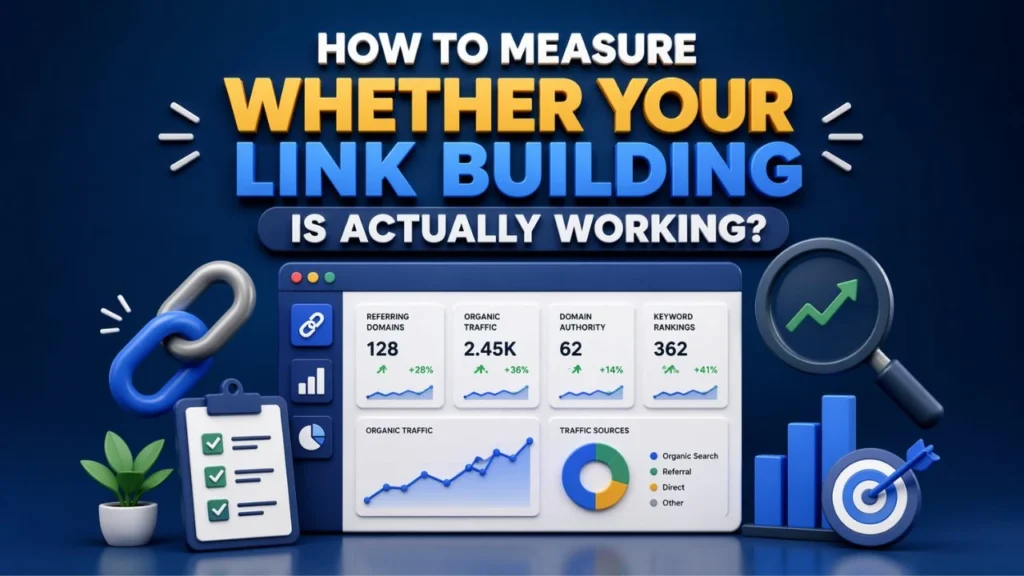
One mistake businesses make is measuring success by raw link count alone. In other words, the goal is not to collect links like trophies. The goal is to improve organic performance.
Track outcomes like these:
- Referring domains earned
- Ranking improvements for target pages
- Growth in search visibility
- Organic traffic to linked pages
- Assisted conversions
- Brand mentions
- Referral traffic from strong placements
That is how you turn Link Building from an activity into a measurable growth channel.
Why link building now supports SEO, GEO, AEO, and voice search together?
The smartest thing you can do in 2026 is stop treating these as separate worlds.
Strong Off-Page SEO helps traditional rankings. Clear, structured, source-worthy content improves your chances of being cited or summarized in AI-driven experiences. FAQ sections, direct answers, and clean heading structure make your page easier to surface for answer engines and easier to reuse in voice-led search patterns. Google also states that structured data helps it understand page content, and FAQ structured data may help users discover information in rich results. Google’s speakable markup documentation also shows how certain content can be identified for audio playback on Google Assistant-enabled devices.
So when you build a page around real expertise, concise answers, smart formatting, and high-quality links, you are no longer optimizing for one channel. You are building for the full search ecosystem.
When link building services make sense?
You can build links in-house, but not every business has the team, time, or systems to do it well.
That is where professional link building services can make a real difference. A strong provider can help you with prospecting, asset ideation, outreach, editorial quality control, reporting, and link risk management. If you are a larger brand with multiple product lines, markets, or approval layers, enterprise link building services become even more valuable because execution needs to be more controlled, more scalable, and more brand safe.
The key is to choose link building services that focus on relevance, content quality, and long-term authority, not just volume.
If that is what you need, Get Link Building Quote.
Final thoughts
The truth is simple. Link building strategies still work in 2026, but only when they are built on quality.
You do not need hundreds of random backlinks. You need relevant links from pages that make sense, earned through content that deserves to be cited. That is what strong Off-Page SEO looks like now. It is not noisy. It is not mechanical. It is strategic.
If you want better rankings, stronger authority, more visibility in AI search, and a content engine that earns trust over time, then invest in link building strategies that put value first.
And if you want expert support building that system, Get Link Building Quote.
FAQs
What are the best link building strategies in 2026?
The best link building strategies in 2026 focus on relevance, authority, and editorial value. The strongest approaches include digital PR, original research, competitor backlink gap analysis, unlinked brand mention reclamation, selective guest contributions, and resource-page outreach.
Does Link Building still work for SEO?
Yes. Google says links help determine page relevance and help discover pages for crawling, and major studies still show a strong relationship between backlinks and rankings.
How long does Link Building take to show results?
Many SEO professionals report seeing impact within one to three months, though competitive markets and weak site foundations can extend that timeline.
Are link building services worth it?
Link building services can be worth it when you need scale, outreach systems, editorial quality control, and strategic reporting. They are most valuable when they focus on real authority building rather than link volume.
What do enterprise link building services usually include?
Enterprise link building services usually include content ideation, competitor research, digital PR, outreach, reporting, governance, and brand-safety controls across larger campaigns.
Is guest posting still effective in 2026?
Yes, but only when it is selective, relevant, and genuinely useful to the publisher’s audience. Google’s spam policies make low-quality, large-scale guest posting risky.