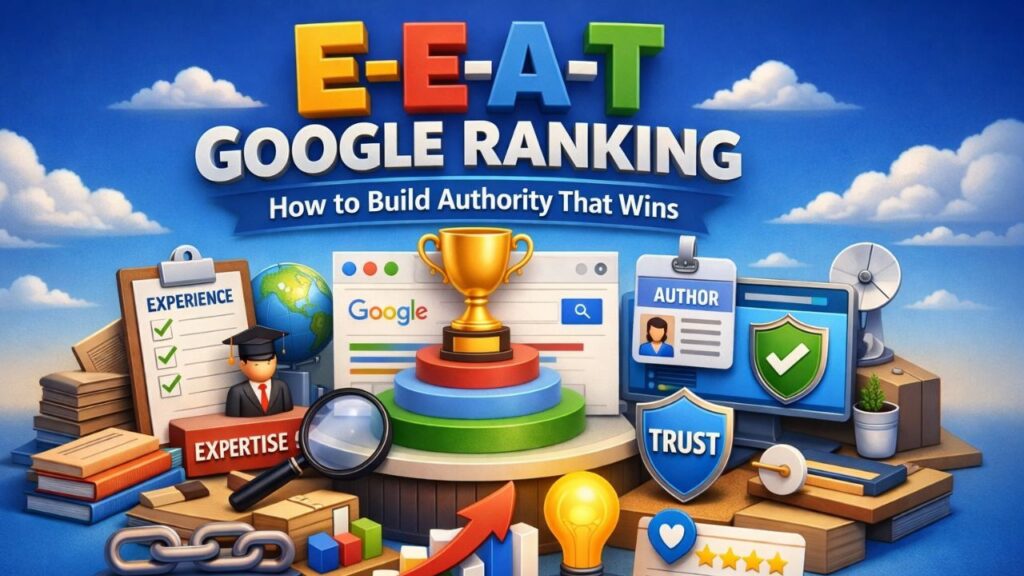
Search is no longer just about keywords and backlinks. Today, Google evaluates your website based on trust, credibility, and real expertise. This shift has made e-e-a-t google ranking one of the most important factors in modern SEO.
If you want your content to rank not only on traditional search engines but also in AI-driven platforms and voice search, you need to understand how authority works and how to build it effectively.
In this guide, we will walk you through exactly how to strengthen your authority and improve your rankings using proven strategies aligned with Google’s expectations.
Table of Contents
🔍 What is E-E-A-T Google Ranking?
E-E-A-T stands for:
- Experience
- Expertise
- Authoritativeness
- Trustworthiness
Google uses these principles to evaluate the quality of content and determine whether it deserves visibility.
Unlike older ranking systems that relied heavily on keywords, e-e-a-t google ranking focuses on how reliable and helpful your content is for users.
If your content demonstrates real knowledge, practical understanding, and trust signals, it becomes more likely to appear in top search results, featured snippets, and AI-generated answers.
Why E-E-A-T Matters in the AI Search Era?
AI systems prioritize content that demonstrates real experience, clear expertise, and strong authority signals such as well-structured information, factual accuracy, and consistent topical depth. They are designed to surface answers from sources they can trust, which means your content must reflect genuine knowledge, be transparent, and provide value without ambiguity.
Trustworthiness becomes even more critical, as AI tools aim to deliver precise and dependable answers in a single response, making it essential for your content to be accurate, well-organized, and backed by credible signals to perform well in e-e-a-t google ranking and get selected and cited.
AI tools prioritize
- Fact-based content
- Structured information
- Trusted sources
This means your website must clearly demonstrate authority if you want to be cited or featured.
Key Takeaways
- AI prefers content that answers questions directly
- Trust signals influence visibility more than ever
- Authority determines whether your content gets cited
If your content lacks credibility, it may never reach your audience, even if it is well-written.
Core Components of E-E-A-T Explained

Let’s break down the four pillars that shape e-e-a-t google ranking. we are essentially referring to the core signals that determine whether your content deserves visibility. Experience ensures the content reflects real-world understanding, Expertise validates subject knowledge, Authoritativeness signals recognition within the industry, and Trustworthiness ensures accuracy, transparency, and reliability. Together, these pillars help search engines decide if your content is genuinely helpful and worthy of ranking higher, especially in AI-driven and answer-based search environments.
1. Experience
Google values content created from real-world understanding. Content should feel practical and grounded, not theoretical.
2. Expertise
Depth matters. Your content must demonstrate clear subject knowledge and cover topics comprehensively.
3. Authoritativeness
Authority is built through recognition. Backlinks, mentions, and consistent publishing strengthen this signal.
4. Trustworthiness
Trust is non-negotiable. Secure websites, transparency, and accurate information play a crucial role.
| Factor | Meaning | Improvement Strategy |
| Experience | Real-world knowledge | Practical content |
| Expertise | Subject depth | Detailed coverage |
| Authority | Industry recognition | Backlinks, mentions |
| Trust | Reliability | Secure & transparent site |
How Core Web Vitals Influence E-E-A-T?

When a website delivers a fast, stable, and responsive experience, it signals reliability and professionalism to both users and search engines. This is where Core Web Vitals become essential, as they measure real-world performance factors like loading speed, interactivity, and visual stability. A site that performs well on these metrics demonstrates attention to quality and user satisfaction, reinforcing trustworthiness and authority—two key pillars of e-e-a-t google ranking that influence how content is evaluated and ranked.
Google measures:
- LCP (Largest Contentful Paint): Loading speed
- CLS (Cumulative Layout Shift): Visual stability
- INP (Interaction to Next Paint): Responsiveness
If your website is slow or unstable, users lose trust. This negatively impacts your e-e-a-t google ranking.
Why It Matters:
- Faster sites build credibility
- Better UX improves engagement
- Stability signals professionalism
How to Build Authority for E-E-A-T Google Ranking?
Now let’s focus on practical steps you can implement.
Step 1: Create High-Quality, Intent-Focused Content
When you solve actual problems clearly and directly, you demonstrate experience by showing you understand user needs, and expertise by providing accurate, well-structured answers. This builds authoritativeness, as search engines recognize your content as a reliable source on the topic, and strengthens trustworthiness because users can depend on your content for clear, actionable information. In simple terms, content that truly answers questions and removes confusion signals to Google that your page deserves higher visibility.
- Use semantic SEO
- Cover topics in depth
- Structure content with headings and bullets
Step 2: Build Author Credibility
Users and AI systems are more likely to trust content when it is clearly created or backed by real individuals with proven experience and expertise, rather than anonymous or generic sources. When your content includes identifiable authors, credentials, real-world insights, and transparent information, it strengthens authority and builds trust. This human layer signals authenticity, making both users and search engines more confident in the reliability of your content, which ultimately improves rankings and visibility.
Add:
- Author bio
- Experience details
- Expertise signals
This improves both user trust and AI recognition.
Step 3: Optimize Technical SEO & Core Web Vitals
Ensure your website performs well.
- Improve loading speed
- Optimize for mobile
- Fix layout shifts
Technical performance supports trust.
Step 4: Earn High-Quality Backlinks
When high-quality websites link to your pages, it strengthens your Experience, Expertise, Authoritativeness, and Trustworthiness, which are core factors influencing e-e-a-t google ranking. These links function as endorsements, helping search engines understand that your content is not only relevant but also respected within its niche. As a result, earning backlinks from reputable domains can significantly improve your visibility, credibility, and overall ranking performance in both traditional and AI-driven search environments.
Focus on:
- Relevant websites
- Authority domains
- Natural link building
Step 5: Strengthen Brand Trust Signals
Trust signals include:
- Reviews
- Testimonials
- Secure browsing (HTTPS)
- Clear policies
These elements reinforce your authority.
Role of a SEO Agency in Kolkata in Building Authority

Working with a SEO agency in Kolkata can help streamline your E-E-A-T strategy.
They bring:
- Local market understanding
- Technical SEO expertise
- Content optimization strategies
A structured approach ensures that your website aligns with both Google and AI search expectations.
E-E-A-T Optimization for AI & Voice Search
To rank in AI and voice search, your content must be easy to understand and extract.
Best Practices
- Use conversational language
- Add question-based headings
- Provide direct answers
What is E-E-A-T in Google ranking?
E-E-A-T refers to Experience, Expertise, Authoritativeness, and Trustworthiness. It helps Google evaluate content quality and decide rankings.
E-E-A-T Ranking Signals Checklist
Use this checklist to evaluate your website:
- Author bio included
- HTTPS enabled
- Structured data implemented
- Core Web Vitals optimized
- High-quality backlinks
- Updated content regularly
Common Mistakes to Avoid
Avoid these errors that weaken your authority:
- Thin or generic content
- Missing author identity
- Poor website performance
- Keyword stuffing
- Lack of trust signals
Scenario-Based Insight
Imagine a website with good content but no author information, slow loading speed, and no backlinks.
Even if the content is helpful, Google may not trust it enough to rank it highly.
By improving E-E-A-T signals, visibility can increase significantly without changing the core topic.
If you want to understand how your website performs in terms of authority and trust:
👉 Request Free Analysis
- Identify gaps in your E-E-A-T signals
- Improve your e-e-a-t google ranking
- Optimize your site for AI and voice search
Conclusion
Building authority is no longer optional. If you want to stay competitive, you need to align your strategy with e-e-a-t google ranking principles.
When your content demonstrates real expertise, strong trust signals, and excellent user experience, it becomes more visible across Google, AI search engines, and voice assistants.
The future of SEO belongs to websites that prioritize credibility, not just keywords.
Featured Snippet Summary
E-E-A-T Google Ranking is a framework that evaluates content based on experience, expertise, authority, and trust. Improving these factors helps websites rank higher in search engines and AI-driven results.
FAQs
What is E-E-A-T Google ranking?
E-E-A-T is a framework used by Google to evaluate content quality based on experience, expertise, authority, and trust.
How does E-E-A-T affect SEO?
It determines whether your content is trustworthy and valuable, which directly impacts rankings and visibility.
Can Core Web Vitals impact E-E-A-T?
Yes, because user experience influences trust, which is a key part of E-E-A-T.
How do I improve E-E-A-T for my website?
Focus on high-quality content, author credibility, technical performance, and trust signals.
Why is E-E-A-T important for AI search?
AI systems prefer citing content that is reliable, structured, and authoritative.
How does Google verify expertise in E-E-A-T?
Google evaluates expertise through content depth, author credentials, topical consistency, and references. Websites that consistently publish well-researched and accurate content are more likely to be recognized as experts.
Does E-E-A-T apply to all websites or only specific niches?
E-E-A-T applies to all websites, but it is especially critical for industries related to finance, health, and legal topics. However, every website benefits from strong trust and authority signals.
How often should I update content to maintain E-E-A-T?
Regular updates are important. Updating content every few months helps maintain accuracy, freshness, and relevance, which strengthens your authority and trustworthiness.
Can new websites rank with E-E-A-T?
Yes, new websites can build E-E-A-T by focusing on high-quality content, clear author information, and strong technical SEO from the beginning. Consistency plays a key role.
Is content length important for E-E-A-T?
Content length alone does not guarantee better rankings. What matters is how well the topic is covered. Comprehensive, structured, and useful content performs better than unnecessarily long articles.
How do backlinks contribute to E-E-A-T?
Backlinks from trusted and relevant websites act as signals of authority. They help search engines understand that your content is credible and valuable.
Does social proof impact E-E-A-T?
Yes, reviews, ratings, and user feedback contribute to trustworthiness. Positive signals from users can strengthen your website’s credibility.
What role does website design play in E-E-A-T?
A clean, professional, and easy-to-navigate design builds trust. Poor design or broken elements can negatively impact user experience and reduce credibility.
How important is HTTPS for E-E-A-T?
HTTPS is essential. It ensures secure browsing and builds trust with users and search engines, which directly supports E-E-A-T.
Can duplicate content affect E-E-A-T?
Yes, duplicate content reduces originality and can weaken trust signals. Unique and valuable content is crucial for maintaining strong authority.
Does page loading speed affect authority?
Yes, faster loading speeds improve user experience, which enhances trust and indirectly supports E-E-A-T signals.
How does internal linking support E-E-A-T?
Internal linking helps structure your website and shows topical relevance. It allows search engines to understand your expertise in a subject area.
What is the role of structured data in E-E-A-T?
Structured data helps search engines understand your content better. It improves visibility in rich results and supports AI-based search systems.
Can AI-generated content meet E-E-A-T standards?
Yes, but only if it is accurate, well-structured, and reviewed for quality. Content should always provide value and demonstrate expertise.
How does user engagement impact E-E-A-T?
Metrics like time on page, bounce rate, and interaction indicate content usefulness. Higher engagement signals improve trust and authority.