Online stores do not grow from search visibility alone. Real growth comes when your pages attract people who are ready to compare, choose, and buy. That is why strong Ecommerce SEO Strategies focus on more than rankings. They connect search intent, site structure, product clarity, content depth, internal linking, and technical health.
If your store has strong products but weak category pages, thin product content, or crawl issues, your growth can slow down even when demand exists. A better approach is to build a search presence that helps both users and search engines understand your store clearly. When your content answers real questions, your page structure is easy to follow, and your product information is complete, organic traffic becomes more valuable.
This guide explains how Ecommerce SEO Strategies support visibility, clicks, trust, and revenue. It also shows why product pages, category pages, informational content, and technical improvements should work together. The goal is not just more traffic. The goal is better traffic that leads to stronger commercial outcomes.
Table of Contents
Why ecommerce SEO matters for revenue growth
Many online stores focus only on paid campaigns because results can appear faster. But paid visibility stops when spend stops. Organic visibility works differently. It builds value over time and helps your store appear when buyers are actively searching for solutions, products, comparisons, and answers.
Strong ecommerce SEO gives your store several advantages:
• It helps your category pages rank for broad commercial searches
• It helps your product pages appear for specific purchase intent queries
• It supports discoverability for informational content that brings users into your funnel earlier
• It improves the quality of organic traffic by matching pages to search intent
• It strengthens trust through useful content, better structure, and complete product information
When these elements are aligned, your store becomes easier to find, easier to understand, and easier to trust. That is where sustainable growth begins.
What strong Ecommerce SEO Strategies include
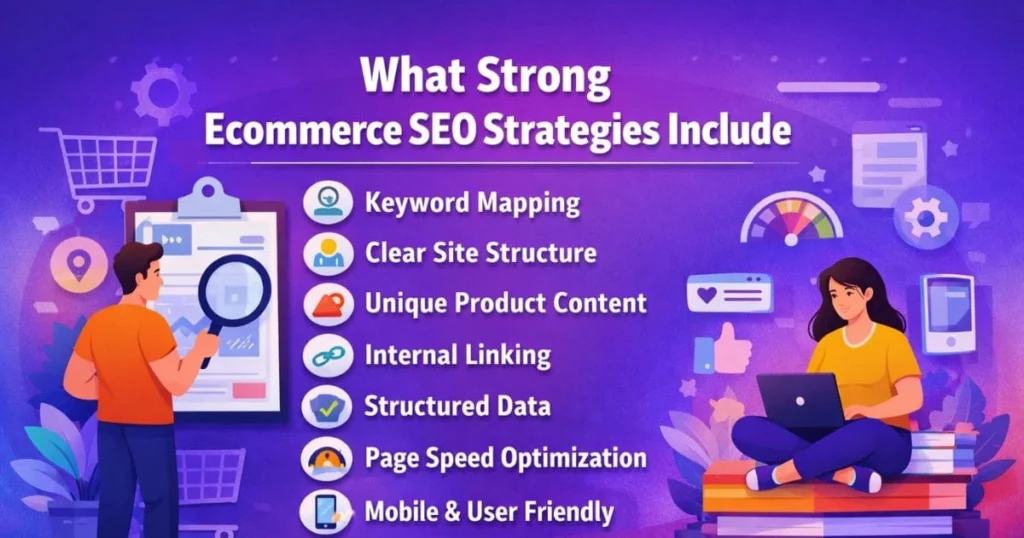
A successful ecommerce SEO program is not one task. It is a connected process. It usually includes:
• keyword mapping for category pages, product pages, and content
• clear site architecture
• useful category page copy
• unique product page content
• structured data
• crawl and index management
• internal linking
• page speed and mobile usability improvements
• content built around commercial and informational search intent
Each part supports the others. When one area is weak, the full system loses efficiency. For that reason, Ecommerce SEO Strategies should be planned as a complete growth framework.
Search intent should shape every page
Search intent helps you decide what kind of page deserves each keyword. If intent is ignored, stores often target the wrong terms on the wrong pages. That creates poor rankings, low engagement, and weak conversions.
Informational intent
These searches come from people who want guidance, answers, or comparisons. They may search for buying guides, product questions, or optimization tips. Blog content, guides, and FAQs work well here.
Commercial intent
These users are researching options and evaluating products or categories. Category pages, collection pages, comparison content, and service pages can perform well for these searches.
Transactional intent
These searches often show strong buying intent. Product pages should be ready for them with clear titles, unique descriptions, trust signals, and complete information.
When search intent shapes your page strategy, Ecommerce SEO Strategies become more practical and more profitable.
Keyword research for ecommerce growth
Keyword research for ecommerce should not begin with product names alone. It should begin with how real people search. Some users search by need. Some search by product type. Some search by brand. Some search by feature, use case, or problem.
How to build useful keyword clusters
Group your terms into clear clusters:
Category keywords
These are broader commercial terms that often fit collection or category pages.
Product keywords
These are more specific and belong on product pages.
Question keywords
These fit blogs, FAQs, and buying guides.
Problem based keywords
These often support awareness stage content and can lead users into category pages later.
Your keyword map should also account for variants in phrasing, such as singular and plural forms, commercial modifiers, and voice style queries. People often ask longer questions through mobile or voice search. That means your content should include natural language phrases and direct answers where appropriate.
Good keyword research helps you avoid overlapping pages and gives each URL a clear role.
Category page SEO is often the main growth driver
Many stores put most of their effort into product pages, but category pages often deserve just as much attention within effective seo services. These pages can rank for broad commercial keywords and act as strong entry points for users who are still exploring options.
What category pages should include
A strong category page usually needs:
• a clear heading
• a short introduction that explains what the page offers
• useful subtopics or supporting text that help users understand choices
• clear internal links to related categories, brands, or guides
• filters that support usability without creating index clutter
• FAQ content when relevant
The copy should not exist only for search engines. It should help people make better decisions. When category pages are thin or repetitive, they often struggle to rank well.
Why category pages influence revenue
Category pages sit close to the buying stage. Users who land there are often evaluating options, price ranges, features, and fit. That makes these pages important for both rankings and conversions. In many stores, Ecommerce SEO Strategies that improve category pages can lead to meaningful revenue gains because they target broader demand and guide users deeper into the store.
Product page SEO should remove doubt
Product pages are where intent becomes action, and strong Ecommerce SEO Strategies help make that possible. If a page is vague, repetitive, or incomplete, users may leave even if the ranking is strong. Product pages should remove doubt and help users move forward with confidence.
What every product page needs
Product pages should include:
• a clear and descriptive title
• unique copy that explains the product properly
• useful details about size, material, features, or specifications
• strong images with relevant alt text
• pricing and availability information
• shipping and return information where relevant
• reviews or trust signals if available
• related product links when helpful
Why unique product content matters
Many stores reuse supplier descriptions. That creates thin content and weak differentiation. Unique content gives search engines clearer signals and gives users better reasons to stay on the page.
How product clarity helps SEO and conversions
Clear product content improves more than rankings. Strong Ecommerce SEO Strategies also improve user confidence. When users can quickly understand what the product is, who it is for, and why it matters, they are more likely to continue the journey.
| Page type | Main SEO goal | Key optimization points | Best keyword type |
|---|---|---|---|
| Category page | Rank for broad commercial terms | Intro copy, filters, internal links, FAQs, product discovery | High volume commercial |
| Product page | Rank for specific purchase terms | Unique copy, specs, images, reviews, schema, variants | Long-tail transactional |
| Blog post | Capture informational demand | Helpful answers, comparisons, guides, FAQs, internal links | Informational and question keywords |
| Service page | Convert business leads | Clear value, trust signals, CTA, supporting proof | Commercial investigation |
Site architecture affects crawlability and growth
Good structure helps users move through the store easily. It also helps search engines discover and understand your important pages. Poor structure can hide key pages, create weak internal linking, and reduce crawl efficiency.
What clear store structure looks like
A strong structure usually follows a simple path:
- Home page
- Category page
- Subcategory page where needed
- Product page
This path should be supported by navigation, breadcrumbs, and internal links as part of strong Ecommerce SEO Strategies. Important pages should not be buried too deep. If users need too many clicks to find key products, search engines may also struggle to treat those pages as important.
Internal linking supports page value
Internal linking is a major part of Ecommerce SEO Strategies because it distributes context and authority across the site. When blogs link to relevant categories, and categories link to related products, your store becomes easier to understand.
Useful internal links can connect:
• guides to categories
• categories to subcategories
• product pages to related products
• blog posts to service or collection pages
• FAQs to relevant product or category pages
These links should feel natural and should help the user continue the journey.
Technical SEO issues can block strong content
Even well written pages can struggle if technical issues hold them back. Technical SEO supports visibility by making pages easier to crawl, render, index, and use.
Common ecommerce technical issues
Duplicate content
This can come from product variants, filtered URLs, parameters, and copied descriptions.
Weak canonical signals
If canonical setup is poor, search engines may choose the wrong version of a page.
Crawl waste
Filtered and sorted URLs can create too many low value pages and reduce crawl efficiency.
Slow page speed
Slow pages reduce user satisfaction and can affect performance.
Mobile usability issues
Most ecommerce traffic now comes from mobile devices. Weak mobile experiences can reduce both rankings and conversions.
JavaScript rendering problems
If key content depends too much on scripts, search engines may not process the page as expected.
Technical work may not always be visible to the user, but it directly supports organic growth. For that reason, Ecommerce SEO Strategies should always include a technical review.
Faceted navigation needs control
Faceted navigation helps users filter products by size, price, color, brand, and other attributes. As part of effective Ecommerce SEO Strategies, it improves usability, but it can also create SEO problems when each filter combination generates a separate URL.
Why this becomes a problem
Too many low value filtered pages can:
• create duplicate or near duplicate content
• dilute crawl resources
• confuse page prioritization
• make index management harder
What to do instead
Not every filtered result should be indexed. Stores need a clear plan for which URLs deserve visibility and which should remain crawl controlled or excluded from indexing. The goal is to preserve usability without creating unnecessary clutter.
Structured data supports search understanding
Structured data helps search engines interpret your products and page relationships more clearly. As part of effective Ecommerce SEO Strategies, it can improve how your store is understood and can support rich search features.
Useful structured data for ecommerce
• product data
• breadcrumb data
• review data where valid
• organization data
• FAQ data where appropriate
When structured data is accurate and aligned with visible page content, Ecommerce SEO Strategies support stronger understanding across standard search, answer based systems, and machine driven summaries.
Why this matters for GEO and AEO
GEO services and AEO services rely on clarity, consistency, and entity understanding. Structured data helps machines connect products, categories, brand details, and page intent more confidently. That makes it easier for your store to be surfaced in different search experiences.
Content depth builds trust and reach
Many ecommerce stores focus only on money pages, but Ecommerce SEO Strategies should also include supporting content for stronger organic growth. Helpful blog posts, category guides, comparison pages, and FAQs can capture informational demand and strengthen your full topic coverage.
Content types that support ecommerce SEO
Buying guides
These help users compare options and move toward a decision.
Product care content
These pages answer questions after purchase intent begins.
Question based content
These pages align well with voice and answer style searches.
Comparison content
These pages support commercial investigation and can send users into relevant categories.
Evergreen FAQs
These improve page usefulness and help capture longer queries.
Supporting content should connect naturally to category pages and product pages. That is how content moves from awareness to action.

Voice search and answer focused search need clearer writing
Search behavior is changing. People often search with longer, more natural phrases. They also expect quick, direct answers. That means ecommerce content should be easy to scan and easy to interpret.
How to make content more answer friendly
• use clear headings
• answer the question early in the section
• keep important explanations concise
• include natural language phrasing
• use FAQ sections for real user questions
• avoid vague wording
Why this improves visibility
Answer focused content helps machines find the key point quickly. It also helps users get value faster. This is especially useful for voice search, mobile search, and AI generated answer formats.
| KPI | What it shows | Why it matters |
|---|---|---|
| Organic clicks | Search demand captured | Measures visibility growth |
| Indexed product pages | Crawl and index health | Shows if products can be found |
| Category page rankings | Commercial keyword progress | Indicates buying-intent visibility |
| Organic conversion rate | Traffic quality | Shows whether SEO traffic is relevant |
| Revenue from organic | Business impact | Connects SEO to actual growth |
| Rich result coverage | Structured data performance | Improves visibility and product detail display |
How to measure the impact of Ecommerce SEO Strategies
Search performance should be measured with business outcomes in mind. Rankings matter, but revenue quality matters more.
Useful SEO metrics for ecommerce stores
• organic clicks
• organic sessions by page type
• rankings for commercial and transactional terms
• indexed product and category pages
• click through rate from search
• organic conversion rate
• revenue from organic traffic
• assisted conversions from informational content
Why page type reporting matters
If you only review sitewide traffic, you may miss what is truly working. Strong Ecommerce SEO Strategies require you to track category pages, product pages, and blog posts separately because each serves a different role. This helps you see where growth begins and where more support is needed.
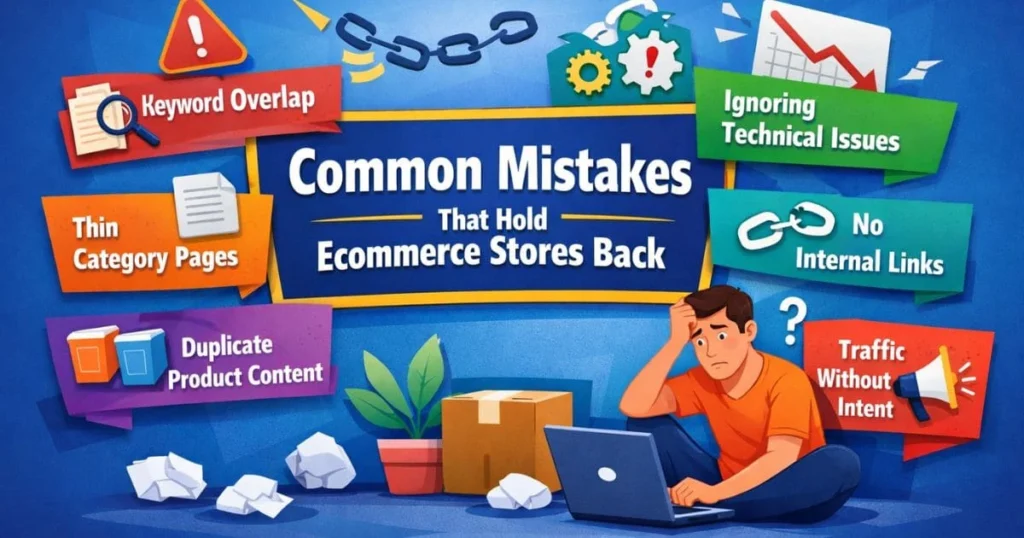
Common mistakes that hold ecommerce stores back
Many stores invest in content but still see limited growth because key mistakes remain unresolved.
Mistake one
Targeting the same keyword across many pages.
This creates overlap and weakens relevance signals.
Mistake two
Leaving category pages too thin.
This reduces usefulness and limits ranking potential.
Mistake three
Using duplicate product content.
This weakens page differentiation.
Mistake four
Ignoring technical issues.
Even useful content can underperform when technical barriers remain.
Mistake five
Publishing content without internal links.
Pages need context and support from the rest of the site.
Mistake six
Focusing only on traffic volume.
Traffic without intent does not create the same business value.
Avoiding these issues is a major part of building stronger Ecommerce SEO Strategies.
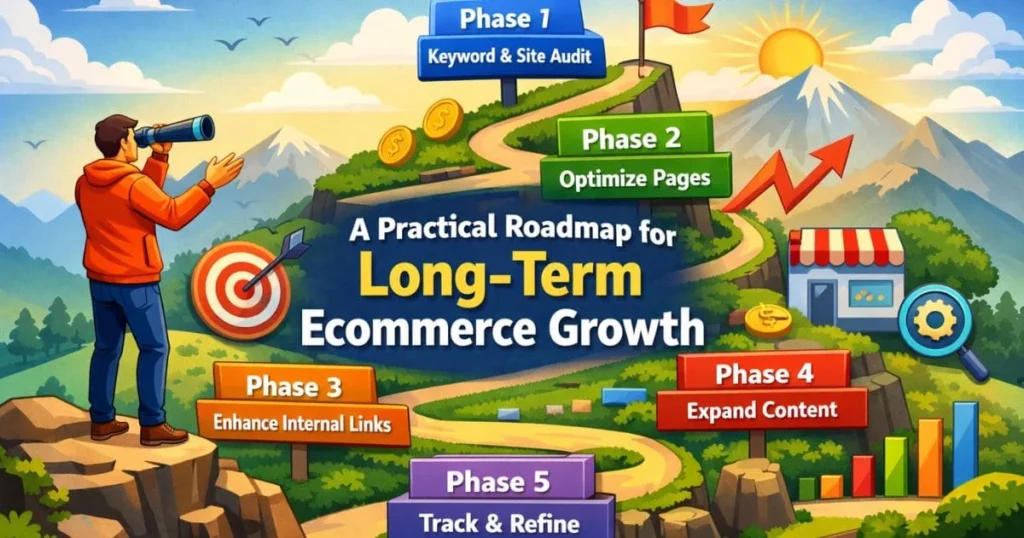
A practical roadmap for long term ecommerce growth
Strong results usually come from a phased approach. Each phase builds on the previous one.
Phase one
Audit keywords, structure, and technical health.
This stage identifies what each page should target and where obstacles exist.
Phase two
Improve category and product pages.
This stage focuses on unique copy, better structure, clearer messaging, and stronger trust signals.
Phase three
Strengthen structured data and internal linking.
This stage improves machine understanding and page relationships.
Phase four
Expand supporting content.
This stage builds informational reach and strengthens the path into commercial pages.
Phase five
Track performance and refine priorities.
This stage helps you focus effort where revenue value is highest.
A good roadmap makes Ecommerce SEO Strategies more measurable and more effective over time.
Conclusion
Revenue growth from organic search comes from clarity, relevance, and consistency. Stores perform better when category pages target the right commercial terms, product pages remove doubt, technical issues are reduced, and content supports the full search journey.
The most effective Ecommerce SEO Strategies do not chase visibility alone. They help users find the right page, understand the offer, and move forward with confidence. That is what makes SEO more valuable for ecommerce brands that want stronger and more stable growth.
FAQ
Q:What are Ecommerce SEO Strategies?
Ans: Ecommerce SEO Strategies are the methods used to improve the visibility of online store pages in search results. They usually include keyword mapping, category page SEO, product page SEO, internal linking, structured data, and technical improvements.
Q:Why are category pages important in ecommerce SEO?
Ans: Category pages often rank for broad commercial searches. They help users explore options and move deeper into the store. Because they target strong purchase intent, they can influence both traffic quality and revenue.
Q:How does product page SEO help sales?
Ans: Product page SEO helps your product pages appear for specific purchase queries. It also improves user trust by giving clear titles, useful descriptions, product details, images, and other decision making information.
Q:Why is technical SEO important for online stores?
Ans: Technical SEO supports crawlability, indexing, mobile usability, page speed, and duplicate content control. Without these foundations, even good content may struggle to perform well.
Q:How do Ecommerce SEO Strategies support GEO and AEO?
Ans: They support GEO and AEO by making content easier for machines to understand. Clear headings, direct answers, structured data, internal links, and strong topical organization all help answer based systems process the content more effectively.
Q:What should an ecommerce SEO content plan include?
Ans: A strong content plan should include category page improvements, unique product content, FAQs, buying guides, comparison content, and question based articles that support both users and core commercial pages.
Q:How long does ecommerce SEO take to show results?
Ans: SEO growth depends on your current site health, competition, and content quality. Some improvements can appear sooner, while larger growth usually comes from consistent work across structure, content, and technical performance.
Q:What is the biggest mistake in ecommerce SEO?
Ans: One common mistake is targeting the same topic on too many pages. Another is leaving category pages and product pages too thin. Clear page roles and useful content usually lead to better outcomes.