
For online stores, organic traffic is one of the most valuable sources of growth. It brings users who are already searching for products, comparing options, and looking for answers before they buy. When your store appears in front of them at the right moment, you gain a stronger chance to earn clicks, trust, and sales without depending only on paid campaigns.
A well planned ecommerce seo strategy helps an online store improve product visibility, category page performance, crawl access, and content relevance. It also supports AI search, answer based results, and voice search by making information clearer, easier to extract, and more useful for users. If your store wants consistent growth, you need more than product uploads and basic metadata. You need a structure that helps both search engines and shoppers understand your site.
Many online stores struggle because their websites are not fully aligned with how people search. Some pages target the wrong queries. Some category pages remain thin. Some product pages are missing useful details. Some stores publish content that never connects with commercial pages. A practical ecommerce seo strategy fixes these issues and turns the website into a stronger traffic asset.
This guide explains the benefits, key elements, and working methods that help online stores grow visibility and sales through search. It also shows how to shape content for SEO, GEO, AEO, and voice search so your pages can appear across search engines, AI search tools, and spoken search results.
Table of Contents
What Is an Ecommerce SEO Strategy
An ecommerce seo strategy is a structured plan used to improve the search performance of an online store. It focuses on category pages, product pages, internal links, technical health, keyword targeting, content planning, and authority building. The goal is simple. Help the right pages rank for the right searches and guide users from discovery to action.
Why ecommerce SEO is different from general SEO
Ecommerce websites have unique challenges. A store often contains many pages, changing inventory, filters, product variants, and category structures. Because of that, a normal SEO approach is not enough. An ecommerce seo strategy has to account for crawl control, duplicate content, purchase intent, and page hierarchy in a more detailed way.
It also has to support both discovery and conversion. Some users search for information. Others search for product types, prices, features, or comparisons. Your site should be ready to meet each kind of need.
Why online stores need a clear framework
Without a proper framework, stores often publish pages without search intent alignment. This leads to weak rankings, poor user flow, and wasted content effort. A strong ecommerce seo strategy creates clarity across the site and improves how search engines interpret your pages.
It can help you:
• Improve page relevance for buying intent
• Strengthen indexing across important pages
• Create better internal page relationships
• Support product discovery at scale
• Build trust through helpful information
• Reduce over dependence on paid visibility
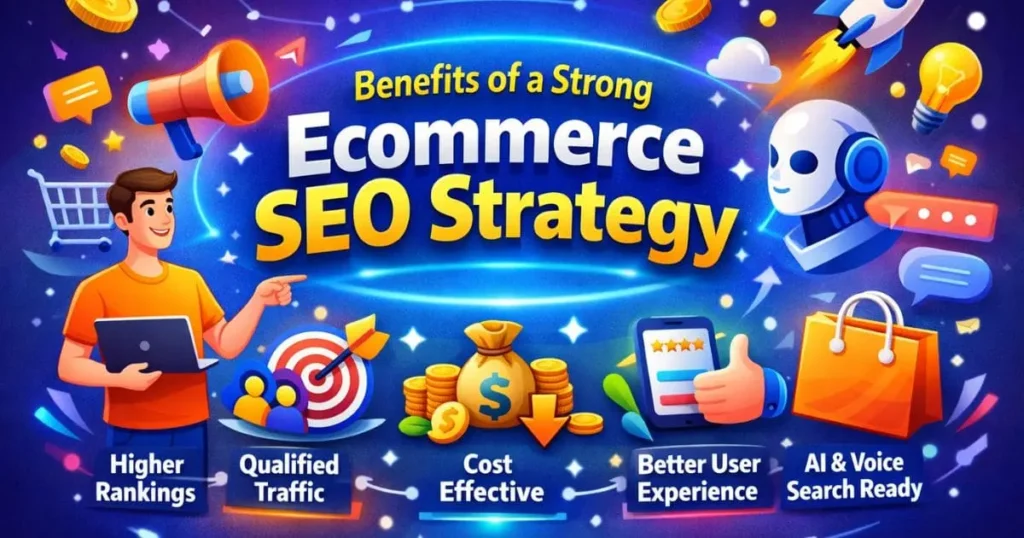
Benefits of a Strong Ecommerce SEO Strategy
A store that invests in a strong ecommerce seo strategy creates a more stable path to growth. Organic visibility does not only bring traffic. It brings users who are already interested in what you sell.
Better visibility for high intent searches
When your product and category pages are optimized properly, they can rank for commercial searches that matter. These are the searches that often come from users closer to taking action. Better visibility means more opportunities to attract the right visitor.
More qualified traffic
A useful ecommerce seo strategy improves keyword targeting and page relevance, which helps bring users with stronger buying intent. Instead of chasing broad traffic alone, you build traffic that has a better chance to convert.
Lower dependence on paid campaigns
Paid traffic can stop when budgets pause. Organic visibility keeps working beyond a single campaign window. Many businesses use Digital marketing services to build broader growth, but strong organic search visibility remains one of the most reliable foundations for sustained results.
Better user experience
Search performance and user experience often work together. Faster pages, cleaner structure, better navigation, and useful content improve both visibility and engagement. A clear ecommerce seo strategy helps users move smoothly from search result to category page to product page.
Stronger support for AI search and answer engines
AI search tools look for structured, clear, and useful information. When your store content is well organized, AI systems can interpret it more easily. This increases your chances of being cited, summarized, or surfaced in AI assisted search experiences.
Benefits of Ecommerce SEO for Online Stores
| Benefit | How It Helps | Business Impact |
| Higher search visibility | Improves rankings for product and category keywords | More clicks and store visits |
| Qualified traffic | Attracts users with buying intent | Better conversion opportunities |
| Lower paid dependency | Reduces over reliance on ads | More sustainable long term growth |
| Better website structure | Helps users and bots navigate pages | Improved indexing and engagement |
| Stronger authority | Builds trust through content and backlinks | Better rankings across more keywords |
Core Elements of an Ecommerce SEO Strategy
A complete ecommerce seo strategy is built on several connected parts. When these parts work together, your store becomes easier to crawl, easier to understand, and easier to rank.
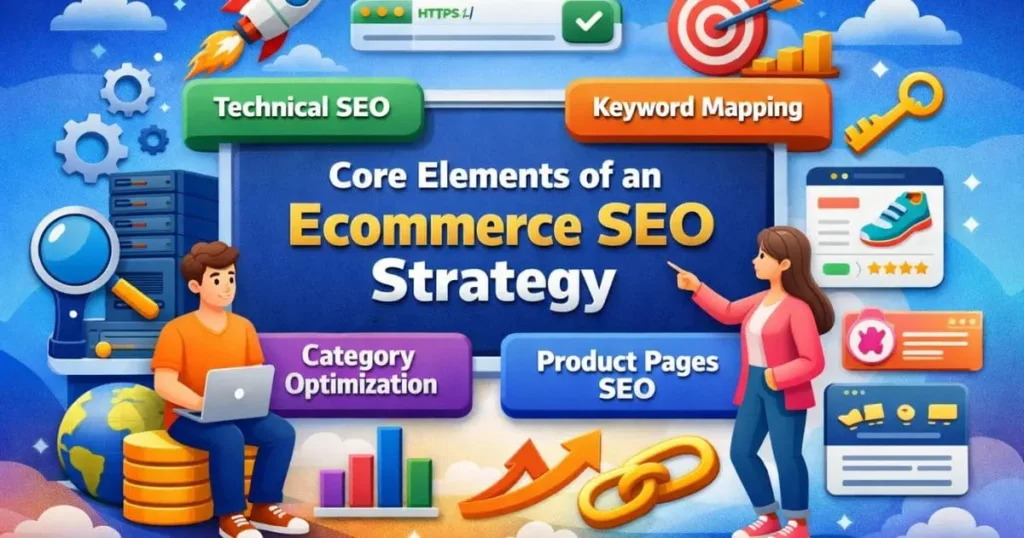
Technical SEO
Technical SEO forms the base of an online store. If search engines cannot access and interpret your pages correctly, content quality alone will not be enough.
Important areas include:
• Crawl efficiency
• Site speed
• Mobile usability
• Schema markup
• Canonical control
• XML sitemap quality
• Proper handling of filters and faceted pages
• Removal of broken links and redirect issues
A strong technical base helps search engines focus on the pages that matter most.
Keyword mapping
An ecommerce seo strategy should map each keyword group to the most suitable page type. Category pages should target broader commercial phrases. Product pages should target specific product intent. Blog pages should target educational and comparison based searches.
This structure prevents cannibalization and gives each page a clearer ranking purpose.
Category page optimization
Category pages often carry major ranking potential, yet many stores leave them thin or generic. A category page should explain what the user can find, what makes the range useful, and how the page matches the search intent.
Useful additions include:
• Introductory copy
• Helpful subheadings
• Buyer questions
• Internal links to related categories
• Content that supports relevance without overwhelming the page
Product page optimization
Every useful ecommerce seo strategy should improve product page depth. Shoppers need details. Search engines need clear signals. Product pages should include useful copy, descriptive titles, clear specifications, optimized images, and concise answers to common questions.
Internal linking
Internal linking helps distribute authority and context across your site. Blog posts should support category pages. Category pages should connect with related collections. Product pages should connect with relevant informational content when appropriate.
If you are looking for expert support, working with an ecommerce SEO agency can help create a stronger internal page structure aligned with revenue goals.
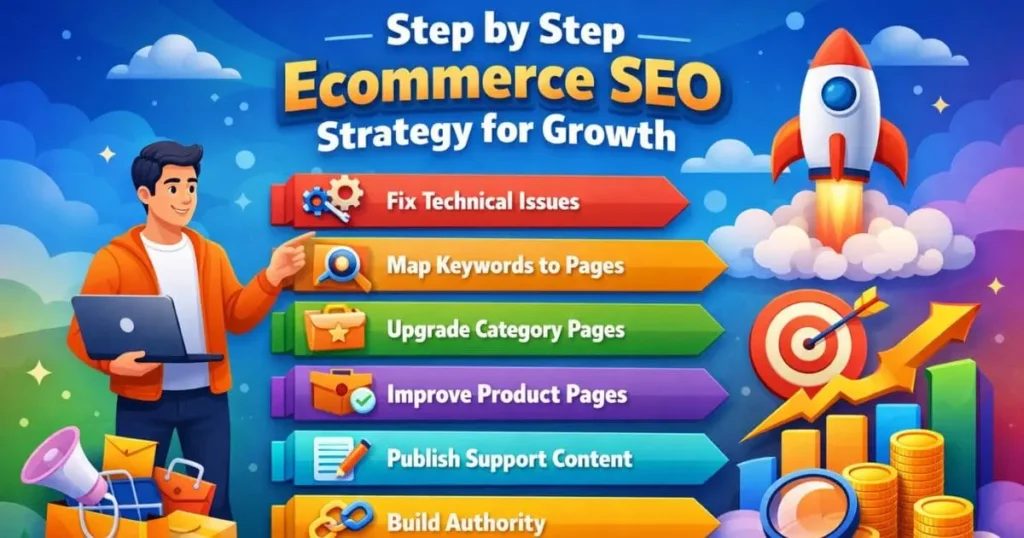
Step by Step Ecommerce SEO Strategy for Growth
A practical ecommerce seo strategy follows a sequence. When you work in the right order, progress becomes easier to measure and easier to scale.
Fix technical barriers
Start by identifying crawl waste, slow page performance, duplicate pages, redirect issues, and indexing problems. Technical fixes often unlock better results from content and keyword work.
Match search intent to page type
Every target phrase should lead to the correct type of page. Product focused searches should lead to product pages. Broader commercial terms should lead to category pages. Informational questions should lead to guides or blog posts.
This is one of the most important parts of an ecommerce seo strategy because it affects both rankings and conversions.
Improve category pages
Category pages should do more than list products. Add concise explanatory copy, useful headings, internal links, and question based content where needed. Make sure the page feels complete and relevant.
Strengthen product pages
Product pages need unique and helpful content. Add product specific details, user friendly descriptions, image optimization, trust signals, and answers to common concerns. This helps both search visibility and conversion readiness.
Publish supporting content
A store grows faster when commercial pages are supported by content marketing services that answers earlier stage questions. This can include buying guides, comparison pages, product education content, and industry related search topics.
Build authority
Search visibility also depends on trust signals from outside the site. A well planned approach to Link building services can help important pages earn stronger authority and better rankings when the work stays relevant and quality focused.
Content Types and Their SEO Role
| Content Type | Search Intent | Best Use |
| Buying guides | Informational and commercial | Attract early stage buyers |
| Product comparisons | Commercial investigation | Help users evaluate options |
| FAQ content | Voice search and answer based search | Capture question queries |
| Category guides | Commercial | Support important money pages |
| Trend articles | Informational | Bring new topical traffic |
Content Strategy That Supports Ecommerce SEO
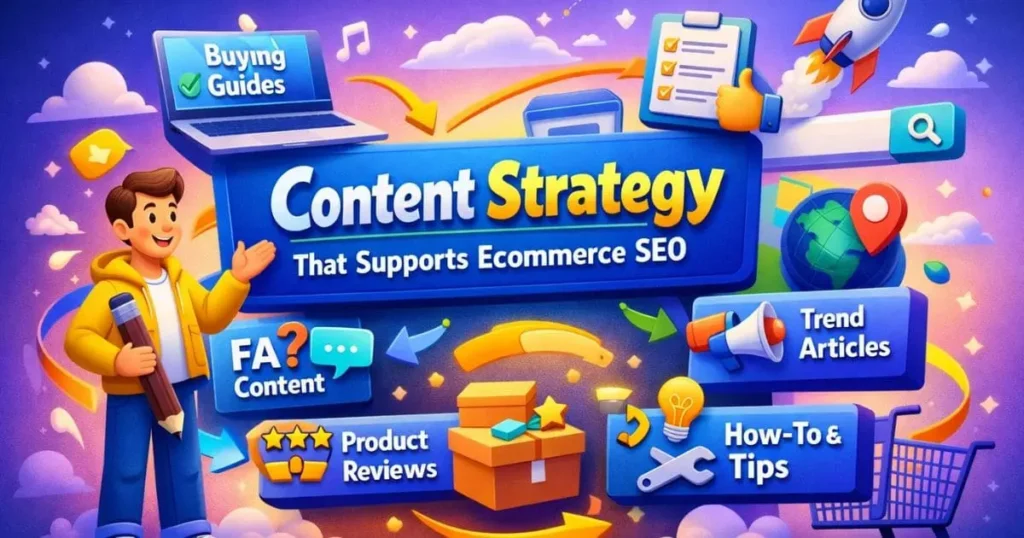
Content is not separate from an ecommerce seo strategy. It is one of the forces that helps category pages and product pages perform better. Good content attracts informational searches, answers user questions, and creates paths toward conversion focused pages.
Content types that help online stores rank
Online stores can benefit from several content formats:
• Buying guides
• Product comparison pages
• Common question pages
• Category support content
• Trend based informational posts
• Problem solving content
• Feature explanation pages
Each content type should serve a purpose. Some pages attract discovery traffic. Some help users compare options. Some strengthen internal link paths to money pages.
Content for AI search and answer engines
GEO services and AEO services friendly content is clear, structured, and easy to summarize. If you want better visibility in AI search tools, your ecommerce seo strategy should use direct answers, strong headings, clear entity signals, and concise explanations.
Helpful methods include:
• Write short answer paragraphs under question style headings
• Keep definitions simple and accurate
• Use topic relevant supporting terms naturally
• Build clear relationships between blog posts and service pages
• Organize content so meaning is easy to extract
Voice search support
Voice search queries are often longer and more conversational. A strong ecommerce SEO strategy should include natural language phrases, user questions, concise answers, and JSON-LD schema markup for AI search to improve how content is understood and spoken aloud by devices.
This matters even more when stores serve place based intent. Some ecommerce brands also support pickup, regional delivery, or location focused discovery. In those cases, Local SEO can add another useful layer by helping the business appear when nearby intent becomes part of the search.
Common Mistakes That Hold Back Ecommerce SEO
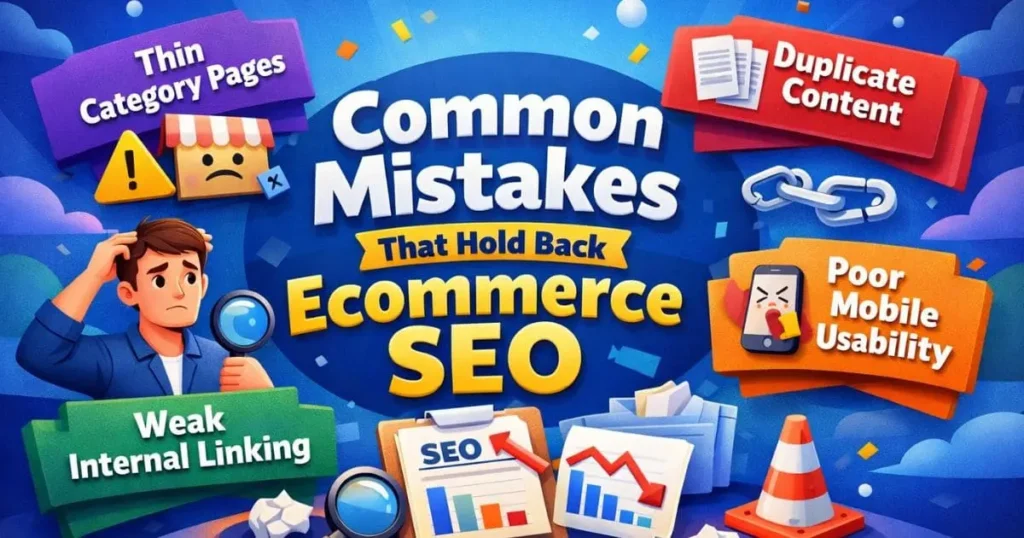
Even a large store can lose ranking potential when basic issues remain unresolved. A good ecommerce seo strategy avoids the following mistakes.
Thin category pages
A category page that contains only product listings may struggle to show enough relevance. Search engines need context, and users need confidence that they are on the right page.
Duplicate content issues
Many ecommerce sites create duplicate paths through filters, sorting options, or repeated product text. This can weaken ranking signals and waste crawl attention.
Weak internal linking
If blog posts do not support category pages, and category pages do not connect clearly across the site, search engines may struggle to understand hierarchy and importance.
Poor mobile usability
Many shoppers browse on mobile. Slow or awkward mobile experiences can weaken both visibility and conversion performance.
Overuse of the focus keyword
A strong ecommerce seo strategy does not depend on repetition alone. The focus keyword should appear naturally, supported by context and related language. Keyword stuffing can make content feel forced and less useful.
Lack of authority signals
Good pages still need trust. If your store lacks citations, references, or relevant external mentions, rankings may remain limited in more competitive areas.
How to Measure Ecommerce SEO Progress
You cannot improve what you do not measure. A practical ecommerce seo strategy should track both visibility and business outcomes.
Important metrics to watch
• Organic sessions
• Category page rankings
• Product page impressions
• Click through rate
• Indexed page count
• Conversion rate from organic traffic
• Revenue from organic visitors
• Assisted conversions
• Engagement on high value pages
Why measurement matters
Metrics help you understand which pages are working, which keyword groups are growing, and where the next opportunity sits. This also helps you decide where to expand content, improve structure, or update weaker pages.
In some broader site reviews, businesses compare multiple channels and tools to understand return more clearly. A phrase such as Calculate Your Local SEO ROI in Seconds may appear in that context, but for ecommerce, the bigger goal is to connect search growth with real revenue impact and page level performance.
Important Ecommerce SEO Metrics
| Metric | What It Shows | Why It Matters |
| Organic traffic | Growth in search visits | Shows visibility improvement |
| Keyword rankings | Position changes for target terms | Tracks search performance |
| Click through rate | Search result engagement | Reflects metadata effectiveness |
| Conversion rate | Sales from organic users | Shows traffic quality |
| Indexed pages | Search engine access to pages | Confirms technical health |
Why SEO GEO AEO and Voice Search Must Work Together
A modern ecommerce seo strategy should not focus on traditional search alone. Search behavior now spreads across search engines, AI generated answers, answer based interfaces, and voice led discovery and RAG in SEO.
SEO
SEO helps your store rank in search engines through relevance, technical quality, content depth, and authority signals.
GEO
GEO helps your store appear in AI driven discovery by making content easy to interpret, summarize, and cite. This means your structure, wording, and topic clarity matter more than ever.
AEO
AEO supports visibility in answer based results. Clear definitions, direct responses, and structured headings improve your chances of appearing where users want immediate answers.
Voice search
Voice search favors conversational phrasing, natural questions, and concise responses. A useful ecommerce seo strategy considers how people speak, not only how they type.
When all four work together, your content becomes more adaptable across search environments.
When to Work With Professional Support
Some stores can manage parts of optimization internally, but many need help aligning technical work, content planning, and page structure. Professional support becomes valuable when growth stalls, category pages stop improving, or the site has too many unresolved issues.
A team offering SEO services can help identify which page types need attention first, which content gaps are limiting rankings, and how internal links should support stronger commercial visibility.
Some businesses also combine store optimization with broader Digital marketing services to improve brand reach, but the search foundation still needs dedicated attention if the goal is stronger organic traffic.
If your store wants clearer growth direction, stronger page targeting, and better alignment between visibility and revenue, support from an ecommerce SEO agency can make the work more focused and more effective.
Conclusion
A strong ecommerce seo strategy helps online stores build visibility where it matters most. It improves technical health, aligns pages with search intent, strengthens product and category relevance, and creates useful content paths that guide users from question to purchase.
It also helps your store adapt to the way search now works across standard results, AI summaries, answer based experiences, and voice search. When your content is clear, well organized, and genuinely useful, your chances of stronger visibility improve across all of these spaces.
If you want sustainable organic growth, better rankings, and pages that do more than sit online, now is the right time to invest in a smarter ecommerce seo strategy.
Get Ecommerce SEO Quote
Want your online store to attract more qualified traffic and build stronger product visibility? Choose a focused plan that improves rankings, supports content growth, and turns key pages into better search assets.
FAQ
Q: What is an ecommerce seo strategy?
Ans: An ecommerce seo strategy is a plan that helps online stores improve product page visibility, category page rankings, technical health, content relevance, and organic traffic growth through structured optimization.
Q: Why is an ecommerce seo strategy important for online stores?
Ans: It helps stores attract users who are already searching for products or solutions. This makes traffic more relevant and gives the business a better chance to earn sales from search.
Q: How long does ecommerce SEO take to show results?
Ans: Results depend on competition, site quality, content depth, technical condition, and authority. Some improvements appear earlier, while stronger growth usually comes through consistent work over time.
Q: Which pages matter most in an ecommerce seo strategy?
Ans: Category pages, product pages, brand pages, and supporting blog content all matter. Each page type should target a different stage of search intent.
Q: Does ecommerce SEO support AI search?
Yes. Clear headings, direct answers, strong structure, and useful topic coverage help content become easier for AI systems to interpret and surface.
Q: Can voice search help ecommerce websites?
Ans: Yes. Voice search can help stores reach users asking conversational questions, especially when content includes concise answers and natural language phrasing.
Q: Should blog content link to commercial pages?
Ans: Yes. Blog content should support commercial visibility by guiding users toward relevant category or service pages where it makes sense.
