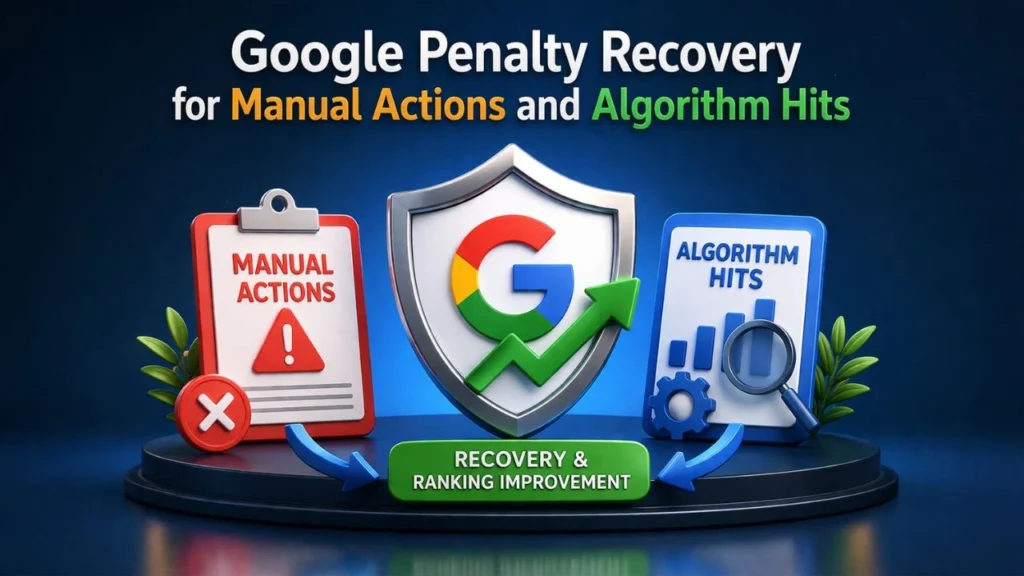
Have you noticed a sudden drop in your website traffic or rankings? One day everything looks stable, and the next day your visibility disappears. If that sounds familiar, you may be dealing with Manual Actions and Algorithm Hits.
The good news is that recovery is possible. With the right approach to Google Penalty Recovery, you can regain lost rankings and even come back stronger than before. In this guide, we will walk you through everything you need to know to fix penalties and restore your site’s performance.
Table of Contents
What Are Manual Actions and Algorithm Hits?
When a site’s traffic or rankings suddenly plummet, the very first task is pinpointing why it happened. Broadly, search-engine penalties fall into two buckets—Manual Actions and Algorithm Hits—and each demands a different recovery playbook.
Manual Actions
A Manual Action is a hand-applied penalty, a human reviewer inside Google (or another search engine) inspects your site, decides it breaks published guidelines (e.g., for spammy links, thin content, or cloaking), and issues an enforcement notice in Search Console. Because the review is explicit, you’ll always receive a detailed alert that explains:
- What rule was broken (such as “Unnatural inbound links”).
- Which part of the site is affected (a single page, a section, or the entire domain).
- How to request reconsideration once you have fixed the problem.
Recovery, therefore, revolves around cleaning up the cited issues, documenting the fixes, and submitting a reconsideration request. Success is binary: the manual penalty is either lifted or it isn’t.
Algorithm Hits
By contrast, an Algorithm Hit is an automatic demotion triggered when a core ranking system—think broad core updates, spam updates, or product-reviews updates—detects signals that no longer satisfy its quality thresholds. There is:
- No human reviewer issuing a formal notice.
- No explicit list of errors telling you what to fix.
- No reconsideration button—rankings rebound only after the site aligns with the algorithm’s intent and the system refreshes.
Here, recovery means performing a holistic audit (content quality, expertise signals, technical health, link profile, user-experience metrics) to identify mismatches with the latest algorithmic expectations, then improving them across the board. Patience is required; positive changes are recognized the next time that specific system runs.
Not every ranking wobble is a penalty. Before panicking, differentiate between:
| Signal | Typical Cause | Action Needed |
|---|---|---|
| Sudden de-index | Manual Action | Immediate remediation & reconsideration |
| Gradual slide | Core or spam update | Algorithm update recovery sprint |
| Random spikes | Data lag, A/B tests | Monitor—often self-corrects |
Pro tip: Your fastest clue is Google Search Console. Manual Actions appear in the dashboard; algorithmic hits don’t—so you must infer them from timing and traffic graphs.
If you are wondering, “What is the difference between a manual penalty and an algorithm update?” — the answer lies in how they are applied. One is manual, and the other is automated, but both can significantly impact your rankings.
Full-Stack Recovery Framework
| Phase | Goal | Key Tasks | KPI |
|---|---|---|---|
| Discover | Identify root issues | Crawl, log analysis, backlink audit | % errors fixed |
| Repair | Remove / improve | Disavow, rewrite, UX fixes | Quality score |
| Reinforce | Future-proof | EEAT content clusters, schema | Entity coverage |
Signs Your Website Has Been Penalized
When a site is hit by Manual Actions and Algorithm Hits, its visibility can plummet almost overnight. Here’s how that typically shows up:
1. Sudden drop in organic traffic
Search engines may drastically reduce or remove your pages from their indexes, so the steady flow of visitors you normally see can nosedive within days.
2. Loss of keyword rankings
Queries that once delivered your content now surface competitors instead. This ranking erosion is a tell-tale sign that an algorithmic filter—or a manual penalty—has targeted specific optimisation issues on your site.
3. Pages disappearing from search results
Entire URLs (sometimes whole sections) can vanish from the index. If a previously indexed page now returns “No results found” for its exact title search, the page is likely de-indexed because the system has deemed it untrustworthy or non-compliant.
4. Warnings in Google Search Console
Inside Google Search Console, you’ll often see red-flag messages such as Manual Action for Spam or Security Issues. These alerts outline what triggered the penalty and provide the first clues for recovery.
So, if you’re wondering “Why did my website traffic suddenly drop?”, scrutinise these signals first—because a sharp decline usually points to hidden Manual Actions and Algorithm Hits rather than mere seasonality or tracking glitches.
👉 Get Penalty Diagnosis
How to Diagnose Manual Actions and Algorithm Hits?
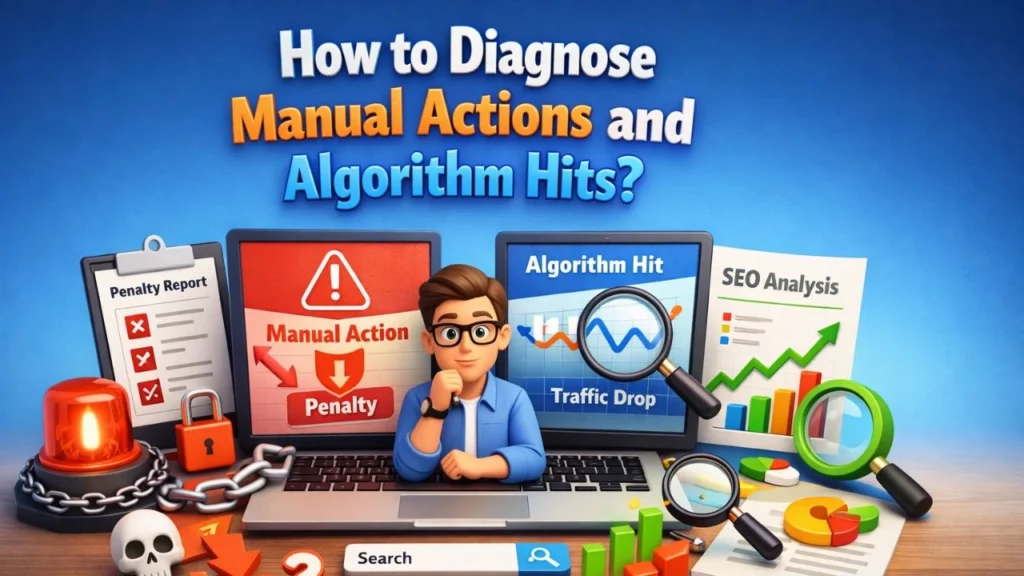
Before you reach for quick-fix tactics, first make sure you understand exactly why your site lost visibility. A systematic diagnosis prevents you from wasting effort on the wrong remedy and speeds up true recovery.
Start with Google Search Console
Open the Manual Actions and Page Indexing reports. If the Console flags a manual action, you have direct confirmation that a human reviewer applied a penalty. If you see widespread crawling or indexing errors, those technical issues may be the real culprit.
Match traffic patterns to update timelines
Export your analytics data and overlay it with the dates of confirmed core updates or spam-focused updates. A sharp drop that aligns with one of these roll-outs points to an algorithmic hit rather than a manual penalty.
Run a comprehensive SEO audit
Examine three pillars:
• Technical – crawlability, site speed, mobile friendliness, structured data
• Content – originality, depth, E-E-A-T signals, keyword cannibalization
• Backlinks – quality, relevance, anchor-text profile, toxic link risk
Isolate the primary trigger
Correlate your audit findings with the traffic-drop timeline to diagnose Manual Actions and Algorithm Hits effectively. If toxic links dominate and no manual notice exists, you may be dealing with Penguin-style algorithm filters. If thin or AI-spun pages ballooned right before the drop, the Helpful Content or Spam update is likely responsible.
By moving through these four checkpoints in order—Console alerts, traffic correlations, full-spectrum audit, then root-cause mapping—you anchor every next step of your Google Penalty Recovery plan in evidence rather than guesswork, dramatically improving your chance of a fast, lasting rebound.
Google Penalty Recovery Process (Step-by-Step)
Recovering a site that has been hit by Manual Actions and Algorithm Hits follows a clear, repeatable workflow. Use the checklist below to move methodically from diagnosis to full restoration of organic visibility.
| Step | What to Do | Why It Matters |
|---|---|---|
| 1. Diagnose the Penalty Type | Compare Search Console messages, analytics timelines, and algorithm-tracker calendars to confirm whether the loss stems from Manual Actions and Algorithm Hits or a different cause. | An accurate diagnosis dictates every fix that follows; treating an algorithmic filter like a manual penalty—or vice versa—wastes time. |
| 2. Resolve Technical SEO Roadblocks | * Improve crawlability with a clean robots.txt and XML sitemap. * Fix broken internal and external links. * Optimize Core Web Vitals and overall site speed. | Technical friction can mask deeper issues and slow recovery even after the penalty is lifted. |
| 3. Audit & Purge Toxic Backlinks | Use link-analysis tools to locate manipulative, irrelevant, or spammy domains, remove what you can, and submit a precise disavow file. | Manual Actions and Algorithm Hits tied to unnatural links will not clear until the backlink profile is demonstrably trustworthy. |
| 4. Elevate Content Quality | * Delete or merge thin, duplicated, or AI-spun pages. * Add depth, original insights, and topical relevance. * Showcase Expertise, Experience, Authority, and Trust (E-E-A-T) with bylines, citations, and transparent sourcing. | High-value, user-centric content signals to Google that the site now meets quality thresholds. |
| 5. Submit a Reconsideration Request (When Applicable) | For manual penalties, document every fix—screenshots, spreadsheets, and timelines—then file a concise, respectful reconsideration request. For algorithmic hits, monitor ranking rebounds after the next core update or data refresh. | Clear communication accelerates review; patience prevents unnecessary re-submissions that can reset the queue. |
Pro tip: Specialized Google penalty recovery services can compress this workflow—especially the backlink audit and reconsideration stages—by combining forensic SEO expertise with direct experience handling Manual Actions and Algorithm Hits.
Algorithm Update Recovery Strategies
Recovering from Manual Actions and Algorithm Hits is a marathon, not a sprint. Begin by matching every page to real-world search intent content that directly answers users’ questions earns enduring trust and stabilizes rankings.
Next, audit and refresh outdated pages so they reflect current data, current best practices, and today’s SERP layout. Reinforce site architecture through strategic internal linking; thoughtful links distribute authority, help crawlers understand topical clusters, and surface deeper resources.
Finally, expand each piece’s depth and credibility with thorough research, supporting evidence, and expert perspectives—Google’s systems reward authority that goes beyond surface-level advice. In short, effective algorithm-update recovery isn’t about quick fixes; it’s about steadily building sustainable SEO strength that can weather future Manual Actions and Algorithm Hits.
How Long Does Google Penalty Recovery Take?
Recovery time varies widely because Google treats Manual Actions and Algorithm Hits very differently:
- Manual Actions (manual penalties) – Once you fix every underlying issue and submit a detailed reconsideration request, Google’s reviewers can lift the penalty in just a few days, though complex cases may stretch to a couple of weeks.
- Algorithm Hits (algorithmic penalties) – Because they rely on the next algorithm refresh or core update, improvements you make today may not be reflected in rankings for several weeks—or even a few months—after the problem is resolved.
So when you ask, “How long does it take to recover from a Google penalty?” remember that the true timeline hinges on two factors: whether you’re dealing with Manual Actions and Algorithm Hits, and how swiftly and thoroughly you eliminate the root causes triggering them.
Common Mistakes That Delay Recovery
Many sites stay stuck under penalties because they repeat the same four mis-steps:
- Treating symptoms, not causes – If you don’t map your traffic drop to its specific trigger—whether it stems from Manual Actions and Algorithm Hits—you end up fixing the wrong things and prolong the pain.
- Blanket use of the Disavow tool – Uploading massive disavow files without auditing which links are genuinely toxic can wipe out valuable equity and still leave the penalty intact.
- Continuing to publish thin or spun pages – Low-value content makes it hard for Google to trust the rest of your site, so recovery slows or stalls.
- Failing to watch rolling updates – Core and spam updates (plus new Manual Actions and Algorithm Hits) can land while you’re mid-recovery; if you don’t monitor them, you won’t know why progress suddenly reverses.
Steer clear of these pitfalls and you dramatically raise your Google Penalty Recovery success rate.
Advanced Recovery Tips for Better Results
For a faster, more resilient recovery from Manual Actions and Algorithm Hits, concentrate on four inter-locking pillars that harden your site against future penalties:
| Priority | What it Means | How It Protects & Accelerates Recovery |
|---|---|---|
| 1. Build topical authority | Publish in-depth, interrelated content that answers every question searchers (and Google) have about your niche. Demonstrate consistent subject-matter expertise, original insights, and up-to-date references. | When Google sees you as the definitive resource on a topic, you regain trust lost to Manual Actions and Algorithm Hits more quickly—and you’re less likely to be flagged again for thin or low-value pages. |
| 2. Strengthen internal linking | Connect related pages with descriptive, keyword-appropriate anchor text. Use hub-and-spoke structures (pillar pages → supporting articles) so PageRank and topical relevance flow naturally. | Clear internal pathways help crawlers rediscover cleaned-up pages, reinforce contextual signals, and dilute any toxic backlinks that originally triggered Manual Actions and Algorithm Hits. |
| 3. Improve user experience (UX) | Speed up load times, simplify navigation, ensure mobile friendliness, and surface clear calls to action. Track Core Web Vitals and behavioral metrics (time on page, pogo-sticking). | Positive engagement tells Google that visitors trust and enjoy your content—counter-evidence that helps overturn lingering algorithmic demotions tied to past hits. |
| 4. Enhance trust signals | Display author credentials, cite reputable sources, use HTTPS, show transparent contact details, maintain up-to-date legal pages, and collect genuine reviews. | Strong E-E-A-T markers reassure both users and quality raters, making it harder for future Manual Actions and Algorithm Hits to stick. |
Key takeaway: treat recovery as more than a one-time fix. By weaving topical depth, smart architecture, stellar UX, and unmistakable trust cues into every page, you not only rebound faster but also build long-term immunity against the next wave of Manual Actions and Algorithm Hits.
Why You May Need Google Penalty Recovery Services?
For a faster, more resilient recovery from Manual Actions and Algorithm Hits, concentrate on four inter-locking pillars that harden your site against future penalties:
| Priority | What it Means | How It Protects & Accelerates Recovery |
|---|---|---|
| 1. Build topical authority | Publish in-depth, interrelated content that answers every question searchers (and Google) have about your niche. Demonstrate consistent subject-matter expertise, original insights, and up-to-date references. | When Google sees you as the definitive resource on a topic, you regain trust lost to Manual Actions and Algorithm Hits more quickly—and you’re less likely to be flagged again for thin or low-value pages. |
| 2. Strengthen internal linking | Connect related pages with descriptive, keyword-appropriate anchor text. Use hub-and-spoke structures (pillar pages → supporting articles) so PageRank and topical relevance flow naturally. | Clear internal pathways help crawlers rediscover cleaned-up pages, reinforce contextual signals, and dilute any toxic backlinks that originally triggered Manual Actions and Algorithm Hits. |
| 3. Improve user experience (UX) | Speed up load times, simplify navigation, ensure mobile friendliness, and surface clear calls to action. Track Core Web Vitals and behavioral metrics (time on page, pogo-sticking). | Positive engagement tells Google that visitors trust and enjoy your content—counter-evidence that helps overturn lingering algorithmic demotions tied to past hits. |
| 4. Enhance trust signals | Display author credentials, cite reputable sources, use HTTPS, show transparent contact details, maintain up-to-date legal pages, and collect genuine reviews. | Strong E-E-A-T markers reassure both users and quality raters, making it harder for future Manual Actions and Algorithm Hits to stick. |
Key takeaway: treat recovery as more than a one-time fix. By weaving topical depth, smart architecture, stellar UX, and unmistakable trust cues into every page, you not only rebound faster but also build long-term immunity against the next wave of Manual Actions and Algorithm Hits.
👉 Get Penalty Diagnosis
How to Prevent Future Manual Actions and Algorithm Hits?

A swift, lasting recovery starts long before traffic takes a dive, it begins with prevention. By consistently following Google and other major search-engine guidelines, you build a foundation that is far less vulnerable to Manual Actions and Algorithm Hits.
That foundation is reinforced when you publish genuinely helpful, well-researched content, because high-quality pages satisfy both human readers and ranking systems. Regular backlink audits are just as critical; spotting and pruning toxic or irrelevant links keeps your site’s link profile clean and authoritative.
Finally, make a habit of tracking core updates and industry news so you can adapt your strategy the moment algorithms evolve. When these best practices become routine, recovery—should you ever need it—will be faster, stronger, and far less frequent.
Final Thoughts
Facing a search-engine penalty can be daunting, yet it’s rarely a life sentence for your site. By first distinguishing between Manual Actions and Algorithm Hits, and understanding the specific issues each one targets, you gain the clarity needed to craft a focused remediation plan, request reconsideration when required, and steadily regain lost visibility
FAQs
What causes Manual Actions and Algorithm Hits?
They are caused by guideline violations, poor content quality, spammy backlinks, or failing to meet algorithm standards.
Can a website fully recover from Google penalties?
Yes, with proper Google Penalty Recovery, most websites can regain rankings and traffic.
How do I know if I have a manual penalty?
You will receive a notification in Google Search Console.
What is the fastest way for Google penalty recovery?
Identify the issue quickly, fix it completely, and follow best practices consistently.
Do algorithm penalties recover automatically?
Sometimes, but most require active algorithm update recovery efforts.
Should I hire Google penalty recovery services?
If the issue is complex or severe, professional help can speed up recovery and reduce risks.
What is the first step in fixing Manual Actions and Algorithm Hits?
The first step is identifying the exact issue through Google Search Console and a detailed SEO audit to understand whether it is a manual penalty or an algorithm-related issue.
Can backlinks alone cause Manual Actions and Algorithm Hits?
Yes, spammy or unnatural backlinks are one of the most common causes, especially for manual actions related to link schemes.
How often should I audit my website to avoid penalties?
It is recommended to conduct a full SEO audit every 3 to 6 months to prevent potential issues related to Manual Actions and Algorithm Hits.
Does removing content help in Google penalty recovery?
Yes, removing or improving low-quality or duplicate content can significantly help in recovering from both manual and algorithm penalties.
Are new websites affected by Manual Actions and Algorithm Hits?
Yes, even new websites can be impacted if they violate guidelines or use poor SEO practices early on.
Focus on quality, user intent, and long-term strategies. That is how you not only recover but also build a stronger and more resilient online presence.