
If you’ve noticed a sudden drop in rankings or traffic after March 27, 2026, you’re not alone. The latest google core update has reshaped how websites are evaluated, pushing many businesses to rethink their strategy. The good news is this: with the right approach, google core update recovery is absolutely possible. In fact, many websites not only recover but come back stronger.
In this guide, we’ll walk you through exactly what changed, why your rankings dropped, and how you can implement a reliable algorithm update recovery strategy that works in today’s AI-driven search environment.
Table of Contents
📊 What is the March 2026 Google Core Update?
A Google core update is a major change to Google’s ranking system designed to improve search results. Unlike penalties, these updates reassess content quality, relevance, and trust signals across the web.
The March 2026 Google core update focused heavily on:
- Content usefulness and depth
- E-E-A-T (Experience, Expertise, Authoritativeness, Trustworthiness)
- User engagement signals
- AI-readability and structured content
This means Google is now prioritizing content that clearly answers user intent rather than just matching keywords.
Timeline & Phases
| Date | Milestone | Notes |
|---|---|---|
| 27 Mar 2026 | Update announced | Posted to Search Status Dashboard |
| 27 Mar – 03 Apr | Wave 1 | Initial recalibration of helpful-content scores |
| 03 Apr – 10 Apr | Wave 2 | Link-signal audit & INP weighting |
| 10 Apr – 11 Apr | Tremors | Minor reversals typical of end-rollout |
Key Focus Areas
- Information Gain Score – Pages offering net-new insights outranked amalgamated summaries.
- INP < 200 ms – Responsiveness joined LCP & CLS as an explicit tie-breaker.
- Experience Signals – First-hand product photos, author bios, and citations gained extra weight.
- Trust & Source Transparency – YMYL niches saw stricter scrutiny on medical and financial claims.
Compared with September 2025’s update, March 2026 tilted harder toward UX metrics and originality while slightly de-emphasising sheer backlink volume.
Signs Your Website Was Impacted
You might need google core update recovery if you notice:
- Sudden drop in organic traffic
- Rankings fluctuating across multiple keywords
- Loss of featured snippets or top positions
- Decrease in impressions or click-through rates
If these changes started after the update rollout, it’s likely your site has been re-evaluated.
Impact-Assessment Checklist
Before making changes, verify that google core update recovery is truly needed:
| Diagnostic Task | Tool | Goal |
|---|---|---|
| Confirm traffic drop window | GA4 date-range compare (26 Mar → today) | Rule out seasonality |
| Plot impression delta | Search Console ✓ “Compare last 28 days” | Spot collapsing query clusters |
| Segment by template | Looker Studio URL regex | Identify page-type weaknesses |
| Run INP report | Lighthouse / CrUX | Flag > 200 ms outliers |
| Benchmark E-E-A-T | Manual audit | Score each pillar 0-5 |
Give every affected URL a Recovery Severity Score (RSS) out of 5 to triage effort.
Google Core Update vs SEO Penalty Recovery
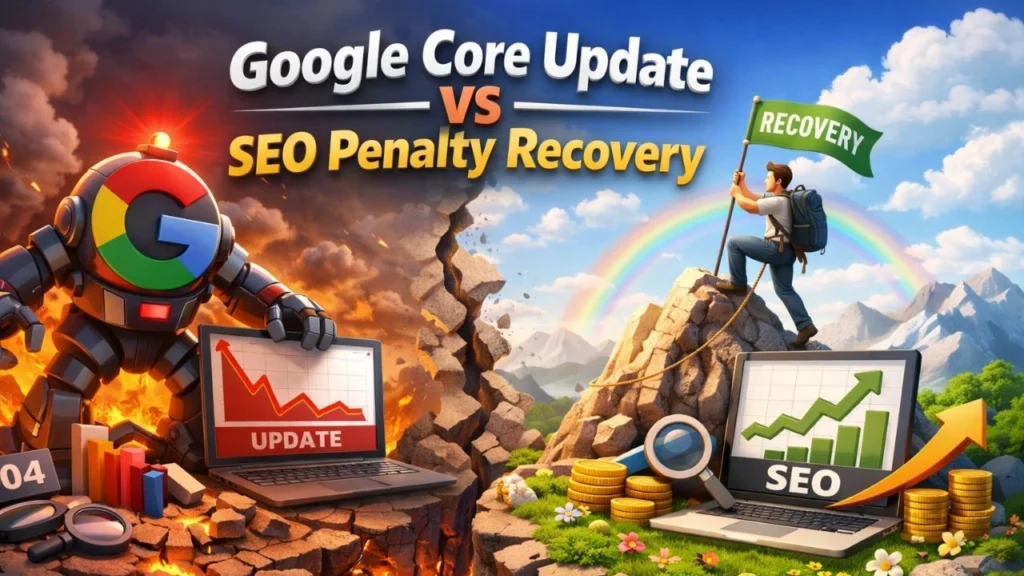
Many website owners panic and assume they’ve been penalized. But that’s not always true. SEO Penalty Recovery applies when Google manually or algorithmically penalizes a site for violating guidelines.
On the other hand, algorithm update recovery focuses on improving content quality and relevance after a ranking reassessment.
👉 In most cases, you don’t need penalty removal. You need better content and structure.
SEO Penalty Recovery vs Algorithm Update Recovery
| Feature | Manual/Penalty | Broad Core Update |
|---|---|---|
| Trigger | Violation of Google guidelines | Periodic recalibration |
| Notification | Manual-action message | None |
| Fix window | Immediate once issue fixed | Dependent on next refresh |
| Typical tasks | Disavow toxic links, remove spam | Content, UX, trust improvements |
If Search Console shows a manual action, follow penalty playbooks first. Otherwise, proceed with this algorithm update recovery guide.
Why Websites Lose Rankings After Core Updates?
Understanding the reason behind ranking drops is the first step in google core update recovery.
Common causes include:
- Thin or outdated content
- Lack of E-E-A-T signals
- Poor internal linking
- Misaligned search intent
- Over-optimized or keyword-stuffed pages
Google is no longer rewarding content that simply exists. It rewards content that helps.
Step-by-Step Google Core Update Recovery Strategy
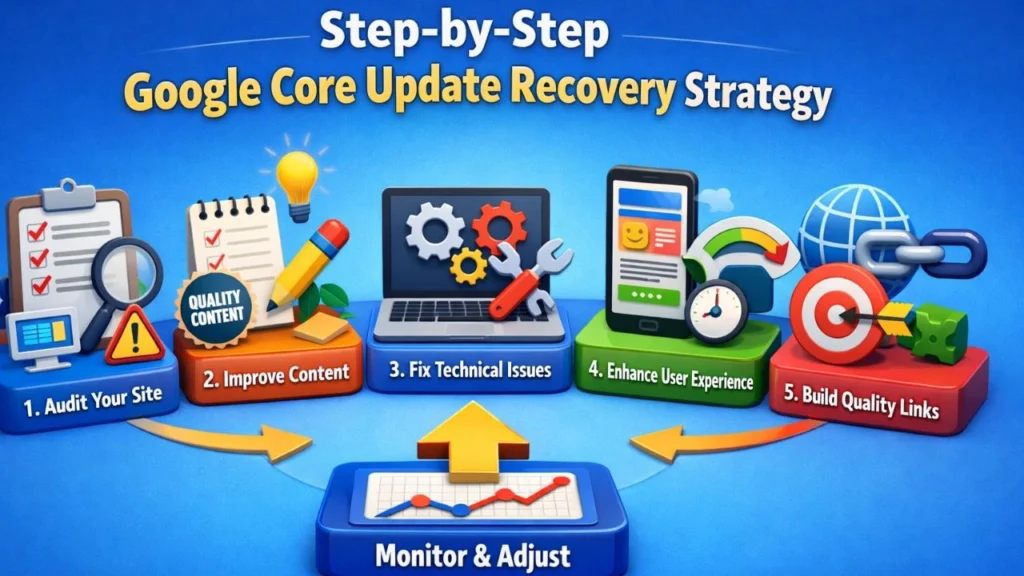
Now let’s focus on what you should actually do.
1. Perform a Full Content Audit
Start by reviewing your entire website.
- Identify pages with declining traffic
- Remove or improve low-quality content
- Consolidate similar pages
This step alone can significantly improve your google core update recovery progress.
2. Improve E-E-A-T Signals
Google wants to trust your content. You need to show why it should.
- Add author bios
- Highlight expertise
- Include credible external references
- Show real experience where applicable
Trust is now a ranking factor.
3. Align Content with Search Intent
Ask yourself: does your content actually answer the user’s query?
- Match intent (informational, transactional, navigational)
- Provide clear, structured answers
- Avoid unnecessary fluff
This is critical for both traditional SEO and AI search visibility.
Content Re-Alignment for E-E-A-T & AEO
- Expertise – Attribute quotes to credentialed authors; embed mini bios under each article.
- Experience – Include original photos, screen recordings, and test data.
- Authority – Secure contextual backlinks from universities, industry journals, and local business associations.
- Trust – Display privacy policy, contact options, and editorial guidelines.
For Answer Engine Optimization (AEO), wrap primary answers in tags within 42-word blocks; add direct “You asked, we answer” phrasing to capture voice assistants.
4. Fix Technical SEO Issues
Even great content won’t rank if your site has technical problems.
Focus on:
- Core Web Vitals
- Mobile responsiveness
- Page speed
- Crawl errors
Technical SEO supports your algorithm update recovery efforts.
Technical Enhancements for AI & Voice Visibility
- Core Web Vitals – Aim for INP < 200 ms, LCP < 2.5 s, CLS < 0.1.
- Crawl-Budget Signals – Eliminate 3xx redirect chains and duplicate parameterised URLs.
- Structured Data – Add
Speakablemarkup to summary paragraphs; deployBreadcrumbListfor every template. - Sitemaps & IndexNow – Ping Search and AI engines instantly after publishing updates.
5. Strengthen Internal Linking
Internal links help search engines understand your site structure.
- Use contextual links
- Build topic clusters
- Connect related content
This improves authority and helps distribute ranking power.
Link-Profile Stabilisation
- Audit: Classify links into Trusted, Neutral, or Toxic tiers.
- Prune vs Disavow: If anchor is “casino bonus”, disavow; if link is no-followed forum tag, ignore.
- Earn: Create interactive tools, publish data studies, or run small-scale scholarships to attract editorial links.
6. Optimize for AI and Voice Search
Search is evolving, and your content should too.
- Use conversational language
- Add FAQ sections
- Structure content clearly
- Use schema markup
This improves your chances of appearing in AI-generated answers and voice results.
7. GEO Layer: Strengthening Local Signals
- Hyper-Local Landing Pages: target neighbourhood modifiers but avoid doorway footprints.
- Regional Expertise: cite area-specific studies, local chamber statistics, or governmental data.
- NAP Consistency: audit GMB, schema, footer, and citation directories for uniform Name-Address-Phone.
- Local Backlinks: sponsor webinars with city colleges or collaborate on research with nearby associations.
Algorithm Update Recovery vs Quick Fixes
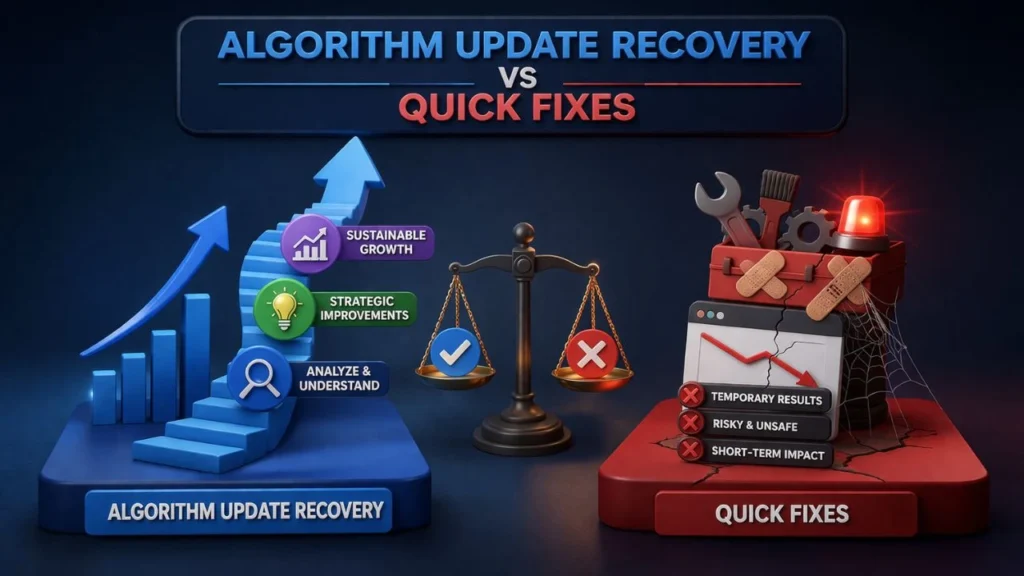
There’s no shortcut to google core update recovery. Quick fixes like keyword stuffing or backlinks won’t help anymore. In fact, they can make things worse.
What works now is:
- Consistent content improvement
- User-first approach
- Long-term SEO strategy
Recovery is a process, not an instant result.
Content Optimization Framework for Recovery
To succeed, your content must go beyond basic SEO.
Focus on:
- Semantic SEO
- Topical authority
- Entity-based optimization
- Clear content structure
This ensures your content is understandable not just for users, but also for AI systems.
How AI Search is Changing Recovery Strategies
AI-driven search experiences are transforming how content ranks.
Now, search engines:
- Extract answers directly from content
- Prioritize structured information
- Reduce reliance on traditional rankings
This makes google core update recovery more about clarity than complexity.
Timeline for Google Core Update Recovery
Recovery doesn’t happen overnight.
Here’s what to expect:
- Initial improvements in a few weeks
- Significant recovery after the next update cycle
- Continuous gains with consistent optimization
Patience is essential.
Monitoring & Iteration Cadence
| Milestone | Action | KPI |
|---|---|---|
| 72 Hours | Check real-time analytics for stabilisation | Bounce rate, scroll depth |
| 30 Days | Compare pre-update vs today in Search Console | Impressions, clicks, avg pos |
| 90 Days | Full content hub analysis | Conversion rate, link growth |
Set anomaly alerts in Looker Studio to trigger when organic sessions deviate >15 % versus 7-day moving
Tools to Track Recovery Progress
You should monitor your progress using:
- Google Search Console
- Google Analytics
- Rank tracking tools
- Content audit platforms
Tracking helps you understand what’s working and what needs adjustment.
Common Mistakes to Avoid During Recovery
Avoid these common pitfalls:
- Making too many changes at once
- Ignoring search intent
- Over-optimizing keywords
- Not updating old content
These mistakes can delay your algorithm update recovery.
When Should You Start SEO Penalty Recovery?
If you suspect a real penalty:
- Check Google Search Console for manual actions
- Analyze sudden deindexing issues
- Review backlink profile
Otherwise, focus on improving your content rather than chasing penalties.
Take-Action Checklist
☐ Run the Impact Assessment spreadsheet
☐ Fix INP outliers and update stale posts
☐ Add unique media + firsthand insights
☐ Secure at least 5 high-authority niche links
☐ Request Recovery Audit for a tailored plan
Future-Proof SEO Strategy After March 2026 Update
To stay ahead, you need to adapt continuously.
- Build topical authority
- Focus on helpful content
- Optimize for AI search engines
- Update content regularly
SEO is no longer static. It’s evolving constantly.
Recover Faster with Expert Help
If your rankings dropped after the update, guessing won’t get you far.
Get a complete analysis of your website along with a personalized google core update recovery strategy designed to restore your rankings and visibility.
FAQs
What is google core update recovery?
It is the process of improving your website after ranking drops caused by a google core update by enhancing content quality and relevance.
How long does algorithm update recovery take?
It typically takes a few weeks to a few months depending on the improvements made and Google’s re-evaluation cycle.
Is SEO Penalty Recovery the same as core update recovery?
No, SEO Penalty Recovery deals with penalties, while core update recovery focuses on content and quality improvements.
Can rankings improve after a google core update?
Yes, with the right strategy, rankings can recover and even perform better than before.
What is the first step in recovery?
Start with a content audit and align your pages with search intent.
Final Thoughts
The March 2026 update has made one thing clear: search engines are prioritizing real value over superficial optimization.
If you focus on helping users, structuring your content properly, and building trust, your google core update recovery journey will not only restore your rankings but also strengthen your long-term SEO foundation.
