Did your website disappear from organic Google search? Is the drop in organic traffic very significant? These are the obvious indications that your website is under the siege of a Google penalty.
Google penalties are a horror for site owners and digital marketers. These penalties can derail your search visibility, drop traffic, and tarnish your online reputation. The recovery process from a Google penalty should be done quickly and effectively in a bid to get your business back on track. Google Penalty Recovery becomes essential when businesses want to restore their lost visibility and rebuild trust with search engines.
This complete guide will clarify what Google penalties are, show you how to detect the problem, and suggest the measures that should be undertaken to get your lost rankings back.
Table of Contents
Understanding Google Penalties
The Google penalties are given by Google when your site breaks the Webmaster Guidelines of Google. These guidelines provide that the search results are relevant and beneficial and that they are trustworthy for the users. Understanding these guidelines is the first step toward effective Google Penalty Recovery.
- Manual Actions: Manually reviewed by a Google reviewer for obvious violations such as spammy backlinks, hidden text, or cloaking.
- Algorithmic Penalties: Automated penalties, determined by Google’s dynamic search algorithms and focusing on problems such as thin content, keyword stuffing, or bad user experience.
Recognizing the Signs of a Google Penalty

Here’s how to know if your website may have a Google penalty:
- Sudden Drop in Rankings: Loss of rankings in a substantial number of keywords in search engines.
- De-indexing: The pages are disappearing from Google searches.
- Traffic Plummets: A significant and sustained decrease in organic search traffic.
- Manual Action Notice in Google Search Console: Sometimes, Google messages in the search console about the violation. Identifying these signals early can help businesses begin Google Penalty Recovery before the damage becomes long-term.
Diagnosing the Problem of Google Penalty
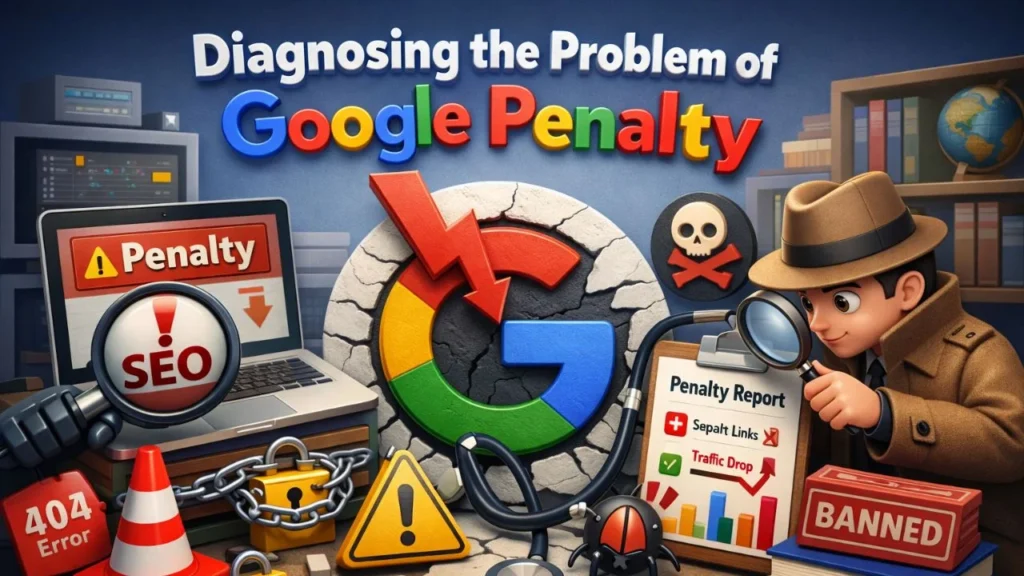
Before starting your Google penalty recovery process, you need to identify the main cause of the penalty.
- Check Google Search Console: Check your Search Console for any manual action notifications. This tells instantaneously if the site is under a manual penalty.
- Scrutinize Algorithm Updates: Study the latest Google algorithm updates. You must try to correlate your traffic stops to the timing and content of these updates. This will lead you to possible algorithmic reasons for the penalty and help you plan an effective Google Penalty Recovery strategy.
Restoring Your Ranking: Manual Penalty Removal
If you’ve received a manual action, fixing the underlying violation is your path to redemption. Common causes and their solutions include:
Unnatural Links:
- Perform a backlink audit using tools such as Ahrefs or Semrush to find out the low-quality and spammy backlinks.
- Contact the webmasters of these sites and ask them to delete your links.
- Use a Disavow Tool provided by Google to discredit detrimental links.
Thin or Low-Quality Content:
- Enhance the quality of the existing pages by giving them more depth and value.
- Do away with duplicate or very thin pages.
- Make sure that your content is original and that it is informative.
Cloaking or Hidden Text:
Remove such URL that manipulates the users, but search engines do not see. Ensure content consistency.
Requesting Reconsideration
After you are sure that the violation has been dealt with, submit a reconsideration request in the Google Search Console.
- Provide a clear account of the measures you have taken to solve the problem.
- Be truthful and show a real dedication to following Google’s rules. Submitting a transparent request is an important stage in Google Penalty Recovery for websites affected by manual actions.
Towards Algorithmic Penalty Recovery
Google from time to time provides an unclear sign of algorithmic penalties. The recovery process of your site mainly depends on matching with the new algorithmic expectations.
- Comprehend the Algorithm Change: Investigate the area of the update that probably caused your penalty. Find information on what Google now favors.
- SEO Audit: Perform an in-depth SEO audit to find out sitewide issues that may impact your quality score. Ensure that you closely monitor the areas targeted by the algorithm update as part of your Google Penalty Recovery plan.
Enhance Content:
- Thin content should be removed or substantially improved.
- Eliminate keyword stuffing and over-optimization.
- Concentrate on the development of informative user-centered content.
Clean Your Backlink Profile:
- Carefully scrutinize your backlinks and look for unnatural, spammy links.
- Make efforts to delete or repudiate them. Concentrate on creating high-value, relevant backlinks from now on.
Resolve Technical SEO Issues:
- Structurally organize your site so it can be crawled easily by search engines.
- Eliminate problems including broken links, slow loading speed, and mobile compatibility.
Successful Penalty Recovery – Some Extra Thoughts
- Patience is Key: Healing is a long process. Refrain from shortcuts or tricks that are against Google guidelines.
- Prevent Future Penalties: Practice white-hat SEO by providing long-term user value, bringing in links organically, and staying up-to-date with Google’s updates, which are released frequently. Maintaining these practices also helps sustain the results of Google Penalty Recovery.
Proactive SEO: Your Penalties Shield
Long-term SEO strategies that maintain quality standards. Here’s what this entails:
- High-Quality Content Creation: Produce high-quality original content that addresses the questions of users and provides exclusive information.
- Natural Link Building: Concentrate on quality backlink building via guest posts, development of shareable content as well as public relations.
- Technical Excellence: Make sure that your website has a user-friendly interface, fast loading times, is mobile-friendly and has a clear structure.
- Monitor and Adapt: Keep an eye on the Search Console for issues, monitor your rankings, and be aware of Google algorithm changes so that you can adjust your strategy proactively.
Conclusion
Although Google’s penalties can be a big blow, they are not a death sentence. Having clear knowledge of possible reasons, organized solving a penalty, and returning to high-quality SEO, you can forget a penalty.
On the other hand, sometimes the recovery presents a chance for a review of the website, which means you may come out stronger than before.
Through the strategies given above, you would recover your rankings, protect your online status, and build nerve in Google penalties. A structured Google Penalty Recovery approach ensures that your website not only regains rankings but also maintains sustainable SEO performance.
Need Help? If you cannot figure out what’s wrong with your penalty or cannot figure out what to do to recover, get in touch with a skillful SEO expert. They can offer customized advice and assistance to facilitate a quick and permanent Google Penalty Recovery.
Frequently Asked Questions (FAQs)
1. What is a Google penalty?
A Google penalty is a negative impact on a website’s search rankings caused by violations of Google’s Webmaster Guidelines. It can occur due to practices such as spammy backlinks, thin content, cloaking, or other manipulative SEO tactics.
2. What are the main types of Google penalties?
There are two primary types of Google penalties.
Manual penalties are applied by a Google reviewer after identifying guideline violations.
Algorithmic penalties occur automatically when Google’s algorithms detect issues like low quality content, keyword stuffing, or poor user experience.
3. How can I check if my website has received a Google penalty?
You can check for penalties by reviewing Google Search Console for manual action notifications, monitoring sudden ranking drops, analyzing organic traffic decreases, or noticing pages disappearing from search results.
4. How long does it take to recover from a Google penalty?
Recovery time varies depending on the type of penalty and the severity of the issue. Manual penalties may take several weeks after submitting a reconsideration request, while algorithmic penalties may take longer until Google re-evaluates your website during future updates.
5. Can a website fully recover from a Google penalty?
Yes, most websites can recover if the issues causing the penalty are properly identified and resolved. Improving content quality, removing spammy backlinks, and following ethical SEO practices can help restore rankings over time.
6. What are the common reasons for Google penalties?
Some of the most common causes include unnatural backlinks, keyword stuffing, thin or duplicate content, hidden text, cloaking, and poor technical SEO practices.