
Search is evolving faster than ever. What used to be a simple list of blue links is now powered by AI-driven summaries, voice assistants, and answer engines. If you want your content to appear in these new formats, you need to go beyond traditional optimization.
That’s where json-ld schema markup becomes essential.
It helps search engines and AI systems understand your content clearly, making it easier for them to display your information in rich results, featured snippets, and conversational responses. If you’re serious about improving your Technical SEO, this is not optional anymore.
Whether you are trying to enhance visibility, improve click-through rates, or strengthen your authority, structured data plays a critical role. And if you’re unsure where your site currently stands, it’s always a smart move to Get Technical SEO Audit before implementing advanced strategies.
Table of Contents
Data-Backed Insight for Credibility
AI-driven search is rapidly growing:
- AI tools are contributing to a rising share of informational queries
- Search engines still dominate, but AI-assisted results are increasing fast
- Structured data like json-ld schema markup plays a direct role in how AI selects and displays answers
👉 This strengthens your positioning for both traditional SEO and AI visibility.
What is JSON-LD Schema Markup and Why It Matters?
At its core, json-ld schema markup is a structured data format that helps search engines understand the meaning behind your content. Instead of guessing what your page is about, search engines get clear, organized information.
Content Page → JSON-LD Schema → Search Engine → AI System → Rich Results
Unlike other formats, JSON-LD is easy to implement and doesn’t interfere with your HTML structure. That’s why search engines prefer it.
Here’s why it matters:
- It improves content interpretation
- It increases chances of rich results
- It supports AI-generated answers
- It strengthens your overall Technical SEO
When your content is structured properly, AI systems can easily extract and display it in summaries, voice responses, and featured snippets.
How AI Search Engines Use Structured Data?
AI search engines don’t just scan content for keywords like traditional systems once did—they actually interpret meaning, intent, and context. Instead of matching exact phrases, they rely on techniques from Natural Language Processing and Machine Learning to understand what a user is really asking and how different pieces of information relate to each other.
They rely heavily on structured data like json-ld schema markup to:
- Understand context and relationships
- Identify key entities
- Generate accurate answers
- Deliver conversational responses
For example, when someone asks a voice assistant a question, the answer often comes from structured content, not just plain text.
This is where AEO (Answer Engine Optimization) comes into play. By implementing structured data, you make your content ready for:
- Voice search
- Zero-click searches
- AI-generated summaries
It also aligns with broader strategies like Online Presence Analysis, ensuring your brand is consistently visible across platforms.
Types of Schema Markup You Should Focus On
Not all schema types are equally useful for AI visibility. You should prioritize those that directly support search intent and answer-based queries.
Key schema types include:
- Article schema for blog content
- FAQ schema for quick answers
- HowTo schema for step-by-step guides
- Organization schema for brand identity
- Product schema for eCommerce pages
- Breadcrumb schema for navigation clarity
Using the right json-ld schema markup ensures that your content aligns with how users search and how AI delivers results.
Step-by-Step Process to Build JSON-LD Schema Markup
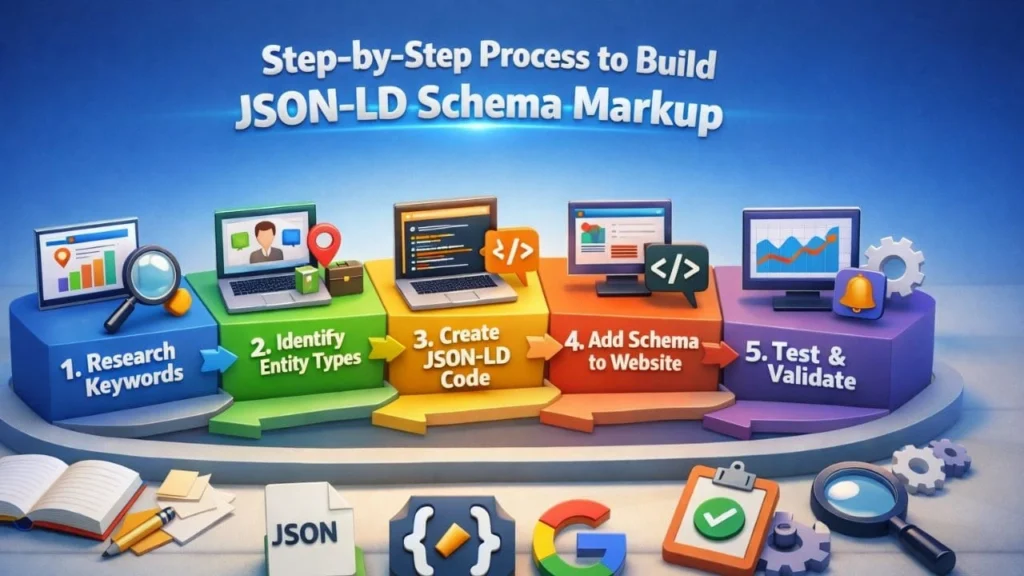
Let’s break this down into actionable steps so you can implement it effectively.
Step 1: Identify Your Page Type
Start by understanding what your page represents. Is it a blog post, service page, or product page? This determines the type of json-ld schema markup you’ll use.
Step 2: Choose the Right Schema
Select a schema type that matches your content intent. For example:
- Blog → Article schema
- Service → Organization or Service schema
- FAQ page → FAQ schema
Step 3: Generate JSON-LD Code
You can create json-ld schema markup manually or use tools. Make sure your code is clean and structured properly.
Step 4: Add Essential Properties
Include important details like:
- Headline
- Author
- Publish date
- Description
- URL
These properties help search engines understand your content deeply.
Step 5: Add the Code to Your Website
Insert the code inside your page using:
<script type=”application/ld+json”>
{
“@context”: “https://schema.org”,
“@type”: “Article”,
“headline”: “How to Build JSON-LD Schema Markup for AI Search Visibility”,
“description”: “Step-by-step guide to implementing JSON-LD schema markup for better AI search visibility and SEO performance.”,
“author”: {
“@type”: “Person”,
“name”: “Your Name”
},
“publisher”: {
“@type”: “Organization”,
“name”: “Your Website Name”
},
“datePublished”: “2026-03-21”,
“dateModified”: “2026-03-21”
}
</script>
This ensures it is readable by search engines without affecting user experience.
Step 6: Validate Your Markup
Always test your json-ld schema markup using validation tools. This step helps you catch errors early.
Step 7: Monitor Performance
Track how your structured data impacts:
- Impressions
- Click-through rates
- Search visibility
This step is often overlooked but critical for long-term success.
Best Practices for AI Search Optimization
If you want your structured data to perform well, follow these best practices:
- Keep your data accurate and updated
- Match schema with search intent
- Avoid overloading pages with irrelevant markup
- Use conversational language for voice search
- Align your content with a strong Content Marketing Strategy
Consistency also matters. Your structured data should match your actual content. This improves trust and helps AI systems rely on your information.
Common Mistakes to Avoid
Even small mistakes can significantly reduce the effectiveness of your JSON-LD schema markup because search engines rely on precise, structured data to correctly understand and display your content in rich results. Minor issues such as missing required properties, incorrect data types, improper nesting, or syntax errors can prevent search engines from interpreting the markup accurately, which may result in lost visibility, lower click-through rates, or failure to qualify for enhanced search features like rich snippets.
Avoid these:
- Using incorrect schema types
- Missing required fields
- Adding duplicate schema
- Not testing the implementation
- Ignoring core Technical SEO elements
Many websites implement schema but fail to see results because of these simple errors.
JSON-LD Schema Markup and Voice Search Optimization
Voice search is expanding quickly due to the widespread use of smart devices and assistants like Google Assistant, Siri, and Alexa, which allow users to search using natural, conversational language instead of typing. In this context, structured data—often implemented through formats like Schema.org markup—helps search engines better understand the meaning and context of website content.
By organizing information in a clear, machine-readable way, structured data increases the chances of content being selected for voice search results, especially for direct answers, featured snippets, and quick responses. This is important because voice assistants typically provide a single, concise answer rather than a list of links, making structured data a key factor in improving visibility and accessibility in voice-driven search experiences.
When users ask questions through voice assistants, the system looks for:
- Direct answers
- Structured information
- Clear context
How JSON-LD Schema Markup Makes Your Content Voice-Ready?
By using JSON-LD schema markup, you make your content voice-ready because it helps search engines and AI assistants clearly understand the meaning and structure of your information. JSON-LD (JavaScript Object Notation for Linked Data) organizes key details—such as business information, FAQs, reviews, or articles—into a machine-readable format that tools like Google Assistant, Siri, and Amazon Alexa can easily interpret.
When users perform voice searches, these systems prefer concise, well-structured answers, and schema markup increases the chances that your content will be selected as a direct spoken response. In simple terms, it bridges the gap between human-readable content and machine understanding, making your website more accessible, discoverable, and optimized for voice-based queries.
To optimize further:
- Use FAQ schema
- Write conversational answers
- Focus on question-based queries
This approach improves your chances of being selected as the spoken answer.
Advanced Tips for Competitive SERP Ranking
If you want to outperform competitors, you need to go beyond basics.
Here’s how:
- Combine schema with strong internal linking
- Improve page speed and user experience
- Use structured data across multiple pages
- Integrate with technical SEO audit services
- Strengthen credibility through Online Reputation Management
- Support scalability with systems like Cloud Computing Engineering
You should also align your efforts with broader digital strategies such as Performance Marketing Services to maximize visibility.
And if you want to identify gaps in your current setup, don’t hesitate to Get Technical SEO Audit to uncover hidden opportunities.
Advanced GEO (Generative Engine Optimization) Layer
To rank in AI-generated results:
- Focus on entity-based content
- Use structured headings and semantic clarity
- Reinforce topics with consistent terminology
- Ensure your json-ld schema markup aligns with page intent
👉 This improves your chances of being cited in AI-generated answers.
Tools to Create and Test JSON-LD Schema Markup
You don’t have to build everything from scratch. Several tools can simplify the process:
1. Google Structured Data Markup Helper
This is a beginner-friendly tool provided by Google that helps you create structured data visually without coding.
How it works:
- You paste your webpage URL or HTML code
- The tool loads your page and lets you highlight elements like:
- Title
- Author
- Price
- Ratings
- You assign schema properties by clicking and tagging those elements
Output:
- It generates ready-to-use JSON-LD code
- You can copy and add it to your website
Why use it:
- Ideal for beginners
- No need to manually write schema code
- Speeds up schema creation
2. Rich Results Test
The Rich Results Test is also from Google and is used to check whether your structured data is valid and eligible for rich results in search.
What it does:
- Tests your JSON-LD, Microdata, or RDFa
- Shows errors and warnings
- Confirms if your page qualifies for:
- Featured snippets
- Product rich results
- Review stars
- FAQ snippets
Why use it:
- Ensures your schema is technically correct
- Helps avoid errors that could prevent rich results from showing
- Essential for SEO validation
3. Schema.org
Schema.org is the official vocabulary and documentation source for structured data.
What it provides:
- A complete library of schema types like:
- Article
- Product
- Organization
- FAQ
- LocalBusiness
- Detailed properties for each schema type
- Guidelines on how to structure data properly
Why use it:
- It is the foundation of all structured data
- Helps you understand what properties to include
- Ensures your markup follows search engine standards
4. SEO Plugins for CMS Platforms
These are tools that automatically generate schema markup for your website, especially useful if you’re using platforms like:
- WordPress
- Shopify
- Wix
Popular examples include:
- Yoast SEO
- Rank Math
- All in One SEO
What they do:
- Automatically add JSON-LD schema to your pages
- Let you configure schema types (Article, Product, FAQ, etc.)
- Provide built-in validation and suggestions
Why use them:
- No coding required
- Saves time and effort
- Ideal for website owners managing content regularly
These tools help you generate and validate json-ld schema markup efficiently.
Future of Schema Markup in AI Search
Search is moving toward an AI-first model. This means structured data will become even more important.
In the near future:
- AI will rely more on structured content
- Answer engines will dominate search results
- Schema will become a standard requirement
If you start now, you’ll have a strong advantage over competitors who delay adoption.
Conversion Optimization
When Should You Implement JSON-LD Schema Markup?
You should implement json-ld schema markup when:
- Your pages are not getting rich results
- Your CTR is low despite rankings
- Your content is not appearing in AI summaries
- You want to improve visibility in voice search
If your competitors are already optimizing for AI search and structured data, delaying implementation can cost you visibility. Taking action now ensures your content remains competitive across both traditional and AI-powered search platforms.
👉 If you notice these issues, it’s the right time to Get Technical SEO Audit and fix underlying gaps.
Conclusion
The way search engines and AI systems interpret content is changing rapidly. If you want to stay visible, you need to adapt your strategy.
Implementing json-ld schema markup is one of the most effective ways to do that. It improves how your content is understood, increases your chances of appearing in rich results, and prepares your site for AI-driven search.
When combined with strong Technical SEO, structured data can significantly boost your rankings and visibility.
If you’re serious about improving performance and identifying gaps, now is the right time to Get Technical SEO Audit and take your strategy to the next level.
FAQs
What is json-ld schema markup in SEO?
It is a structured data format that helps search engines understand your content better and display it in rich results.
How does json-ld schema markup improve AI visibility?
It provides clear context to AI systems, allowing them to use your content in summaries, voice responses, and featured snippets.
Is JSON-LD better than other schema formats?
Yes, it is preferred because it is easy to implement and does not interfere with your page structure.
Where should I add JSON-LD code?
You should add it inside the script tag in your HTML, usually within the head or body section.
Can schema markup improve rankings?
It does not directly boost rankings, but it improves visibility, click-through rates, and overall search performance.
What is the difference between JSON-LD and Microdata?
JSON-LD is the recommended format by Google because it is added in a separate script tag and does not interfere with your HTML structure. Microdata, on the other hand, is embedded directly within HTML tags, making it harder to manage and update.
Can I use multiple schema types on the same page?
Yes, you can use multiple schema types on a single page as long as they are relevant. For example, a blog post can include:
Article schema
FAQ schema
Breadcrumb schema
Author schema
This helps search engines better understand your content.
How long does it take for schema markup to show results in search?
There is no fixed timeline. After implementing schema:
Google needs to recrawl and index your page
Rich results may appear within a few days to several weeks
It depends on your website’s crawl frequency and authority
Does schema markup guarantee rich results?
No, schema markup does not guarantee rich results. It only makes your content eligible. Google decides whether to display rich snippets based on:
Content quality
Relevance
Search intent
Compliance with guidelines
Can incorrect schema harm SEO?
Yes, incorrect or misleading schema can negatively impact SEO. If you violate guidelines:
Your rich results may be removed
Your site may lose eligibility for structured features
It can reduce trust with search engines
Always validate schema using testing tools.
Is JSON-LD necessary for every website?
It is not mandatory, but it is highly recommended. Websites that benefit most from JSON-LD include:
Blogs
E-commerce stores
Local businesses
News websites
Even simple schema can improve visibility in search results.
7. Can I add schema markup without a developer?
Yes, you can use:
SEO plugins like Yoast SEO or Rank Math
Google’s Structured Data Markup Helper
Online schema generators
These tools allow you to add schema without coding knowledge.
How often should I update my schema markup?
You should update schema whenever:
Your content changes
You add new sections or FAQs
You update product details or reviews
You modify page structure
Keeping schema updated ensures accuracy and better SEO performance.
What are the most important schema types for SEO?
Some of the most impactful schema types include:
Article
Product
FAQ
LocalBusiness
Review
Using these helps improve your chances of appearing in rich results.
Can schema markup improve click-through rate (CTR)?
Yes, schema markup can significantly improve CTR by making your search listing more attractive. Rich snippets like:
Star ratings
FAQs
Pricing
Images
help users trust your result and click more often.