
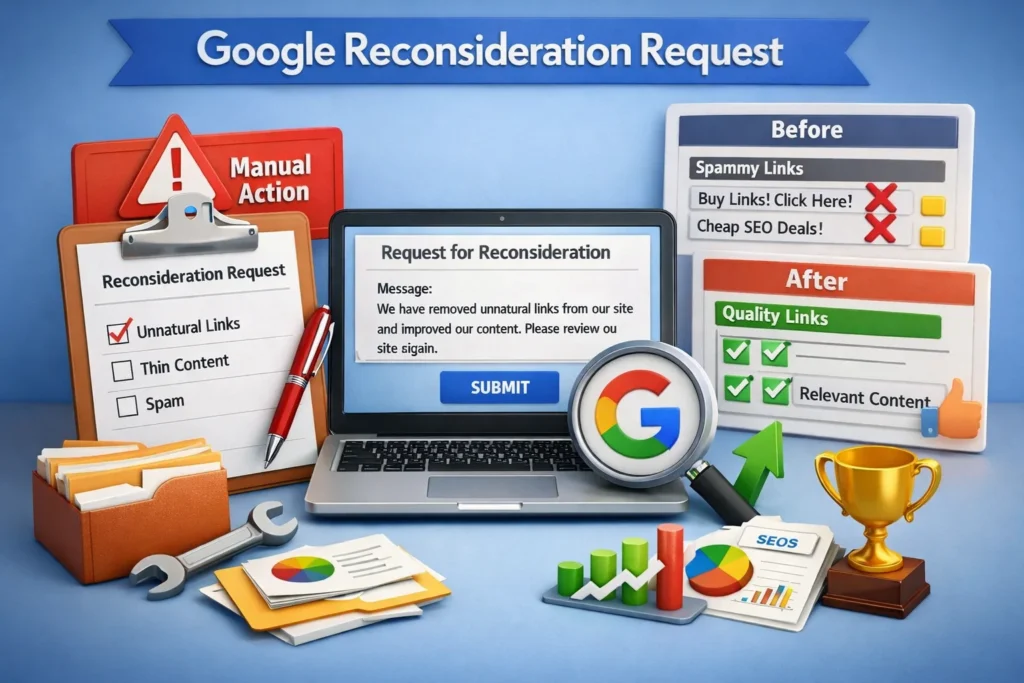
If your site has been hit with a manual action, a strong Google Reconsideration Request can become the bridge between cleanup and renewed trust. But the truth is simple: Google does not want excuses, vague promises, or generic apology notes. It wants evidence that you understood the issue, fixed it properly, and put safeguards in place so it does not happen again. Google’s own guidance says a reconsideration request is used after problems tied to a manual action or a security issues notification have been fixed. It also says a good request should explain the exact issue, describe the fixes, and document the outcome.
That matters because many site owners confuse a ranking drop with a penalty. Not every traffic decline needs a Google Reconsideration Request. Google has said reconsideration requests are intended for sites with manual spam actions, while a purely algorithmic drop does not require one because there is no manual action to revoke.
So if you are building a recovery-focused SEO campaign, this article will help you understand when a Google Reconsideration Request makes sense, what should go into it, which mistakes can hold you back, and how you can write one with clarity and confidence.
Table of Contents
What Is a Google Reconsideration Request?
A Google Reconsideration Request is a formal request submitted through Google Search Console after you fix problems identified in a manual action or security issue. In simple terms, it is your chance to tell Google, “We found the issue, we cleaned it up, and here is proof.”
That is why a Google Reconsideration Request is not just a formality. It is a recovery document. If your website relied on manipulative links, thin pages, deceptive tactics, hacked content, or low-trust patterns, your request has to show that the problem is genuinely resolved. A rushed or shallow response usually signals that the same habits may still exist.
For businesses, this is bigger than a single message in Search Console. A rejected Google Reconsideration Request can delay visibility, weaken leads, and slow the entire SEO campaign. A well-prepared one, on the other hand, gives your team a more disciplined recovery path built on cleanup, documentation, and accountability.
When Do You Actually Need a Google Reconsideration Request?
You need a Google Reconsideration Request when Google has applied a manual action or when your site has a security issue that requires review after cleanup. Google’s help documentation is direct on this point.
You do not usually need a Google Reconsideration Request for a normal ranking drop caused by an algorithm update. In those cases, the right move is to improve quality, trust, and site performance, then wait for Google’s systems to reassess the site. That is why smart recovery teams separate manual penalties from algorithmic problems early.
This distinction is where many businesses go wrong. They hire Algorithmic Recovery Experts when the site has a manual action, or they draft a Google Reconsideration Request for an issue that only needs broader quality improvement. The better path is diagnosis first, action second.
Why Some Reconsideration Requests Fail
A weak Google Reconsideration Request usually fails for one of three reasons. First, the cleanup was incomplete. Google says you should request review only after all issues listed in the report are fixed across all affected pages.
Second, the request is too vague. Google specifically says a good request should explain the exact issue, describe the steps taken, and document the result. If your note says only “we fixed everything,” that is not enough.
Third, the website owner treats the request like a negotiation instead of a compliance review. That approach rarely works. A Google Reconsideration Request is strongest when it is factual, transparent, and backed by evidence.
What You Should Fix Before Sending a Google Reconsideration Request?
Before writing any Google Reconsideration Request, fix the cause, not just the symptom. That means your recovery process should include the following areas.
1. Link Profile Cleanup
If the issue involves unnatural links, your SEO campaign needs a serious review of how those links were built. Look for paid placements, obvious link exchanges, spammy directories, sitewide footer links, irrelevant guest posts, and patterns tied to old outreach vendors. Google has advised site owners reviewing backlink-related issues to look for patterns and investigate links created during past campaigns.
This is where Enterprise Link Building Services can become either a solution or a risk. If those services are focused on editorially earned, relevant, policy-safe links, they support long-term trust. If they rely on scale without quality control, they can create the exact problem that triggers a manual action.
2. Citation Cleanup for Local Trust
If your business has local visibility goals, Citation cleanup matters more than many teams realize. Inconsistent listings, fake business information, duplicate profiles, and low-quality directory spam can weaken trust signals and complicate your recovery work. While a local listing issue alone does not automatically mean a manual action, poor citation hygiene often overlaps with broader spam tactics. Good Citation cleanup helps you remove noise and bring consistency back into your local footprint.
3. Technical SEO Review
A penalty recovery is not only about links or content. Technical SEO often plays a quiet but important role. Broken canonicals, orphaned spam URLs, crawl traps, cloaked pages, hacked files, index bloat, misleading redirects, and poor template control can all make recovery harder.
If your site has been compromised, Google’s security guidance says you should fix the issue first and then request a security review. It also notes that security reviews can take from a few days to a few weeks.
So yes, a strong Google Reconsideration Request should often be supported by a strong Technical SEO audit.
4. Content and Quality Fixes
If the site has thin pages, copied content, doorway pages, spun location pages, or other manipulative assets, remove them or rewrite them meaningfully. Recovery gets stronger when your site no longer looks like it was built to game search systems.
This is also the point where many businesses consider outside Google penalty recovery services. That can be useful when the site is large, the damage is widespread, or internal teams need help documenting the recovery process. Still, even with outside help, the substance has to come from real fixes.
How to Write a Google Reconsideration Request the Right Way?

A good Google Reconsideration Request follows a simple structure.
- Start by acknowledging the issue clearly.
- Then explain what caused it.
- After that, list the exact actions you took.
- Next, share the outcome of those actions.
- Finally, explain how you will prevent the issue from happening again.
That structure aligns closely with Google’s published guidance: explain the quality issue, describe the steps taken, and document the outcome.
Your tone should be calm and responsible. Do not sound defensive. Do not overexplain. Do not write like you are trying to impress a reviewer. Write like a business that understands what went wrong and took the work seriously.
Google Reconsideration Request Example 1: Unnatural Links
Here is a practical Google Reconsideration Request example for a backlink-related manual action:
Subject or opening:
We received a manual action related to unnatural links pointing to our site. After reviewing our backlink history, we found links created through a past SEO campaign that did not meet Google’s quality expectations.
What we fixed:
We audited the backlink profile, identified manipulative patterns, contacted site owners for removals, stopped the linking practices responsible for the issue, and documented the results. We also reviewed our vendor process and discontinued any low-quality link acquisition activity.
What changed going forward:
Our future link acquisition will focus only on editorial relevance, quality review, and natural placement standards. We have updated our approval process so new campaigns are checked before launch.
Closing:
We respectfully request that Google review our site again. We believe we have addressed the underlying issue and taken steps to prevent recurrence.
This style works because it is direct, specific, and accountable. A Google Reconsideration Request like this is much stronger than a generic apology.
Google Reconsideration Request Example 2: Thin Content and Scaled Pages

A second Google Reconsideration Request example might apply to a site that published many low-value pages to capture search traffic:
“We identified that parts of our site contained thin and repetitive pages created during an older growth phase. These pages did not provide enough original value and created a low-quality experience. We removed low-value pages, consolidated overlapping URLs, improved core category content, and updated editorial checks for future publishing. We have now completed a full quality review of affected areas and request reconsideration.”
This version works because it does not dodge responsibility. It shows cleanup, structural improvement, and a prevention plan.
Google Reconsideration Request Example 3: Hacked Site or Security Issue
If the issue is security-related, your Google Reconsideration Request should explain that the compromise was identified, cleaned, and locked down. Google says security reviews are requested after the problem is fixed, and those reviews can take from a few days to a few weeks.
A sample could look like this:
“We identified unauthorized content injection on several pages. We removed the injected content, restored clean files, reviewed server access, updated passwords, patched vulnerable components, and verified the affected URLs. We also added internal monitoring to detect similar activity earlier. We now request a security review.”
That is clean, credible, and aligned with what reviewers need.
Mistakes to Avoid in Any Google Reconsideration Request
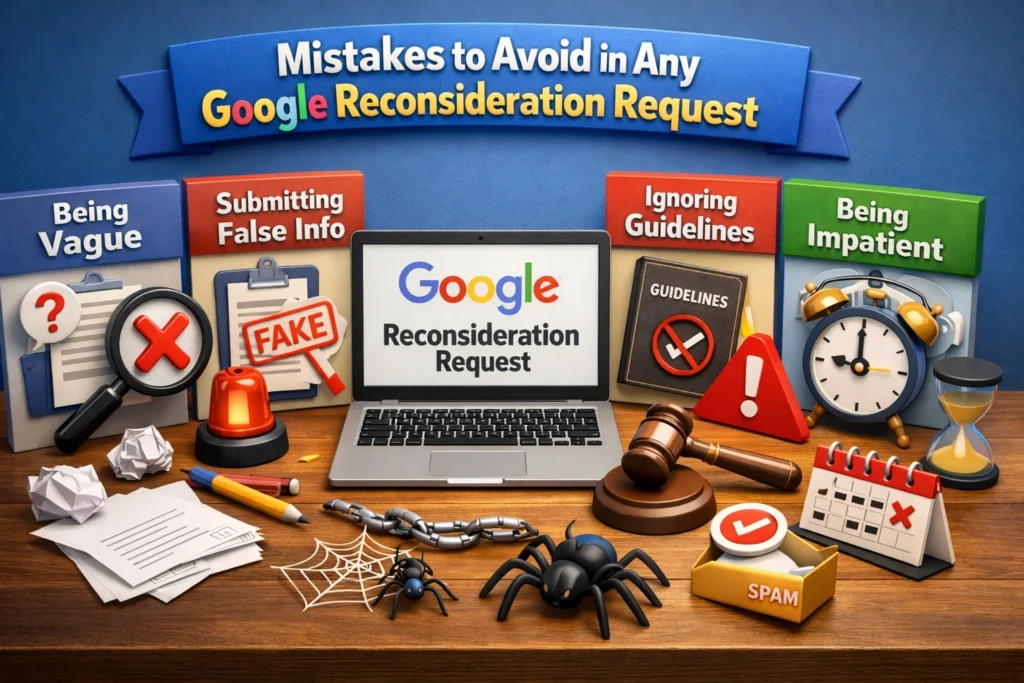
The first mistake is submitting too early. If important issues remain unresolved, the Google Reconsideration Request is likely to fail.
The second is writing without evidence. Even if you do not attach huge files, your wording should make it obvious that the work was real.
The third is confusing manual issues with algorithmic ones. That wastes time and can derail your entire recovery plan. Google has clearly said that algorithmic visibility changes do not require reconsideration because there is no manual action to revoke.
The fourth is ignoring connected issues. For example, a business may focus on backlinks while forgetting Technical SEO problems, hacked files, or weak Citation cleanup. Recovery often works best when the whole trust picture improves together.
How Long Does It Take After You Submit?
For security reviews, Google says the process can take from a few days to a few weeks after the problem is fixed and the review is requested.
For broader warning systems, Google also notes there can be a delay before all warnings disappear because updates need time to propagate across systems.
That means even after a successful Google Reconsideration Request, recovery may not feel instant. Rankings, trust signals, and crawl behavior can take time to settle. So once you submit, keep monitoring the site, keep improving quality, and keep your recovery documentation organized.
How a Google Reconsideration Request Fits Into a Bigger SEO Campaign?
A strong Google Reconsideration Request should not be treated as a standalone act. It belongs inside a broader recovery-focused SEO campaign that improves quality, trust, governance, and site maintenance.
That bigger campaign often includes:
- backlink review and policy-safe acquisition
- Citation cleanup for local trust consistency
- Technical SEO fixes that reduce crawl and indexing issues
- content pruning and quality improvement
- safer vendor controls for Enterprise Link Building Services
- performance tracking and documentation
This is why some businesses work with Google Penalty Recovery Services after a manual action. The strongest providers do not just write the request for you. They help you build the evidence behind it.
Final Thoughts
A Google Reconsideration Request works best when it reflects real correction, not just careful wording. If your site has a manual action, the winning formula is simple: diagnose accurately, fix deeply, document clearly, and submit honestly.
Do that, and your Google Reconsideration Request becomes more than an appeal. It becomes proof that your site deserves another review.
If you are dealing with link risks, local trust issues, content cleanup, or Technical SEO problems and want a more disciplined recovery process, Request Google Penalty Audit.
FAQs
What is a Google Reconsideration Request?
A Google Reconsideration Request is a request asking Google to review your site after you fix issues identified in a manual action or security notification.
Can I send a Google Reconsideration Request after an algorithm update?
Usually no. Google says reconsideration requests are intended for manual spam actions, and algorithmic visibility changes do not require one.
What should a Google Reconsideration Request include?
Google says a good request should explain the exact issue, describe the steps you took to fix it, and document the outcome.
How long does a review take?
For security issues, Google says a review can take from a few days to a few weeks.
Does Technical SEO matter during recovery?
Yes. Even when the original issue is links or content, Technical SEO can affect how cleanly Google sees your fixes and re-evaluates the site.
Why is Citation cleanup useful in recovery?
Citation cleanup helps reduce inconsistency, spam signals, and local trust confusion, especially for businesses that rely on location-based visibility.
Should I hire Google Penalty Recovery Services?
If the issue is complex, large-scale, or tied to multiple site areas, experienced Google Penalty Recovery Services can help with diagnosis, cleanup planning, documentation, and submission quality.
How do I know whether my backlink cleanup is enough before submitting a request?
Your backlink cleanup is usually strong enough when you have reviewed the link patterns that caused the issue, removed or neutralized the manipulative ones you can control, stopped the practices that created them, and can clearly explain the work inside your reconsideration request. Google says a good request should explain the exact issue, describe the steps taken to fix it, and document the outcome.
What proof should I collect before submitting a Google Reconsideration Request?
You should collect evidence that shows the issue was investigated and fixed, such as cleanup logs, removal records, examples of corrected pages, and notes on process changes. Google’s guidance says the request should document the outcome of your efforts, so your proof should support that claim clearly.
Should I remove bad links or disavow them before filing a reconsideration request?
The safest approach is to focus first on real cleanup by removing or correcting problematic links wherever possible and then explaining what actions were taken. Google’s guidance around backlink-related reconsideration emphasizes understanding the patterns behind the links and resolving the underlying issue rather than sending a vague request.
Can I submit more than one reconsideration request for the same issue?
Yes, but you should usually submit again only after doing more meaningful cleanup. If the first request is not successful, that usually means Google believes the issue has not been resolved fully, so the next request should be based on stronger fixes and clearer documentation.
What happens inside Google after a reconsideration request is submitted?
After submission, Google reviews the site for compliance and then communicates the outcome through Search Console. Google has said site owners can be informed whether their site was affected by a manual action and can learn the result of the reconsideration review there.
Should I admit past SEO mistakes openly in the reconsideration request?
Yes. A reconsideration request is stronger when it is honest and specific about what went wrong, what caused it, and what you changed. Google explicitly says a good request should explain the exact quality issue and the steps taken to fix it, so clear accountability helps more than vague language.
Can duplicate business listings affect penalty recovery efforts?
Duplicate or low-quality listings may not always be the direct cause of a manual action, but they can still weaken trust and create confusion in your cleanup process. That is why citation cleanup is useful when you are trying to improve overall search trust, especially for local businesses, even if the reconsideration request itself is tied to a broader spam issue. This is an inference based on Google’s emphasis on resolving the exact underlying issue and documenting the cleanup properly.
How detailed should my explanation be in a reconsideration request?
It should be detailed enough to show that you understood the problem, fixed it thoroughly, and changed your process going forward, but concise enough to stay readable. Google’s own guidance points to three essentials: explain the issue, describe the fixes, and document the result.
Is it necessary to stop old link building vendors before requesting reconsideration?
If those vendors were responsible for manipulative or low-quality links, stopping that activity is an important part of showing that the issue will not happen again. Google’s backlink guidance focuses on understanding how problematic links were created and resolving the source of the problem, not just the visible symptoms.
