If you want the direct answer first, here it is. Most websites do not need the Disavow Tool in 2026. Google describes it as an advanced feature, says most sites will not need it, and advises using it mainly when a site has a large number of spammy or artificial links that caused, or are likely to cause, a manual action. Google also advises trying to remove those links first where possible.
Table of Contents
The short answer in 2026
What the answer looks like today
The reason this topic still matters is simple. Link spam still exists, but Google also says its systems, including SpamBrain, work to detect spam and reduce the value of manipulative links. That means not every weak looking backlink needs a disavow file. In many cases, Google can judge which links to trust without extra help from site owners, which is why Google Penalty Recovery Services should focus on real risk patterns rather than every low quality link.
What this means for site owners
You should think of the Disavow Tool as a selective recovery option, not a routine monthly SEO task. If there is no manual action, no obvious pattern of paid links, and no serious backlink cleanup issue, you are usually better off improving content quality, service page clarity, internal linking, and trust signals across the site. That is often a more useful direction than reacting to every low quality link report.
What the Disavow Tool actually does
The simple definition
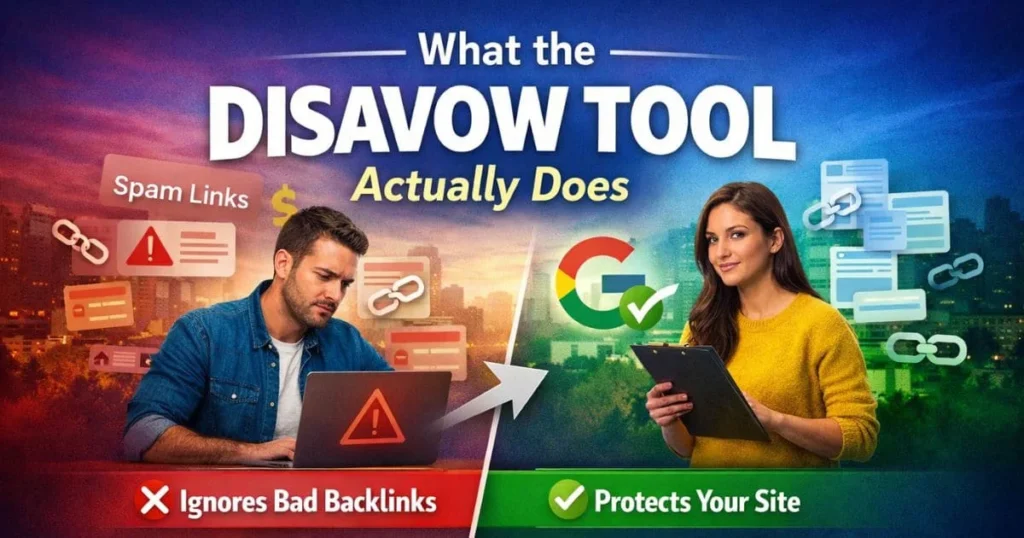
The Disavow Tool lets you ask Google to ignore specific backlinks when assessing your site. It does not erase links from the web. It does not remove them from third party tools. It simply gives Google a signal that you do not want certain links considered as part of your backlink profile. Google says the file is uploaded as a text file and can contain page level or domain level entries.
What it does not do
It is not a shortcut for every traffic decline. It is not a guarantee of recovery. Google also notes that in link spam related situations, once spammy links are nullified, any ranking value those links once passed cannot be regained. So if a site relied on manipulative links, using the tool will not restore that lost advantage. It helps cleanup, but it does not create new authority.
When you should use the Disavow Tool
Use it when there is a manual action
Google is very clear here. If your site has a manual action for unnatural links, or if you believe one is likely because of paid links or other link schemes, the tool may be appropriate after removal efforts. This is the strongest and clearest use case. Google also asks site owners to make a good faith effort to remove bad links first, rather than simply adding everything to a file.
Use it when there is a large scale pattern of artificial links
A useful question is not whether a few links look weak. The better question is whether there is a clear pattern that points to manipulation. Google says the main threshold is a considerable number of spammy, artificial, or low quality links, together with manual action risk. That points to scale, intent, and pattern rather than isolated noise.
Use it when the backlink issue is inherited
Some sites carry old link building baggage for years. A domain may have links built by a past agency, from paid placements, low value directories, irrelevant sitewide pages, or networks made mainly to pass ranking signals. When those patterns are visible, a manual backlink review and Google Search Console audit become more useful than a generic toxicity score. If the signals align with Google spam policies, a careful disavow process can support cleanup.
Use it in some negative SEO or hacked link situations
Google says it works hard to make sure actions on third party sites do not negatively affect your website, but it also states that in some circumstances incoming links can affect its view of a page or site. In addition, Google spam policies discuss hacked content, hidden links, and injected spam. So if a site sees an obvious flood of manipulative links tied to hacked or deceptive behavior, this may justify a deeper review and possibly a disavow file.
Decision table
| Situation | Use the Disavow Tool | Why |
|---|---|---|
| Manual action for unnatural links | Yes | Strong recovery case |
| Paid links built in the past | Usually yes after cleanup | High policy risk |
| A few random spam backlinks | No | Google often handles these |
| Low DR links with no pattern | No | Not enough evidence |
| Negative SEO with obvious scale | Maybe | Review carefully first |
| Hacked or injected spam links | Often yes | Cleanup may be needed |
| Old agency built manipulative links | Often yes | Risk may be inherited |
The table below reflects Google’s current guidance about when this tool is usually warranted and when it is usually unnecessary.
When you should not use the tool
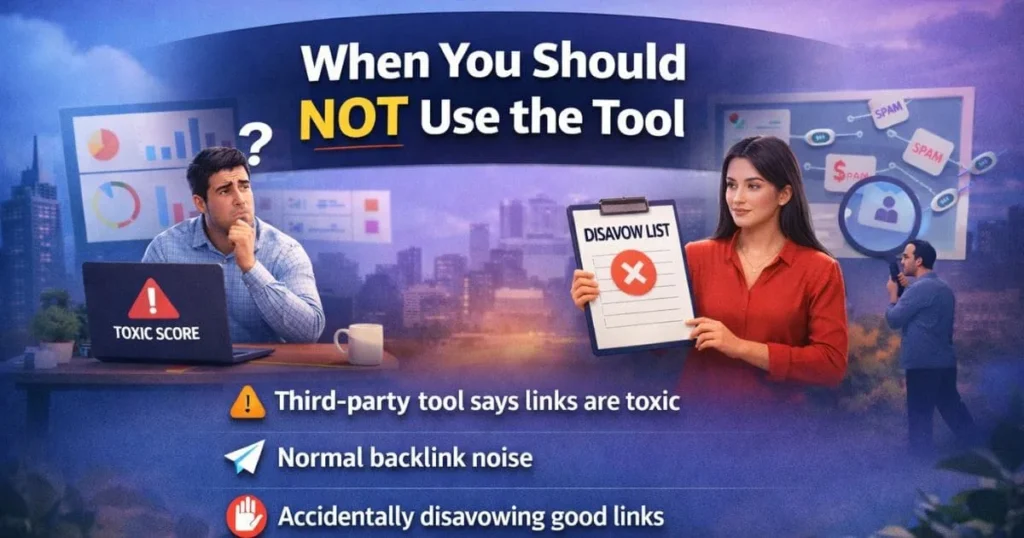
Do not use it just because a third party tool says links are toxic
A common mistake is treating outside link metrics as final truth. Google does not tell site owners to disavow links based on a score from a crawler. Its guidance focuses on manual action risk, artificial patterns, and links that violate spam policies. That means a scary looking dashboard is not enough by itself.
Do not use it for normal backlink noise
Scraper pages, copied listings, low value mentions, and random junk links may look unpleasant, but they are not always a reason for action. Google says most sites will not need this tool and that its systems already work to assess which links to trust. That is why overreaction often causes more harm than benefit.
Do not disavow good links by mistake
Google also warns site owners not to disavow organic links. That matters because many sites weaken their own authority by placing real editorial mentions, business citations, niche references, or legitimate placements into a disavow file. A cleanup file should stay tight, reviewed, and based on evidence.
How to decide if your site really needs it
Start with Google Search Console
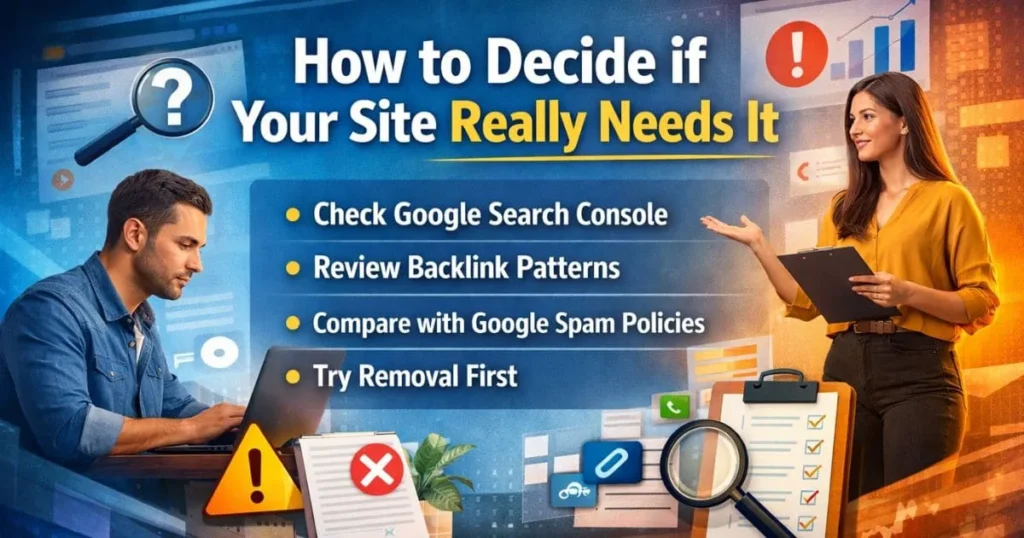
The first check is simple. Look for a manual action. If there is no manual action, do not assume every ranking decline is a link problem. Google spam policies allow both automated systems and human review to take action against policy violations, so knowing whether your site has an official manual issue changes the whole recovery path.
Review patterns, not single links
A useful backlink review asks these questions:
• Is there a large volume of manipulative anchors
• Are the referring domains clearly irrelevant
• Do many links appear sitewide or on thin pages
• Do the links look paid, exchanged, or machine placed
• Did the pattern begin during an old link building campaign
This kind of review is closer to Google’s policy based approach than a surface scan of metrics.
Compare the evidence with Google spam policies
Google’s spam policies focus on tactics that manipulate search systems. That includes deceptive practices and link related abuse that aim to influence rankings in an artificial way. If the links pointing to your site clearly fit that kind of pattern, the case for cleanup becomes stronger. If they do not, the case becomes weaker.
Try removal first
Google’s help pages are explicit about this. If you can get a backlink removed, make a good faith effort to remove it first. That matters even more when a site may need to file a reconsideration request. Removal shows real cleanup work. A file alone is not the same thing as effort backed by documentation.

Benefits of using the tool in the right situation
What the tool can help with
Used carefully, the tool can support a cleaner backlink profile and a more credible recovery process. Its main value is not speed. Its value is precision.
• It helps separate your site from manipulative link patterns
• It supports manual action cleanup
• It gives structure to a backlink audit
• It reduces dependence on old low quality links
• It helps align recovery work with Google’s published guidance
These benefits are strongest when the backlink issue is real and documented.
What it cannot do
It cannot fix weak content, poor service page quality, poor internal linking, or thin brand signals. It also cannot restore value that came from manipulative links once Google has removed that effect. That is why real recovery usually needs broader work across the site.
A practical strategy for 2026
Diagnose before you act
A smart process begins with diagnosis, not fear. Confirm whether there is a manual action, whether the backlinks actually violate policy, and whether the pattern is broad enough to matter. This reduces the chance of removing useful authority by mistake.
Build a review system
Group links by domain, anchor pattern, placement type, and likely source. A domain level review is often more useful than a page by page panic review, and Google specifically notes that the domain operator can be used in the file for multiple links from the same domain. That can keep the file cleaner and easier to manage.
Keep the file focused
The safest file is usually a narrow one. Include links that clearly appear manipulative, deceptive, or part of a larger spam pattern. Do not include real mentions simply because they come from modest sites. Google says incorrect use can harm your performance, so restraint matters.
Monitor the site after submission
After submission, watch the manual action report, ranking movement, organic clicks, and service page performance. For many sites, the file is only one part of the work. If the domain also has thin pages, weak topical depth, and poor trust signals, those issues still need attention. Link cleanup is a support measure, not a complete growth plan.
Checklist table for before and after submission
This checklist turns Google’s guidance into a practical working flow.
| Stage | Action | Why it matters |
|---|---|---|
| Before | Check for manual action | Confirms whether disavow is relevant |
| Before | Audit backlink patterns | Avoids guesswork |
| Before | Request link removals | Matches Google guidance |
| Before | Document cleanup work | Helps with reconsideration |
| After | Upload correct file | Prevents accidental damage |
| After | Monitor Search Console | Track manual action changes |
| After | Review traffic and rankings | Measure recovery trend |
| After | Improve site quality and trust | Recovery needs more than link cleanup |
Why broader SEO still matters
A backlink issue is rarely the only issue on a site. Strong SEO services are built on a combination of useful content, clear intent targeting, sound internal linking, and healthy trust signals. If those foundations are weak, removing bad links may clean the profile without improving overall visibility in a meaningful way.
The same principle applies to Local SEO services. Local rankings rely on relevance, trust, and consistency across local signals. A disavow file cannot replace complete business information, service page clarity, review quality, or location based topical relevance.
This also matters for businesses that promote several digital marketing services from one domain. If the site architecture is unclear, service intent overlaps, or category pages lack depth, the domain may struggle even after link cleanup. In other words, the file can support recovery, but it cannot stand in for a strong site structure.
For sites with a real link problem, Google Penalty Recovery often needs a broader process that combines backlink review, page quality improvements, trust repair, and smarter internal linking. That is why many businesses benefit more from a full recovery plan than from treating the file as a one click fix.
If a site has a manual action or a clear history of manipulative backlinks, this is where Google Penalty Recovery Services can become relevant as part of a structured cleanup path. The goal should be recovery based on evidence, not guesswork.
Common myths about the topic
Myth one: every bad looking backlink must be disavowed
Google does not say that. In fact, it says most sites do not need the tool. A few ugly links are not automatically a threat. Pattern and policy fit matter more than appearance.
Myth two: the tool fixes every ranking drop
This is not true. A ranking decline can come from content quality issues, stronger competitors, technical problems, or search system changes. Google’s own guidance on link spam updates also notes that removing spam link effects does not restore the lost value those links once passed.
Myth three: more disavow entries mean safer SEO
This idea often creates damage. Google warns that incorrect use can hurt site performance and also says site owners should avoid disavowing organic links. A focused file is usually safer than a broad one.
Conclusion
So, should you use the Disavow Tool in 2026? For most sites, no. Google says most websites will not need it, and its spam systems already work to handle many low value link situations. But if your site has a manual action, a documented pattern of artificial backlinks, or a serious inherited link problem, the tool can play a useful role inside a broader recovery plan. The best approach is careful review, good faith removal work, a focused file, and stronger page quality across the site.
FAQ
Q: Do most websites need the Disavow Tool in 2026?
Ans: No. Google says most sites will not need it because Google can often assess which links to trust without extra input. The main use case is a large number of spammy or artificial links tied to manual action risk.
Q: Can bad backlinks still hurt rankings in 2026?
Ans: They can in some circumstances, especially when they are part of a manipulative pattern that violates Google spam policies or leads to a manual action. At the same time, Google says it works hard to reduce the impact of harmful third party actions.
Q: Should I disavow links from scraper sites?
Ans: Not automatically. Random scraper links are often part of normal web noise. What matters more is whether there is a broader manipulative pattern and whether the links raise real policy concerns.
Q: Do I need to remove links before I disavow them?
Ans: Google says yes where possible. It asks site owners to make a good faith effort to remove links first, especially in manual action cleanup. A file should support removal work, not replace it.
Q: Can the tool restore rankings after spammy links lose value?
Ans: Not by itself. Google says when spam link effects are removed, any ranking value those links once passed cannot be regained. The file can support cleanup, but recovery usually depends on broader site quality as well.
Q: Is the tool enough for Google Penalty Recovery?
Ans: Usually no. A real Google Penalty Recovery process may also require manual link review, documentation, content improvements, better internal linking, and stronger trust signals across the site.