Search is changing fast. People no longer depend only on standard search results to find information. They ask questions on Google, use AI Overviews, search through ChatGPT, compare answers on Perplexity, speak to voice assistants and expect clear answers within seconds.
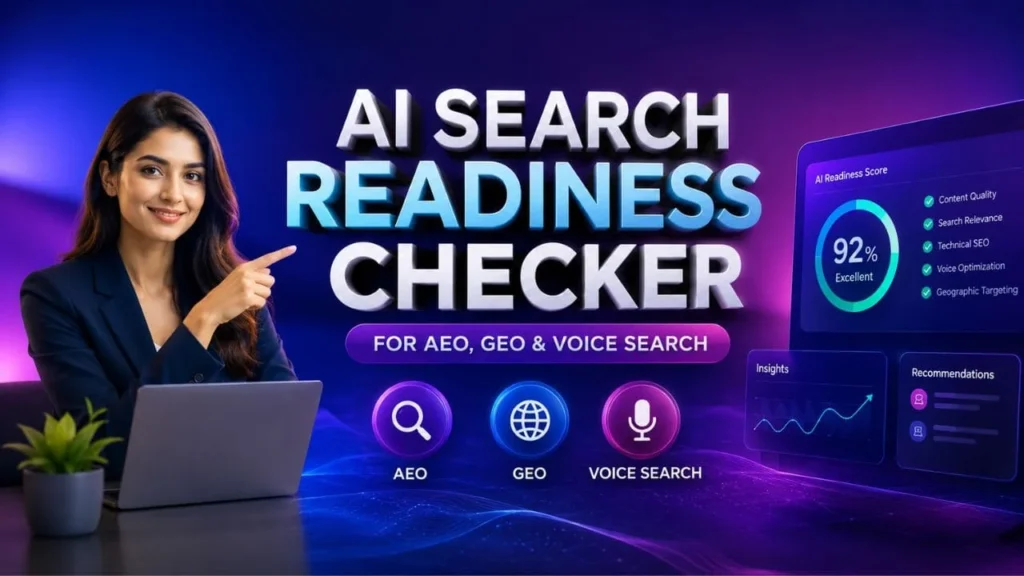
This means your website content must do more than rank for keywords. It must be easy to crawl, easy to understand, easy to summarize and useful enough for search engines and AI systems to trust. An AI Search Readiness Checker helps you review whether your website is prepared for this new way of search.
Google explains that AI features in Search are built to help users find information in helpful ways, while standard SEO fundamentals still matter for visibility. Google also states that mobile first indexing means the mobile version of a page is mainly used for indexing and ranking. That makes technical quality, mobile usability, structured data and content clarity very important for modern SEO planning.
Table of Contents
What Is an AI Search Readiness Checker?
An AI Search Readiness Checker is a website audit tool that reviews whether a page is ready for AI search engines, answer engines, generative engines and voice search.
It checks how well your content can be found, understood, extracted and presented by modern search systems. Instead of only looking at keywords, it reviews important areas such as:
- Content structure
- Heading clarity
- Schema markup
- Mobile usability
- Core Web Vitals
- Crawl access
- Entity signals
- FAQ readiness
- Voice search answers
- AEO and GEO readiness
Why AI Search Readiness Matters
Traditional SEO is still important, but search results now include more direct answers, AI summaries and conversational responses. If your content is unclear, poorly structured or hard to crawl, it may struggle to appear in AI generated answers.
An AI Search Readiness Checker helps you find these problems before they affect visibility. It gives website owners, content writers and SEO teams a practical way to improve pages for Google SERP, AI search, voice search and answer based results.
How It Supports SEO AEO GEO and Voice Search
SEO Support
It helps you find common issues that affect SEO services, such as weak headings, thin content, missing internal links, slow pages and crawl problems.
AEO Support
It helps you create direct answers for featured snippets, People Also Ask results, voice search responses, and better Answer Engine Optimization performance.
GEO Support
It improves your content structure through Generative Engine Optimization so generative engines can understand your topic, brand, service and page intent.
Voice Search Support
It helps you write question based sections that match how people speak while searching.
| Area | Traditional SEO | AI Search Readiness |
|---|---|---|
| Main goal | Rank in search results | Get understood, cited and summarized |
| Content style | Keyword focused | Answer focused and entity rich |
| Technical need | Crawl and index pages | Crawl, parse, extract and validate meaning |
| Best format | Long form optimized content | Clear sections, FAQs, summaries and schema |
| User behavior | Click based search | Zero click answers, AI summaries and voice responses |
How AI Search Is Different From Traditional SEO
Traditional SEO focuses on ranking pages in search results. AI search focuses on understanding and summarizing information.
Your content must still be optimized for search engines, but it should also be prepared for answer engines and AI tools that read, process and summarize web pages.
Why Your Website Needs AI Search Readiness
Your website may already have good content, but that does not always mean it is ready for AI search. AI systems need clean signals. They look for clear answers, well marked information, trusted entities and technical access.
Search Queries Are Becoming More Conversational
Users now search with complete questions such as:
- What is the best way to check AI search readiness?
- How do I optimize my website for AI Overviews?
- Why is schema markup important for voice search?
- How can I make my website ready for ChatGPT search?
This is why your content must answer natural language questions clearly.
AI Tools Prefer Clear Structure
AI systems can process long content, but they work better when the page is well organized. A page with clear headings, short paragraphs, structured data and helpful summaries gives stronger signals than a page with vague sections.
Use:
- Short answers after important headings
- H2 and H3 headings with questions
- Tables for comparison
- Bullet points for steps
- FAQ sections for voice search
- Schema markup for machine readable context
Technical SEO Still Matters
AI search readiness does not replace Technical SEO. It depends on it.
If a page is slow, blocked by robots.txt, missing from the sitemap or poorly rendered on mobile, search engines may not process it properly. Google states that Core Web Vitals measure real user experience across loading, interactivity and visual stability, which makes them useful for both SEO and user satisfaction.
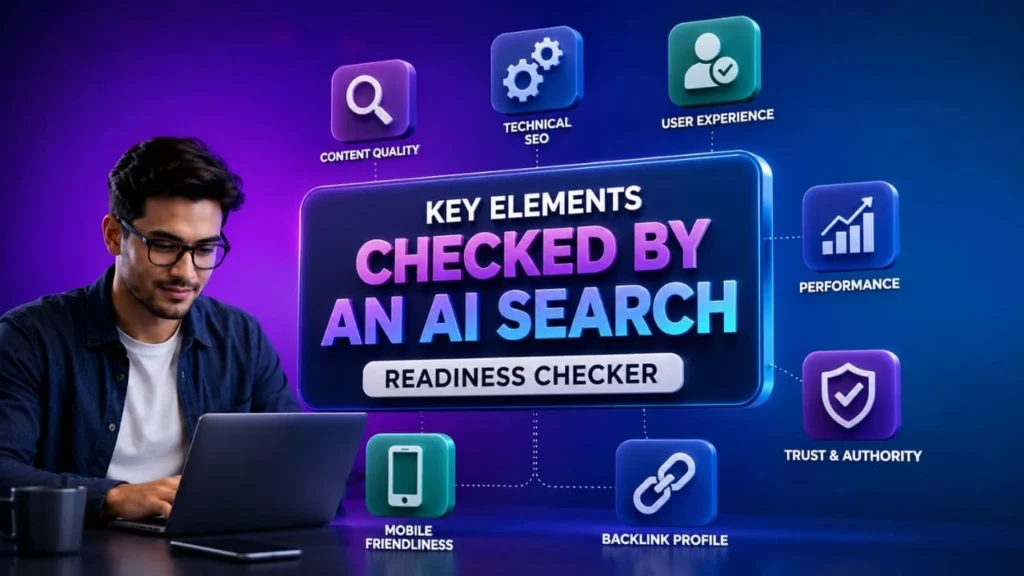
Key Elements Checked by an AI Search Readiness Checker
A proper AI Search Readiness Checker should review both content and technical signals. This helps you understand whether your page is ready for search engines, AI tools and voice assistants.
Heading Structure
Headings guide both readers and search engines. A weak heading structure makes your page harder to understand.
What to Check
- One clear H1
- Logical H2 sections
- Helpful H3 and H4 subsections
- Question based headings
- No repeated headings
- No vague headings such as Overview or More Details
Best Practice
Use headings that match user intent. For example, instead of writing “Important Details”, use “How Does AI Search Readiness Improve Visibility?”
Schema Markup
Schema markup helps search engines understand page meaning, while structured data AI AEO supports clearer content interpretation for search engines, answer engines, and AI powered search tools. Google says structured data can help it understand page content and the people, companies or items mentioned in the markup.
Schema Types to Consider
- Article schema
- FAQPage schema
- BreadcrumbList schema
- Organization schema
- LocalBusiness schema
- WebPage schema
- SoftwareApplication schema for tool pages
Why It Matters
Schema gives search engines extra context about your content. For AEO, GEO and voice search, this can help your page become easier to interpret.
Content Extractability
Content extractability means how easily search engines and AI tools can pull useful answers from your page.
Improve Extractability With
- Direct answers
- Summary boxes
- Tables
- Lists
- Definitions
- FAQs
- Clear topic flow
- Short paragraphs
Example Answer Format
Question: What is AI search readiness?
Answer: AI search readiness means your website is structured, crawlable and clear enough for AI search engines, answer engines and voice assistants to understand and use your content in responses.
Entity Clarity
Entities are people, brands, services, locations, tools and topics that help search systems understand context.
For Dakshraj Enterprise, the content should naturally connect entities such as:
- AI Search Readiness Checker
- AEO
- GEO
- Voice search
- Technical SEO
- Digital marketing services
- SEO services
- Local Seo services
- Social media marketing services
- Dakshraj Enterprise
- Kolkata
Clear entity signals help search systems understand what your page is about and how it connects to your services.
Mobile First Indexing and AI Search Readiness
Mobile first indexing is a major part of modern SEO. Since Google mainly uses the mobile version of content for indexing and ranking, your mobile page must contain the same useful content and signals as your desktop page.
Why Mobile First Indexing Matters
If your mobile version hides content, loads slowly or blocks important resources, your page may lose search visibility. This can also affect AI search readiness because AI systems depend on search crawlers and structured page data.
What to Check for Mobile First Indexing
- Mobile page content matches desktop content
- Headings are visible on mobile
- Internal links work properly
- Images have useful alt text
- Structured data is available on mobile
- Buttons and menus are easy to use
- Page speed is acceptable
- Layout does not shift while loading
Where Mobile First Technical SEO Services Help
Mobile first technical SEO services can help businesses fix hidden content, slow loading pages, poor mobile design, crawl issues and structured data errors. This is useful when your website has many service pages, blog posts or location based pages.
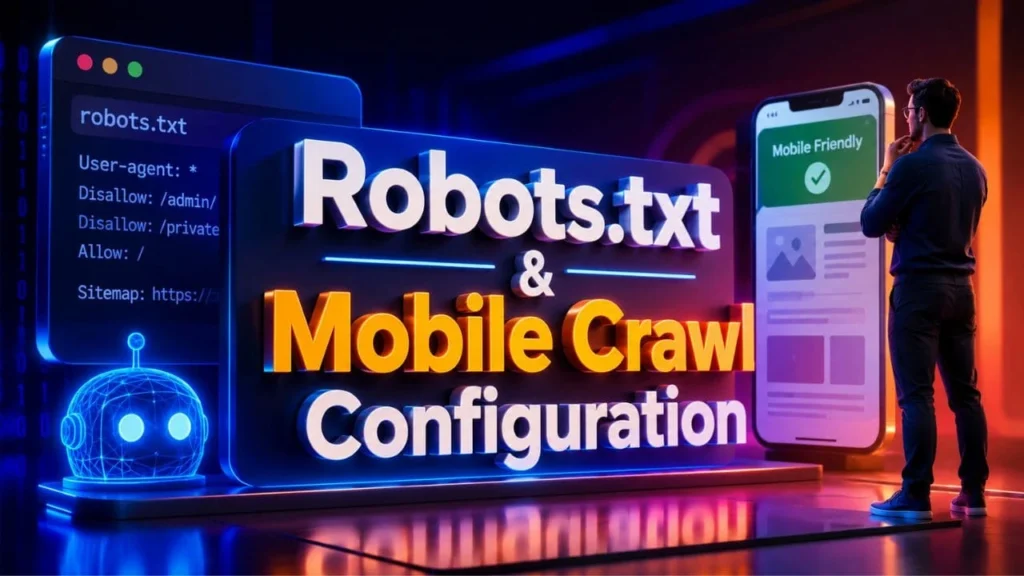
Robots.txt and Mobile Crawl Configuration
Your robots.txt configuration guide tells crawlers which areas of your site they can or cannot access. Google notes that robots.txt is used to manage crawler traffic, but it should not be used as a security method because crawler obedience can vary.
What to Review
- Important pages are not blocked
- CSS and JavaScript files are crawlable
- Mobile resources are accessible
- XML sitemap is included
- Staging or private URLs are not exposed
- AI crawlers are handled intentionally
- Crawl rules do not block important content
Why It Matters for AI Search
If crawlers cannot access your content or layout resources, search engines may not fully understand your page. That can reduce your chances of ranking in SERP, appearing in AI Overviews or being used in voice search answers.
Core Web Vitals Audit Checklist
Core Web Vitals measure real user experience. They are important because users expect fast and stable pages. They also help search engines understand whether your website provides a good page experience.
Practical Checklist
- Check Largest Contentful Paint
- Check Interaction to Next Paint
- Check Cumulative Layout Shift
- Compress large images
- Reduce unused JavaScript
- Improve server response time
- Use browser caching
- Avoid heavy third party scripts
- Test important landing pages
- Review mobile and desktop performance separately
Why This Helps AI Search Readiness
A fast and stable page improves user experience. It also supports SEO because search engines can crawl and process pages more efficiently.
Benefits of Using an AI Search Readiness Checker
An AI Search Readiness Checker gives you a practical view of what is working and what needs improvement.
Better Visibility Across Search Platforms
It helps you prepare content for:
- Google Search
- Google AI Overviews
- ChatGPT search
- Gemini
- Perplexity
- Copilot
- Voice assistants
- Featured snippets
- People Also Ask
Stronger AEO Performance
AEO focuses on direct answers. When your page includes clear definitions, FAQs and question based headings, it becomes easier for answer engines to use.
Better GEO Planning
GEO focuses on making your content understandable for generative engines. This includes better entity use, topic coverage, summary sections and structured data.
Improved Technical SEO
The tool can support Technical SEO by helping you review crawlability, mobile usability, schema, Core Web Vitals and page structure.
Better Content Decisions
You can use the results to improve content before publishing or updating an existing page. This reduces guesswork and helps your team focus on meaningful changes.
AI Search Readiness Strategy for Better Rankings
Ranking in search engines, AI search and voice search requires a balanced strategy. You need strong content, clean technical signals and helpful user focused answers.
Build Topic Clusters
Create supporting content around related topics such as:
- What is AEO?
- What is GEO?
- How does voice search work?
- How to optimize for AI Overviews?
- Why schema markup matters for AI search?
- How Technical SEO supports AI visibility?
Each supporting blog should link to the AI Search Readiness Checker target page.
Add Answer First Sections
Answer first content helps readers and search engines quickly understand your point.
Good Format
- Ask a direct question
- Give a clear answer in 40 to 60 words
- Add more detail below
- Include bullet points when useful
Use Internal Links With Purpose
Internal links help search engines understand page relationships. For this topic, link from related blog posts and service pages to your tool page.
Use anchors such as:
- AI Search Readiness Checker
- AI search readiness audit
- AEO and GEO checker
- voice search readiness tool
- Technical SEO audit tool
Connect With Relevant Services
Your content should naturally connect the topic with your services.
For example, Digital marketing services can support AI search readiness by combining content planning, SEO, social visibility and conversion focused updates.
SEO services can improve the foundation of your website by fixing on page issues, internal links, content gaps and keyword intent.
Technical SEO can make sure your site is crawlable, indexable, fast and structured for both search engines and AI systems.
Local Seo services can help location based businesses improve visibility in local search, Google Maps and voice searches with local intent.
Social media marketing services can support brand discovery, content sharing and audience trust, which can indirectly strengthen online visibility.
| Readiness Area | What to Check | Why It Matters |
|---|---|---|
| Crawlability | Robots.txt, sitemap, index tags | AI and search crawlers need access |
| Structure | H1, H2, H3, FAQs, tables | Helps answer engines extract meaning |
| Schema | Article, FAQ, Breadcrumb, Organization | Gives machine readable context |
| Mobile SEO | Mobile first indexing, speed, UX | Google mainly uses mobile content |
| Content quality | Clear answers, entities, freshness | Improves AI citation potential |
| Voice search | Conversational questions and short answers | Helps users asking spoken queries |
Practical AI Search Readiness Checklist
Use this checklist before publishing or updating important pages.
Common AI Search Readiness Issues
Many websites struggle with AI visibility because their content, technical setup and duplicate content issues are not properly aligned.
Weak Heading Structure
If headings are vague, repeated or poorly arranged, search engines may find it harder to understand your page.
Missing Schema Markup
Without schema, your page may lose useful machine readable context.
Thin Content
Thin content does not fully answer the user query. It may mention the topic but fail to explain benefits, steps, problems and solutions.
Poor Mobile Experience
Slow loading, hidden content and unstable layouts can hurt both users and search visibility.
Crawl Restrictions
Wrong robots.txt rules can block important resources. This can stop search engines from reading your page correctly.
Voice Search Optimized Questions
Voice search works best when your content answers natural questions.
What Is an AI Search Readiness Checker?
An AI Search Readiness Checker is a tool that checks whether your website is ready for AI search, AEO, GEO and voice search. It reviews content structure, schema, crawlability, mobile usability and answer clarity.
How Do I Know If My Website Is Ready for AI Search?
Your website is ready for AI search when it has clear answers, structured headings, valid schema, fast mobile performance, crawlable pages and strong topic coverage.
Can AI Search Readiness Improve Voice Search?
Yes, it can help. Voice search depends on clear and direct answers. If your content includes question based headings, FAQs and short responses, it becomes easier for voice assistants to use.
Is Technical SEO Important for AI Search?
Yes. Technical SEO helps search engines crawl, render and understand your website. Without a strong technical base, even good content may not perform well.
Suggested Schema Markup
For this blog post, use:
Article Schema
Use this for the main blog content.
FAQPage Schema
Use this for the FAQ section.
BreadcrumbList Schema
Use this to show page hierarchy.
Organization Schema
Use this to support Dakshraj Enterprise brand signals.
WebPage Schema
Use this to define the page type and main topic.
SoftwareApplication Schema
Use this on the target tool page for the AI Search Readiness Checker.
FAQ
What is an AI Search Readiness Checker?
An AI Search Readiness Checker is a tool that reviews whether a website page is ready for AI search engines, answer engines, generative engines and voice search. It checks content, schema, headings, crawlability, mobile usability and technical signals.
Why is AI search readiness important?
AI search readiness is important because users now receive answers from AI Overviews, voice assistants and generative search tools. Your content must be clear, structured and easy to understand.
How does AI search readiness help AEO?
It helps AEO by improving direct answers, FAQs, heading structure and schema markup. These elements make it easier for answer engines to extract useful responses.
How does AI search readiness help GEO?
It helps GEO by improving entity clarity, topic depth, structured content and brand context. This helps generative engines understand what your page is about.
Does mobile first indexing affect AI search visibility?
Yes. Since Google mainly uses the mobile version of content for indexing and ranking, your mobile page must be complete, fast and crawlable.
What role does robots.txt play in AI search readiness?
Robots.txt helps manage crawler access. If important pages, CSS or JavaScript files are blocked, search engines may not fully understand your content.
Is schema markup required for AI search?
Schema markup is not the only factor, but it helps search engines understand content better. It is useful for SEO, AEO, GEO and rich result readiness.
How often should I check AI search readiness?
Check it whenever you publish a new page, update an important blog, redesign your website, add schema or change your technical SEO setup.
Conclusion
AI search is changing how users find information online. Ranking in traditional search is still important, but your content must also be ready for AI Overviews, answer engines, voice assistants and generative search platforms.
An AI Search Readiness Checker helps you understand whether your page is structured, crawlable, mobile friendly and clear enough for modern search systems. It can guide improvements in content quality, schema markup, Technical SEO, mobile first indexing, Core Web Vitals and voice search optimization.
Before updating your next blog post, service page or landing page, test it with the AI Search Readiness Checker and improve the areas that matter most for SEO, AEO, GEO and voice search visibility.