Video content has become one of the most powerful assets in digital marketing. Whether you publish product demonstrations, educational tutorials, webinars, customer testimonials, or brand awareness campaigns, video helps engage audiences in ways that text alone often cannot. However, creating quality video content is only part of the equation. Search engines must be able to discover, understand, and index your videos before they can appear in search results.
This is where video sitemap SEO becomes essential.
Many marketers invest significant resources in video production but overlook the technical SEO elements that help search engines find and rank those videos. As a result, valuable content remains invisible to potential viewers despite its quality and relevance.
A properly implemented video sitemap provides search engines with detailed information about your videos, making it easier for them to crawl, understand, and display your content in search results. It can also improve video indexing, support rich search features, and strengthen your overall video SEO strategy.
As search evolves beyond traditional results and incorporates AI generated answers, visual search, and voice search experiences, the importance of structured video discovery continues to grow. Businesses that optimize video content effectively are better positioned to gain visibility across multiple search platforms.
In this guide, you will learn how video sitemap SEO works, why it matters, how search engines index videos, and how a properly configured XML video sitemap can improve your digital marketing performance.
Table of Contents
What Is Video Sitemap SEO?
Understanding Video Sitemaps
A video sitemap is a specialized sitemap designed to provide search engines with information about video content available on your website.
Unlike a standard XML sitemap that focuses on webpages, a video sitemap includes metadata specifically related to videos. This additional information helps search engines understand the content, purpose, and location of each video.
Video sitemap SEO refers to the process of optimizing video discovery and indexing through the strategic implementation of video sitemaps and supporting metadata.
The goal is simple: help search engines discover your videos faster and understand them more accurately.
Without this information, search engines may struggle to identify video content, especially when videos are embedded using complex scripts, hosted through third party platforms, or loaded dynamically.
A video sitemap provides clear signals that improve visibility and support stronger search performance.
Why Video Discovery Matters?
Search engines cannot rank content they cannot find.
Even the most informative video has limited value if it remains undiscovered by search crawlers. Video discovery plays a critical role in determining whether your content appears in search results, video carousels, AI generated summaries, and featured search experiences.
When your videos are easily discoverable, they gain more opportunities to generate:
- Organic traffic
- Brand visibility
- User engagement
- Lead generation
- Conversion opportunities
This is why video sitemap SEO has become an important component of modern digital marketing strategies.
What Is an XML Video Sitemap?
An XML video sitemap is a machine readable file that provides search engines with structured information about videos hosted on your website.
The sitemap contains metadata that helps search engines understand:
| Metadata Element | Purpose |
| Video title | Identifies the video topic |
| Description | Explains video content |
| Thumbnail URL | Provides preview image |
| Video location | Shows where the video exists |
| Landing page URL | Associates video with webpage |
| Duration | Indicates content length |
| Publication date | Helps determine freshness |
This information enables search engines to process video content more efficiently.
Instead of relying solely on crawling and interpretation, search engines receive direct guidance about the video and its context.
The result is often faster discovery and improved video indexing.
Standard Sitemap vs XML Video Sitemap
Many website owners assume their regular XML sitemap is enough.
However, there is a significant difference.
| Standard XML Sitemap | XML Video Sitemap |
| Lists webpages | Lists video content |
| Focuses on URLs | Focuses on videos and URLs |
| Basic indexing signals | Detailed video metadata |
| Limited video information | Rich video specific data |
| General SEO support | Enhanced video SEO support |
For websites that rely heavily on video content, using an XML video sitemap provides a stronger foundation for visibility.
How Search Engines Use Video Sitemaps
- Search engines continuously crawl the web looking for new and updated content.
- When a video sitemap is available, it acts as a roadmap that guides crawlers directly to video resources.
- The process typically follows several stages.
Discovery
Search engines identify the sitemap through:
- Search Console submissions
- Robots.txt references
- Internal discovery mechanisms
Processing
The crawler reads the metadata contained in the sitemap.
This information helps determine:
- Video relevance
- Topic alignment
- Content freshness
- User value
Validation
Search engines verify that:
- Videos are accessible
- Metadata is accurate
- Landing pages exist
- Thumbnails function properly
Indexing
Once validated, the video becomes eligible for indexing and potential inclusion in video search features.
This streamlined process demonstrates why video sitemap SEO can improve visibility compared to relying solely on standard crawling.
Why Video Sitemap SEO Matters for Digital Marketing?
- Digital marketing is increasingly dependent on multimedia content.
- Consumers expect visual experiences, and businesses are producing more video content than ever before.
- The challenge is ensuring those videos generate measurable results.
- An effective video sitemap SEO strategy helps bridge the gap between content creation and search visibility.
Key Benefits of Video Sitemap SEO
| Benefit | Marketing Impact |
| Faster video discovery | Improved visibility |
| Better video indexing | Increased search presence |
| Enhanced video SEO | Higher ranking opportunities |
| Rich result eligibility | Better click through rates |
| Improved engagement | More user interaction |
Increased Organic Visibility
When search engines understand your videos, they can display them in more places.
These opportunities may include:
- Video search results
- Universal search results
- Featured snippets
- Video rich results
- AI generated search experiences
The broader your visibility, the greater your potential reach.
Better User Engagement
- Videos often generate stronger engagement metrics than text based content.
- Visitors frequently spend more time on pages containing relevant videos.
Higher engagement signals can support:
- Longer session duration
- Improved user satisfaction
- Increased conversions
- Better audience retention
A strong video SEO strategy supported by video sitemaps helps maximize these benefits.
Improved Search Performance
Search engines aim to deliver the most useful content for every query.
When video content is properly indexed and optimized, it can compete for valuable search positions alongside traditional webpage listings.
This creates additional opportunities to attract traffic from highly targeted searches.
Video Sitemap SEO and AI Search
- Search is changing rapidly.
- AI powered search engines increasingly rely on structured information to understand and summarize content.
- Videos are becoming important sources of information within these ecosystems.
Structured metadata provided through video sitemap SEO helps AI systems interpret:
- Video topics
- Content relevance
- Publication dates
- User intent alignment
The clearer the signals you provide, the easier it becomes for AI systems to reference and surface your content.
Why AI Systems Prefer Structured Content
AI search platforms analyze large amounts of information.
Structured metadata improves accuracy and context.
Video sitemaps contribute by supplying:
- Clear content descriptions
- Topic classifications
- Content ownership information
- Accessibility signals
As AI search continues to evolve, structured video optimization is likely to become increasingly important.
Video Sitemap SEO and Voice Search
- Voice search continues to influence how users discover information.
- Many voice assistants pull answers from highly structured content sources.
- Although voice responses are often text based, videos frequently support the content ecosystem that powers these responses.
Video metadata helps search engines better understand:
- User intent
- Topical relevance
- Content authority
- Contextual relationships
This makes video sitemap SEO a valuable component of voice search readiness.
How Video Indexing Works?
- Understanding video indexing is essential for improving search visibility.
- Many marketers focus exclusively on rankings while overlooking the indexing stage.
- However, ranking cannot occur until indexing happens.
What Is Video Indexing?
- Video indexing is the process through which search engines analyze, understand, and store information about video content in their databases.
- Once indexed, a video becomes eligible to appear in search results.
- If a video is not indexed, it generally cannot compete for visibility regardless of its quality.
Why Video Indexing Matters
Effective video indexing enables:
- Search visibility
- Rich search features
- Enhanced discoverability
- Increased traffic opportunities
- Better content distribution
For digital marketers, indexing represents the gateway to organic performance.
How Search Engines Discover Video Content
- Search engines use multiple methods to locate videos.
- Understanding these discovery channels helps improve optimization efforts.
Through Website Crawling
- Search engine bots regularly crawl websites looking for new content.
- Videos embedded on accessible webpages may be discovered during this process.
- However, discovery is not always guaranteed.
Challenges include:
- JavaScript rendering issues
- Hidden content
- Poor site architecture
- Complex embedding methods
This is one reason why video sitemap SEO remains important.
Through XML Video Sitemap Submission
- An XML video sitemap provides a direct path to video content.
- Instead of relying solely on crawling, search engines receive explicit instructions about available videos.
- This often improves efficiency and supports faster indexing.
Through Structured Data
Video schema markup supplies additional context.
Search engines use structured data to better understand:
- Video topics
- Duration
- Publication information
- Thumbnail assets
Combining schema markup with video sitemaps creates stronger optimization signals.
Through Internal Linking
- Internal links help search engines navigate between related content.
- Videos linked from relevant pages are generally easier to discover than isolated content.
Strong internal linking improves:
- Crawl efficiency
- Topic relevance
- User navigation
- Content relationships
Common Reasons Videos Fail to Get Indexed
- Many websites publish videos that never achieve proper indexing.
- Understanding the common causes can help prevent these issues.
Missing Video Metadata
- Incomplete metadata creates uncertainty for search engines.
- Missing titles, descriptions, thumbnails, and publication dates can negatively impact indexing.
Poor Landing Page Quality
- Search engines evaluate the page hosting the video.
- Weak content surrounding the video may reduce indexing potential.
Blocked Resources
If search engines cannot access video files, thumbnails, or supporting resources, indexing becomes difficult.
Duplicate Content Issues
Duplicate video pages can confuse search engines and dilute indexing signals.
Lack of Video Sitemap SEO
- Many indexing problems stem from the absence of a properly configured video sitemap.
- Without a clear roadmap, search engines may overlook valuable video assets entirely.
- Implementing a comprehensive video sitemap SEO strategy helps eliminate many of these barriers and improves the likelihood that your content will be discovered and indexed efficiently.
Essential Components of an XML Video Sitemap
A successful video sitemap SEO strategy starts with providing search engines with accurate and complete metadata. The more information search engines receive about your videos, the easier it becomes for them to understand and index the content correctly.
An XML video sitemap contains several important elements that describe your videos and their relationship to the hosting webpage.
Core Elements of an XML Video Sitemap
| Element | Purpose |
| Video Title | Defines the topic of the video |
| Description | Explains the content of the video |
| Thumbnail URL | Displays preview image in search results |
| Landing Page URL | Identifies the webpage hosting the video |
| Content URL | Shows the actual video file location |
| Duration | Indicates video length |
| Publication Date | Provides freshness signals |
| Category | Helps define content context |
| Tags | Adds topical relevance |
Each of these elements contributes to better video indexing and stronger video SEO performance.
Mandatory Video Metadata
Video Title
The title is one of the most important optimization elements.
A good video title should:
- Clearly describe the topic
- Include primary keywords naturally
- Match user search intent
- Encourage engagement
Search engines use the title to understand the primary subject of the video.
Video Description
Descriptions provide additional context.
A strong description should:
- Summarize the video accurately
- Include relevant keywords naturally
- Explain the value provided
- Support topical relevance
Detailed descriptions help strengthen video sitemap SEO by providing search engines with more information about the content.
Thumbnail URL
Thumbnails play a major role in attracting clicks. Search engines often display thumbnails alongside video results.
High quality thumbnails should:
- Be visually appealing
- Represent the video accurately
- Maintain proper dimensions
- Load correctly across devices
Video Location
Search engines need access to the video itself.
This can be provided through:
- Content URL
- Player URL
Accurate video locations improve crawlability and support efficient indexing.
Recommended Video Metadata
Although some elements are optional, they provide valuable context that can improve visibility.
Duration
- Duration helps search engines understand the scope of the content.
- Users may also prefer certain video lengths depending on their needs.
Publication Date
- Freshness can influence visibility for time sensitive topics.
- Providing publication dates helps search engines understand content recency.
Category
Categories create additional context and improve topical classification.
Tags
Tags support semantic understanding and can reinforce relevance for related searches.
How to Create an XML Video Sitemap
Implementing an XML video sitemap does not have to be complicated. The approach depends largely on the size of your website and the volume of video content you publish.
Manual XML Video Sitemap Creation
For smaller websites, manual creation may be sufficient.
The process typically involves:
- Listing all video URLs
- Adding required metadata
- Creating the XML structure
- Validating the sitemap
- Uploading the file to the server
Manual creation offers complete control but becomes difficult as video libraries grow.
CMS Generated Video Sitemaps
Many content management systems offer automated sitemap generation.
Benefits include:
- Faster implementation
- Automatic updates
- Reduced maintenance
- Improved accuracy
For businesses producing regular video content, automation often provides a more scalable solution.
Plugin Based Sitemap Generation
Many website owners use plugins to create and maintain video sitemaps.
Advantages include:
- Simplified setup
- Automatic metadata collection
- Scheduled updates
- Reduced technical complexity
Plugins can be particularly useful for marketing teams with limited development resources.
Enterprise Video Sitemap Solutions
Large websites often require advanced solutions.
Enterprise level sitemap management may include:
- Automated sitemap generation
- Dynamic updates
- Multi language support
- Large scale video management
- Advanced reporting
For organizations managing hundreds or thousands of videos, enterprise solutions can significantly improve operational efficiency.
Best Practices for Video Sitemap SEO
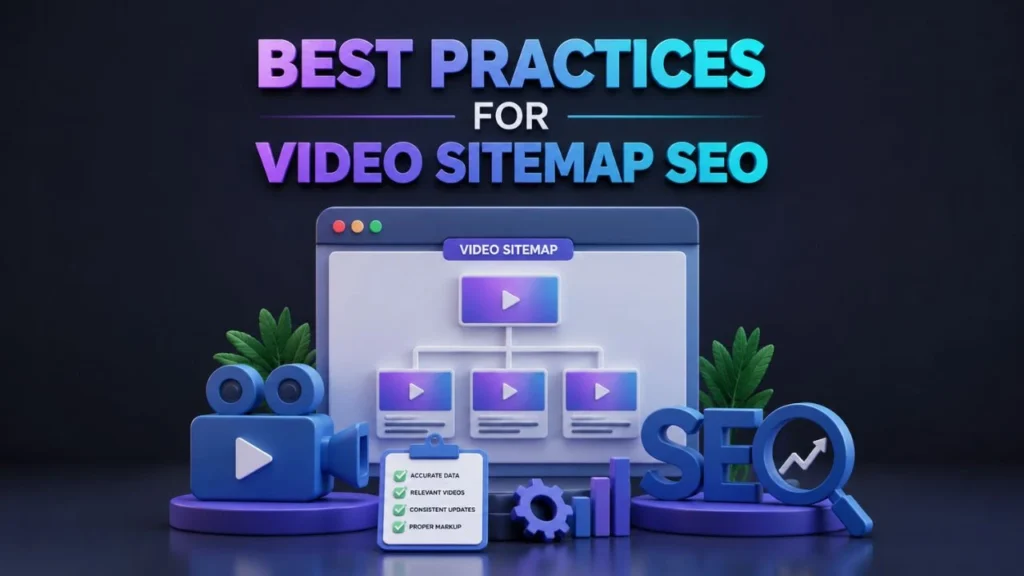
Creating a sitemap is only the first step. To maximize results, you need to follow proven video sitemap SEO best practices.
Use Unique Metadata for Every Video
Duplicate titles and descriptions can create confusion.
Each video should have:
- Unique title
- Unique description
- Distinct thumbnail
- Individual landing page
Unique metadata improves content differentiation and supports stronger rankings.
Optimize Video Landing Pages
Search engines evaluate both the video and the page hosting it.
A high quality landing page should include:
- Relevant written content
- Supporting headings
- Internal links
- Clear topic focus
- Strong user experience
When video pages provide additional value, indexing and ranking opportunities often improve.
Maintain Accurate Video Information
Metadata should remain current and accurate. Outdated information can reduce trust and affect search visibility.
Review periodically:
- Titles
- Descriptions
- URLs
- Thumbnails
- Categories
Consistency supports long term video SEO success.
Use High Quality Thumbnails
Thumbnails frequently influence click through rates.
Best practices include:
- Clear imagery
- Strong visual contrast
- Relevant content representation
- Mobile friendly design
Even when rankings remain constant, improved thumbnails can increase traffic.
Update XML Video Sitemap Regularly
Search engines favor fresh information.
Whenever new videos are published:
- Add them to the sitemap
- Verify metadata
- Resubmit if necessary
Regular updates help maintain efficient video indexing.
Avoid Broken URLs
Broken video URLs create negative signals.
Check regularly for:
- Missing video files
- Invalid thumbnails
- Redirect errors
- Landing page issues
Technical maintenance is an important component of video sitemap SEO.
Strengthen Internal Linking
Internal linking improves both user navigation and crawlability.
Consider linking videos from:
- Related blog posts
- Resource hubs
- Category pages
- Educational content clusters
Strong internal architecture helps search engines discover video content more efficiently.
Video Sitemap SEO and Schema Markup
- Many marketers focus exclusively on sitemaps and overlook structured data.
- While sitemaps help search engines discover videos, schema markup helps them understand those videos.
- Together, they create a powerful optimization framework.
Why Structured Data Matters
Structured data provides machine readable information about content.
For videos, schema can communicate:
- Topic
- Duration
- Publication date
- Thumbnail information
- Content creator
- Video location
This additional context supports richer search experiences.
Understanding VideoObject Schema
VideoObject schema is one of the most important structured data formats for video content.
It helps search engines identify critical video information and increases eligibility for enhanced search features.
Key properties often include:
| Schema Property | Purpose |
| Name | Video title |
| Description | Video summary |
| Thumbnail URL | Preview image |
| Upload Date | Publication date |
| Duration | Video length |
| Content URL | Video file location |
| Embed URL | Video player URL |
When implemented correctly, schema strengthens video SEO and improves search understanding.
Combining Schema Markup and XML Video Sitemap
- Some marketers ask whether they should use schema or a video sitemap.
- The answer is both.
- Each serves a different purpose.
| Optimization Method | Primary Function |
| XML Video Sitemap | Discovery |
| Video Schema | Understanding |
| Internal Linking | Crawlability |
| Metadata Optimization | Relevance |
| Content Quality | User value |
Using both approaches creates stronger optimization signals than relying on either one individually.
Benefits of Combining Both Strategies
When schema markup and video sitemap SEO work together, businesses often experience:
- Improved video discovery
- Faster indexing
- Better metadata interpretation
- Rich result eligibility
- Enhanced search visibility
This combined approach aligns well with modern search engine requirements.
How to Submit an XML Video Sitemap
- Creating a sitemap is only useful if search engines can find it.
- Proper submission ensures faster processing and better visibility.
Submit Through Search Console
Search Console remains one of the most effective methods for sitemap submission.
Benefits include:
- Faster discovery
- Error reporting
- Indexing insights
- Performance monitoring
After submission, monitor processing status regularly.
Add Sitemap Reference to Robots.txt
- Another best practice involves referencing the sitemap within your robots.txt file.
- This helps search engines locate sitemap resources efficiently during crawling.
- A properly configured robots.txt file supports stronger video sitemap SEO implementation.
Monitor Sitemap Status
- Submitting a sitemap is not a one time activity.
- Regular monitoring helps identify issues before they impact performance.
Watch for:
- Processing errors
- Missing videos
- Crawl problems
- Validation issues
Early detection often prevents larger indexing challenges.
Validate Sitemap Quality
Before submission, validate your sitemap carefully.
Check for:
- XML formatting errors
- Missing metadata
- Broken URLs
- Invalid thumbnails
- Duplicate entries
A clean sitemap improves search engine trust and increases indexing efficiency.
Advanced Video Sitemap SEO Strategies
- As competition increases, advanced optimization techniques become more important.
- Businesses seeking stronger visibility should move beyond basic implementation.
Build Video Content Clusters
- Search engines increasingly evaluate topical authority.
- Creating related videos around a central topic can strengthen relevance.
For example, a digital marketing website may create video clusters covering:
- Technical SEO
- Content marketing
- Link building
- Analytics
- Local SEO
Topic clusters help establish expertise and support broader visibility.
Optimize for Search Intent
Successful video SEO aligns with user intent.
Before creating videos, identify:
- Informational intent
- Commercial intent
- Transactional intent
- Navigational intent
Matching content to intent improves engagement and ranking potential.
Use Entity Based Optimization
Search engines increasingly rely on entities rather than simple keywords.
Video metadata should clearly reference:
- Topics
- Concepts
- Products
- Services
- Industry terminology
Entity optimization improves contextual understanding and supports AI search visibility.
Enhance Semantic Relevance
Semantic optimization involves covering related concepts comprehensively.
For example, a video about video indexing may also reference:
- Crawling
- Search visibility
- Metadata
- Structured data
- XML video sitemap
This broader context helps search engines understand content depth and expertise.
Prepare for AI Search Visibility
AI driven search experiences prioritize content that is:
- Well structured
- Authoritative
- Comprehensive
- Accurate
- Easy to interpret
A strong video sitemap SEO framework contributes to these goals by improving content accessibility and discoverability.
As AI search continues to evolve, businesses that prioritize structured optimization will likely gain a competitive advantage.
Measuring Video Sitemap SEO Success
Implementing an effective video sitemap SEO strategy is only the beginning. To understand whether your efforts are producing results, you need to track performance and analyze key metrics regularly.
Measuring success helps you identify what is working, uncover optimization opportunities, and make data-driven decisions that improve your overall digital marketing strategy.
The goal is not simply to get videos indexed. The goal is to ensure those videos contribute to visibility, engagement, and business growth.
Key Performance Indicators for Video Sitemap SEO
Several metrics can help evaluate the effectiveness of your optimization efforts.
| KPI | Why It Matters |
| Indexed Videos | Measures successful video discovery |
| Video Impressions | Indicates search visibility |
| Video Clicks | Reflects user interest |
| Click Through Rate | Measures listing effectiveness |
| Watch Time | Indicates engagement quality |
| Organic Traffic | Shows SEO impact |
| Conversions | Connects visibility to business outcomes |
Monitoring these metrics consistently allows marketers to understand the real value of their video SEO initiatives.
Monitor Video Indexing Performance
- One of the first metrics to review is the number of indexed videos.
- If videos are not appearing in search engine indexes, they cannot generate organic visibility.
Regularly evaluate:
- Indexed video count
- Newly discovered videos
- Excluded videos
- Crawling issues
- Processing delays
Strong video indexing performance indicates that your sitemap and supporting technical SEO elements are functioning correctly.
Analyze Search Visibility
Visibility metrics reveal how frequently your videos appear in search results.
Important indicators include:
- Impressions
- Ranking positions
- Video rich result appearances
- Search result coverage
Increasing visibility often signals that your video sitemap SEO strategy is helping search engines better understand and surface your content.
Evaluate User Engagement
Search visibility is important, but engagement ultimately determines whether visitors find value in your content.
Key engagement metrics include:
- Watch duration
- Average engagement time
- Bounce rate
- Return visits
- Content interactions
High engagement frequently indicates strong alignment between user intent and video content.
Measure Business Impact
Video content should contribute to broader marketing objectives.
Track outcomes such as:
- Lead generation
- Form submissions
- Newsletter signups
- Product inquiries
- Sales conversions
Connecting video performance to business goals helps demonstrate the long term value of investing in video SEO and sitemap optimization.
Using Search Console for Video Performance Analysis
Search Console provides valuable insights into how search engines interact with your videos.
It can help identify:
- Indexing status
- Sitemap processing
- Crawling issues
- Search performance trends
Regular analysis allows marketers to respond quickly when issues arise.
Review Video Indexing Reports
Video indexing reports can reveal:
- Successfully indexed videos
- Videos requiring attention
- Missing metadata
- Processing failures
These reports often provide actionable insights that improve optimization efforts.
Monitor Sitemap Health
A healthy XML video sitemap should consistently process without major errors.
Review regularly for:
- Invalid URLs
- Missing required fields
- Unsupported formats
- Duplicate entries
Maintaining sitemap quality supports long term search visibility.
Identify Crawl Issues
Crawl problems can negatively affect video indexing.
Common issues include:
- Blocked resources
- Server errors
- Redirect chains
- Missing video files
Addressing these technical barriers can improve indexing efficiency and search performance.
Common Video Sitemap SEO Mistakes to Avoid

- Even experienced marketers can make mistakes that reduce visibility.
- Understanding common pitfalls can help protect your investment in video content.
Missing Required Metadata
One of the most frequent errors involves incomplete metadata.
Missing elements such as:
- Titles
- Descriptions
- Thumbnail URLs
- Video locations
can make it difficult for search engines to process content effectively.
Comprehensive metadata remains a fundamental component of successful video sitemap SEO.
Using Duplicate Metadata
Duplicate titles and descriptions can confuse search engines and reduce content differentiation.
Each video should have:
- Unique titles
- Unique descriptions
- Distinct thumbnails
- Dedicated landing pages
Unique metadata strengthens topical relevance and improves user experience.
Ignoring Landing Page Quality
- Search engines evaluate more than the video itself.
- A weak landing page can negatively impact visibility.
Effective video pages should include:
- Valuable supporting content
- Clear topic focus
- Relevant headings
- Internal links
- Strong user experience
High quality landing pages often contribute to stronger video SEO performance.
Failing to Update the XML Video Sitemap
- Many websites create a sitemap once and never revisit it.
- As content changes, outdated information can accumulate.
Regular updates ensure that search engines receive accurate information regarding:
- New videos
- Removed videos
- Updated metadata
- URL changes
Freshness supports efficient discovery and indexing.
Blocking Important Resources
Search engines need access to:
- Video files
- Thumbnails
- Landing pages
- Supporting assets
Blocked resources may prevent successful indexing. Review crawl permissions regularly to ensure accessibility.
Overlooking Structured Data
- While XML video sitemap implementation is valuable, it should not replace schema markup.
- Combining both approaches provides stronger signals and improves search engine understanding.
- Structured data continues to play a growing role in modern search ecosystems.
Weak Internal Linking
Videos hidden deep within a website are often more difficult for search engines to discover.
Strengthen visibility by linking videos from:
- Related blog posts
- Category pages
- Resource centers
- Topic clusters
Internal linking remains one of the most effective methods for improving crawlability.
Future of Video Sitemap SEO
- Search behavior continues to evolve.
- As technology advances, video content will play an even greater role in how information is discovered and consumed.
- Businesses that prepare today will be better positioned to benefit from future search opportunities.
AI Driven Search Experiences
- Artificial intelligence is reshaping search.
- AI powered platforms increasingly summarize information, answer questions directly, and surface multimedia content based on user intent.
Structured metadata provided through video sitemap SEO helps AI systems:
- Understand content context
- Identify relevant topics
- Interpret video information
- Surface appropriate content
As AI search expands, structured video optimization will likely become even more important.
Growth of Video Rich Results
Video rich results continue to gain visibility within search engines.
These enhanced listings often attract more attention than traditional text results.
Benefits include:
- Improved visibility
- Higher click through rates
- Better user engagement
- Increased traffic opportunities
A properly optimized XML video sitemap can help support eligibility for these features.
Visual Search Expansion
- Visual search technologies are becoming increasingly sophisticated.
- Users can now search using images, screenshots, and visual cues rather than traditional text queries.
- Video content may become more integrated into these experiences, making optimization increasingly valuable.
Voice Search and Multimedia Discovery
- Voice search continues to influence search behavior.
- Users increasingly expect fast, conversational answers.
- Video content often supports the information ecosystem that powers these responses.
- Structured video metadata helps search engines better understand content relationships and user intent.
- This strengthens the role of video sitemap SEO within voice search optimization strategies.
Entity Based Search Evolution
Search engines are moving toward entity driven understanding rather than relying solely on keywords.
Future optimization efforts should focus on:
- Topics
- Concepts
- Relationships
- Context
- Expertise
Entity optimization can improve both traditional search performance and AI search visibility.
Video Sitemap SEO Checklist
Use this checklist to evaluate your implementation and identify areas for improvement.
| Task | Status |
| Create XML video sitemap | □ |
| Add unique video titles | □ |
| Write optimized descriptions | □ |
| Include thumbnail URLs | □ |
| Verify video accessibility | □ |
| Optimize landing pages | □ |
| Add VideoObject schema | □ |
| Improve internal linking | □ |
| Submit sitemap to search engines | □ |
| Monitor indexing reports | □ |
| Update sitemap regularly | □ |
| Fix crawl errors | □ |
| Review performance metrics | □ |
| Optimize for AI search | □ |
| Improve user engagement | □ |
Regular audits can help maintain strong performance over time.
Conclusion
Video continues to be one of the most influential content formats in digital marketing. However, producing high quality videos is only part of the strategy. Search engines must be able to discover, understand, and index those videos before they can generate meaningful visibility and traffic.
This is where video sitemap SEO delivers substantial value.
A properly configured XML video sitemap helps search engines locate video content more efficiently, understand its context, and process important metadata that supports search visibility. When combined with schema markup, optimized landing pages, strong internal linking, and high quality content, video sitemaps become a powerful component of a modern video SEO strategy.
As AI search, voice search, and visual search continue to evolve, structured video optimization will become increasingly important. Businesses that invest in accurate metadata, efficient video indexing, and comprehensive sitemap management will be better positioned to capture visibility across both traditional and emerging search platforms.
Whether you manage a small business website or a large digital marketing platform, implementing a strong video sitemap SEO strategy can help your videos reach the audiences they deserve while supporting long term organic growth.
Frequently Asked Questions
What Is Video Sitemap SEO?
Video sitemap SEO is the process of optimizing video discovery and indexing by providing search engines with structured metadata about video content through a video sitemap.
What Is an XML Video Sitemap?
An XML video sitemap is a specialized XML file that contains information about videos hosted on a website, helping search engines discover and understand video content more efficiently.
Why Is Video Indexing Important?
Video indexing allows search engines to store and process information about your videos. Indexed videos can appear in search results, while non indexed videos generally cannot.
Does Every Website Need a Video Sitemap?
Any website that relies on video content for marketing, education, lead generation, or brand awareness can benefit from implementing a video sitemap.
Can Video Schema Replace a Video Sitemap?
No. Schema markup and video sitemaps serve different purposes.
A video sitemap helps search engines discover content, while schema markup helps them understand that content.
How Often Should an XML Video Sitemap Be Updated?
The sitemap should be updated whenever new videos are published, existing videos are modified, or video URLs change.
Can Video Sitemap SEO Improve Rankings?
While a sitemap alone does not guarantee higher rankings, it improves discovery, indexing, and understanding, all of which contribute to stronger video SEO performance.
Does Video Sitemap SEO Help AI Search Engines?
Yes. Structured metadata helps AI systems interpret video content more accurately, improving visibility across AI powered search experiences.
What Are the Most Common Video Indexing Problems?
Common issues include:
Missing metadata
Broken URLs
Blocked resources
Poor landing pages
Outdated sitemaps
Missing structured data
Addressing these problems can significantly improve video indexing outcomes.