Local businesses often need a steady flow of enquiries, calls, bookings, store visits, and service requests. But running ads without a proper system can waste money fast. Many businesses get form fills, but the leads may not respond, may be outside the service area, or may not be ready to buy. This is where a Meta Ads lead funnel becomes useful.
A well-planned funnel helps a business move people from awareness to interest, then from enquiry to follow-up and final conversion. It is not only about running Facebook or Instagram ads. It is about creating a clear path for a local customer who sees the ad, understands the service, shares details, and receives a timely response.
For local service providers, clinics, salons, consultants, real estate agents, contractors, and stores, a strong lead funnel can improve lead quality and reduce confusion in the sales process. The goal is simple: reach the right people, collect the right details, and follow up in the right way.
Table of Contents
What Is a Meta Ads Lead Funnel?
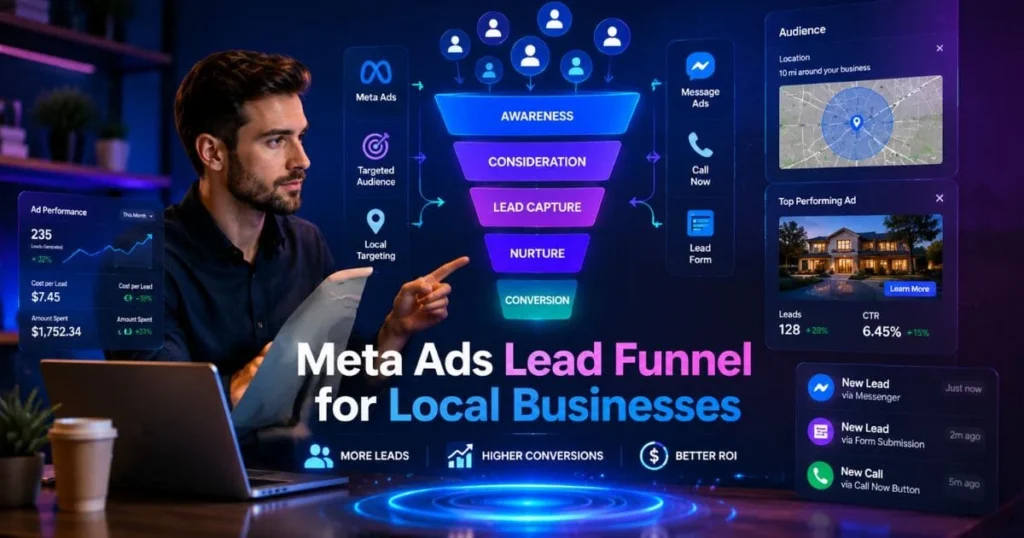
A Meta Ads lead funnel is a step-by-step advertising process that guides potential customers from seeing an ad to becoming a lead and finally taking action. That action may be booking an appointment, calling the business, visiting a store, sending a WhatsApp message, or filling out a form.
The funnel usually has four main stages:
- Awareness
- Interest
- Lead capture
- Follow-up and conversion
When these stages work together, local businesses can avoid depending on random ad clicks. Instead, they can build a structured process that attracts people who are more likely to need the service.
Why Local Businesses Need a Proper Lead Funnel
Many local businesses start ads with one simple goal: get more leads. But not every lead is useful. Some people may click by mistake. Some may not understand the service. Some may be looking for a price that does not match the business. Others may live outside the service area.
A proper funnel helps solve these problems by making the customer journey clearer. It allows the business to educate users before asking for details. It also helps filter leads before the sales team spends time calling them.
For example, a salon may want appointment bookings, while a clinic may need consultation requests. A real estate agent may need budget and location details, while a contractor may need project type and service area. Each business needs a funnel built around its customer journey.
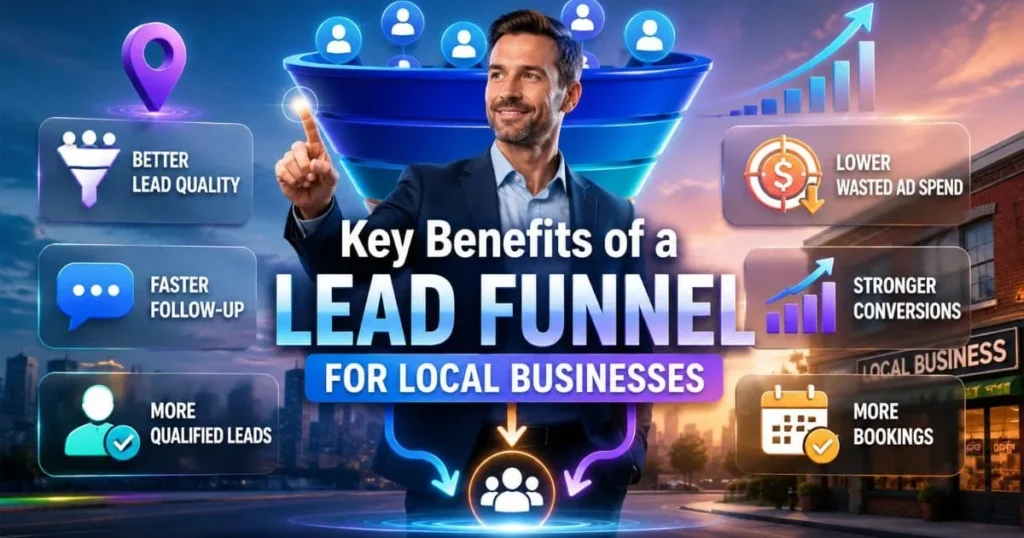
Key Benefits of a Lead Funnel for Local Businesses
A strong funnel helps local businesses in several ways:
- It improves the quality of enquiries.
- It helps the business reach people in the right location.
- It reduces wasted ad spend.
- It supports better follow-up.
- It helps track which campaigns produce real customers.
- It creates a better experience for potential customers.
- It helps businesses understand what customers want before calling them.
When a funnel is planned properly, the business does not only get more names and phone numbers. It gets better information, stronger intent, and a higher chance of conversion.
How Meta Ads Help Local Businesses Generate Leads
Meta platforms allow businesses to reach people through Facebook, Instagram, Messenger, and related placements. For a local business, this can be helpful because customers often use social media before making buying decisions. Many businesses also combine these efforts with performance marketing services to improve targeting, track campaign results, and generate measurable returns from their advertising investments.
A person may see a service ad while scrolling, save it, compare options, read comments, check the page, and then enquire later. This is why Meta Ads for local businesses can work well when the campaign is built with the right audience, message, creative, and follow-up process.
Facebook Ads for Local Business Leads
Facebook ads for local business leads are useful when the target audience uses Facebook to discover services, check community recommendations, and contact nearby providers. Facebook can work well for home services, real estate, clinics, education, repair services, and local stores.
The ad should clearly show:
- What service is being offered
- Which location is served
- What problem the service solves
- What the user should do next
- Why the business is reliable
Instagram Ads for Local Business Leads
Instagram ads for local business leads are useful for businesses where visuals matter. Salons, gyms, restaurants, clinics, interior services, real estate projects, fashion stores, and local retail businesses can use Instagram to build interest through images, reels, and short videos. Following an Instagram SEO guide for local leads can also help businesses improve discoverability, attract nearby audiences, and generate more qualified inquiries through organic and paid efforts.
Instagram ads work better when the creative is clean, direct, and easy to understand. The user should know the service and next step within a few seconds. Pairing ad campaigns with an Instagram SEO guide for local leads can also help businesses improve visibility, attract relevant audiences, and generate more qualified inquiries from local customers.
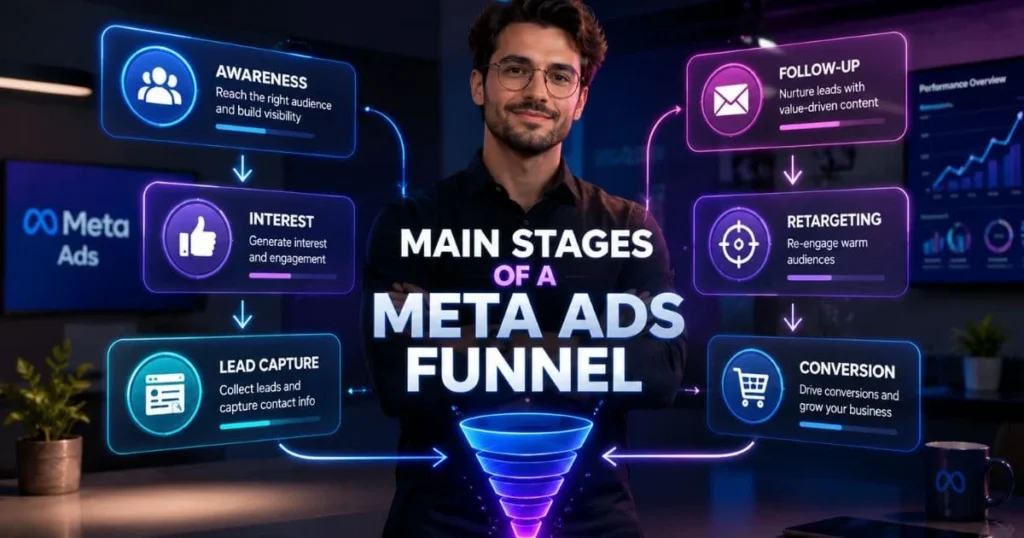
Main Stages of a Meta Ads Funnel
A funnel should not start and end with only one lead form. It should guide people gradually. The following stages can help a local business create a better system.
Stage 1 Awareness
Awareness is the first stage. At this point, the customer may not know the business yet. The goal is to introduce the service and show why it matters.
Best Awareness Ad Ideas
- Problem-based short videos
- Local service introduction ads
- Simple educational posts
- Before and after visuals where suitable
- Customer pain point creatives
- Location-based service messages
At this stage, the ad should not feel too heavy. It should make people understand the service quickly.
Stage 2 Interest Building
Once people know about the business, they need more information. They may ask:
- Is this service right for me?
- Is the business near my area?
- Can I trust this provider?
- What happens after I enquire?
- How soon will they respond?
This is where content can build trust. A local business can use service explanation ads, review-based ads, process videos, FAQs, and offer-based creatives.
Stage 3 Lead Capture
You can revise the sentence like this, naturally incorporating the phrase without repetition:
Lead capture is where the user shares contact details. This can happen through a form, website landing page, call button, WhatsApp message, or Messenger chat. To improve lead quality, businesses should optimize contact forms for qualified leads by collecting relevant information that helps identify potential customers.
Meta lead ads for local businesses can be useful because users can submit information without leaving the platform. This reduces friction and makes enquiries easier.
Common Lead Capture Methods
- Instant form
- Website landing page
- WhatsApp enquiry
- Messenger chat
- Phone call ad
- Appointment booking form
The best option depends on the business type. A clinic may prefer appointment forms. A contractor may prefer call enquiries. A salon may prefer WhatsApp bookings. A real estate agent may prefer a form with budget and location questions.
Stage 4 Lead Qualification
Not all leads are equal. Some are ready to book, while others are only checking prices. Some may not be in the service area. Some may need a service the business does not offer.
Lead qualification helps filter serious leads. The form should include simple questions that help the business understand the customer. Businesses that order digital marketing services often use lead qualification forms to identify high-intent prospects, improve conversion rates, and focus on inquiries that match their target audience and service offerings.
Useful Qualification Questions
- Which service do you need?
- What is your location?
- When do you need the service?
- What is your budget range?
- Do you prefer a call or WhatsApp reply?
- Are you looking for urgent support or future planning?
These questions help reduce irrelevant enquiries and improve follow-up quality.
Stage 5 Follow-Up
Follow-up is one of the most important parts of the funnel. Many businesses lose leads because they reply late. Local customers often contact more than one provider. If one business responds faster and more clearly, it may win the enquiry.
A follow-up process should include:
- Quick call attempt
- WhatsApp message
- Short service explanation
- Appointment link if needed
- Reminder message
- Status tracking
The message should be polite, clear, and helpful. It should not pressure the customer.
Stage 6 Retargeting
Some people show interest but do not enquire immediately. They may watch a video, open a form, visit a page, or message once and then stop. Retargeting helps bring these people back.
Meta Ads retargeting for local businesses can include review ads, FAQ ads, reminder ads, or offer explanation ads. The goal is to reconnect with warm users who already showed some interest.
Funnel Planning Table
| Funnel Stage | Main Goal | Best Ad Type | Customer Action | Important Metric |
|---|---|---|---|---|
| Awareness | Introduce the business | Video, image, reel | Watch or engage | Reach, views |
| Interest | Build trust | Carousel, review ad, FAQ ad | Click or save | Engagement rate |
| Lead Capture | Collect details | Form, WhatsApp, landing page | Submit enquiry | Cost per lead |
| Qualification | Filter better leads | Form questions | Share service need | Qualified lead rate |
| Follow-Up | Move lead forward | Call, WhatsApp, email | Reply or book | Response rate |
| Retargeting | Bring back warm users | Reminder or proof ad | Reconnect | Conversion rate |
| Conversion | Turn lead into customer | Booking or offer ad | Call, visit, purchase | Cost per customer |
How to Build a Lead Funnel Step by Step
Step 1 Define the Final Goal
Before creating ads, decide what the business wants from the campaign. The goal may be:
- Phone
Before creating ads calls
- Appointment bookings
- WhatsApp enquiries
- Store visits
- Form submissions
- Consultation requests
- Service estimates
A clear goal helps choose the right campaign structure.
Step 2 Understand the Local Customer
Here’s the revised version with “rank Google Maps in Kolkata” added naturally and without repetition:
Meta Ads targeting for local businesses should consider city, nearby areas, service radius, age group, interest level, customer behavior, and strategies that help businesses rank Google Maps in Kolkata for better local visibility. The business should also think about who usually buys the service and what problems they want solved.
A local campaign should focus on the people who can actually become customers. For example, a business serving one city should not waste budget on areas it cannot serve.
Step 3 Choose the Right Campaign Type
A Meta Ads campaign for local business may use lead forms, website traffic, calls, engagement, or messages depending on the objective. The right choice depends on how customers usually contact the business.
For example, an urgent repair service may need call ads. A clinic may need appointment requests. A coaching center may need enquiry forms. A retail store may need store visit awareness and message enquiries.
Step 4 Create Strong Ad Copy
Ad copy should be clear, local, and service-focused. It should answer:
- What is the service?
- Who is it for?
- Which area is covered?
- What problem does it solve?
- What should the user do next?
Avoid vague lines. Instead of saying “best service near you,” the ad should explain the actual benefit and location.
Step 5 Use Better Creative
Creative plays a major role in ad performance. A strong image or video can stop people from scrolling and make the service easier to understand.
Creative ideas include:
- Service process visuals
- Short explainer videos
- Before and after images where suitable
- Team or workspace photos
- Local area reference
- Customer problem visuals
- Simple offer graphics
Step 6 Create the Lead Form Carefully
The form should be short enough to complete but detailed enough to filter leads. Asking only for name and phone number may increase volume, but it can also reduce quality.
For Facebook lead ads for local services, form questions should match the buying process. A home repair service may ask for service type and location. A clinic may ask for preferred appointment time. A real estate agent may ask for budget and property type.
Step 7 Build a Follow-Up System
You can revise the sentence naturally like this:
Leads should not sit in a spreadsheet without action. A business should decide who will call, when they will call, and what message they will use. Partnering with a digital strategy consultancy can also help align lead management efforts with broader business goals and improve follow-up effectiveness.
A simple follow-up flow can include:
- First call within a short time
- WhatsApp message if the call is not answered
- Second follow-up after a few hours
- Reminder the next day
- Retargeting ad for non-responders
This keeps the process organized and reduces lead leakage.
Step 8 Track Real Results
Many businesses only check cost per lead. That is not enough. A campaign with cheap leads may still fail if the leads do not answer or never book. Effective lead generation requires looking beyond price and focusing on lead quality, response rates, appointment bookings, and overall conversion optimization. By evaluating how leads move through the sales funnel, businesses can identify which data sources deliver better engagement and stronger results. In many cases, investing in higher-quality leads produces a better return on investment than purchasing large volumes of low-cost contacts that generate little business value.
Track these metrics:
- Total leads
- Qualified leads
- Calls answered
- Appointments booked
- Final customers
- Cost per booking
- Cost per sale
- Revenue from campaign
This helps the business understand whether the funnel is actually working.
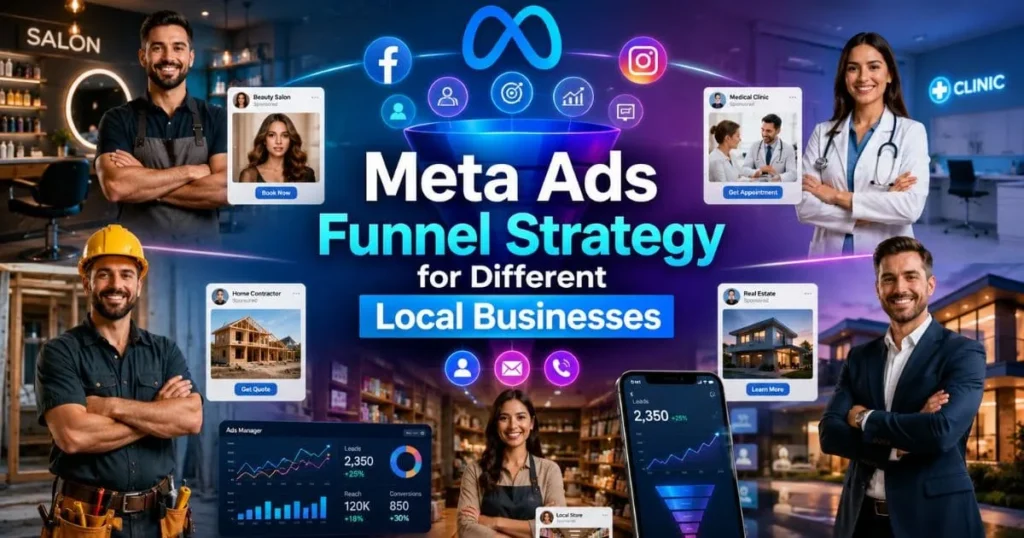
Meta Ads Funnel Strategy for Different Local Businesses
Different businesses need different funnel setups. A single method does not work for every industry.
Contractors and Home Service Providers
Facebook Ads for contractors should focus on service area, project type, urgency, and trust. People looking for repairs or home improvement usually want fast answers and clear estimates.
A good funnel may include:
- Problem-based awareness ad
- Form with location and service type
- Call follow-up
- Retargeting with reviews or completed work examples
Salons and Beauty Services
Facebook Ads for salons can use strong visuals, service packages, appointment reminders, and customer reviews. The funnel should make booking easy.
Useful lead questions include:
- Which service do you want?
- Preferred date
- Preferred time
- Location
- Contact number
Clinics and Healthcare Services
Facebook Ads for clinics should focus on trust, clarity, and appointment convenience. The ad should avoid confusing claims and should clearly explain the service.
A clinic funnel may include:
- Awareness ad explaining the treatment or service
- Appointment enquiry form
- Follow-up call
- Reminder message
- Retargeting with FAQs
Real Estate Agents
Facebook Ads for real estate agents should collect useful details such as budget, location preference, property type, and buying timeline. Real estate leads often need nurturing because decisions take time.
A funnel may include:
- Property interest ad
- Lead form with budget question
- WhatsApp follow-up
- Site visit booking
- Retargeting with location highlights
Local Stores
Facebook Ads for local stores should encourage people to visit, message, or check available products. Stores can use offers, product highlights, seasonal promotions, and location-based ads.
A simple funnel may include:
- Product discovery ad
- Message enquiry
- Store direction or contact
- Retargeting for people who engaged
Instant Forms vs Landing Pages
You can naturally add “local landing page SEO” like this:
A local business can collect leads in different ways. The two most common options are instant forms and landing pages. When combined with local landing page SEO, landing pages can help attract targeted local traffic, improve visibility in search results, and generate higher-quality leads.
When to Use Instant Forms
Instant forms are useful when the business wants fast enquiries. They are simple and easy for users to complete. They work well when the service is easy to understand.
Instant forms may be suitable for:
- Salons
- Clinics
- Consultants
- Local repair services
- Real estate enquiries
- Coaching centers
- Event bookings
When to Use Landing Pages
Landing pages are useful when the service needs more explanation. They allow the business to show details, reviews, pricing information, service process, FAQs, and proof of work.
Landing pages may work better for:
- High-value services
- B2B services
- Real estate
- Healthcare services
- Home renovation
- Legal or financial services
- Education and coaching
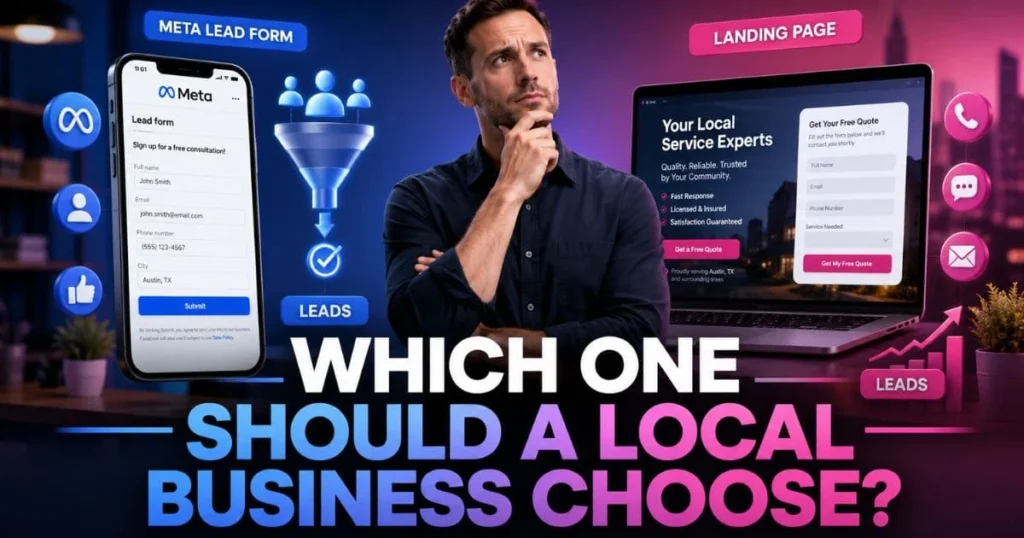
Which One Should a Local Business Choose?
There is no single answer. If the goal is quick enquiry volume, instant forms may work well. If the goal is stronger intent and more informed customers, landing pages may perform better.
A business can test both and compare qualified leads, not only total leads.
Common Mistakes in Local Lead Funnels
Many campaigns fail because the funnel is incomplete. The issue is not always the ad platform. Often, the problem is planning, messaging, targeting, or follow-up.
Mistake 1 Running Ads Without a Funnel
Running one ad and waiting for leads is not enough. A good funnel should educate, capture, qualify, and follow up.
Mistake 2 Targeting Too Broadly
A local business should not target people who cannot visit, book, or use the service. Facebook Ads targeting local customers should be based on actual service reach.
Mistake 3 Using Weak Forms
If the form asks too little, the business may get many low-quality leads. If it asks too much, users may not complete it. Balance is important.
Mistake 4 Ignoring Retargeting
Warm users often need reminders. If a business does not retarget them, it may lose people who were close to enquiring.
Mistake 5 Slow Follow-Up
Speed matters. A local lead may contact several businesses at once. Slow response can reduce conversion even if the ad campaign is strong.
Mistake 6 Tracking Only Lead Cost
A low cost per lead does not always mean success. A business should measure real actions such as calls, bookings, store visits, and customers.
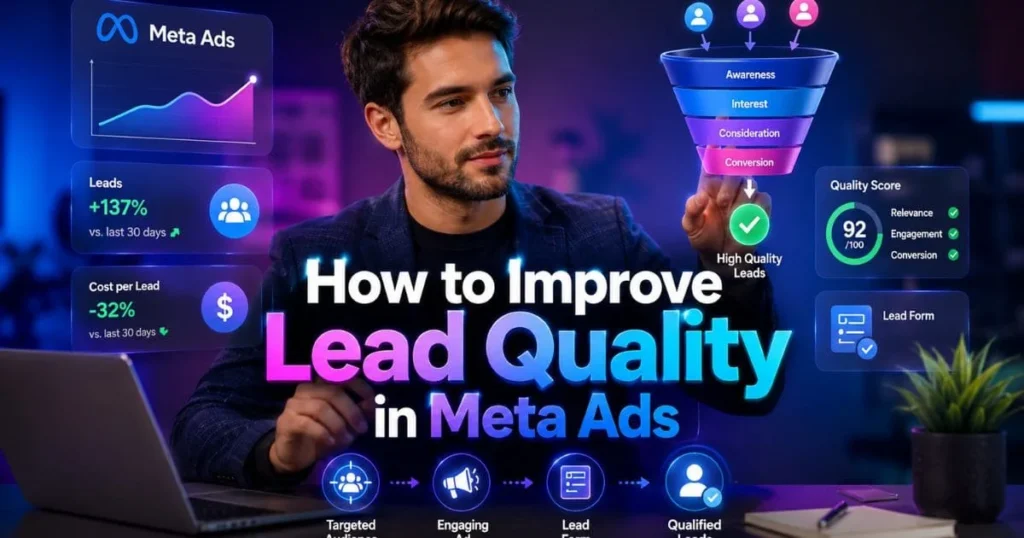
How to Improve Lead Quality in Meta Ads
Lead quality improves when the business sets clear expectations before the user submits details.
Use Clear Location-Based Messaging
Mention the service area clearly. This helps avoid enquiries from places the business cannot serve.
Ask Better Questions
The form should include practical questions. These questions should help the business understand whether the lead is serious and relevant.
Use Honest Ad Copy
The ad should not create false expectations. If pricing, availability, or location matters, the message should be clear.
Match the Offer With Customer Intent
A customer looking for urgent repair needs a different message than someone planning a future project. The offer should match the stage of the customer.
Improve Follow-Up Scripts
A strong follow-up message should be short and direct.
Example:
“Hello, thank you for your enquiry. We received your request for [service]. Could you confirm your location and preferred time for a quick call?”
This type of message feels helpful and easy to answer.
Lead Funnel Examples by Intent
For Quick Enquiries
Use a short form, direct ad copy, and fast phone follow-up.
For Appointment Bookings
Use a form with date and time preference, then confirm through WhatsApp or call.
For High-Value Services
Use educational content, landing pages, retargeting, and lead qualification.
For Store Visits
Use location-based ads, product highlights, directions, and message support.
Role of Facebook and Instagram Together
A local business does not need to choose only one platform. Facebook and Instagram can support different parts of the funnel.
A Facebook Ads lead generation funnel may work well for service explanations, community-based targeting, and form submissions. An Instagram lead generation funnel may work well for visuals, reels, lifestyle-based creative, and younger audience groups.
Together, both platforms can support awareness, engagement, lead capture, and retargeting.
Planning a Complete Campaign System
A proper campaign system should connect all important parts of the funnel. This includes audience, creative, form, landing page, follow-up, and tracking.
A Meta Ads lead generation strategy should not depend only on ad delivery. It should also include how the business handles the lead after submission.
A Facebook lead funnel for small businesses can be simple. It does not need many complicated steps. It only needs clear targeting, useful content, lead capture, and consistent follow-up.
Similarly, a Meta Ads funnel strategy should focus on customer journey. The campaign should match what the customer needs to know before enquiring.
For a small brand, a lead generation funnel for local business can start with three campaigns:
- Awareness campaign
- Lead capture campaign
- Retargeting campaign
This basic setup is often easier to manage than running many ads without a clear purpose.
Where Different Keywords Fit in a Funnel
A Facebook Ads campaign for local business can focus on people who already use Facebook to ask for local recommendations. A Meta Ads sales funnel can combine both Facebook and Instagram to move people from attention to action.
A Facebook Ads marketing funnel may include page engagement, lead forms, and retargeting. A lead funnel for small business marketing should stay simple and practical, especially when the team is small.
Meta Ads for local service providers can work well when the service area and customer need are clear. Meta Ads for service businesses should focus more on enquiry quality than only lead volume.
For businesses that depend on appointments, repairs, consultations, or home visits, local service business lead generation becomes stronger when ads and follow-up are connected.
A good system supports local business lead generation with Meta Ads by attracting the right audience, qualifying enquiries, and keeping the sales process organized.
For long-term growth, local customer acquisition with Meta Ads should include testing, tracking, and continuous improvement.
FAQ
What is a Meta Ads lead funnel?
A Meta Ads lead funnel is a planned process that helps a local business move people from seeing an ad to submitting an enquiry and becoming a customer. It includes awareness, lead capture, qualification, follow-up, and retargeting.
Are Meta Ads good for local businesses?
Yes, Meta Ads can be useful for local businesses when campaigns are planned with proper location targeting, clear service messaging, lead forms, and fast follow-up. The results depend on audience quality, offer, creative, and sales process.
How can a local business improve lead quality from Facebook and Instagram ads?
A local business can improve lead quality by using clear ad copy, location-specific targeting, custom form questions, better creative, quick follow-up, and proper tracking of booked appointments or final customers.
H3: Should a local business use instant forms or landing pages?
Instant forms are better for quick enquiries, while landing pages are better when the service needs more explanation. A business should test both and compare qualified leads, not only total form submissions.
Why are my Meta Ads leads not converting?
Leads may not convert because of weak targeting, unclear ad copy, poor form questions, slow follow-up, lack of trust signals, or no retargeting. The issue may also be that the campaign is tracking leads but not real customer actions.
How many questions should a lead form have?
A local business can usually ask 3 to 5 useful questions. The form should collect enough information to qualify the lead without making the process too difficult.
What should I track in a local lead funnel?
Track total leads, qualified leads, response rate, call answer rate, booked appointments, service area match, cost per booking, and final customer conversion.
Conclusion
A strong lead funnel gives local businesses a better way to manage Facebook and Instagram advertising. It helps move people from awareness to enquiry, then from enquiry to booking or purchase.
The main goal is not only to get more leads. The real goal is to get better leads, respond faster, and understand which campaigns are creating real business value.
A well-planned Meta Ads lead funnel includes clear targeting, useful creative, proper forms, qualification questions, fast follow-up, and retargeting. When all these parts work together, local businesses can build a more reliable lead generation system and reduce wasted ad spend.