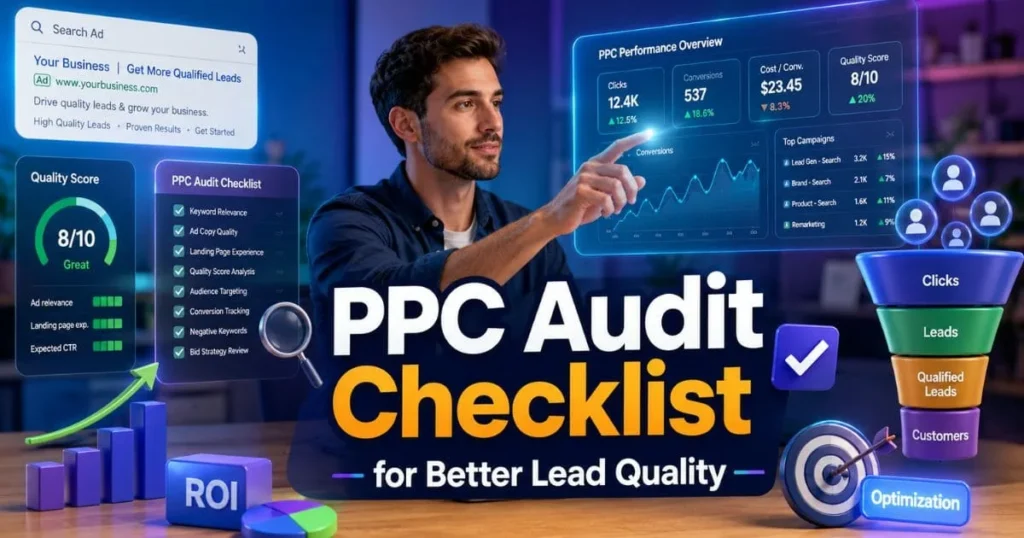
Running paid ads can bring fast traffic, but traffic alone does not help a business grow. The real value comes when clicks turn into qualified enquiries, sales calls, form submissions, bookings, and real customers. Many businesses spend money on ads and still receive weak leads because the campaign is not reviewed properly. A PPC audit checklist helps find where money is being wasted and where lead quality can improve.
A strong audit does not only check cost per click or impressions. It looks at keyword intent, ad relevance, landing page experience, tracking accuracy, bidding, search queries, forms, calls, and follow up quality. When these areas work together, a campaign can attract users who are more likely to convert.
This guide explains how to review paid campaigns in a clear and practical way so you can reduce wasted spend and generate better leads.
Table of Contents
What Is a PPC Audit?
Many advertisers focus only on the number of leads. That can be risky. A campaign may generate many enquiries, but if those enquiries are from the wrong location, wrong budget range, or wrong service need, the sales team loses time. This is why a digital marketing blog should focus not only on lead volume but also on lead quality, audience relevance, and conversion potential. A smaller number of qualified enquiries often delivers better results than a large volume of unqualified leads.
A PPC campaign audit is especially useful when a campaign is getting clicks but not enough qualified leads. It helps answer simple but important questions:
- Are the ads reaching the right audience?
- Are the keywords attracting buyers or random visitors?
- Are low quality searches wasting budget?
- Are form fills and calls being tracked correctly?
- Are landing pages convincing enough for users to enquire?
A good audit turns campaign data into practical decisions.
Why Lead Quality Matters More Than Lead Volume
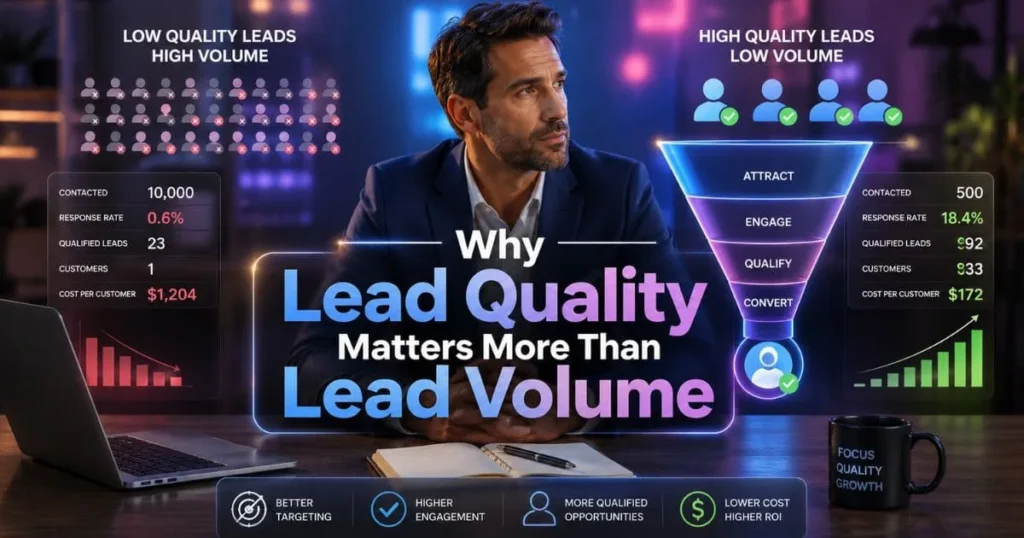
Many advertisers focus only on the number of leads. That can be risky. A campaign may generate many enquiries, but if those enquiries are from the wrong location, wrong budget range, or wrong service need, the sales team loses time.
Better lead quality means:
- More relevant enquiries
- Lower wasted ad spend
- Better sales conversations
- Higher chance of conversion
- Clearer campaign reporting
- Less pressure on the follow up team
A PPC lead quality audit helps connect advertising data with real business outcomes. Instead of asking only how many leads were generated, the audit asks how many of those leads were actually useful.
Signs Your PPC Campaign Needs an Audit
A campaign may need a review when performance looks active but results feel weak. Some common signs include:
- High clicks but low enquiries
- Many enquiries from the wrong location
- A high cost per lead with poor sales results
- Repeated calls from users looking for something else
- Search queries that do not match your service
- Landing pages with high bounce rates
- Form submissions with incomplete or fake details
- Campaigns spending budget but not producing qualified prospects
When these issues appear, a paid search audit can show where the campaign is leaking money.
Complete Audit Areas for Better PPC Leads
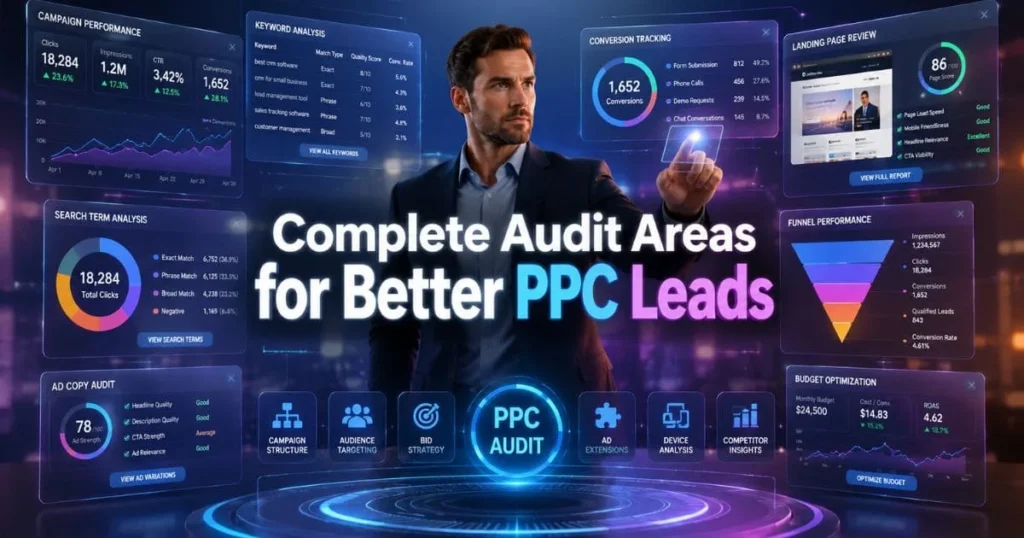
A full review should cover all major campaign elements. Looking at only one area may not give the full picture.
Campaign Goals
Before checking settings and numbers, define what a good lead means. For one business, a good lead may be a booked consultation. For another, it may be a quote request, phone call, form submission, demo request, WhatsApp enquiry, or a conversion generated through Performance Max Google Ads campaigns. Clear lead definitions help businesses measure campaign success accurately and optimize marketing efforts based on meaningful outcomes rather than raw traffic or clicks alone.
Questions to Ask
- What type of enquiry is valuable?
- Which service should the lead ask about?
- Which locations should be targeted?
- What budget range makes the lead qualified?
- Which actions should count as conversions?
When goals are clear, campaign performance becomes easier to judge.
Campaign Structure
A proper campaign structure review helps keep ads organised by service, location, audience intent, and budget. Poor structure often makes it harder to understand which part of the campaign is working.
For example, a single campaign covering many services may create reporting confusion. It may also push budget toward low value queries while important services get less visibility.
What to Check
- Campaign naming
- Ad group themes
- Keyword grouping
- Location settings
- Budget split
- Device performance
- Search and display separation
- Brand and non brand campaign split
A clean structure helps improve reporting and makes campaign optimisation easier.
Main PPC Audit Areas
| Audit Area | What to Check | Why It Matters |
|---|---|---|
| Campaign goals | Lead type, location, service, budget fit | Helps define what quality means |
| Keywords | Intent, match type, cost, conversions | Controls the type of traffic you receive |
| Search queries | Actual user searches | Shows wasted clicks and new opportunities |
| Ads | Message, CTA, relevance | Filters users before they click |
| Landing page | Headline, speed, form, trust | Helps turn clicks into enquiries |
| Tracking | Forms, calls, bookings, CRM data | Shows which leads are valuable |
| Budget | Spend by campaign and keyword | Helps reduce waste |
| Bidding | CPA, conversion value, lead feedback | Guides spend toward better results |
Keyword Review for Better Lead Quality
Keywords are one of the biggest reasons behind poor or strong lead quality. A campaign may look active, but weak keyword intent can attract users who are only researching, looking for jobs, comparing free options, or searching for unrelated services. This is especially important during a Google Ads setup for small business, where selecting high-intent keywords helps attract prospects who are more likely to convert rather than casual searchers.
A keyword match type audit helps check how broad, phrase, and exact match keywords are behaving. Broad match can bring volume, but it needs strong monitoring. Exact match may bring cleaner traffic, but it can limit reach if used too tightly.
H3: Keyword Intent to Review
- High intent service keywords
- Location based keywords
- Problem based keywords
- Comparison searches
- Low intent informational searches
- Free or job related searches
- Queries outside the service area
A Google Ads audit checklist should always include keyword intent because the wrong search intent can damage lead quality even when the ads are getting clicks.
Search Term Review
For example, a campaign for premium services may still trigger searches containing words like free, cheap, training, jobs, PDF, template, or course. These queries often indicate a mismatch between user intent and your business goals. Reviewing this report also helps uncover negative keywords that PPC advertisers ignore, allowing you to reduce wasted ad spend, improve traffic quality, and focus your budget on searches that are more likely to convert.
The search terms report shows the real phrases people typed before clicking on the ad. This is one of the most important areas to review because it reveals whether your keywords are attracting the right audience.
Search Terms to Watch
- Free service searches
- Job and career searches
- Training and course searches
- DIY searches
- Wrong city or country searches
- Support queries when not relevant
- Very low budget queries
- Unrelated product or service terms
Reviewing the search terms report regularly helps you find wasted spend and improve targeting.
Negative Keyword Review
A negative keyword audit helps stop ads from showing for searches that are not useful. Without negative keywords, ads may appear for users who have no buying intent.
Negative keywords can include terms related to jobs, free resources, unrelated industries, wrong locations, and searches that do not match the service.
Negative Keyword Categories
- Jobs
- Salary
- Career
- Internship
- Free
- Template
- Course
- Training
- DIY
- Wrong locations
- Unrelated brands
- Low intent topics
A strong negative keyword audit can reduce irrelevant clicks and help improve campaign efficiency.
Ad Copy Review
An ad copy audit checks whether ads clearly match the user’s intent. Strong ad copy does not just attract clicks. It attracts the right clicks.
Poor ad copy often creates a mismatch. A user may click expecting one thing and then leave when the landing page says something else. This wastes budget and lowers trust.
What Good PPC Ad Copy Should Include
- Clear service name
- Location where needed
- Specific benefit
- Simple call to action
- Relevant offer
- No misleading claims
- Words that match the landing page
Example Ad Copy Angle
Instead of writing only “Get More Leads Today,” a service business can use clearer wording such as “Book a PPC Review for Qualified Leads.” This sets better expectations before the click.
Landing Page Review
Good PPC landing pages are focused. They answer the user’s question quickly, make the next step simple, and support conversion rate optimization through effective A/B testing, helping businesses identify which page elements drive more leads and customer actions.
A landing page audit checks whether the page supports the promise made in the ad. If the landing page is slow, confusing, too general, or missing trust signals, users may leave without contacting the business.
Landing Page Elements to Check
- Clear headline
- Relevant service details
- Fast loading speed
- Mobile friendly layout
- Trust signals
- Short but useful form
- Strong CTA
- Phone number visibility
- Location relevance
- FAQs
- Privacy note
A proper landing page audit can help turn more relevant clicks into qualified enquiries.
Conversion Tracking Review
A conversion tracking audit checks whether the campaign is measuring real business actions. If tracking is wrong, campaign decisions will also be wrong.
For example, counting every button click as a conversion may make results look better than they are. A campaign may then optimise for users who click but never become real leads.
A conversion tracking audit can also help identify gaps between lead capture and follow-up processes, making it easier to reduce lead leakage CRM issues that may prevent qualified prospects from progressing through the sales pipeline. This ensures that campaign performance is measured against genuine business outcomes rather than superficial engagement metrics.
Conversion Actions to Review
- Form submissions
- Phone calls
- WhatsApp clicks
- Email clicks
- Appointment bookings
- Quote requests
- CRM qualified leads
- Offline sales data
Common Tracking Mistakes
- Duplicate conversion actions
- Tracking page views as leads
- Not tracking calls correctly
- No separation between weak and qualified leads
- No CRM feedback
- No lead value assigned
A strong conversion tracking audit helps improve reporting and decision making.
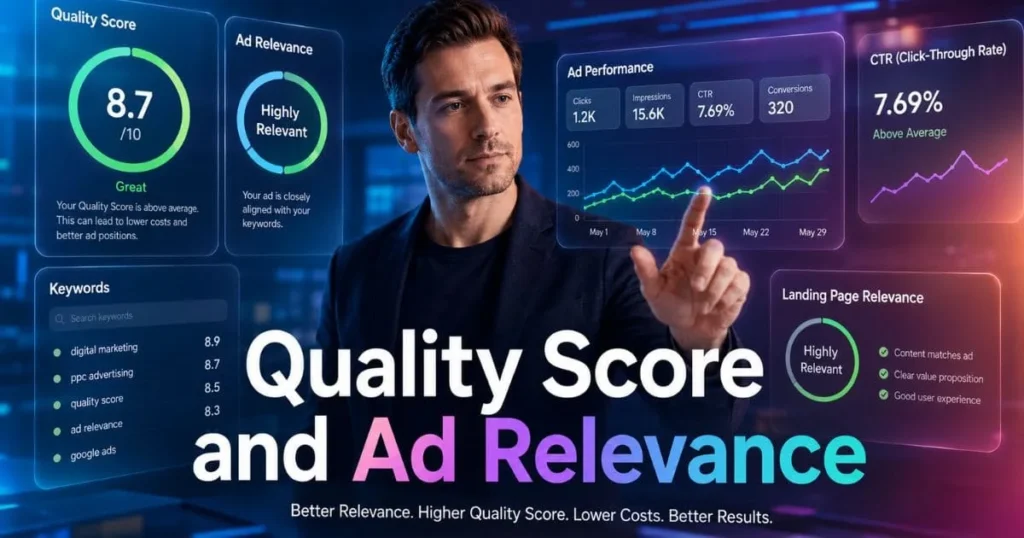
Quality Score and Ad Relevance
A Quality Score check helps review keyword relevance, ad relevance, and landing page experience. While it does not directly measure lead quality, it can show whether ads and landing pages are aligned with user searches.
A low score may suggest that the keyword, ad, and landing page do not match well. This can increase cost and reduce campaign efficiency. Google Ads Quality Score optimization focuses on improving this alignment, helping advertisers enhance ad performance, increase click-through rates, and make better use of their advertising budget.
How to Improve Relevance
- Group similar keywords together
- Use ad copy that matches the search
- Send users to specific landing pages
- Improve page speed
- Remove weak keywords
- Test better CTAs
- Use clear and useful content
A regular Quality Score check helps spot areas that need attention.
Budget and Bidding Review
A PPC budget audit checks whether money is going to the right campaigns, keywords, devices, and locations. Sometimes a campaign spends most of its budget on traffic that rarely becomes a good lead. A smart Google Ads budget strategy helps distribute spending toward the campaigns, audiences, and keywords that generate the strongest business results while reducing wasted ad spend.
A bidding strategy audit checks whether the campaign bidding method matches the quality of the data. Automated bidding works better when conversion tracking is clean and enough useful data is available.
Budget Questions to Ask
- Which campaigns use the most budget?
- Which keywords spend without qualified leads?
- Which locations bring better enquiries?
- Which devices convert better?
- Which time slots produce useful leads?
Bidding Questions to Ask
- Is the strategy focused on real conversions?
- Is poor quality data affecting bidding?
- Is target CPA realistic?
- Are qualified leads tracked separately?
- Should conversion value be used?
A PPC performance audit should review both spend and lead value, not only click cost.
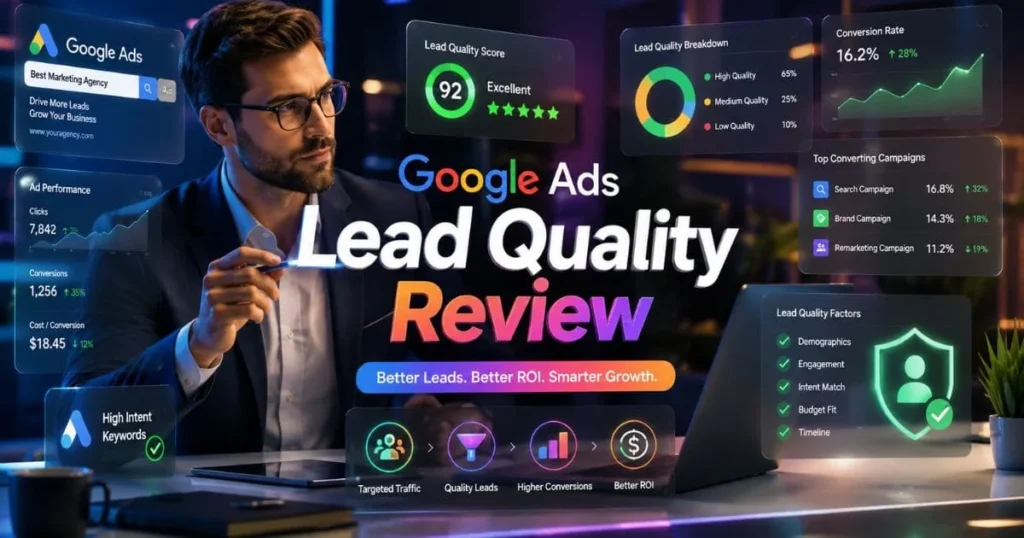
Google Ads Lead Quality Review
Improving Google Ads lead quality means checking what happens after the click. Many campaigns fail because they count every lead equally. A form fill from an unqualified user should not be treated the same as a serious enquiry.
To improve PPC lead quality, businesses need to connect ad data with sales data. Sales team feedback can show which keywords, ads, and pages bring real opportunities.
Lead Quality Factors
- Correct location
- Clear requirement
- Valid phone number
- Valid email
- Right service interest
- Matching budget
- Strong buying intent
- Fast response from sales team
A Google Ads campaign audit should include these factors so the campaign can focus on better enquiries.
Lead Quality Scoring Model
| Lead Factor | Strong Signal | Weak Signal |
|---|---|---|
| Search intent | Service or quote based query | Free, job, or unrelated query |
| Location | Inside service area | Outside target area |
| Requirement | Clear service need | Vague message |
| Budget | Matches pricing | Too low or missing |
| Contact details | Valid phone and email | Wrong or fake details |
| Urgency | Ready to speak soon | Only browsing |
| Sales feedback | Qualified after contact | Not relevant |
Checklist for Service Based Businesses
Service businesses need paid ads that bring enquiries from the right people and right locations. A PPC optimization checklist for service businesses should focus on local intent, call quality, form quality, and campaign efficiency.
A PPC vs SEO ROI comparison can also help businesses understand where to allocate their marketing budget. While PPC can generate immediate enquiries and faster visibility, SEO often delivers long-term organic traffic and lower acquisition costs over time. Evaluating both channels regularly helps identify the best balance for sustainable lead generation and return on investment.
What to Review
- Location targeting
- Call extensions
- Phone call tracking
- Service based keywords
- Local search intent
- Landing page location signals
- Form fields
- Mobile experience
- Follow up speed
A paid search audit for service businesses should also compare calls and forms separately because call leads may behave differently from form leads.
Case Study: How One Service Campaign Improved Lead Quality
A service based business was receiving many paid leads, but the sales team reported that most enquiries were weak. Some users were outside the service area, some were asking for unrelated services, and others had very low buying intent.
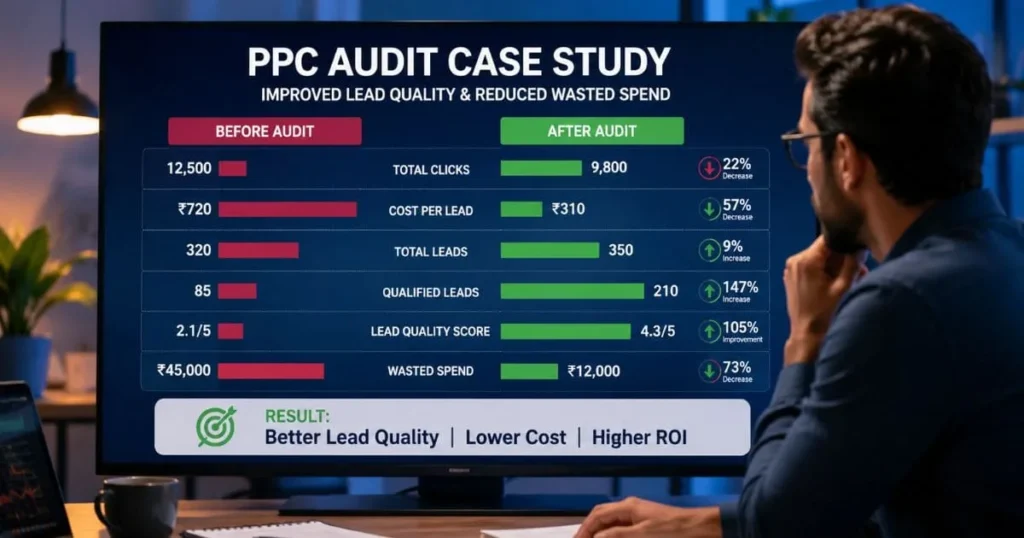
The first step was a PPC lead quality audit. The review found that broad keywords were bringing irrelevant searches. The search terms report showed job, free, and training related queries. The landing page was too general and did not ask users about their location or service need.
The team made several changes. Weak keywords were paused. Negative keywords were added. Ad copy was rewritten to mention the service more clearly. The form was updated with fields for location and requirement. Tracking was adjusted so qualified leads could be reviewed separately.
After the changes, total lead volume became slightly lower, but the sales team received better enquiries. Wasted clicks reduced, and more budget went toward users with stronger intent. This shows why a Google Ads campaign audit should look beyond surface level numbers.
Common PPC Audit Mistakes to Avoid
Looking Only at Cost Per Lead
A cheap lead is not always a good lead. If the user has no real intent, the low cost does not help the business.
Ignoring Sales Feedback
Ad platforms show clicks and conversions, but the sales team knows whether the enquiry was useful. That feedback should be part of a PPC performance audit.
Sending All Traffic to One Page
A generic landing page may not match every keyword or ad. Specific pages usually help users understand the offer faster.
Not Reviewing Search Queries Often
Search behaviour changes. Regular reviews help stop budget from going to irrelevant searches.
Final PPC Audit Checklist Before Optimising Spend
Use this PPC audit checklist before making major budget or bidding changes:
- Define what a qualified lead means
- Review campaign structure
- Check keyword intent
- Review match types
- Analyse search queries
- Add negative keywords
- Check ad relevance
- Review landing page quality
- Test forms and calls
- Fix conversion tracking
- Review location performance
- Compare device performance
- Check Quality Score signals
- Review budget allocation
- Study sales feedback
- Track qualified leads separately
FAQs
Q: What is included in a PPC audit?
A PPC audit includes a review of keywords, ads, landing pages, conversion tracking, bidding, budget, locations, devices, and lead quality. The goal is to find waste and improve campaign performance.
Q: How can I improve lead quality from paid ads?
You can improve lead quality by using better keyword intent, adding negative keywords, improving landing pages, fixing tracking, and reviewing sales feedback. This helps the campaign focus on users who are more likely to become customers.
Q: Why are my Google Ads leads poor quality?
Poor leads may come from broad keywords, weak exclusions, unclear ad copy, wrong location targeting, poor forms, or incorrect tracking. A proper review helps find which part of the campaign is causing the issue.
Q: What should I check first in a PPC audit?
Start with conversion tracking, search queries, keyword intent, negative keywords, and landing page relevance. These areas often show the fastest clues about wasted spend and poor lead quality.
Q: How often should PPC campaigns be reviewed?
Search queries and spend should be checked weekly. Keywords, ads, forms, and landing pages can be reviewed monthly. A deeper campaign review can be done every quarter.
Q: Does Quality Score affect lead quality?
Quality Score does not directly measure lead quality, but it shows whether keywords, ads, and landing pages are relevant. Better relevance can support stronger traffic and more useful enquiries.
Q: Why is tracking important for PPC leads?
Tracking shows which actions users take after clicking an ad. Without correct tracking, the campaign may optimise for weak actions instead of real enquiries, calls, bookings, or qualified leads.
Conclusion
PYou can add the phrase naturally like this without repetition:
A complete review should include keywords, search queries, negative keywords, ad copy, landing pages, tracking, bidding, budget, location settings, and sales feedback. Understanding the difference between performance marketing vs digital marketing can also help businesses choose the right measurement approach, as performance marketing focuses on measurable actions while digital marketing covers a broader range of online brand-building activities. When these areas are checked together, it becomes easier to reduce wasted spend and attract stronger leads.
Paid advertising works best when campaigns are reviewed with lead quality in mind. Clicks and impressions are useful, but they do not tell the full story. A campaign should be judged by the quality of enquiries it brings, not just the number of conversions shown in the dashboard.
Using a PPC audit checklist regularly can help businesses make better decisions, improve reporting, and get more value from paid campaigns.