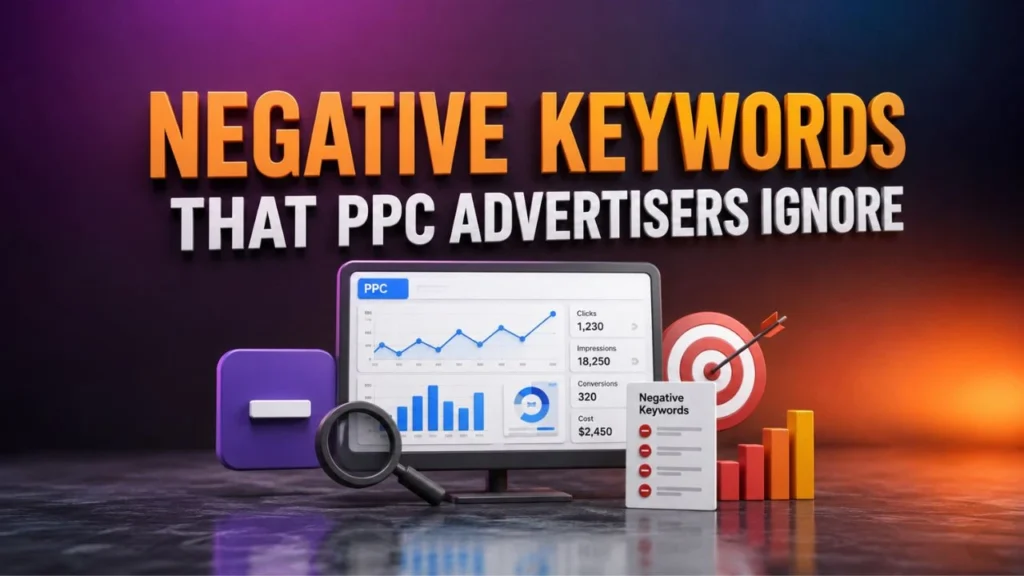
Paid advertising can generate fast visibility, quality leads, and measurable conversions when campaigns are built strategically. Yet many advertisers continue to lose a significant portion of their budget because they overlook one important factor: Negative Keywords.
While businesses often focus on finding high volume keywords, writing ad copy, and increasing clicks, they frequently ignore the impact of irrelevant searches. This is where negative keywords in PPC become essential. They help prevent ads from appearing for searches that are unlikely to convert, allowing businesses to focus on users with real buying intent.
In today’s competitive advertising landscape, relying only on broad targeting can quickly lead to wasted ad spend. Smart advertisers use Google Ads negative keywords to improve targeting accuracy, increase conversion quality, and strengthen campaign performance. Whether you are running search ads for lead generation, ecommerce, or local services, a strong keyword exclusion strategy can dramatically improve campaign efficiency.
This guide explains how Negative Keywords work, why they matter, and how advertisers can use them for better paid search optimization. You will also learn how search query exclusion, AI driven PPC optimization, and predictive keyword exclusion are changing the future of digital advertising.
Table of Contents
What Are Negative Keywords in PPC?
Negative Keywords are terms or phrases that prevent your advertisements from appearing when users search for unrelated topics. Instead of targeting more people, these keywords help advertisers avoid the wrong audience.
For example, if a company sells premium marketing software, it may want to exclude searches containing words like free, internship, tutorial, or jobs. These searches may generate clicks but rarely result in conversions.
When used correctly, negative keywords in PPC help filter traffic and improve campaign precision.
Why Negative Keywords Matter?
Many advertisers believe more traffic automatically means better results. In reality, irrelevant traffic often increases costs without improving conversions.
Negative Keywords help businesses:
- Reduce wasted ad spend
- Improve audience targeting
- Increase conversion rates
- Improve Quality Score
- Enhance ad relevance
- Strengthen improving PPC ROI efforts
- Generate high converting PPC traffic
Without proper search query exclusion, campaigns can attract visitors who have no intention of purchasing products or services.
How Google Ads Negative Keywords Improve Campaign Performance?
Google Ads allows advertisers to add exclusions at campaign and ad group levels. These exclusions ensure ads are shown only for relevant searches.
Google Ads negative keywords support better:
- Ad targeting refinement
- Search intent filtering
- Budget allocation
- Paid search optimization
- PPC campaign management
When advertisers ignore search exclusion terms, they often experience lower click quality, higher bounce rates, and declining returns.
Example of Poor Keyword Filtering
Suppose a business offers enterprise SEO consulting services. If the campaign targets broad keywords related to SEO, ads may appear for:
- Free SEO tools
- SEO tutorial PDFs
- SEO jobs near me
- SEO training courses
- SEO internships
These searches may increase clicks but rarely produce revenue. By adding search exclusion terms, advertisers can block these low intent searches.
Why PPC Advertisers Ignore Negative Keywords?
Despite their importance, many advertisers still fail to prioritize search exclusion term in their campaign optimization strategy.
Over Dependence on Automation
Modern advertising platforms heavily promote automated bidding and smart campaigns. While automation improves efficiency, it cannot fully replace human analysis.
Many advertisers assume automation handles search intent automatically, but irrelevant queries still slip through campaigns.
Lack of Search Terms Report Analysis
One of the most common PPC mistakes is ignoring search terms report analysis. This report reveals the exact queries users type before clicking ads.
Without reviewing search terms regularly, advertisers continue paying for irrelevant traffic.
Poor Understanding of User Intent
Clicks do not always equal conversions. Advertisers who focus only on impressions and click through rates often overlook whether traffic has purchase intent.
Irrelevant search blockers help advertisers align campaigns with genuine customer intent.
Broad Match Overuse
Broad match keywords can trigger ads for loosely related searches. Without proper search query exclusion, campaigns become vulnerable to budget waste.
This issue is especially common in low ROI advertising campaigns.
The Hidden Cost of Ignoring Negative Keywords
Many advertisers underestimate how much money irrelevant traffic consumes.
| PPC Issue | Campaign Impact |
| Irrelevant Clicks | Wasted budget |
| Poor Audience Match | Lower conversion rate |
| Weak Ad Relevance | Higher CPC |
| Low Intent Traffic | Poor lead quality |
| Weak Filtering | Reduced improving Google Ads performance |
When businesses fail to use irrelevant search blockers properly, they often struggle with:
- Rising advertising costs
- Declining ROI
- Poor lead quality
- Reduced customer engagement
- Low conversion performance
How Negative Keywords Improve PPC ROI
Improving PPC ROI is not only about getting more clicks. It is about attracting the right users.
Negative Keywords support:
- Better targeting precision
- Higher conversion rates
- Lower wasted spend
- More qualified visitors
- Better budget efficiency
When campaigns stop paying for irrelevant traffic, businesses can allocate resources toward high intent audiences.
Types of Negative Keywords in Google Ads
Understanding keyword match types is essential for successful PPC campaign management.
Broad Match Negative Keywords
- Broad non converting keywords prevent ads from appearing when all excluded terms are present in a query.
- These are useful for blocking wide categories of unwanted searches.
Phrase Match Negative Keywords
- Phrase match exclusions block searches containing the exact phrase in the same order.
- These are valuable when advertisers want more precise filtering.
Exact Match Negative Keywords
- Exact match exclusions stop ads from appearing only for identical search terms.
- These provide the highest level of control.
| Match Type | Best Use Case |
| Broad Negative | General filtering |
| Phrase Negative | Intent focused filtering |
| Exact Negative | Precision exclusion |
Most Ignored Negative Keywords Categories
Many advertisers repeatedly overlook the same exclusion opportunities.
Free Related Searches
Users searching for free tools or services often have low purchasing intent.
Common exclusions include:
- free
- trial
- template
- download
Job Related Searches
Businesses that are not hiring through ads should exclude:
- jobs
- careers
- salary
- internship
Educational Queries
Some searches are informational rather than transactional.
Examples include:
- tutorial
- guide
- course
- training
Cheap or Discount Searches
Premium brands may not want traffic from bargain focused users.
Relevant exclusions may include:
- cheap
- lowest price
- discount
- coupon
DIY Searches
People looking for self help solutions may not convert.
Examples include:
- do it yourself
- how to
- DIY
These exclusions improve ad targeting refinement and support better paid search optimization.
How to Find Negative Keyword Opportunities?
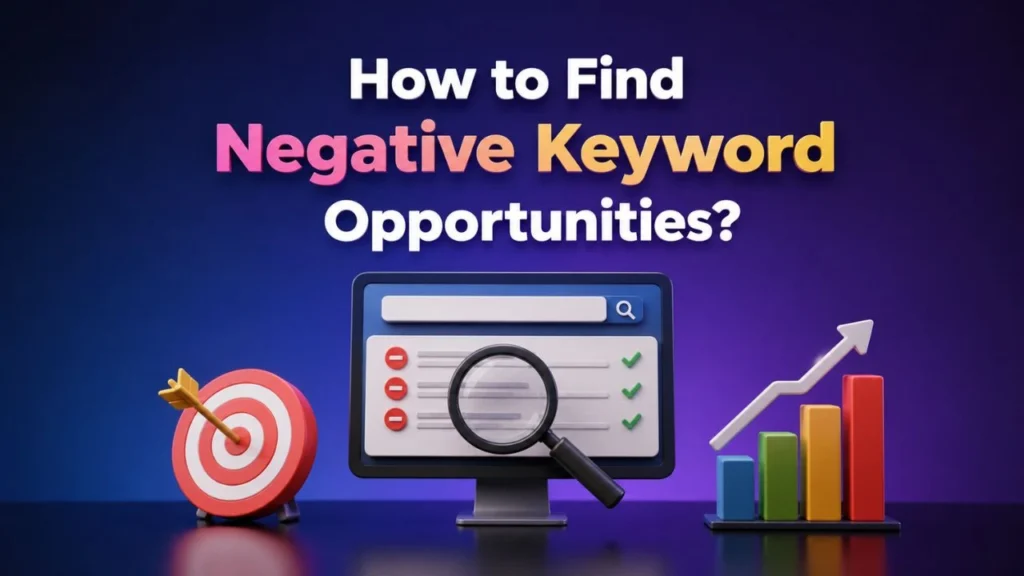
One of the most effective ways to discover non converting keywords is through continuous campaign monitoring.
Use Search Terms Report Analysis
Search terms report analysis helps advertisers identify irrelevant queries triggering ads.
This process reveals:
- Low converting searches
- Irrelevant audience behavior
- Poor intent keywords
- Budget wasting queries
Analyze Conversion Data
- Conversion reports can reveal which search terms generate clicks without sales or leads.
- Keywords with high spend but low conversions often deserve exclusion.
Monitor Bounce Rates
- High bounce rates may indicate poor traffic relevance.
- If visitors leave quickly after clicking ads, the search intent may not align with landing page goals.
Evaluate Customer Intent
Not every search indicates purchase readiness.
Negative Keywords help advertisers separate:
- Research intent
- Informational intent
- Transactional intent
- Commercial intent
Search Query Exclusion Strategies for Better PPC Performance
Search query exclusion is one of the strongest tools for campaign control.
Campaign Level Exclusions
- Campaign wide exclusions help remove broad irrelevant traffic.
- For example, ecommerce brands may exclude terms like free or repair.
Ad Group Level Exclusions
- Ad group exclusions improve segmentation and audience precision.
- This allows advertisers to control keyword overlap between groups.
Shared Negative Keyword Lists
- Google Ads allows advertisers to create reusable exclusion lists.
- This improves efficiency across multiple campaigns.
Geographic Exclusions
- Some businesses serve only specific locations.
- Geographic filtering prevents clicks from irrelevant regions.
Seasonal Exclusions
Advertisers can adjust Negative Keywords during holidays, promotions, or seasonal demand changes.
| Exclusion Strategy | Benefit |
| Campaign Exclusions | Broad traffic filtering |
| Ad Group Exclusions | Better targeting |
| Shared Lists | Simplified management |
| Geographic Filtering | Local relevance |
| Seasonal Filtering | Budget control |
AI Driven PPC Optimization and Predictive Keyword Exclusion
- Artificial intelligence is transforming digital advertising.
- AI driven PPC optimization helps advertisers identify patterns faster and improve decision making.
What Is Predictive Keyword Exclusion?
- Predictive keyword exclusion uses machine learning to identify search patterns likely to perform poorly.
- Instead of waiting for wasted spend to accumulate, advertisers can proactively block low quality traffic.
Benefits of AI Driven PPC Optimization
AI tools support:
- Faster search analysis
- Better intent prediction
- Improved search query exclusion
- Smarter bidding decisions
- Better audience targeting
AI also strengthens improving Google Ads performance by helping advertisers react quickly to changing user behavior.
Human Oversight Still Matters
Although automation is powerful, human strategy remains essential.
Experienced advertisers understand:
- Customer psychology
- Purchase intent
- Industry specific search behavior
- Conversion focused optimization
The best results often come from combining automation with manual analysis.
Negative Keywords and Voice Search Optimization
Voice search is changing how people search online.
Users now type conversational queries such as:
- Where can I find free marketing software?
- How do I learn PPC advertising?
- What is the cheapest SEO service?
These conversational searches increase the importance of Negative Keywords.
Why Voice Search Requires Better Filtering
Voice searches are often:
- Longer
- More conversational
- Question based
- Informational
Without proper keyword exclusion strategy, advertisers may attract users seeking information instead of purchases.
Voice Search and Search Intent
- Businesses must analyze conversational intent carefully.
- Search query exclusion becomes increasingly important as voice search grows across mobile devices and AI assistants.
Google Ads Optimization Tips Using Negative Keywords
Businesses looking for stronger campaign results should follow structured optimization practices.
Review Search Terms Weekly
Regular search terms report analysis helps advertisers identify new exclusion opportunities.
Weekly reviews improve:
- Traffic quality
- Conversion efficiency
- Audience targeting
- Cost management
Focus on Conversion Intent
Advertisers should prioritize:
- Commercial intent
- Transactional intent
- High purchase intent searches
This helps generate high converting PPC traffic.
Build Structured Exclusion Lists
Organized lists simplify PPC campaign management and improve scalability.
Test Match Types Carefully
- Different match types produce different filtering results.
- Testing exclusions carefully improves paid search optimization.
Monitor Quality Score
Relevant traffic supports:
- Better click through rates
- Improved ad engagement
- Higher Quality Scores
- Lower cost per click
These improvements directly support improving PPC ROI.
Common PPC Mistakes Related to Negative Keywords
Even experienced advertisers make exclusion related mistakes.
Over Blocking Keywords
- Aggressive exclusions may block valuable traffic.
- Advertisers should carefully evaluate search intent before adding exclusions.
Ignoring Match Types
Incorrect match type usage can reduce campaign accuracy.
Failing to Update Exclusion Lists
- Search behavior changes continuously.
- Static keyword lists eventually become outdated.
Ignoring Search Query Trends
Advertisers who skip search query exclusion analysis often miss important performance insights.
| Common PPC Mistakes | Negative Impact |
| No Search Review | Wasted spend |
| Weak Filtering | Poor lead quality |
| Broad Match Overuse | Irrelevant clicks |
| No Intent Analysis | Lower ROI |
Building a Strong Keyword Exclusion Strategy
A successful keyword exclusion strategy requires ongoing optimization.
Start With Customer Intent
Understanding customer intent is essential.
Advertisers should identify:
- What users want
- What users do not want
- Which searches convert
- Which searches waste budget
Use Data Driven Decisions
Campaign decisions should rely on:
- Search data
- Conversion reports
- User behavior metrics
- Engagement signals
Combine SEO and PPC Insights
SEO keyword research often reveals informational queries that should become Negative Keywords in paid campaigns.
Prioritize Long Term Optimization
- Improving Google Ads performance is an ongoing process.
- Advertisers who continuously refine exclusions usually achieve better long term results.
Future Trends in Negative Keywords and PPC Optimization
Digital advertising continues evolving rapidly.
AI Powered Search Intent Prediction
AI systems are becoming better at identifying:
- Buyer intent
- Low quality searches
- Conversion patterns
- Audience relevance
Smarter Automation Tools
Future PPC platforms may automatically recommend predictive keyword exclusion opportunities.
Growth of Conversational Search
- Voice assistants and AI search tools continue changing search behavior.
- Advertisers will need stronger search query exclusion methods to maintain relevance.
Increasing Importance of First Party Data
Businesses using customer data effectively can improve targeting accuracy and campaign personalization.
Conclusion
Negative Keywords are one of the most important yet overlooked elements of successful PPC advertising.
Many businesses focus heavily on increasing clicks while ignoring the importance of filtering irrelevant traffic. However, strong campaign performance depends on attracting users with genuine purchase intent.
By using Google Ads negative keywords strategically, advertisers can improve paid search optimization, strengthen ad targeting refinement, reduce wasted spend, and increase improving PPC ROI.
As digital advertising becomes more competitive, businesses must invest in smarter search query exclusion practices, better search terms report analysis, and advanced campaign optimization strategy methods.
AI driven PPC optimization and predictive keyword exclusion will continue shaping the future of paid advertising. Yet even with advanced automation, human understanding of customer intent will remain essential.
Businesses that continuously refine Negative Keywords and focus on search intent will be better positioned to attract high converting PPC traffic, improve campaign efficiency, and achieve stronger long term advertising success.
Frequently Asked Questions
What are Negative Keywords in PPC?
Negative Keywords are terms advertisers exclude to prevent ads from appearing for irrelevant searches.
Why are Google Ads negative keywords important?
Google Ads negative keywords help improve targeting accuracy, reduce wasted clicks, and strengthen conversion quality.
How do Negative Keywords improve PPC ROI?
Negative Keywords improve PPC ROI by filtering low intent traffic and focusing budget on users more likely to convert.
What is search query exclusion?
Search query exclusion is the process of blocking irrelevant search terms from triggering ads.
How can advertisers find negative keyword opportunities?
Advertisers can use search terms report analysis, conversion tracking, and audience behavior insights to discover exclusion opportunities.
What are common PPC mistakes related to Negative Keywords?
Common PPC mistakes include ignoring search reports, overusing broad match keywords, and failing to update exclusion lists regularly.
What is predictive keyword exclusion?
Predictive keyword exclusion uses AI and machine learning to identify low quality searches before they waste advertising budget.
Why is voice search important for PPC optimization?
Voice search generates conversational queries that often require stronger search query exclusion strategies.
How often should advertisers review Negative Keywords?
Advertisers should review Negative Keywords regularly, ideally weekly or monthly depending on campaign size.
Can AI improve PPC campaign management?
Yes. AI driven PPC optimization helps advertisers improve targeting, bidding, and search analysis for better overall campaign performance.