Pay per click advertising remains one of the most effective digital marketing channels for generating targeted traffic, qualified leads, and measurable business growth. However, success in PPC advertising depends on more than selecting popular keywords and creating compelling ad copy. One of the most important factors influencing campaign performance is understanding and properly using PPC keyword match types.
Many advertisers focus heavily on keyword research but pay less attention to how those keywords are matched to user searches. As a result, they often attract irrelevant clicks, waste advertising budgets, and struggle to achieve a positive return on investment. This is where keyword match types become crucial.
Keyword match types determine how closely a user’s search query must relate to your selected keyword before your advertisement becomes eligible to appear. Choosing the right match type can help you reach the right audience, improve conversion rates, lower wasted spend, and significantly increase PPC ROI.
Whether you are managing campaigns for a small business, an ecommerce store, a service company, or an enterprise brand, understanding Google Ads match types is essential for creating successful paid search campaigns.
In this comprehensive guide, you will learn how keyword match types work, their benefits and limitations, how they affect campaign performance, and how to build a keyword strategy that delivers stronger results from your search ads keywords.
Table of Contents
What Are PPC Keyword Match Types?
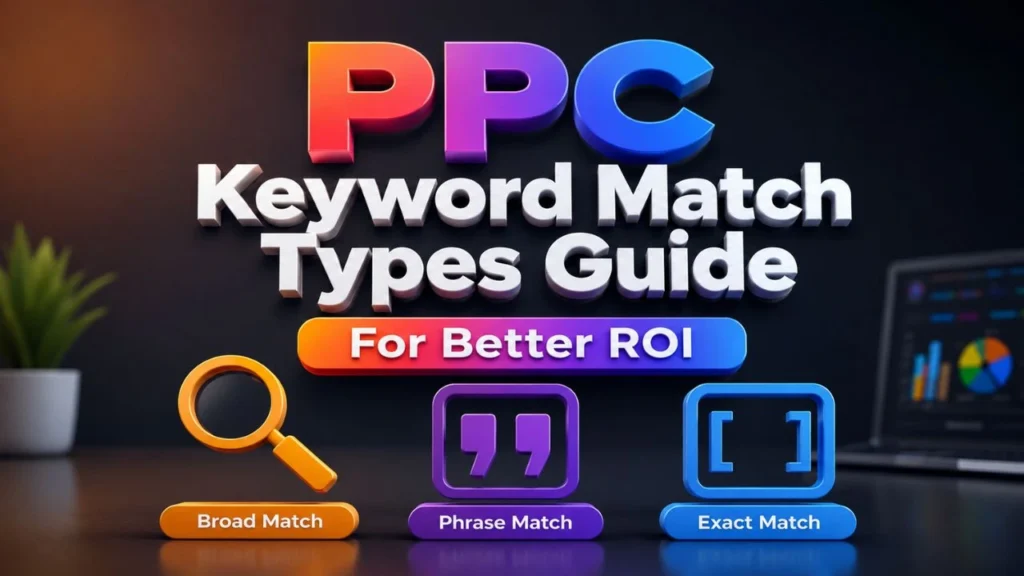
PPC keyword match types are settings used in advertising platforms that control how closely a user’s search query must match a keyword before an ad is shown.
These settings help advertisers balance three important goals:
- Reach
- Relevance
- Return on investment
Without keyword match types, advertisers would have very little control over when their ads appear.
For example, if your keyword is “digital marketing agency,” you may want your ad to appear only for highly relevant searches rather than every remotely related marketing term.
Keyword match types provide that level of control.
Why Keyword Match Types Matter
Keyword match types directly impact:
- Click through rate (CTR)
- Conversion rate
- Cost per click (CPC)
- Quality Score
- Advertising budget efficiency
- Overall PPC ROI
When your keywords align closely with user intent, your ads are more likely to generate valuable clicks and conversions.
When they do not align properly, your budget may be spent on visitors who have little interest in your products or services.
Quick Overview of PPC Keyword Match Types
| Match Type | Symbol | Reach | Relevance | Traffic Volume | Conversion Potential |
| Broad Match | None | Very High | Medium | High | Medium |
| Phrase Match | “Keyword” | Medium | High | Moderate | High |
| Exact Match | [Keyword] | Lower | Very High | Lower | Very High |
| Negative Match | Exclusion | Controlled | Very High | Filters Traffic | Very High |
Understanding Google Ads Match Types
Modern Google Ads match types have evolved significantly over the years. Search engines no longer rely solely on exact keyword matching. Instead, they use machine learning, natural language processing, and semantic understanding to determine user intent.
Today’s matching systems consider:
- Synonyms
- Related concepts
- Search context
- User behavior
- Historical performance data
This means advertisers must understand how match types work alongside Google’s automated systems.
The primary keyword match types include:
- Broad Match
- Phrase Match
- Exact Match
- Negative Match
Each serves a unique purpose within a PPC campaign.
Broad Match Keywords Explained
What Is Broad Match?
Broad Match is the default keyword setting in Google Ads.
It provides the widest reach and allows Google to display ads for searches related to the keyword’s meaning.
Example
Keyword:
digital marketing services
Possible search queries:
- online marketing solutions
- internet advertising agency
- local marketing consultants
- digital promotion company
Google interprets the intent behind the search and decides whether the ad should appear.
Benefits of Broad Match
Increased Reach
Broad Match provides maximum exposure and helps advertisers reach larger audiences.
Keyword Discovery
Advertisers often discover profitable search terms they would never have considered during initial keyword research.
Faster Data Collection
More impressions and clicks generate valuable campaign insights quickly.
Supports Smart Bidding
Google’s automated bidding systems often perform effectively when paired with Broad Match keywords.
Drawbacks of Broad Match
Irrelevant Traffic
Some searches may have limited relevance to your offer.
Higher Spending
Broader targeting often results in more clicks and potentially higher costs.
Lower Conversion Efficiency
Traffic quality can vary substantially.
Best Practices for Broad Match
- Pair with Smart Bidding strategies
- Monitor search term reports regularly
- Build comprehensive negative keyword lists
- Use Broad Match primarily for discovery and scaling
Phrase Match Keywords Explained
What Is Phrase Match?
Phrase Match offers a balance between reach and precision.
Keywords are enclosed within quotation marks.
Example:
“seo services”
Google may display ads for:
- affordable seo services
- professional seo services
- seo services near me
The search query must generally maintain the keyword’s intended meaning.
Advantages of Phrase Match
Better Intent Alignment
Users searching phrase variations often demonstrate stronger purchase intent.
Improved Traffic Quality
Phrase Match generally attracts more relevant visitors than Broad Match.
Greater Budget Efficiency
Reduced irrelevant traffic often improves PPC ROI.
Easier Optimization
Performance trends are often easier to analyze.
Limitations of Phrase Match
- Less reach than Broad Match
- May still trigger unexpected searches
- Requires ongoing monitoring
When to Use Phrase Match
Phrase Match works particularly well when:
- Campaign budgets are moderate
- Conversion tracking is established
- Audience targeting is clearly defined
- Traffic quality matters more than volume
Exact Match Keywords Explained
What Is Exact Match?
Exact Match provides the highest level of targeting precision.
Keywords are placed inside brackets.
Example:
[digital marketing company]
Ads appear primarily for searches closely aligned with that keyword’s meaning.
Benefits of Exact Match
High Relevance
Search intent aligns closely with the advertiser’s offering.
Better Conversion Rates
Highly targeted visitors are more likely to convert.
Improved Budget Control
Spending focuses on high-value searches.
Stronger PPC ROI
Many advertisers achieve their best returns through Exact Match campaigns.
Drawbacks of Exact Match
Limited Reach
Traffic volume may be lower.
Slower Scaling
Campaign expansion often requires additional keywords.
Missed Opportunities
Some valuable searches may be excluded.
Best Applications
Exact Match works well for:
- Lead generation
- Ecommerce sales
- Local services
- High-intent keywords
- Competitive industries
Negative Keywords and Their Role in PPC Success
- Negative keywords tell search engines when not to show your ads.
- They prevent wasted spending and improve campaign efficiency.
Example
If you sell premium marketing services, you may exclude:
- free
- internship
- course
- training
- jobs
This prevents your ads from appearing for users seeking something different from your offer.
Benefits of Negative Keywords
Reduced Wasted Spend
Budget is preserved for qualified prospects.
Improved CTR
More relevant impressions often improve click-through rates.
Better Conversion Rates
Traffic quality increases significantly.
Higher PPC ROI
Fewer wasted clicks contribute directly to profitability.
How PPC Keyword Match Types Affect PPC ROI?
Every keyword match type influences ROI differently.
Cost Per Click
- Broad Match often generates more clicks but may increase costs due to lower relevance.
- Phrase Match typically balances cost and quality.
- Exact Match often attracts the most qualified traffic.
Conversion Rate
Traffic quality generally improves as targeting becomes more specific.
- Broad Match → Lower average conversion rates
- Phrase Match → Moderate to high conversion rates
- Exact Match → Highest conversion rates
Quality Score
Google evaluates:
- Ad relevance
- Expected CTR
- Landing page experience
Proper match type selection improves all three factors.
Comparison Table: Broad Match vs Phrase Match vs Exact Match
| Feature | Broad Match | Phrase Match | Exact Match |
| Reach | Highest | Medium | Lowest |
| Precision | Lowest | High | Highest |
| CPC Control | Moderate | Good | Excellent |
| Conversion Rate | Moderate | High | Very High |
| PPC ROI | Moderate | High | Highest |
| Data Collection Speed | Fast | Moderate | Slow |
| Budget Efficiency | Medium | High | Very High |
Choosing the Right Match Type for Different Goals
Brand Awareness Campaigns
Recommended:
- Broad Match
- Phrase Match
Reason:
Maximum reach and audience discovery.
Lead Generation Campaigns
Recommended:
- Phrase Match
- Exact Match
Reason:
Higher relevance and stronger conversion potential.
Ecommerce Campaigns
Recommended:
- Phrase Match
- Exact Match
Reason:
Better purchase intent targeting.
Local Service Businesses
Recommended:
- Exact Match
- Phrase Match
Reason:
Local customers often use specific searches.
Advanced PPC Keyword Match Type Strategies
Many successful advertisers combine multiple match types rather than relying on one.
Layered Keyword Targeting
Example:
Broad Match:
digital marketing
Phrase Match:
“digital marketing services”
Exact Match:
[digital marketing agency]
This structure captures users across different stages of the buying journey.
Intent Based Campaign Structuring
Top Funnel
Broad Match
Goal:
Awareness and discovery.
Middle Funnel
Phrase Match
Goal:
Evaluation and consideration.
Bottom Funnel
Exact Match
Goal:
Conversions and sales.
Search Term Report Optimization
- One of the most valuable PPC optimization techniques is analyzing search term reports.
- These reports show exactly which user searches triggered your ads.
Review reports regularly to:
- Discover new keywords
- Identify irrelevant traffic
- Build negative keyword lists
- Improve keyword targeting
Common PPC Keyword Match Type Mistakes
Using Only Broad Match
Many advertisers rely exclusively on Broad Match and waste budget.
Ignoring Negative Keywords
Failure to add negatives often results in unnecessary spending.
Choosing Reach Over Relevance
- Traffic volume alone does not guarantee success.
- Qualified traffic matters more.
Not Reviewing Search Queries
Campaign performance suffers when search term reports are ignored.
Overusing Exact Match
Excessively restrictive targeting may limit growth opportunities.
Building an Effective Keyword Match Type Strategy
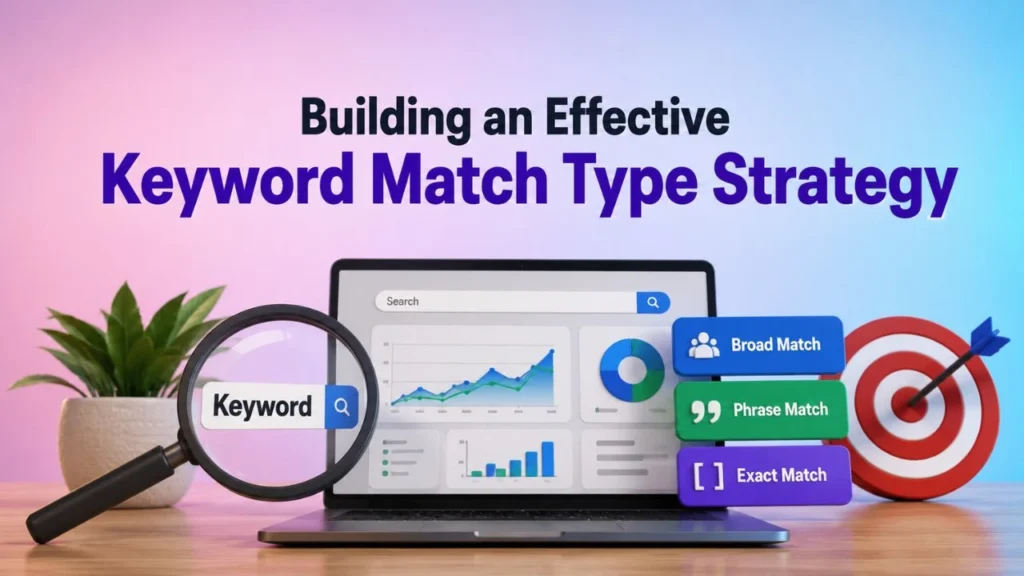
A strong strategy includes:
Research
Understand audience search behavior.
Testing
Experiment with different match types.
Monitoring
Review campaign performance frequently.
Optimization
Adjust based on real-world data.
Expansion
Scale successful keyword groups gradually.
Future of PPC Keyword Match Types
Search advertising continues to evolve.
Artificial intelligence now plays a larger role in:
- Query matching
- Audience targeting
- Bid management
- Campaign optimization
AI Driven Search Advertising
Modern search engines increasingly focus on:
- User intent
- Contextual relevance
- Behavioral signals
- Predictive modeling
Advertisers who understand keyword match types will be better positioned to benefit from these advancements.
Voice Search and Match Types
Voice searches tend to be:
- Longer
- More conversational
- Question based
Phrase Match and Broad Match often capture these searches effectively.
Examples:
- What is the best PPC agency near me?
- How much do PPC services cost?
- Which keyword match type improves ROI?
As voice search grows, semantic keyword targeting becomes increasingly important.
Best Practices for Maximizing PPC ROI
Use Multiple Match Types
Avoid depending on a single match type.
Build Negative Keyword Lists
Continuously eliminate irrelevant searches.
Focus on Search Intent
Intent often matters more than volume.
Analyze Search Term Reports Weekly
Regular reviews improve campaign efficiency.
Improve Landing Page Experience
Strong landing pages increase conversion rates.
Track Conversion Data
Data driven decisions consistently outperform assumptions.
Test and Optimize
Continuous optimization is essential for long-term success.
Conclusion
Understanding PPC keyword match types is fundamental to building profitable paid advertising campaigns. The right keyword strategy helps ensure your ads appear before the right audience at the right time while minimizing wasted spend.
Broad Match provides reach and discovery opportunities. Phrase Match delivers a balance between scale and relevance. Exact Match offers precision and strong conversion potential. Negative keywords protect your budget and improve overall campaign efficiency.
Successful advertisers rarely rely on a single approach. Instead, they strategically combine multiple Google Ads match types, monitor performance, analyze search queries, and continuously optimize their campaigns.
As search engines become more intelligent and user behavior evolves, mastering PPC keyword match types will remain a critical skill for digital marketers seeking higher visibility, stronger conversions, and improved PPC ROI. By focusing on intent, relevance, and continuous optimization, you can create campaigns that deliver sustainable growth and long-term advertising success.
Frequently Asked Questions
What are PPC keyword match types?
PPC keyword match types are settings that determine how closely a user’s search query must match your chosen keyword before an ad is displayed.
Which keyword match type generates the best PPC ROI?
Exact Match often generates the highest PPC ROI because it targets highly relevant searches with strong purchase intent.
Are Google Ads match types still important?
Yes. Although search engines use advanced AI systems, match types remain essential for controlling relevance, budget, and targeting precision.
Should beginners use Broad Match?
Broad Match can be useful for discovering new opportunities, but it should be paired with negative keywords and careful monitoring.
What is the difference between Phrase Match and Exact Match?
Phrase Match allows searches that contain the meaning of the keyword phrase, while Exact Match focuses on searches closely aligned with the specific keyword.
How do negative keywords improve campaign performance?
Negative keywords prevent ads from appearing for irrelevant searches, reducing wasted spending and improving PPC ROI.
Can I use multiple match types together?
Yes. Many successful PPC campaigns combine Broad Match, Phrase Match, and Exact Match to maximize reach while maintaining control.
How often should keyword match types be reviewed?
Campaign performance should be reviewed weekly, while deeper keyword analysis should occur at least monthly.
Do keyword match types affect Quality Score?
Indirectly, yes. Better targeting often improves ad relevance, CTR, and landing page engagement, which contribute to Quality Score.
How do search ads keywords influence conversions?
Relevant search ads keywords connect advertisers with users who are actively searching for products or services, increasing conversion opportunities.