Search behavior has changed. People no longer type only two or three words and leave after reading one short answer. They compare services, ask detailed questions, check pricing intent, look for local options, use voice assistants, and read several pages before making a decision. That is why topical clustering content has become more useful than the old habit of writing one article around one keyword.
For a digital marketing website, this shift matters even more. A visitor may first search for SEO basics, then read about local SEO, technical audits, content planning, Google Business Profile, link building, conversion tracking, and finally choose a service provider. If your website has disconnected blog posts, users may not find a clear path. If your website uses connected topic groups, each page can support the next step in the buyer journey.
Old keyword SEO was mostly about ranking one page for one phrase. Modern SEO is about proving subject depth, answering related questions, and helping search engines understand how your pages connect. This is where a stronger SEO content strategy can make your blog more useful, more organized, and more visible.
Table of Contents
What Changed in SEO?
Search engines have become better at understanding meaning, intent, and context. They do not only look at repeated words on a page. With semantic SEO entity optimization, they also evaluate whether the content explains a topic clearly and whether related pages support that topic.
In the past, a website could publish separate posts for similar keywords such as “SEO tips,” “SEO guide,” and “SEO strategy.” Many of those pages would compete with each other. Today, that approach can confuse both users and search engines.
A better method is to group related ideas under one clear structure. For example, a digital marketing website can create one main page on SEO services and support it with pages about technical SEO, local SEO, ecommerce SEO, content optimization, SEO audits, and reporting. This makes the website feel complete and easier to explore.

What Is Topical Clustering Content?
Topic content planning is a method where one main subject is supported by related subtopics. The main subject usually sits on a pillar page. The supporting articles explain specific parts of that subject and link back to the main page.
In topic clusters SEO, this structure helps a website show depth. Instead of publishing random blogs, you create a connected content system. Users can move from a broad idea to a specific answer without leaving your website.
Core Parts of a Topic Cluster
A strong topic cluster usually includes:
- A pillar page that explains the main topic
- Supporting articles that answer related questions
- Clear links between the main page and supporting pages
- Search intent mapping for each article
- Fresh updates when user behavior changes
For digital marketing services, this method works well because every service has several connected topics. SEO is connected with content, technical fixes, local visibility, analytics, and conversions. PPC is connected with landing pages, ad copy, tracking, and lead quality. A cluster structure helps you explain these relationships clearly.
Why the Old Keyword Approach Is Not Enough
The old keyword approach focused too much on exact phrases. Writers often created content because a keyword had search volume, not because the topic served a clear purpose. This created many weak pages with repeated ideas.
For example, a website might publish separate articles on “SEO checklist,” “SEO audit checklist,” and “technical SEO checklist” without explaining how these pages connect. This can create keyword cannibalization, where multiple pages compete for similar search intent.
Keyword research is still important, but it should not control the entire plan. It should support a wider content structure. The goal is not to use a keyword many times. The goal is to answer the real question behind the search.
Old Keyword SEO vs Topic Based Planning
| Factor | Old Keyword Approach | Topic Based Planning |
|---|---|---|
| Main goal | Rank one page for one phrase | Build depth around a complete topic |
| Content structure | Separate articles | Connected pillar and support pages |
| User journey | Often broken | Easier to follow |
| Internal links | Added randomly | Planned with purpose |
| Search intent | Often narrow | Covers several stages |
| Business value | Limited | Supports service pages |
| AI readiness | Weak | Better for direct answers |
Why Topic Groups Work Better for Digital Marketing Websites
Digital marketing is not a single action. A business owner looking for SEO may also need content planning, website fixes, local visibility, conversion improvement, or paid ads. If your blog covers these topics in a connected way, it becomes more useful.
Better Support for Service Pages
A service page alone cannot answer every user question. If you offer local SEO, users may also want to know about Google Business Profile, reviews, citations, map rankings, local landing pages, and NAP consistency. Supporting blogs can explain these points and guide readers back to the service page.
This helps create better service page relevance without making the service copy too long or repetitive.
Stronger Topical Authority
Topical authority grows when your website covers a subject from different useful angles. A digital marketing site that explains SEO audits, content planning, link building, local search, technical fixes, reporting, and user intent sends a stronger signal than a site with only one general SEO page.
The benefit is not only for search engines. Users also trust websites that answer their next question before they need to search again.
Better Internal Linking
A planned internal linking strategy helps users and search engines move through your content. When each supporting blog links to the right main page, your website structure becomes easier to understand.
For example, a blog on Core Web Vitals can link to a technical SEO service page. A post on Google reviews can link to a local SEO service page. A guide on landing page conversion can link to performance marketing or PPC services. These links create clear paths from learning to action.

The Role of Semantic SEO and Keyword Grouping
Semantic SEO focuses on meaning, not only exact words. It helps content cover related concepts, questions, entities, and user needs. This is important because two users may search differently but want the same answer.
Keyword clustering helps group related phrases under one content theme. Instead of writing ten weak posts, you can build one strong page and several useful support pages. This reduces overlap and improves clarity.
A content clustering strategy also helps you decide what should become a pillar page and what should become a supporting article. For a digital marketing website, this can prevent confusion between SEO service pages, blog guides, and comparison content.
Sample Content Cluster for Digital Marketing Services
| Main Topic | Supporting Content Ideas | Business Purpose |
|---|---|---|
| SEO Services | SEO audit, technical SEO, local SEO, ecommerce SEO | Support organic service visibility |
| Content Marketing | Blog planning, content optimization, content calendar | Support authority and lead education |
| PPC Advertising | Google Ads setup, landing pages, tracking | Support paid lead generation |
| Local SEO | Google Business Profile, citations, reviews | Support local service discovery |
| AI Visibility | AEO, GEO, structured answers | Support future search behavior |
How to Build a Topical Clustering Content Step by Step
Step 1: Choose a Core Service Topic
Start with a topic that connects directly with your business. For a digital marketing agency, this could be SEO, local SEO, PPC, content marketing, web design, or online reputation management.
The chosen topic should have enough depth to support several articles within your content marketing strategy. If the topic is too narrow, it may not need a full cluster.
Step 2: Understand Search Intent
Search intent optimization helps you understand why someone is searching. A user searching “what is SEO” needs education. A user searching “best SEO service provider” is closer to taking action. A user searching “local SEO cost” may be comparing options.
Your cluster should include content for different stages of intent. This gives users a smoother path from awareness to decision.
Step 3: Create a Strong Pillar Page
A pillar page should explain the main topic in a complete but easy to read way. It should introduce the core service, explain benefits, answer basic questions, and link to deeper supporting pages.
A pillar page strategy works best when it is planned before writing support articles. This keeps the full content structure organized from the start.
Step 4: Write Useful Supporting Pages
Topical Clustering Content should answer specific questions in detail. Each support page should have a clear purpose. Do not repeat the same points across multiple blogs.
For example, if your pillar page is about SEO services, the support pages can cover SEO audits, technical SEO, local search, ecommerce SEO, link building, and content planning.
Step 5: Link Pages With Clear Purpose
Every internal link should help the reader. Do not add links only for SEO. Link from broad pages to detailed pages, from detailed pages back to pillar pages, and between related support pages when it adds value.
This is where your internal linking strategy becomes part of the user experience.
Step 6: Review and Update Existing Content
Many digital marketing blogs already have useful posts, but they are often not connected. Review old content and place each article into a cluster. For better content decay SEO refresh, merge overlapping pages, improve thin content, and add clear links where needed.
This improves your digital marketing content strategy without always needing to publish new articles.

How Topic Groups Help AI Search, Answer Engines and Voice Search
Search is changing because users now receive answers from AI tools, snippets, voice assistants, and search result summaries. Content needs to be clear, direct, and well structured.
AI search optimization works better when your pages explain topics in a connected and complete way. With structured data AI AEO, clear headings, short answers, helpful definitions, and related support pages make it easier for systems to understand your content.
Answer engine optimization also benefits from direct answers. Add short definitions, FAQ sections, comparison tables, and step by step explanations. This helps your content respond to specific questions.
Voice search SEO needs natural language. People ask voice assistants full questions such as “How does topic clustering help SEO?” or “Why is keyword based content not enough?” Your headings and answers should match this style.
Voice Search Questions to Include
- What is a topic cluster in SEO?
- Why are topic clusters better than old keyword planning?
- How can a digital marketing agency use content groups?
- How many support pages should one pillar page have?
- How does content structure improve service page ranking?
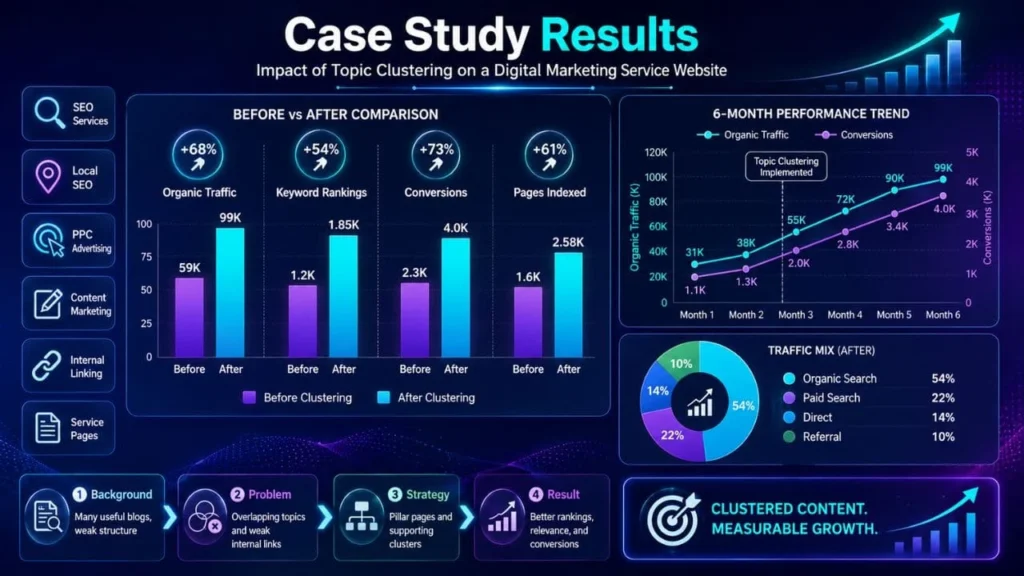
Case Study: Topic Clustering for a Digital Marketing Service Website
Background
A digital marketing service website had many blogs about SEO, paid ads, content, and local search. The articles had useful information, but they were not planned as a connected system. Several posts targeted similar ideas, and many had no clear links to service pages.
Problem
The website faced four common issues:
- Similar pages competed with each other
- Blog traffic did not move toward service pages
- Important service pages had weak supporting content
- Users could not easily find the next useful article
Strategy Applied
The topical clustering content team reviewed all existing blogs and grouped them by service theme. They created main content hubs for SEO, local SEO, PPC, and content marketing. Then they connected each supporting article to the most relevant main page.
They also improved headings, added FAQs, updated outdated paragraphs, and removed repeated sections. The focus shifted from writing more pages to organizing existing pages better.
Result
After the new structure was applied, the website had clearer content paths. Service pages received stronger support from blog articles. Users could move from educational content to relevant service pages more naturally. Search engines could also understand which pages were most important within each service category.
This case study shows that content hub SEO is not only about publishing more. It is about organizing what you already have and filling real content gaps.

Common Mistakes to Avoid
Creating Too Many Similar Pages
Do not create several pages for the same intent. Similar pages can weaken performance and confuse search engines. It is better to create one strong page and link related support content around it.
Ignoring Business Goals
Every topic should connect with a user need or business goal. A digital marketing blog should not chase keywords that do not relate to services, leads, or audience education.
Adding Links Without Context
Internal links should feel natural. Link only when the target page helps the reader understand the topic better or take the next useful step.
Writing for Bots Instead of People
Search engines reward content that helps people. Use clear language, direct answers, and logical structure. Avoid stuffing keywords into every paragraph.
FAQ
Q: What is topic based content planning?
Ans: It is a way to organize articles around a main subject and its related subtopics. It helps users find complete answers and helps search engines understand how pages are connected.
Q: Why does it beat the old keyword approach?
Ans: It works better because it focuses on topic depth, user intent, page relationships, and helpful answers instead of repeating one phrase across a page.
Q: Is keyword research still useful?
Ans: Yes. Keyword research is still useful for finding demand and language patterns. However, it should support topic planning, not replace it.
Q: How many support pages should a pillar page have?
Ans: There is no fixed number. A service topic may need five, ten, or more support pages depending on user questions, competition, and business goals.
Q: How can this help a digital marketing website?
Ans: It can help service pages gain stronger support, improve blog structure, reduce overlap, and guide readers from learning to enquiry.
Conclusion
The old keyword approach is not completely useless, but it is no longer enough for modern SEO. Search engines and users both expect deeper, clearer, and better connected content.
Topical clustering content helps digital marketing websites build authority, organize service related topics, improve internal links, and answer more user questions. When combined with search intent, useful supporting pages, and regular updates, it becomes a smarter way to grow organic visibility.
For digital marketing services, the goal is simple. Do not publish random blogs only because keywords have volume. Build connected topic groups that help users learn, compare, and take the next step with confidence.