Service businesses often invest significant time and resources into acquiring clients and delivering measurable results. However, many fail to maximize the SEO potential of the success stories they create. A well-structured case study page can do much more than showcase results. It can attract qualified organic traffic, build trust, support conversions, and strengthen topical authority.
This is where Case Study Page SEO becomes essential.
When optimized correctly, case study pages can rank for commercial and informational search queries, help AI search systems understand your expertise, and provide valuable proof that influences buying decisions. As search engines increasingly prioritize experience, expertise, authority, and trustworthiness, proof based content has become a powerful asset for service brands.
In this guide, we will explore how Case Study Page SEO works, why it matters, and how you can optimize your service brand case studies and proof pages to achieve better visibility across traditional search engines, AI search platforms, and voice search systems.
Table of Contents
What Is Case Study Page SEO?
Case Study Page SEO refers to the process of optimizing case study content so it can rank in search engines while simultaneously demonstrating expertise and delivering proof of results.
Traditional case studies are often created solely for sales purposes. They focus on outcomes but rarely consider search intent, keyword optimization, internal linking, structured content, or technical SEO.
SEO focused case studies are different.
They are designed to satisfy both search engines and users. They combine storytelling, data, strategic keyword usage, and user experience elements to create pages that attract traffic and convert visitors.
Why Service Brands Need SEO Optimized Case Studies?
Many service providers compete in crowded industries where trust plays a major role in decision making. Potential clients want evidence before making a purchase.
Service brand case studies provide that evidence.
By showcasing processes, challenges, solutions, and measurable outcomes, these pages help visitors understand how a service provider approaches problems and delivers results.
From an SEO perspective, they also create opportunities to target industry specific keywords, long tail search terms, and intent driven queries.
How Search Engines Evaluate Proof Pages
Search engines assess proof pages using multiple signals, including:
- Content relevance
- Topical depth
- User engagement
- Internal linking structure
- Page experience
- Authority signals
- Structured data implementation
The more comprehensive and valuable your proof pages are, the more likely they are to rank for relevant searches.
Why Case Study Pages Matter for Digital Marketing SEO?
Case studies are often overlooked in content marketing strategies. Many businesses focus heavily on blogs, service pages, and landing pages while ignoring the ranking potential of proof driven content.
Building Trust Through Real Results
- Trust is one of the strongest conversion drivers in digital marketing.
- Visitors want evidence that a service provider can solve their problems. Service brand case studies provide tangible proof of expertise and performance.
- When users see documented outcomes, they gain confidence in the service being offered.
Supporting Commercial Intent Searches
Many searchers actively look for proof before making a purchasing decision.
They may search for phrases related to:
- SEO results
- marketing outcomes
- lead generation performance
- campaign success stories
A properly optimized case study SEO strategy allows brands to capture this intent and guide visitors toward conversion.
Strengthening Brand Authority
- Authority is increasingly important in modern search.
- Publishing well documented proof pages demonstrates industry knowledge, experience, and problem solving capabilities.
- This strengthens overall website authority and supports rankings across related topics.
Helping AI Search Systems Understand Expertise
- AI powered search platforms analyze content differently from traditional search engines.
- They look for clear evidence of expertise, contextual relevance, and authoritative information.
- Case studies naturally contain these elements, making them valuable assets for AI search optimization.
SEO Benefits of Service Brand Case Studies
A strategic approach to Case Study Page SEO can deliver benefits beyond lead generation.
Higher Topical Authority
- Topical authority refers to a website’s perceived expertise within a subject area.
- Case studies help reinforce topic clusters by providing practical demonstrations of knowledge and execution.
For example, if your website covers SEO services, content marketing, and lead generation, related case studies strengthen those topic areas.
Better Long Tail Keyword Coverage
- Case studies often naturally include highly specific search phrases.
- These long tail keywords may have lower competition and stronger commercial intent compared to broader terms.
- As a result, case study SEO can help attract highly qualified traffic.
Increased Organic Visibility
- Optimized service brand case studies can rank independently in search results.
- Instead of relying solely on service pages and blogs, businesses gain additional entry points into search engines.
- This expands overall visibility and traffic potential.
Improved User Engagement
- Users frequently spend more time reading case studies than traditional sales content.
- They want to understand challenges, strategies, and outcomes.
- Longer engagement signals can contribute to improved user experience metrics.
Enhanced Lead Generation
- Proof pages often sit closer to the bottom of the marketing funnel.
- Visitors reading them are typically evaluating options and seeking validation.
- This makes case studies powerful tools for lead generation and conversion optimization.
Keyword Research for Case Study Page SEO
Effective optimization begins with understanding how people search.
Primary Keywords
The primary keyword for this topic is:
Case Study Page SEO
This keyword should appear naturally throughout the content, including:
- Title tag
- Introduction
- Key headings
- Conclusion
- Image alt text where appropriate
The supporting keyword case study SEO should also be integrated naturally.
Supporting Semantic Keywords
Modern search engines rely heavily on semantic understanding.
Relevant supporting terms include:
- service brand case studies
- proof pages
- client success stories
- SEO case studies
- digital marketing case studies
- conversion focused content
- authority building content
- trust signals
Using related phrases helps search engines understand context while improving topical coverage.
Search Intent Mapping
- Different users have different goals.
- Some want to learn about case study SEO.
- Others may want to optimize existing proof pages.
Understanding intent allows content creators to structure information effectively and improve relevance.
Voice Search Opportunities
Voice searches tend to be conversational.
Examples include:
- How do I optimize a case study page?
- What is Case Study Page SEO?
- Why are service brand case studies important?
Including question based headings increases the likelihood of appearing in voice search results.
Essential Structure of an SEO Optimized Case Study Page
A well structured page improves both user experience and search visibility.
Compelling Headline
- The headline should clearly communicate value and include relevant keywords where appropriate.
- Readers should immediately understand what the case study covers.
Executive Summary
- Many users prefer quick insights before reading detailed content.
- An executive summary provides an overview of the challenge, strategy, and results.
Challenge Section
- This section explains the problem that needed solving.
- Clearly defining the challenge helps create context for the solution.
Strategy Section
- The strategy section outlines the approach taken to address the challenge.
- This demonstrates expertise and builds credibility.
Implementation Process
- Documenting the execution process provides transparency and educational value.
- It also supports experience based content signals.
Results and Outcomes
- Results are often the most important part of service brand case studies.
- Where possible, outcomes should be measurable and clearly presented.
Key Takeaways
Summarizing lessons learned improves usability and enhances reader engagement.
Strong Call to Action
Every proof page should guide visitors toward a logical next step.
This may include:
- Contacting your team
- Requesting a consultation
- Exploring related services
- Reading additional resources
On Page SEO Best Practices for Case Study SEO
Creating a strong case study is only part of the process. To maximize visibility, every page should follow proven on page SEO practices.
Optimize Title Tags
The title tag is often the first thing users see in search results. It should clearly communicate the page topic while incorporating the primary keyword naturally.
A strong title can improve click through rates and help search engines understand page relevance.
Write Compelling Meta Descriptions
Meta descriptions may not directly influence rankings, but they can significantly impact clicks.
An effective description should:
- Summarize the page value
- Include important keywords naturally
- Encourage users to visit the page
- Match search intent
Use SEO Friendly URLs
- URLs should be concise, descriptive, and easy to understand.
- Instead of long, complex structures, create URLs that clearly indicate the topic of the page.
- Simple URLs improve user experience and make content easier to share.
Optimize Header Structure
A logical heading hierarchy helps both users and search engines.
Use:
- H1 for the main page topic
- H2 for major sections
- H3 for supporting subsections
- H4 where additional detail is required
Proper structure improves readability and content organization.
Improve Image SEO
Case studies often contain screenshots, graphs, reports, and visual data.
Optimize images by:
- Compressing file sizes
- Using descriptive file names
- Adding relevant alt text
- Improving loading speed
Image optimization contributes to overall page performance and accessibility.
Add Strategic Internal Links
Internal linking helps distribute authority throughout the website.
Relevant links can connect case studies to:
- Service pages
- Related blog posts
- Industry guides
- Resource centers
This strengthens content relationships and improves crawlability.
Include Relevant External References
- Where appropriate, linking to authoritative resources can improve credibility.
- External references should support the content and provide additional value to readers.
How to Optimize Proof Pages for Better Search Visibility?
Proof pages serve a unique role within a service website. They combine trust building with search visibility.
What Are Proof Pages?
Proof pages are content assets designed to demonstrate expertise and results.
They may include:
- Case studies
- Client achievements
- Performance reports
- Industry outcomes
- Success documentation
These pages help validate claims made elsewhere on the website.
Why Proof Pages Matter for SEO
- Search engines increasingly prioritize content that demonstrates real world experience.
- Proof pages provide evidence that supports expertise and authority.
- This makes them valuable components of a modern SEO strategy.
Incorporate Trust Signals
Trust signals help strengthen credibility.
Examples include:
- Measurable outcomes
- Process explanations
- Industry experience
- Client testimonials
- Data driven insights
Strong trust signals can positively influence both user perception and search performance.
Differentiate Proof Pages From Testimonials
- Testimonials focus on opinions.
- Proof pages focus on documented outcomes.
- While both are useful, proof pages generally provide greater SEO value because they contain richer content and deeper topical coverage.
Connect Proof Pages to Conversion Funnels
Proof pages should not exist in isolation.
They should support the broader customer journey by connecting users to:
- Service pages
- Contact forms
- Consultation requests
- Industry resources
This improves both engagement and conversion opportunities.
E-E-A-T Strategies for Case Study Page SEO
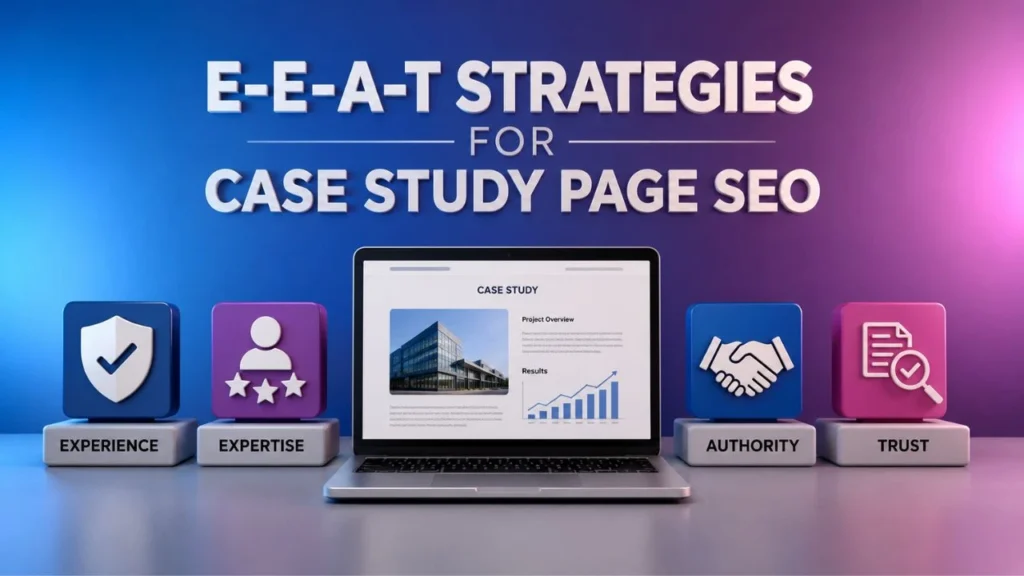
Experience, Expertise, Authoritativeness, and Trustworthiness continue to play an important role in search quality evaluation.
Demonstrate Experience
Case studies naturally showcase practical experience.
Explain:
- The challenge addressed
- The strategy used
- The implementation process
- The outcomes achieved
Detailed documentation helps establish first hand experience.
Highlight Expertise
- Expertise is demonstrated through knowledge, methodology, and insights.
- Avoid generic statements.
- Instead, provide detailed explanations that showcase professional understanding.
Build Authority
- Authority develops when a website consistently publishes valuable, accurate, and relevant information.
- Service brand case studies contribute to authority by reinforcing expertise across specific topics.
Strengthen Trustworthiness
Trust is often the deciding factor in service based purchasing decisions.
Trustworthiness can be improved through:
- Accurate information
- Clear methodologies
- Transparent reporting
- Consistent branding
- Helpful content
The stronger your trust signals, the more persuasive your proof pages become.
Structured Data and Schema for Case Study SEO
Schema markup helps search engines understand content more effectively.
Why Structured Data Matters
- Structured data provides additional context about a page.
- This can improve content interpretation and support enhanced search visibility.
Useful Schema Types
Article Schema
Suitable for educational and informational case study content.
Organization Schema
Helps connect content with the business behind it.
FAQ Schema
Supports question based content and may improve visibility for FAQ sections.
Review Schema
Can be useful when incorporating verified review related content.
Benefits for AI Search Systems
- AI powered search tools often rely on structured information.
- Schema markup can help these systems understand page context, relationships, and relevance more accurately.
AI Search Optimization for Case Study Pages
- Search is evolving rapidly.
- AI powered systems increasingly generate answers using information gathered from trusted content sources.
Create Clear Information Architecture
AI systems perform best when content is logically organized.
Use:
- Clear headings
- Concise summaries
- Structured sections
- Well organized information
This improves content retrieval and understanding.
Focus on Entities
- Entity SEO is becoming increasingly important.
- Instead of focusing only on keywords, cover related concepts, topics, and industry terminology.
- This helps search engines understand broader subject relevance.
Build Context Around Results
AI search platforms look for context.
Explain:
- What happened
- Why it happened
- How it happened
- What was learned
Context improves information quality and retrieval potential.
Answer Common Questions
- Question based content increases opportunities for AI generated citations.
- Consider incorporating answers to common industry questions throughout the page.
Voice Search Optimization for Service Brand Case Studies
Voice search continues to influence content creation strategies.
Use Conversational Language
- Voice queries tend to be natural and conversational.
- Content should answer questions directly while maintaining readability.
Include Question Based Headings
Examples include:
- What is Case Study Page SEO?
- How do proof pages improve rankings?
- Why are service brand case studies important?
These formats align closely with voice search behavior.
Provide Direct Answers
- Many voice search responses come from concise answer sections.
- Providing clear explanations improves visibility opportunities.
Internal Linking Strategies for Case Study Page SEO
Internal linking remains one of the most effective SEO techniques.
Connect Service Pages
- Case studies should support relevant service offerings.
- This creates stronger topic relationships across the website.
Support Topic Clusters
- Case studies can strengthen broader content clusters by linking related educational content.
- This helps reinforce topical authority.
Improve User Navigation
Strategic links help users discover additional resources and stay engaged longer.
Better navigation often leads to improved user experience.
Common Case Study SEO Mistakes to Avoid
Even strong content can underperform if critical mistakes are present.
Thin Content
- Short, low value case studies rarely perform well in search results.
- Comprehensive coverage typically generates stronger outcomes.
Missing Data
- Unsupported claims reduce credibility.
- Where possible, provide measurable insights and clear outcomes.
Weak Internal Linking
Without internal links, case studies may struggle to contribute to overall site authority.
Poor User Experience
Slow loading pages, cluttered layouts, and difficult navigation can negatively impact engagement.
Ignoring Search Intent
- Every page should satisfy a specific user need.
- Understanding intent helps create more relevant and valuable content.
Measuring Success of Case Study Page SEO
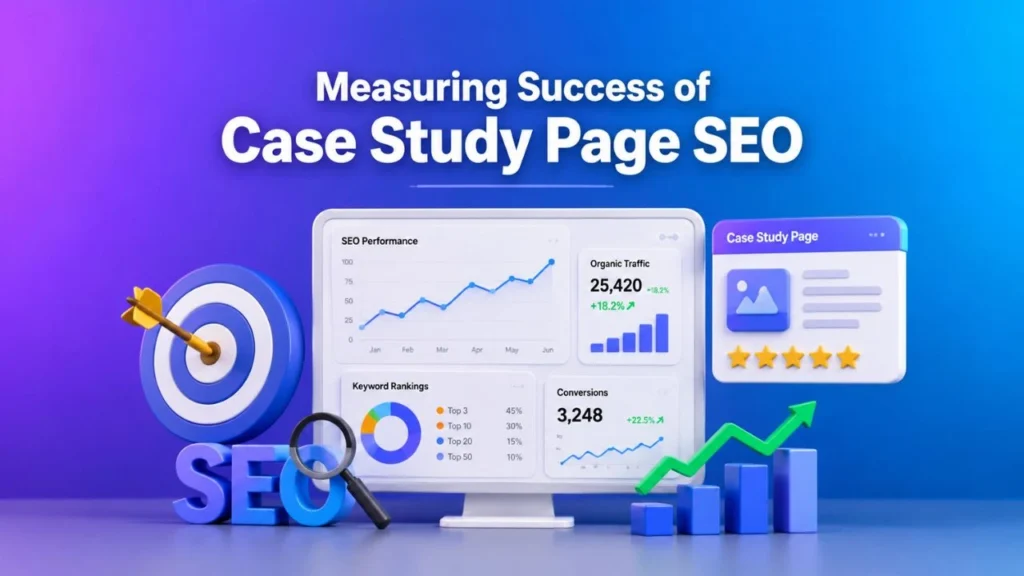
Tracking performance helps identify opportunities for improvement.
Organic Traffic
Monitor how much search traffic reaches your case study pages.
Keyword Rankings
Track target keywords and related search terms.
Engagement Metrics
Evaluate:
- Time on page
- Scroll depth
- Bounce rate
- User interactions
Conversion Metrics
Measure actions such as:
- Form submissions
- Consultation requests
- Service inquiries
Assisted Conversions
- Case studies often influence purchasing decisions even when they are not the final touchpoint.
- Tracking assisted conversions provides a more complete performance picture.
Conclusion
Case Study Page SEO has become an essential component of modern digital marketing. Search engines, AI search systems, and potential clients all look for evidence before making decisions. Well optimized service brand case studies provide that evidence while creating valuable opportunities for organic visibility.
By combining strategic keyword optimization, strong content structure, internal linking, EEAT principles, structured data, and user focused design, businesses can transform ordinary proof pages into powerful SEO assets.
As search continues to evolve, proof driven content will play an increasingly important role in demonstrating expertise and earning visibility. Organizations that invest in high quality case study SEO today will be better positioned to build trust, strengthen authority, and attract qualified leads tomorrow.
Frequently Asked Questions
What is Case Study Page SEO?
Case Study Page SEO is the process of optimizing case studies to improve search visibility, user engagement, and lead generation while demonstrating expertise and results.
How does case study SEO improve rankings?
Case study SEO improves rankings by enhancing content relevance, strengthening topical authority, supporting internal linking, and providing valuable proof based content.
Why are service brand case studies important?
Service brand case studies build trust, showcase expertise, and provide evidence that supports purchasing decisions.
What are proof pages?
Proof pages are content assets that demonstrate experience, expertise, and measurable outcomes through documented results.
Can proof pages rank in search engines?
Yes. Well optimized proof pages can rank for informational, commercial, and long tail search queries.
How often should case studies be updated?
Updating case studies periodically ensures accuracy, freshness, and continued relevance.