In today’s search landscape, ranking a service page requires much more than inserting keywords into headings and content. Search engines have become increasingly sophisticated in understanding what users are actually looking for when they type a query. This shift has made Search Intent SEO one of the most important elements of successful digital marketing.
Whether you offer digital marketing services, SEO consulting, web design, PPC management, content marketing, or any other professional service, understanding user behavior can significantly improve your visibility. Businesses that focus on search intent optimization often achieve better rankings, stronger engagement, and higher conversions because their content aligns with what users genuinely need.
The goal of modern SEO is not simply to rank pages. It is to provide the most relevant answer to a user’s query. When your content matches user search intent, search engines are more likely to reward your pages with improved visibility and stronger positions in search results.
In this guide, we will explore how Search Intent SEO influences service page rankings and how digital marketers can leverage intent-driven strategies to create pages that both rank and convert.
Table of Contents
What Is Search Intent SEO?
Search Intent SEO refers to the process of creating and optimizing content based on the reason behind a user’s search query. Instead of focusing solely on keywords, marketers analyze the purpose of a search and develop content that fulfills that purpose.
For example, someone searching for:
- “What is local SEO?” is seeking information.
- “Best local SEO services” is comparing providers.
- “Hire local SEO agency” is ready to take action.
Although these searches may appear similar, the intent behind them differs significantly.
Understanding these differences helps marketers create content that aligns with search query intent, resulting in stronger rankings and improved user satisfaction.
Understanding User Search Intent
Every search begins with a need.
People search because they want to learn something, compare options, find a specific website, or complete a purchase. Search engines analyze these patterns to determine which pages deserve to rank.
This is why search intent in SEO has become a fundamental ranking consideration.
When users find exactly what they need on a page, they are more likely to:
- Stay longer
- Engage with content
- Explore additional pages
- Submit inquiries
- Convert into customers
These positive interactions strengthen user engagement signals that search engines use to evaluate page quality.
Why Search Intent Matters More Than Keywords Alone?
Traditional SEO often emphasized keyword frequency and exact-match phrases. While keywords remain important, modern algorithms place greater emphasis on relevance.
Search engines evaluate:
- Content relevance
- Keyword relevance
- Topical relevance
- User satisfaction
- Search experience optimization
A page that accurately addresses user needs often outperforms a page that simply repeats keywords.
This is why businesses that invest in intent based SEO frequently achieve better results than those relying solely on conventional keyword targeting.
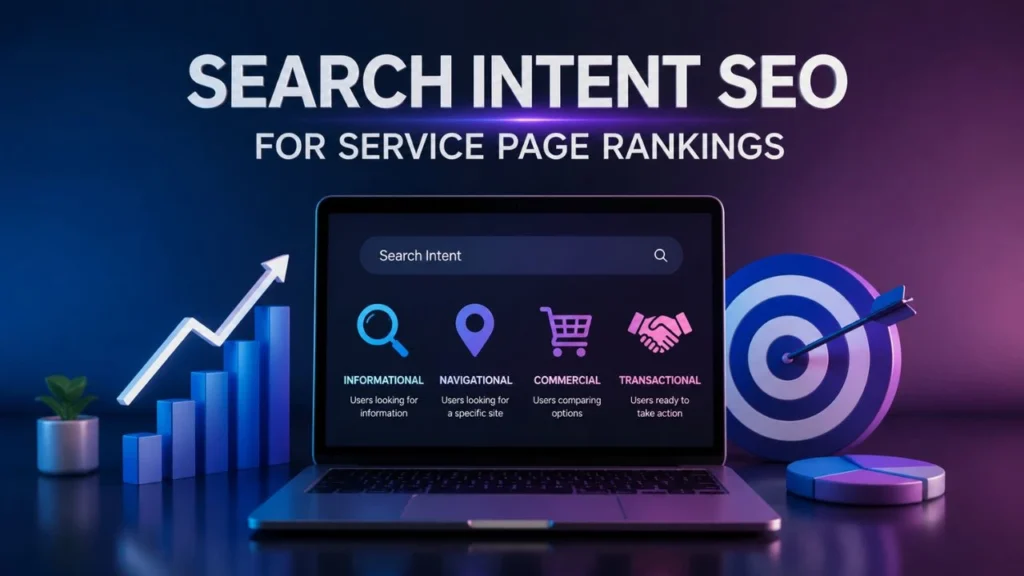
Quick Overview of Search Intent Types
| Search Intent Type | User Goal | Example Query | Service Page Opportunity |
| Informational Intent | Learn something | What is technical SEO | Educational content |
| Navigational Intent | Find a specific website | SEO agency login | Brand pages |
| Commercial Intent | Compare options | Best SEO services | Comparison pages |
| Transactional Intent | Take action | Hire SEO consultant | Service pages |
| Local Search Intent | Find nearby services | SEO company near me | Local service pages |
Understanding these intent categories helps create a more effective SEO search intent strategy.
Why Search Intent SEO Matters for Service Page Rankings
- Many businesses struggle to rank service pages because they focus on what they want to promote rather than what users want to find.
- Search engines prioritize pages that provide the best solution for a particular query.
- When your service page aligns with user intent, several benefits emerge.
Better Content Relevance
- Search engines constantly assess whether a page answers a searcher’s question.
- When content demonstrates strong content relevance, it becomes easier for search engines to understand its purpose and value.
Relevant content naturally supports:
- Better rankings
- Improved engagement
- Higher trust signals
Stronger User Engagement Signals
User engagement plays a critical role in modern SEO.
Positive engagement signals include:
- Longer session duration
- Increased page views
- Higher click-through rates
- Lower bounce rates
When users find exactly what they expect, engagement naturally improves.
Higher Conversion Rates
- Service pages designed around audience intent often generate more inquiries and leads.
- This happens because visitors are guided through a logical decision-making process rather than being overwhelmed with promotional messaging.
- The result is more effective SEO conversion optimization and stronger business outcomes.
Improved Search Engine Rankings
Search engines continuously analyze user interactions.
Pages that consistently satisfy users tend to earn:
- Higher keyword rankings
- Better SERP performance
- Increased organic visibility
- Sustainable organic traffic growth
This demonstrates how Search Intent SEO directly influences ranking potential.
How Search Intent Affects Service Page Rankings?
One of the most important questions marketers ask is:
- How does search intent affect service page rankings?
- The answer lies in Google’s primary objective: delivering the most useful result for every search.
Google’s Goal: Matching Search Intent
Google’s algorithms are designed to identify the most relevant content for a query.
The search engine evaluates:
- Topic relevance
- Content depth
- User satisfaction
- Search behavior patterns
When your content succeeds in matching search intent, search engines gain confidence that your page deserves visibility.
For service businesses, this means creating pages that answer questions, address concerns, and guide visitors toward appropriate actions.
The Relationship Between Search Intent and Search Ranking Factors
Many important search ranking factors are indirectly influenced by search intent.
These include:
Click Through Rate Optimization
A page title that aligns with user intent typically attracts more clicks.
User Engagement Signals
Relevant content encourages visitors to stay longer and interact with the page.
Content Quality Signals
Search engines evaluate whether content is comprehensive, useful, and trustworthy.
Search Experience Optimization
A positive user experience strengthens overall ranking potential.
Collectively, these signals help improve search rankings over time.
Search Intent and Conversion Optimization
Ranking alone is not enough. The ultimate goal of service page SEO is converting visitors into leads or customers.
When pages address genuine needs, users are more likely to:
- Request consultations
- Contact sales teams
- Complete inquiry forms
- Schedule appointments
This connection between intent and conversions explains why search intent and conversion optimization should work together.
The Evolution of Search Intent in SEO
- SEO has changed dramatically over the last decade.
- Earlier strategies often relied heavily on exact-match keywords and backlinks. Today, understanding context has become equally important.
From Keywords to Intent
Search engines now analyze:
- Context
- Meaning
- Relationships between concepts
- User behavior
This evolution has increased the importance of:
- Semantic SEO
- Entity based SEO
- Intent driven content
Rather than evaluating isolated keywords, search engines attempt to understand the broader topic.
The Rise of Semantic SEO
Semantic SEO focuses on related concepts, topics, and entities.
For example, a page about local SEO services may naturally include terms such as:
- Google Business Profile optimization
- Local search rankings
- Location based keywords
- Geo targeted SEO
- Near me searches
Including these related concepts strengthens topical authority and helps search engines understand the page more accurately.
Why Entity Based SEO Matters?
Entity based SEO focuses on people, places, organizations, services, and concepts rather than just keywords.
For service businesses, this means creating content that clearly explains:
- Services offered
- Industries served
- Geographic areas covered
- Related marketing solutions
This approach improves contextual understanding and supports stronger rankings.
The Four Primary Types of Search Intent in SEO
- Understanding search intent categories is essential for creating effective service pages.
- Each intent type serves a different stage of the customer journey.
Informational Intent
Informational intent occurs when users want to learn something.
Examples include:
- What is SEO?
- How does local SEO work?
- What are ranking factors?
These users are not necessarily ready to buy. They are seeking knowledge.
How Informational Intent Supports Service Page SEO?
Although informational searches may not generate immediate conversions, they help businesses:
- Build authority
- Increase trust
- Generate awareness
- Attract qualified traffic
Educational content often serves as an entry point into the buyer journey.
Best Content Formats for Informational Intent
Effective formats include:
- Blog posts
- Guides
- Tutorials
- FAQs
- Industry insights
Creating content around informational intent strengthens overall SEO performance and topical authority.
Navigational Intent
Navigational intent occurs when users want to find a specific website, brand, or page.
Examples include:
- SEO agency website
- Digital marketing company contact page
- SEO services login portal
These users already know where they want to go.
Optimizing for Navigational Intent
Businesses should ensure:
- Clear site structure
- Branded landing pages
- Consistent navigation
- Accurate metadata
Strong navigational optimization improves user experience and brand visibility.
Commercial Intent
Commercial intent exists when users are evaluating options before making a decision.
Examples include:
- Best SEO agency
- Top digital marketing services
- SEO consultant reviews
This stage is highly valuable because users are actively considering solutions.
Understanding Commercial Investigation Keywords
Commercial investigation keywords indicate strong interest in purchasing but not immediate readiness.
Examples include:
- Best SEO services
- Affordable SEO packages
- SEO agency comparison
These keywords should be incorporated into content designed for evaluation and comparison.
Why Commercial Intent Matters for Service Pages?
- Commercial searches often represent highly qualified prospects.
- By addressing concerns and providing detailed information, businesses can move users closer to conversion.
Transactional Intent
Transactional intent signals readiness to act.
Examples include:
- Hire SEO consultant
- Buy SEO services
- Request SEO proposal
These searches frequently contain:
- Buyer intent keywords
- Purchase intent keywords
- Conversion focused keywords
Users conducting these searches are typically prepared to contact a provider or purchase a service.
Creating Service Pages for Transactional Intent
Effective transactional service pages should include:
- Clear value propositions
- Strong calls to action
- Transparent pricing information when appropriate
- Contact forms
- Trust indicators
This approach supports both rankings and conversions.
Conducting Keyword Intent Analysis for Service Pages
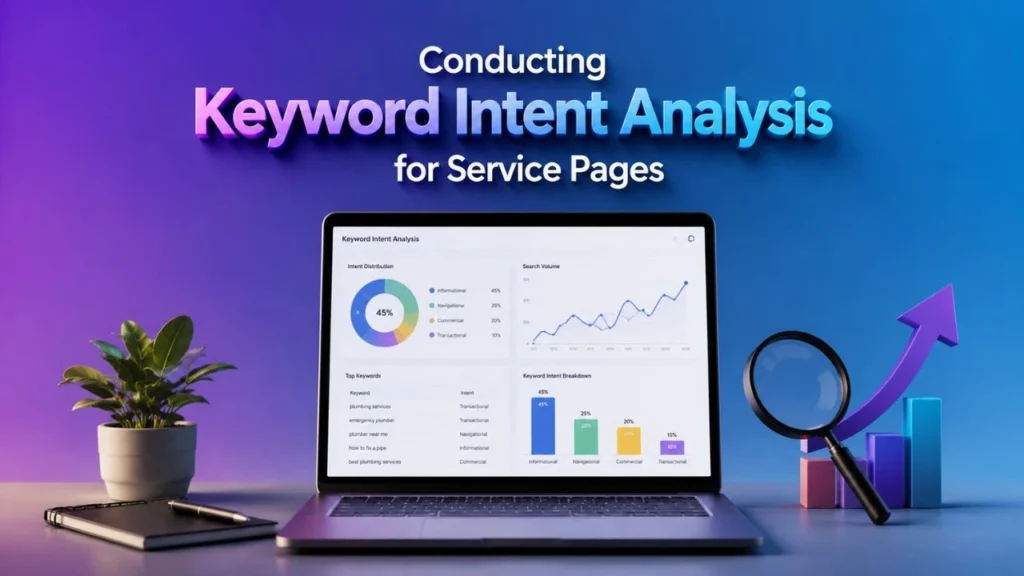
A successful Search Intent SEO strategy begins with understanding why people search for specific terms. Many marketers focus heavily on search volume and competition, but these metrics alone do not reveal what users actually want.
This is where keyword intent analysis becomes essential.
Intent analysis helps identify the motivation behind a keyword so you can create content that satisfies user expectations. When your content aligns with intent, it becomes easier to improve service page rankings, increase conversions, and strengthen overall SEO performance.
What Is Keyword Intent Analysis?
Keyword intent analysis is the process of evaluating search terms to determine the purpose behind them.
Instead of asking, “How many people search for this keyword?” you should ask:
- What is the user trying to accomplish?
- What information are they seeking?
- Are they researching or ready to buy?
- What type of page is most appropriate for this query?
Understanding these factors helps create a more effective service page keyword strategy.
Identifying Search Intent Behind Keywords
Different keywords indicate different levels of buying readiness.
Informational Keywords
Examples include:
- What is SEO?
- How does local SEO work?
- Benefits of content marketing
These searches indicate informational intent and are best addressed through educational content.
Commercial Investigation Keywords
Examples include:
- Best SEO agency
- Top digital marketing services
- SEO pricing comparison
These users are researching options and evaluating providers.
Buyer Intent Keywords
Examples include:
- Hire SEO expert
- SEO consultant near me
- Request SEO audit
These keywords demonstrate strong purchase consideration.
Purchase Intent Keywords
Examples include:
- Buy SEO services
- SEO package pricing
- Start SEO campaign
These searches often indicate immediate readiness to take action.
Intent Based Keyword Research Process
To maximize results, follow a structured intent based keyword research framework.
Step 1: Gather Relevant Keywords
Start with:
- Service-related terms
- Industry-specific topics
- Competitor research
- Customer questions
Step 2: Analyze Search Results
Review the pages currently ranking.
Ask:
- Are blogs dominating?
- Are service pages ranking?
- Are comparison articles present?
Search results often reveal Google’s interpretation of intent.
Step 3: Categorize Intent
Assign each keyword to:
- Informational intent
- Navigational intent
- Commercial intent
- Transactional intent
- Local search intent
Step 4: Map Keywords to Content Types
Once intent is identified, match keywords with suitable pages.
| Intent Type | Ideal Content |
| Informational | Blog posts |
| Navigational | Brand pages |
| Commercial | Comparison content |
| Transactional | Service pages |
| Local | Location pages |
Step 5: Build Content Around Intent
Instead of creating pages around isolated keywords, create content around complete user needs.
This improves:
- Content relevance
- Keyword relevance
- Topical relevance
- Search satisfaction
Building an Effective SEO Search Intent Strategy
Without a clear plan, even excellent content may fail to perform.
An effective SEO search intent strategy ensures every page serves a specific purpose and addresses a particular audience need.
Understanding Audience Intent
Before writing any service page, ask:
- Who is the target audience?
- What problem are they trying to solve?
- What information do they need before contacting a provider?
Understanding audience intent helps create content that resonates with users.
Mapping Search Intent to the Buyer Journey
Search intent changes as users move through the decision-making process.
| Buyer Stage | Intent Type | Content Goal |
| Awareness | Informational Intent | Educate |
| Consideration | Commercial Intent | Compare |
| Decision | Transactional Intent | Convert |
| Loyalty | Navigational Intent | Retain |
Aligning content with each stage improves overall marketing effectiveness.
Creating Intent Driven Content
Modern SEO rewards intent driven content because it provides meaningful value to users.
Intent-driven content focuses on:
- Solving problems
- Answering questions
- Providing actionable guidance
- Addressing objections
This creates a stronger user experience while supporting search visibility.
Search Intent Strategies for SEO Success
Effective search intent strategies for SEO include:
- Studying user behavior
- Analyzing search results
- Creating comprehensive content
- Optimizing page structure
- Monitoring engagement metrics
These practices help maintain alignment between content and user expectations.
Optimizing Service Pages for User Intent
- Many businesses struggle with service page optimization because their pages focus too heavily on company messaging rather than user needs.
- Successful service pages balance promotion with usefulness.
Why Optimizing Service Pages for User Intent Matters
When users visit a service page, they typically want answers to specific questions:
- What service is offered?
- How does it help?
- Why should they trust the provider?
- What should they do next?
Pages that address these questions effectively are more likely to improve service page rankings.
Service Page SEO Fundamentals
Strong service page SEO begins with understanding what users expect to find.
Every service page should clearly communicate:
- Service benefits
- Process details
- Expected outcomes
- Contact options
The goal is to eliminate uncertainty while providing relevant information.
Service Page Content Optimization Techniques
Create User-Focused Headlines
- Headlines should immediately communicate value.
- Users should understand the page’s purpose within seconds.
Write Clear Service Descriptions
Avoid vague marketing language.
Explain:
- What the service includes
- Who it helps
- What outcomes clients can expect
Address Common Questions
Including FAQs improves:
- User experience
- Search visibility
- Voice search optimization
- AEO opportunities
Demonstrate Expertise
Show authority through:
- Industry knowledge
- Educational content
- Detailed explanations
These elements contribute to stronger content quality signals.
Service Page User Experience Best Practices
An excellent service page user experience supports both rankings and conversions.
Focus on:
Mobile Responsiveness
Most searches now occur on mobile devices.
Fast Loading Speeds
Page speed remains a critical ranking factor.
Readable Layouts
Use:
- Short paragraphs
- Clear headings
- Bullet points
- Visual hierarchy
Easy Conversion Paths
Visitors should easily find:
- Contact forms
- Consultation requests
- Service inquiries
Improving user experience often leads to better engagement and conversion rates.
Service Page Keyword Strategy That Aligns With Search Intent
- A successful service page keyword strategy involves more than selecting high-volume keywords.
- The objective is to choose terms that align with user goals.
Selecting High-Intent Keywords
High-intent keywords often indicate strong purchase consideration.
Examples include:
- SEO services
- Digital marketing consultant
- Local SEO company
- PPC management services
These keywords can drive qualified traffic to service pages.
Balancing Keyword Relevance and Topical Relevance
Modern SEO requires more than keyword matching.
Search engines evaluate:
- Keyword relevance
- Topic depth
- Contextual understanding
A page that thoroughly covers a subject often outperforms pages that merely repeat keywords.
Improving Content Relevance Through Semantic SEO
Semantic SEO helps search engines understand relationships between concepts.
For example, a page about SEO services might naturally discuss:
- Search rankings
- Organic traffic growth
- Content optimization
- Local SEO
- Technical SEO
This strengthens contextual relevance.
Leveraging Entity Based SEO
Entity based SEO focuses on meaningful concepts rather than isolated keywords.
For service businesses, entities may include:
- Services
- Industries
- Locations
- Marketing channels
This approach supports stronger search visibility and improved understanding by AI-driven search systems.
Local Search Intent and Service Page SEO
- For many service providers, local visibility is essential.
- Potential customers often search for nearby solutions rather than national providers.
- Understanding local search intent helps businesses capture this valuable traffic.
What Is Local Search Intent?
Local search intent occurs when users want services within a specific geographic area.
Examples include:
- SEO agency near me
- Digital marketing company in Kolkata
- Local SEO consultant
These searches indicate a strong likelihood of conversion.
Why Local Intent Keywords Matter?
Local intent keywords help connect businesses with nearby customers.
Examples include:
- SEO company in Kolkata
- Web design services near me
- Digital marketing agency in my area
These keywords often convert at higher rates because users are actively seeking local solutions.
Optimizing for Near Me Searches
Near me searches continue to grow as mobile usage increases.
To capture this traffic:
- Create location-specific pages
- Include geographic references naturally
- Optimize local business information
- Maintain consistent NAP details
Using Location Based Keywords Effectively
Location based keywords should be integrated naturally into content.
Examples include:
- SEO services in Kolkata
- Local SEO services in West Bengal
- Digital marketing solutions for Kolkata businesses
Avoid excessive repetition. The focus should remain on user value and readability.
Local Service Business SEO Best Practices
Strong local service business SEO requires a combination of content optimization and local authority signals.
Google Business Profile Optimization
Effective Google Business Profile optimization helps improve:
- Local visibility
- Trust signals
- Customer engagement
A complete profile increases your chances of appearing in local search results.
Geo Targeted SEO Strategies
Geo targeted SEO helps businesses connect with audiences in specific locations.
Effective strategies include:
- Local landing pages
- Location-specific content
- Regional keyword targeting
Improving Local Search Rankings
To strengthen local search rankings, focus on:
- Consistent business information
- Local backlinks
- Customer reviews
- Relevant local content
Aligning Local SEO Services With Search Intent
Successful local SEO services align content with what local customers actually need.
This means understanding:
- Local challenges
- Regional search behavior
- Location-specific concerns
By matching local intent with relevant content, businesses can significantly improve visibility and conversions.
Creating Service Pages That Rank and Convert
- Many businesses focus entirely on rankings while neglecting conversions.
- The most successful pages accomplish both objectives.
Characteristics of High Converting Service Pages
High converting service pages typically include:
- Clear value propositions
- User-focused messaging
- Strong calls to action
- Trust-building elements
- Relevant supporting information
Building Conversion Focused Content
Conversion focused keywords should be incorporated naturally throughout service pages.
Examples include:
- Request a consultation
- Get a quote
- Schedule a call
- Start your campaign
These phrases encourage users to take action.
Aligning SEO for Service Pages With User Needs
Effective SEO for service pages requires continuous refinement.
Businesses should regularly review:
- Search intent alignment
- User behavior
- Engagement metrics
- Conversion performance
The better a page satisfies user needs, the more likely it is to achieve sustainable rankings and business results.
Advanced Search Intent Optimization Techniques
Once the foundation of Search Intent SEO is in place, the next step is refining and strengthening your strategy. Search engines are constantly evolving, and businesses that consistently improve their content based on user behavior often achieve more sustainable growth.
Advanced optimization focuses on improving relevance, user satisfaction, and overall search experience.
Analyzing SERP Performance
Search engine results pages provide valuable insight into user expectations.
Monitoring SERP performance helps marketers understand:
- Which pages attract the most clicks
- Which keywords generate traffic
- How users interact with content
- What competitors are doing successfully
Regular SERP analysis allows businesses to identify opportunities for improvement and adjust content accordingly.
Search Experience Optimization
Modern SEO extends beyond keywords and content. Search experience optimization focuses on the complete journey users take after clicking a search result.
Key areas include:
- Page speed
- Mobile usability
- Navigation
- Readability
- Conversion pathways
A positive experience increases engagement and encourages users to remain on the site longer.
Improving Content Relevance
One of the most effective ways to strengthen rankings is by continuously improving content relevance.
Ask yourself:
- Does the content answer user questions?
- Is it aligned with search intent?
- Is the information up to date?
- Are there gaps competitors have addressed?
Relevant content remains one of the strongest ranking signals.
Strengthening Topical Relevance
Search engines increasingly evaluate expertise at the topic level. Strong topical relevance is achieved by covering related subtopics comprehensively.
For example, a service page about SEO services may also discuss:
- Technical SEO
- Local SEO
- Content optimization
- Link building
- Conversion optimization
Comprehensive coverage helps search engines understand subject expertise.
Leveraging Semantic SEO
Semantic SEO strengthens content by connecting related concepts and entities. Instead of focusing on one keyword, semantic optimization creates a network of supporting topics.
Benefits include:
- Improved contextual understanding
- Better keyword coverage
- Enhanced AI search visibility
- Stronger topical authority
Monitoring Search Ranking Factors
Many search ranking factors are influenced by user behavior.
Businesses should regularly track:
- Click-through rates
- Engagement metrics
- Conversion rates
- Bounce rates
- Average session duration
These insights help identify opportunities for optimization.
Improving Service Page Rankings With Search Intent
Many businesses invest heavily in content creation but overlook the importance of intent alignment. The reality is that improving service page rankings with search intent often delivers better results than simply adding more content.
Focus on Matching Content to Search Intent
Every page should answer a specific need. Successful matching content to search intent requires understanding:
- User expectations
- Search behavior
- Decision-making stages
When content accurately fulfills expectations, rankings often improve naturally.
Update Existing Service Pages
Rather than constantly creating new pages, businesses should regularly improve existing assets.
Review:
- Content depth
- Search intent alignment
- Keyword targeting
- Conversion elements
Refreshing content can often produce substantial ranking gains.
Improve User Engagement Signals
Search engines pay attention to how users interact with pages.
Strong user engagement signals include:
- Longer visit duration
- Multiple page views
- Lower bounce rates
- Higher conversions
Creating useful, engaging content encourages these positive behaviors.
Increase Organic Visibility Through Intent Alignment
One of the most effective ways to increase organic visibility is by ensuring every page serves a clear purpose.
Pages that satisfy intent consistently tend to achieve:
- Better rankings
- Higher click-through rates
- More qualified traffic
Content that clearly addresses user needs is more likely to be referenced by AI search platforms.
Best Practices for Service Page SEO
Businesses seeking sustainable rankings should follow proven best practices for service page SEO.
Focus on User Intent First
Every optimization effort should begin with understanding user needs.
Conduct Regular Intent Reviews
- Search behavior changes over time.
- Reviewing content regularly ensures ongoing relevance.
Prioritize Content Quality
Strong content quality signals improve both rankings and user satisfaction.
Create Helpful, Actionable Content
Useful content encourages engagement and trust.
Improve Search Experience Optimization
A positive user experience supports both rankings and conversions.
Build Topical Authority
Develop content clusters around key service areas to strengthen expertise.
Search Intent SEO Checklist for Service Pages
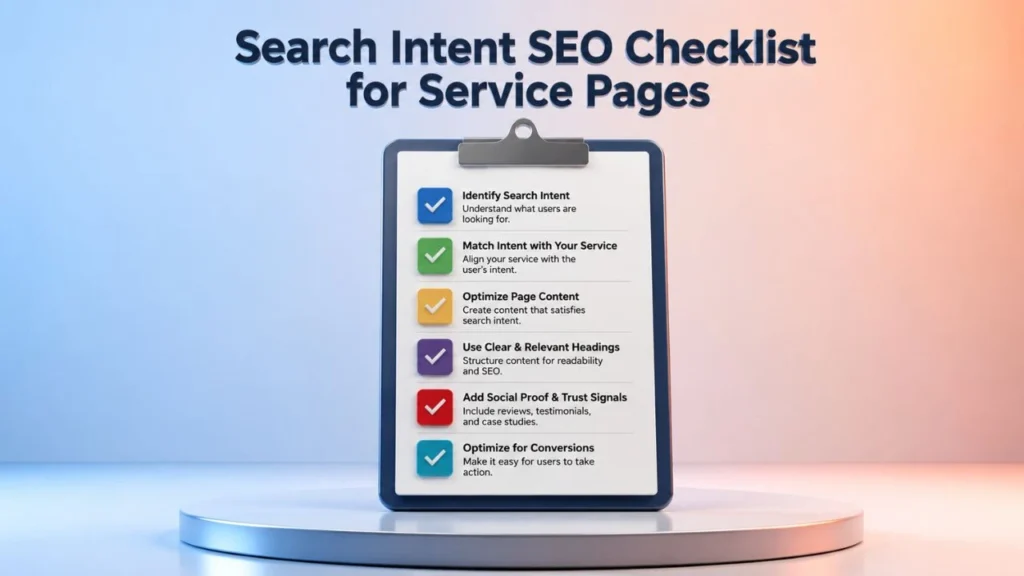
Use the following checklist when optimizing service pages.
| Optimization Area | Completed |
| Conduct keyword intent analysis | ✓ |
| Identify audience intent | ✓ |
| Match content to search intent | ✓ |
| Improve content relevance | ✓ |
| Strengthen topical relevance | ✓ |
| Implement semantic SEO | ✓ |
| Apply entity based SEO | ✓ |
| Optimize service page user experience | ✓ |
| Improve click through rate optimization | ✓ |
| Add FAQ sections | ✓ |
| Optimize for voice search | ✓ |
| Improve local search rankings | ✓ |
| Enhance Google Business Profile optimization | ✓ |
| Monitor SERP performance | ✓ |
| Track organic traffic growth | ✓ |
Conclusion
The future of SEO revolves around understanding people rather than simply targeting keywords. As search engines become increasingly sophisticated, businesses must focus on delivering content that genuinely addresses user needs.
Search Intent SEO is no longer optional for organizations that want to improve visibility, generate qualified traffic, and increase conversions. By understanding user search intent, conducting thorough keyword intent analysis, and implementing an effective SEO search intent strategy, businesses can create pages that both rank and convert.
Whether you are working on service page SEO, local service page SEO, or broader digital marketing campaigns, the principles remain the same. Understand your audience, align content with their goals, and continuously optimize the search experience.
Frequently Asked Questions
What Is Search Intent SEO?
Search Intent SEO is the practice of optimizing content based on the reason behind a user’s search query. It helps search engines understand that your content satisfies user needs.
How Does Search Intent Affect Service Page Rankings?
Search intent influences relevance, engagement, and user satisfaction. Pages that align with intent often achieve better rankings and stronger conversion rates.
What Is the Difference Between Commercial Intent and Transactional Intent?
Commercial intent indicates research and comparison behavior, while transactional intent suggests readiness to take action or purchase.
Why Is Keyword Intent Analysis Important?
Keyword intent analysis helps marketers understand user goals and create content that matches expectations, leading to better rankings and engagement.
How Can I Optimize Service Pages for User Intent?
Focus on answering user questions, providing clear information, improving usability, and creating content aligned with audience needs.
What Role Does Local Search Intent Play in SEO?
Local search intent helps businesses connect with nearby customers who are actively searching for services within a specific geographic area.
Why Are Near Me Searches Important?
Near me searches often indicate strong purchase intent and can generate highly qualified leads for local businesses.
How Does Semantic SEO Support Search Intent SEO?
Semantic SEO improves contextual understanding by connecting related concepts and topics, helping search engines better interpret content.
How Does Search Intent SEO Help AI Search Visibility?
AI systems prioritize content that clearly satisfies user intent. Well-structured, intent-focused content is more likely to be referenced in AI-generated responses.
What Are the Most Important Search Intent Strategies for SEO?
The most effective strategies include intent analysis, content optimization, semantic SEO, user experience improvements, and continuous performance monitoring.