Search visibility often increases during festive campaigns, flash sales, holiday discounts, and limited time ecommerce promotions. Traffic spikes, product pages attract attention, and category pages gain momentum across search engines. However, many online stores notice a sudden decline in rankings once the sales period ends. This ecommerce ranking drop after sale period is more common than many businesses realize.
The problem is not always the sale itself. In most cases, the issue comes from poor SEO planning before, during, and after promotional campaigns. Ecommerce websites frequently focus heavily on short term traffic while ignoring long term organic visibility. When the campaign ends, rankings start disappearing because the website loses relevance, technical stability, or search intent alignment.
If you manage an ecommerce store, understanding why ecommerce rankings drop after seasonal campaigns can help you protect traffic, maintain authority, and improve long term growth. A strong post sale SEO strategy helps your website stay visible even after promotional search demand declines.
In this guide, you will learn the major causes behind ecommerce ranking drop after sale periods, how technical SEO affects performance, why content quality matters, and which ecommerce SEO recovery methods help restore rankings.
Table of Contents
Common Reasons Behind Ecommerce Ranking Drop After Sale
| Problem Area | SEO Impact | Long Term Effect |
| Deleted sale pages | Loss of indexed URLs | Reduced traffic |
| Poor site speed | Weak user experience | Ranking decline |
| Thin content | Lower relevance | Reduced visibility |
| Broken internal links | Crawl issues | Weak page authority |
| Outdated promotional pages | Search intent mismatch | Higher bounce rate |
| Inventory changes | URL instability | Ranking fluctuations |
| Technical SEO neglect | Indexing problems | Traffic loss |
| Weak content updates | Lower freshness signals | Reduced rankings |
What Causes Ecommerce Ranking Drop After Sale?
One of the biggest reasons behind ecommerce ranking drop after sale campaigns is the sudden change in search behavior. During festive periods, people actively search for discounts, deals, offers, bundles, and limited time promotions. Search engines recognize this demand and temporarily reward relevant pages.
Once the season ends, those search trends decline. If your ecommerce store depends heavily on promotional keywords without building evergreen authority, rankings naturally weaken.
Another reason why ecommerce rankings drop is that many stores remove pages immediately after campaigns end. These pages may already have backlinks, indexed authority, and user engagement history. Deleting them creates SEO gaps that affect organic visibility.
Search engines also reevaluate website quality after high traffic periods. Technical weaknesses that were ignored during the campaign often become more noticeable afterward.
Search Intent Changes After Seasonal Campaigns
Search intent changes rapidly after festive or sales periods. Users stop searching for urgent discount related queries and begin searching for broader informational or product comparison keywords.
For example,
- Best laptop discounts
- Festival phone offers
- Flash sale electronics deals
After the season ends, searches shift toward:
- Best laptops for work
- Phone buying guide
- Top gaming smartphones
If your content only targets temporary keywords, your website may experience ecommerce ranking drop after sale periods because search demand has changed.
This is why a balanced ecommerce SEO strategy is important. Your website should target both seasonal and evergreen search intent.
Expired Sale Pages and URL Removal Problems
Many ecommerce websites make the mistake of deleting campaign pages after the sale ends. This creates multiple SEO issues.
Deleting High Performing URLs
A sale landing page may have:
- Indexed authority
- User engagement
- Backlinks
- Internal link value
- Search visibility
Removing that page destroys accumulated SEO signals.
Instead of deleting the page, update it with evergreen content, related products, or upcoming campaign information.
Missing Redirect Strategies
Poor redirect implementation is another major reason why ecommerce rankings drop.
When promotional URLs disappear without proper redirects:
- Users encounter 404 errors
- Search engines lose crawl paths
- Link equity disappears
- User trust declines
Proper redirection helps ecommerce SEO recovery by preserving authority and maintaining user experience.
Loss of Backlink Authority
Promotional campaigns often attract external links from blogs, influencers, and news websites. If those pages are deleted, the backlinks lose value.
Maintaining those URLs with updated content helps preserve SEO authority over time.
How Thin Content Triggers Ecommerce Ranking Decline?
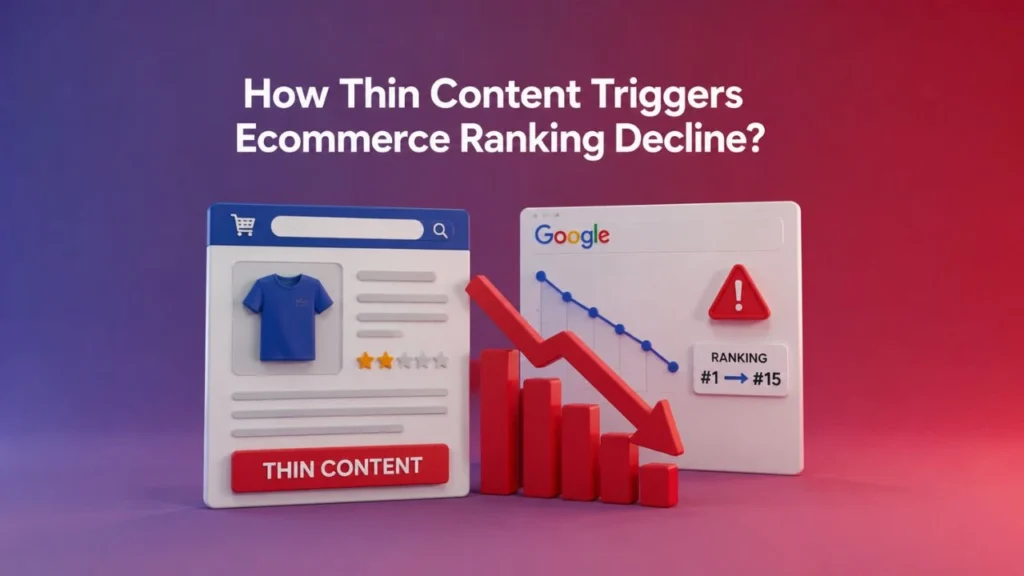
Content quality plays a major role in ecommerce SEO strategies. Many ecommerce stores rely on copied manufacturer descriptions, short category content, or repetitive text.
During high competition periods, thin content may temporarily perform because of strong search demand. However, once competition stabilizes, search engines prioritize deeper and more valuable content.
This is another major cause of ecommerce ranking drop after sale campaigns.
Duplicate Product Descriptions
Using manufacturer supplied descriptions across hundreds of products creates duplicate content issues.
Search engines prefer:
- Unique product explanations
- Detailed specifications
- Real use cases
- FAQs
- Helpful buying guidance
Unique product content improves relevance and strengthens ecommerce SEO recovery efforts.
Low Value Category Pages
Category pages with only product listings often struggle to maintain rankings.
Adding useful content improves:
- Search relevance
- User engagement
- Keyword visibility
- Crawl understanding
Strong category pages should include:
- Buying tips
- Product comparisons
- Frequently asked questions
- Internal links
- Informational content
Seasonal Pages With Temporary Content
- Many websites create promotional pages with minimal content just to target seasonal traffic.
- After the campaign ends, these pages lose value because they lack evergreen relevance.
- A better post sale SEO strategy involves converting temporary pages into long term category hubs.
Lack of Informational Content
Modern ecommerce SEO strategies are no longer limited to product pages. Search engines reward websites that provide:
- Educational blogs
- Product guides
- Comparison articles
- Troubleshooting content
- Voice search friendly FAQs
Informational content supports topical authority and improves long term rankings.
Technical SEO Problems That Appear After Sales Season
Technical SEO problems become more visible after large promotional campaigns. Heavy traffic often exposes weaknesses that were hidden during normal operations.
Why Core Web Vitals Matter for Ecommerce SEO?
- Page experience is a major ranking factor for ecommerce websites.
- A proper Core Web Vitals audit helps identify performance issues affecting rankings and conversions.
- Improving loading speed helps reduce bounce rates and improve engagement.
Largest Contentful Paint Problems
Large banners, uncompressed images, and heavy promotional assets often slow down ecommerce websites.
When pages load slowly:
- Users abandon sessions
- Engagement declines
- Search visibility weakens
Interaction Delays and INP Issues
- Popups, countdown timers, and promotional scripts may create interaction delays.
- After campaigns end, websites sometimes fail to remove unnecessary scripts, which continues harming performance.
Layout Shift Problems
- Aggressive promotional banners can create layout instability.
- Poor layout stability negatively affects user experience and mobile usability.
Crawl Budget Waste After Promotions
Sales campaigns often generate:
- Filter URLs
- Parameter pages
- Duplicate category variations
- Temporary landing pages
Search engines may waste crawl resources on low value URLs. A technical cleanup after campaigns is essential for ecommerce SEO maintenance.
Index Bloat and Low Value Pages
Index bloat occurs when search engines index too many unnecessary pages.
For Examples,
- Empty product pages
- Expired sale URLs
- Thin filter pages
- Duplicate categories
Removing low quality indexed pages improves overall site efficiency.
Why Ecommerce Rankings Drop When Inventory Changes?
- Inventory management also affects SEO.
- Frequent product changes can confuse search engines and create ranking instability.
Out of Stock Product Management Mistakes
Removing out of stock pages immediately is a common SEO mistake.
Instead of deleting pages:
- Keep URLs active
- Suggest related products
- Add restock notifications
- Update availability information
This supports ecommerce SEO recovery and preserves indexed authority.
Missing Alternative Product Suggestions
Users should never land on dead end pages.
Related product suggestions improve:
- Engagement
- Session duration
- Conversion opportunities
- Internal linking
Improper Canonical Tags
Canonical mistakes can create duplicate indexing issues.
Proper canonical implementation helps search engines understand preferred URLs.
Frequent URL Structure Changes
Changing product URLs frequently weakens ranking consistency.
Stable URLs help maintain:
- Backlink authority
- User trust
- Crawl consistency
- Ranking history
Discontinued Product SEO Issues
Even discontinued products may continue attracting traffic.
Instead of deleting those pages:
- Redirect strategically
- Add replacement products
- Preserve informational content
This prevents unnecessary ecommerce ranking drop after sale periods.
Internal Linking Problems After Seasonal Campaigns
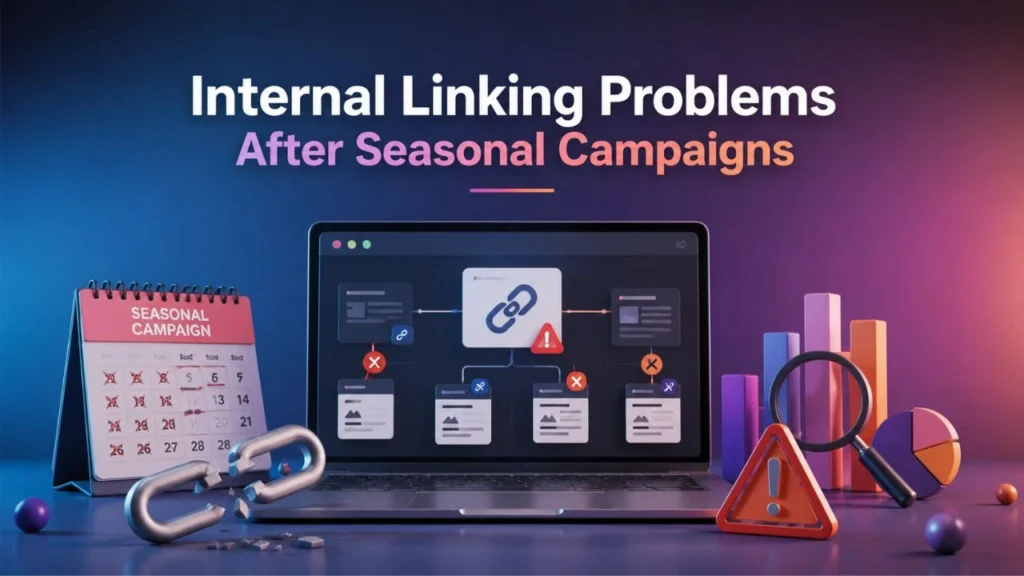
Internal linking strongly influences ecommerce SEO strategies. However, promotional campaigns often disrupt site architecture.
Broken Links From Expired Promotions
Temporary campaign banners frequently link to expired pages.
Broken internal links create:
- Poor user experience
- Crawl inefficiency
- Reduced authority flow
Regular internal link audits are essential for ecommerce SEO maintenance.
Weak Category Page Authority
- Many ecommerce stores focus too much authority on temporary landing pages.
- Evergreen category pages should remain central within the internal linking structure.
- Strong category pages help stabilize rankings even after campaigns end.
Homepage Link Equity Distribution Problems
- During major sales events, homepages often become overloaded with promotional banners and temporary links.
- This can dilute authority distribution across important evergreen pages.
- A balanced structure supports long term SEO stability.
How Internal Linking Supports Ecommerce SEO Recovery?
Smart internal linking helps:
- Improve crawl efficiency
- Distribute authority
- Support keyword relevance
- Strengthen category pages
Contextual links between blogs, products, and categories improve topical depth.
User Experience Signals That Affect Ecommerce Rankings
- Search engines increasingly evaluate user experience signals.
- Poor engagement after campaigns may indicate that your content no longer matches user intent.
Increased Bounce Rates After Sales End
Users who arrive expecting promotions may leave quickly if offers are outdated.
This mismatch affects:
- Bounce rate
- Session duration
- Engagement metrics
Updated content helps maintain relevance.
Declining Engagement Metrics
Low engagement can indicate:
- Weak content quality
- Poor navigation
- Slow loading speed
- Irrelevant landing pages
Improving usability supports ecommerce SEO recovery.
Mobile Experience Problems
- Most ecommerce traffic now comes from mobile devices.
- Poor mobile optimization can lead to significant ecommerce ranking drop after sale periods.
Important mobile factors include:
- Responsive design
- Fast loading speed
- Clear navigation
- Readable content
- Mobile friendly checkout
Voice Search Optimization for Ecommerce Stores
- Voice search is becoming increasingly important for ecommerce SEO strategies.
- Users now search conversationally using smart devices.
For Examples,
- Which phone has the best battery life?
- What are the best running shoes under budget?
- Which laptop is best for students?
To optimize for voice search:
- Use natural language
- Add FAQ sections
- Create concise answers
- Target conversational keywords
Post Sale SEO Strategy for Long Term Ranking Stability
A strong post sale SEO strategy helps ecommerce websites maintain visibility even after seasonal demand decreases.
Maintain Evergreen Landing Pages
Evergreen pages continue attracting traffic year round.
For Examples,
- Buying guides
- Product comparison pages
- Top product collections
- Educational resources
These pages reduce dependency on temporary promotional traffic.
Update Promotional Pages Instead of Deleting Them
Instead of removing sale pages:
- Refresh content
- Add evergreen information
- Link related categories
- Prepare for future campaigns
This helps preserve accumulated authority.
Build Non Seasonal Organic Traffic
- Websites that depend entirely on sales campaigns often struggle with traffic stability.
- Creating informational content improves long term organic growth.
Useful content ideas include:
- Product tutorials
- Industry trends
- Comparison articles
- Problem solving guides
- FAQ content
Strengthen Topical Authority
- Search engines reward websites that demonstrate expertise.
- Creating content clusters around product categories helps strengthen topical authority.
For example,
- Seasonal style guides
- Fabric care tips
- Size selection advice
- Trend analysis blogs
This supports broader ecommerce SEO strategies.
Improve Schema Markup
Structured data improves search visibility.
Important schema types include:
- Product schema
- FAQ schema
- Review schema
- Breadcrumb schema
Schema improves rich results and supports AI search understanding.
Ecommerce SEO Maintenance Checklist After Sales Campaigns
| SEO Task | Purpose | Recommended Frequency |
| Core Web Vitals audit | Improve user experience | Monthly |
| Redirect audit | Preserve SEO authority | After campaigns |
| Internal link review | Improve crawl flow | Monthly |
| Content updates | Maintain freshness | Quarterly |
| Schema validation | Improve rich results | Monthly |
| Technical SEO audit | Detect errors | Quarterly |
| Keyword monitoring | Track rankings | Weekly |
| Index coverage check | Reduce index bloat | Monthly |
Ecommerce SEO Recovery Strategies That Actually Work
Recovering from ecommerce ranking drop after sale periods requires consistent optimization.
Recover Rankings Through Content Optimization
Improving existing content often produces faster results than creating entirely new pages.
Focus on:
- Updating category content
- Improving product descriptions
- Expanding FAQs
- Adding semantic keywords
- Improving readability
Rebuild Authority Signals
Authority remains critical for ecommerce SEO recovery.
Strong authority signals include:
- Quality backlinks
- Internal linking
- Brand mentions
- Helpful content
Optimize for AI Search and AEO
AI powered search systems increasingly prioritize structured and answer focused content.
To improve AEO optimization:
- Use conversational headings
- Add concise answers
- Structure content clearly
- Include FAQs
- Use semantic keywords naturally
GEO Optimization for Ecommerce Brands
Geographic optimization improves local visibility.
Businesses targeting specific regions should:
- Create regional landing pages
- Optimize location keywords
- Add local schema
- Build location specific content
Voice Search Friendly Ecommerce SEO Strategies
Voice search optimization supports future search trends.
Effective voice search content includes:
- Conversational phrases
- Question based headings
- Direct answers
- Natural language structure
Why Ecommerce SEO Maintenance Is Important Year Round?
SEO is not a one time process.
Continuous optimization helps maintain rankings, authority, and visibility.
SEO Is Not Seasonal
Many ecommerce businesses focus only on traffic spikes during promotions.
However, long term visibility requires consistent optimization throughout the year.
Continuous Technical Monitoring
Regular audits help identify:
- Broken pages
- Speed issues
- Crawl errors
- Duplicate content
- Mobile usability problems
Technical consistency supports ranking stability.
Content Freshness and Search Visibility
Search engines prefer updated and relevant content.
Refreshing older pages improves:
- Keyword relevance
- User engagement
- Organic visibility
Importance of Ecommerce SEO Maintenance and Recovery Services
Professional ecommerce SEO maintenance and recovery services help businesses:
- Maintain rankings
- Fix technical issues
- Improve content quality
- Recover lost traffic
- Optimize user experience
Ongoing support is often essential for competitive ecommerce industries.
Advanced Ecommerce SEO Strategies for Sustainable Growth
Long term ecommerce growth depends on strategic SEO planning.
Topic Cluster Based Content
Topic clusters help search engines understand website expertise.
Cluster content improves:
- Internal linking
- Topical authority
- Keyword relevance
- User engagement
AI Search Optimization Techniques
AI search engines analyze context, intent, and semantic meaning.
Optimizing for AI search involves:
- Clear structure
- Entity optimization
- Conversational content
- Answer focused writing
Search Intent Mapping
Understanding user intent improves content targeting.
Different users search for:
- Informational content
- Product comparisons
- Transactional queries
- Problem solving guidance
Intent aligned content performs better across search engines.
Predictive Keyword Planning
Forward looking keyword planning helps websites prepare for future demand.
Businesses should monitor:
- Seasonal trends
- Emerging search behavior
- Industry changes
- Product demand shifts
Structured Data Expansion
- Expanded schema implementation improves search visibility.
- Structured data also helps AI systems better understand ecommerce websites.
Multi Channel Search Visibility
Modern ecommerce SEO strategies should target:
- Traditional search engines
- AI search systems
- Voice assistants
- Visual search platforms
Diversified visibility reduces dependency on one traffic source.
Conclusion
An ecommerce ranking drop after sale campaigns is not simply a seasonal fluctuation. In many cases, it reflects deeper SEO weaknesses that become more visible after promotional demand decreases.
Search engines now evaluate ecommerce websites based on content quality, technical performance, user experience, topical authority, and intent alignment. Stores that rely only on temporary campaigns often struggle to maintain long term visibility.
A strong post sale SEO strategy helps businesses stabilize rankings, improve authority, and maintain consistent traffic beyond seasonal spikes.
By focusing on ecommerce SEO maintenance, improving technical performance, optimizing content quality, and strengthening evergreen visibility, ecommerce brands can protect organic growth and compete more effectively across traditional search engines, AI search platforms, and voice search systems.
Long term SEO success comes from consistency, not temporary promotional visibility.
Frequently Asked Questions
Why does ecommerce ranking drop after sale season?
An ecommerce ranking drop after sale season usually happens because search intent changes, promotional pages lose relevance, technical SEO issues appear, and websites fail to maintain evergreen authority.
How long does ecommerce SEO recovery take?
Ecommerce SEO recovery timelines vary depending on the severity of the problem. Some websites recover within weeks, while larger technical or content issues may require several months.
What is the best post sale SEO strategy?
The best post sale SEO strategy includes maintaining evergreen pages, updating promotional content, improving technical SEO, strengthening internal linking, and publishing informational content.
Why is ecommerce SEO maintenance important?
Ecommerce SEO maintenance helps preserve rankings, improve user experience, prevent technical errors, and maintain long term organic visibility.
How does a Core Web Vitals audit help ecommerce websites?
A Core Web Vitals audit identifies loading speed, interaction, and layout stability issues that affect both rankings and user experience.
What are the best ecommerce SEO strategies for long term growth?
The best ecommerce SEO strategies include topical authority building, semantic content optimization, technical SEO improvements, structured data implementation, and voice search optimization.
Can deleted sale pages hurt SEO rankings?
Yes. Deleting indexed sale pages without proper redirects can cause traffic loss, broken backlinks, and ranking decline.
How do AI search engines rank ecommerce content?
AI search systems prioritize structured, relevant, conversational, and answer focused content that clearly satisfies user intent.