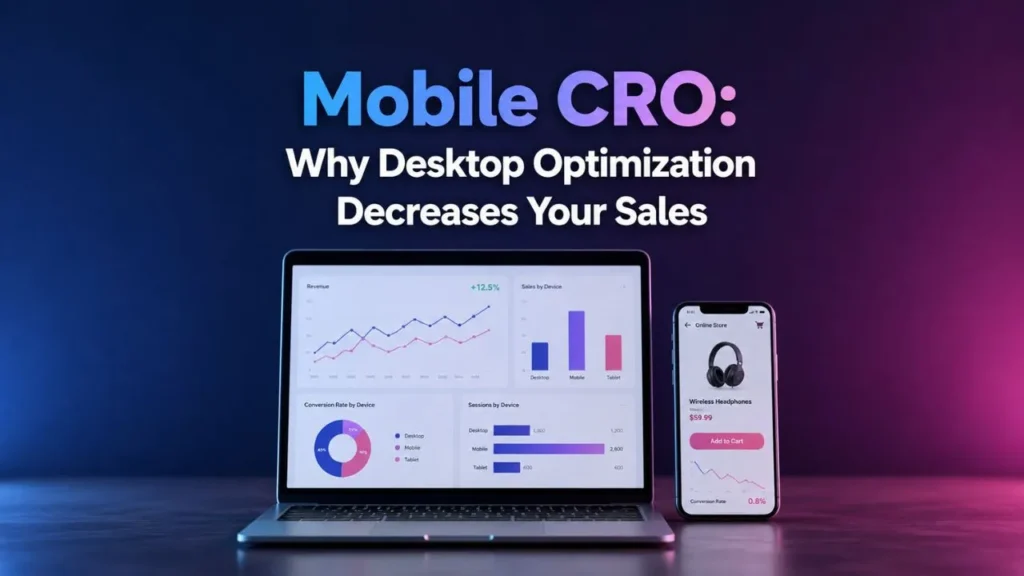
For years, businesses focused heavily on desktop experiences because desktop users were considered the primary source of conversions. Today, that reality has changed. Mobile devices generate a significant share of website traffic across industries, yet many websites are still built around desktop assumptions. This disconnect often creates friction for mobile users and directly impacts revenue.
This is where Mobile CRO becomes essential.
Mobile CRO, or mobile conversion rate optimization, focuses on improving the experience, usability, and performance of a website for smartphone users. Rather than adapting a desktop experience to smaller screens, Mobile CRO prioritizes the needs, behaviors, and expectations of mobile visitors from the beginning.
As mobile traffic growth continues to accelerate, businesses that ignore mobile optimization risk losing leads, sales, and engagement opportunities. Understanding why desktop focused websites fail and how mobile optimization increases sales can help organizations build a stronger website conversion strategy and achieve sustainable online sales growth.
In this guide, we will explore what Mobile CRO is, why mobile conversions matter, and how businesses can optimize their websites for mobile shoppers while improving digital marketing performance.
Table of Contents
Why Does Desktop Optimization Decrease Sales?
The simplest answer is that mobile users behave differently from desktop users.
Desktop optimization often prioritizes large screens, mouse based interactions, and lengthy browsing sessions. Mobile users, however, expect speed, convenience, and simplicity.
When a website relies on desktop centric design principles, it creates obstacles for mobile visitors. These obstacles may include difficult navigation, slow page load speed, complicated forms, and checkout processes that are not optimized for smartphones.
As a result:
- Mobile usability issues increase.
- Mobile engagement metrics decline.
- Friction in conversion path becomes more noticeable.
- Cart abandonment rates rise.
- Lead generation optimization efforts become less effective.
Businesses that focus exclusively on desktop experiences often see lower organic traffic conversion rates from mobile search traffic despite increasing visitor numbers.
Desktop vs Mobile Conversions: A Quick Comparison
| Metric | Desktop Users | Mobile Users |
| Screen Size | Large | Small |
| Navigation Method | Mouse and Keyboard | Touch Interface |
| Session Length | Longer | Shorter |
| Purchase Intent | High | High and Growing |
| Abandonment Risk | Lower | Higher |
| Speed Expectations | Important | Critical |
| Conversion Barriers | Moderate | More Sensitive |
The table clearly highlights why Mobile CRO requires a unique approach instead of simply scaling down desktop designs.
What Is Mobile CRO?
Mobile CRO refers to the process of improving website performance for smartphone and tablet users with the goal of increasing conversions.
A conversion can be:
- A purchase
- A form submission
- A phone call
- A newsletter signup
- A demo request
- Any desired business action
Mobile conversion rate optimization focuses on identifying obstacles that prevent users from completing these actions and removing them.
Unlike traditional optimization approaches, Mobile CRO places significant emphasis on mobile user experience, smartphone user behavior, and user journey optimization.
Why Mobile CRO Matters
Modern consumers frequently discover products, research services, compare prices, and complete purchases using their phones.
If your website creates a poor mobile shopping experience, visitors may leave before reaching the final step in the mobile conversion funnel.
A successful mobile CRO strategy helps businesses:
- Increase conversion rate improvement
- Enhance customer acquisition
- Reduce conversion barriers
- Improve landing page conversion performance
- Strengthen overall digital marketing performance
How Mobile CRO Differs from Traditional CRO?
Traditional CRO often focuses on desktop behavior patterns. Mobile conversion rate optimization requires a different perspective because user expectations are fundamentally different on smartphones.
Mobile User Experience Is More Important
A mobile user experience can determine whether a visitor stays or leaves within seconds.
Small frustrations such as:
- Tiny buttons
- Poor mobile site navigation
- Slow loading pages
- Intrusive popups
can dramatically reduce conversion rates.
Mobile Browsing Habits Are Different
Mobile browsing habits are typically faster and more action oriented.
Users often:
- Browse while commuting
- Research products during short breaks
- Compare multiple websites quickly
- Expect immediate answers
This means your website must provide relevant information with minimal effort.
Touch Friendly Navigation Matters
Desktop websites rely on precise cursor movements.
Mobile visitors use their fingers.
Touch friendly navigation and thumb friendly design make it easier for users to move through content, explore products, and complete actions without frustration.
Why Mobile Conversions Matter More Than Ever?
The growth of smartphones has transformed the way consumers interact with brands.
Today, mobile traffic growth continues across virtually every industry, including ecommerce, healthcare, education, finance, and professional services.
As mobile search traffic increases, businesses need to focus on optimizing experiences that align with modern user expectations.
Understanding Smartphone User Behavior
Smartphone user behavior is driven by convenience.
Users want:
- Fast answers
- Fast loading pages
- Easy navigation
- Simplified checkout experiences
- Clear calls to action
When these expectations are not met, users quickly move to competitors.
This behavior makes Mobile CRO one of the most important elements of a modern website conversion strategy.
Mobile Purchasing Behavior vs Desktop Purchasing Behavior

Mobile purchasing behavior has evolved significantly over the last few years. Consumers are increasingly comfortable making purchases directly from smartphones. However, mobile users remain highly sensitive to usability issues.
| Behavior Factor | Mobile Users | Desktop Users |
| Research Activity | Very High | High |
| Product Comparison | Frequent | Frequent |
| Impulse Purchases | Higher | Moderate |
| Checkout Patience | Low | Higher |
| Speed Expectations | Extremely High | High |
| Navigation Tolerance | Low | Moderate |
This shift highlights why mobile first optimization is becoming a critical requirement for businesses seeking conversion rate improvement.
Why Desktop Focused Websites Fail?
Many organizations still design websites primarily for desktop users and then attempt to adapt those experiences for mobile devices.
This approach often creates problems because mobile users have different needs and expectations.
The Problem with Desktop Centric Design
Desktop centric design frequently includes:
- Complex navigation structures
- Large content blocks
- Small interactive elements
- Lengthy forms
- Multiple conversion steps
While these elements may work reasonably well on desktops, they often create significant conversion barriers on mobile devices.
Common Mobile Conversion Optimization Mistakes
Tiny Clickable Elements
Buttons that are too small make interaction difficult and reduce user satisfaction.
Poor Mobile Site Navigation
Complicated menus increase confusion and disrupt the mobile conversion funnel.
Slow Mobile Performance
Mobile page speed directly influences user engagement metrics and conversion outcomes.
Excessive Form Fields
Poor form optimization increases abandonment rates and reduces lead generation optimization effectiveness.
Intrusive Popups
Aggressive popups interfere with mobile user experience and frustrate visitors.
How Desktop Optimization Hurts Mobile Sales?
Desktop optimization becomes a problem when it ignores mobile realities.
For example:
- Large images slow mobile page speed.
- Complex checkout processes increase abandonment.
- Multiple navigation levels create confusion.
- Long forms discourage completion.
- Poor responsive web design affects usability.
The result is a lower conversion rate despite strong traffic numbers. This is one reason many businesses experience growing mobile traffic but stagnant revenue.
A mobile friendly website built around mobile first design principles can eliminate these issues and support stronger sales funnel optimization.
By understanding how mobile users interact with websites, businesses can create experiences that encourage engagement, increase conversions, and support long term growth.
Mobile UX Impact on Conversions
The relationship between mobile user experience and conversion performance is stronger than many businesses realize. Even minor usability improvements can have a measurable impact on engagement, lead generation, and revenue.
When visitors access your website from a smartphone, they expect a seamless experience from the moment they land on a page until they complete a desired action. Any interruption in that journey can create friction in conversion path and reduce conversion opportunities.
Mobile User Experience and Sales Performance
A positive mobile user experience encourages visitors to:
- Stay longer on your website
- View additional pages
- Engage with content
- Submit inquiries
- Complete purchases
A poor experience often leads to:
- Higher bounce rates
- Lower user engagement metrics
- Reduced organic traffic conversion
- Increased cart abandonment
- Lost sales opportunities
This is why Mobile CRO should be closely aligned with user experience optimization initiatives.
Signs Your Mobile User Experience Needs Improvement
Some common indicators include:
- High mobile bounce rates
- Low mobile conversion rates
- Poor engagement metrics
- Low average session duration
- High exit rates on product pages
- High checkout abandonment rates
If these issues are present, they often point to weaknesses in mobile website optimization.
Touch Friendly Navigation Best Practices
Navigation plays a major role in Mobile CRO success.
Mobile users need to move through a website quickly without confusion. A complicated navigation system can disrupt the customer journey and reduce conversion rates.
Thumb Friendly Design
Most smartphone users navigate websites using one hand.
Thumb friendly design focuses on placing important interactive elements within comfortable reach.
Best practices include:
- Large clickable buttons
- Adequate spacing between elements
- Easy access to navigation menus
- Prominent calls to action
Mobile Site Navigation
Effective mobile site navigation should be:
- Simple
- Predictable
- Easy to access
- Consistent across pages
Visitors should never struggle to find products, services, contact information, or conversion opportunities.
Creating a Better Cross Device Experience
Consumers often interact with brands across multiple devices.
A customer may:
- Discover a product on mobile.
- Research it on desktop.
- Complete the purchase on mobile.
A consistent cross device experience helps maintain trust and improves customer acquisition efforts.
Mobile Website Optimization Essentials
- Successful Mobile CRO begins with strong mobile website optimization.
- Many websites lose conversions because they prioritize aesthetics over functionality. While visual appeal is important, usability should always support conversion goals.
Responsive Web Design Fundamentals
Responsive web design allows websites to adapt automatically to different screen sizes.
Benefits include:
- Better accessibility
- Improved user experience optimization
- Enhanced mobile SEO performance
- Reduced maintenance requirements
Responsive web design is no longer optional. It is a fundamental requirement for businesses seeking sustainable online sales growth.
Creating a Mobile Friendly Website
A mobile friendly website should prioritize:
- Fast loading speeds
- Readable text
- Accessible navigation
- Clear content hierarchy
- Touch friendly interactions
When visitors can easily consume content and complete actions, conversion focused design becomes more effective.
Mobile Landing Page Optimization
- Landing pages often determine whether visitors convert or leave.
- Mobile landing page optimization focuses on creating experiences that encourage immediate action.
Best practices include:
Clear Headlines
Visitors should instantly understand the page’s purpose.
Strong Value Proposition
Explain why users should continue engaging with your content.
Visible Calls to Action
Call to action optimization is critical for improving landing page conversion rates.
Minimal Distractions
Remove unnecessary elements that compete for attention.
Fast Loading Performance
Mobile visitors rarely wait for slow pages.
Mobile Page Speed and Core Web Vitals
- One of the most important aspects of Mobile CRO is speed.
- Users expect websites to load almost instantly. Every additional second of delay can negatively impact engagement and conversion performance.
Why Mobile Page Speed Directly Affects Revenue?
Mobile users often browse while multitasking or on the move.
When a page loads slowly:
- Visitors become frustrated.
- Engagement drops.
- Conversion rates decline.
- Customer acquisition costs increase.
Improving mobile page speed can significantly enhance conversion rate improvement efforts.
Understanding Core Web Vitals
Core Web Vitals measure key aspects of user experience.
The primary metrics include:
Largest Contentful Paint (LCP)
Measures loading performance.
Interaction to Next Paint (INP)
Measures responsiveness.
Cumulative Layout Shift (CLS)
Measures visual stability.
Strong Core Web Vitals contribute to:
- Better user satisfaction
- Improved mobile SEO
- Higher conversion potential
Mobile Optimization Best Practices for Speed
Businesses can improve speed by:
- Compressing images
- Reducing unnecessary scripts
- Using browser caching
- Optimizing server response times
- Eliminating render blocking resources
Mobile Speed Benchmark Table
| Loading Time | Expected Conversion Impact |
| Under 2 Seconds | Highest Conversion Potential |
| 2 to 3 Seconds | Moderate Performance |
| 3 to 5 Seconds | Noticeable Conversion Loss |
| Over 5 Seconds | Significant Revenue Risk |
Optimizing the Mobile Conversion Funnel
The mobile conversion funnel represents the path users take from initial visit to final conversion. Understanding this journey is essential for Mobile CRO success.
What Is a Mobile Conversion Funnel?
A typical mobile conversion funnel includes:
- Awareness
- Interest
- Consideration
- Conversion
At every stage, users may encounter obstacles that prevent them from progressing.
Identifying Friction in Conversion Path
Friction occurs when users experience unnecessary difficulty.
Common sources of friction include:
- Slow page load speed
- Poor mobile site navigation
- Confusing layouts
- Excessive form fields
- Complicated checkout processes
Reducing friction often produces immediate conversion improvements.
Customer Journey Mapping for Mobile Users
Customer journey mapping helps businesses understand:
- User intentions
- Pain points
- Decision making behavior
- Drop off points
When combined with Mobile CRO analysis, customer journey mapping provides valuable insights into user behavior.
Sales Funnel Optimization Techniques
Effective sales funnel optimization includes:
- Streamlining navigation
- Simplifying conversion paths
- Improving content relevance
- Enhancing trust signals
- Optimizing call to action placement
These improvements contribute directly to higher conversion rates.
Mobile Ecommerce Optimization Strategies
Ecommerce businesses often experience the largest impact from Mobile CRO improvements. Many shoppers begin and complete purchases on smartphones, making mobile ecommerce optimization a critical growth factor.
Mobile CRO Best Practices for Ecommerce
Successful ecommerce websites focus on:
- Fast mobile experiences
- Easy product discovery
- Simplified checkout
- Clear product information
- Strong trust indicators
Optimizing Websites for Mobile Shoppers
Mobile shoppers want convenience.
Key optimization areas include:
Product Pages
Provide concise descriptions, high quality images, and clear pricing.
Search Functionality
Users should quickly find products they need.
Filtering Systems
Make browsing easier on smaller screens.
Checkout Experience
Reduce steps wherever possible.
Improving the Mobile Shopping Experience
A strong mobile shopping experience can significantly increase sales.
Best practices include:
- Guest checkout options
- Mobile wallet support
- Saved payment methods
- Simple account creation
These improvements reduce barriers and encourage completion.
Reducing Mobile Checkout Abandonment
Checkout abandonment remains one of the biggest challenges in ecommerce.
Strategies for reducing mobile checkout abandonment include:
Simplified Forms
Request only essential information.
Autofill Support
Allow devices to populate fields automatically.
Progress Indicators
Show users how many steps remain.
Transparent Pricing
Avoid unexpected fees during checkout.
When businesses prioritize checkout optimization, they often see measurable improvements in conversion rates and revenue.
Mobile CRO Strategy for Lead Generation Websites
While ecommerce websites focus on product sales, many business websites rely on lead generation. Whether the goal is generating inquiries, demo requests, consultations, or quote requests, Mobile CRO plays a critical role in maximizing results.
Mobile visitors often have high intent but limited patience. If your website makes it difficult to submit information or contact your business, potential leads may leave before converting.
Lead Generation Optimization for Mobile Users

Lead generation optimization begins with understanding user expectations.
Mobile visitors want:
- Fast access to information
- Simple forms
- Easy communication options
- Clear next steps
Businesses that streamline these elements often achieve stronger conversion performance.
Form Optimization Best Practices
- Forms are among the most common conversion points on business websites.
- Unfortunately, they are also one of the biggest sources of mobile usability issues.
Effective form optimization includes:
Reducing Form Fields
Only request information that is absolutely necessary.
Using Mobile Friendly Inputs
Select the appropriate keyboard type for each field.
Enabling Autofill
Allow users to complete forms faster.
Displaying Clear Error Messages
Help users correct mistakes immediately.
Simplified forms improve lead generation optimization and contribute to higher conversion rates.
Call to Action Optimization
Calls to action guide users toward desired actions.
For mobile visitors, CTAs should be:
- Highly visible
- Easy to tap
- Action oriented
- Relevant to page content
Examples,
- Request a Quote
- Schedule a Consultation
- Start Your Free Trial
- Contact Our Team
Effective call to action optimization removes uncertainty and encourages users to move forward.
Landing Page Conversion Strategies
Improving landing page conversion performance requires a balance between information and simplicity.
Strong mobile landing pages typically include:
- Clear headlines
- Concise content
- Strong trust indicators
- Prominent calls to action
- Fast loading performance
When combined with Mobile CRO best practices, these elements can significantly improve lead generation results.
Mobile SEO and Conversion Optimization
- Many marketers treat mobile SEO and Mobile CRO as separate disciplines. In reality, they work together.
- SEO drives visitors to your website, while Mobile CRO helps convert those visitors into customers.
- Without effective optimization, traffic alone rarely produces meaningful business results.
The Relationship Between Mobile SEO and Mobile CRO
- Mobile SEO helps improve visibility in search engines.
- Mobile CRO helps maximize value from that visibility.
Together they support:
- Customer acquisition
- Online sales growth
- Improved digital marketing performance
- Better organic traffic conversion
Search Intent Optimization for Mobile Users
Search intent optimization ensures content aligns with user expectations.
Mobile users often perform searches with immediate goals, such as:
- Finding information
- Comparing options
- Contacting businesses
- Making purchases
Understanding intent helps businesses create more effective conversion experiences.
Mobile Search Traffic and Conversion Opportunities
As mobile search traffic continues to grow, businesses must ensure their websites can convert visitors efficiently.
Important considerations include:
- Fast page load speed
- Relevant content
- Clear navigation
- Optimized landing pages
- Mobile friendly website architecture
These factors contribute to stronger conversion outcomes and improved business performance.
Mobile Conversion Tracking and Analytics
Improvement is impossible without measurement. Mobile conversion tracking helps businesses identify strengths, weaknesses, and opportunities within the customer journey.
Why Mobile Conversion Tracking Matters?
Tracking enables organizations to understand:
- User behavior
- Conversion paths
- Drop off points
- Revenue sources
- Marketing effectiveness
Without accurate data, optimization decisions become guesswork.
Essential Mobile Engagement Metrics
Several mobile engagement metrics should be monitored regularly.
Bounce Rate
Measures how many users leave after viewing one page.
Average Engagement Time
Indicates content effectiveness.
Scroll Depth
Shows how users interact with page content.
Exit Rate
Identifies pages where users leave the website.
Conversion Rate
- Measures overall performance.
- Monitoring these metrics supports continuous Mobile CRO improvement.
Mobile CRO KPI Dashboard
| KPI | Purpose |
| Mobile Conversion Rate | Measure conversion performance |
| Bounce Rate | Identify engagement issues |
| Cart Abandonment Rate | Detect checkout problems |
| Form Completion Rate | Evaluate lead generation success |
| Scroll Depth | Understand content engagement |
| Revenue Per Visitor | Measure business impact |
| Mobile Traffic Growth | Track audience expansion |
How to Improve Mobile Conversion Rates?
- Businesses often ask: How can we improve mobile conversion rates without redesigning an entire website?
- The answer lies in systematic optimization.
Mobile CRO Strategy Framework
Step 1: Audit the Mobile Experience
Review every stage of the customer journey from a mobile perspective.
Step 2: Identify Mobile Usability Issues
Look for navigation problems, speed concerns, and conversion barriers.
Step 3: Improve Mobile Page Speed
Enhance performance through technical optimization.
Step 4: Simplify the Mobile Conversion Funnel
Reduce unnecessary steps and remove friction.
Step 5: Optimize Landing Pages
Improve messaging, design, and call to action placement.
Step 6: Monitor Performance Metrics
- Track changes and measure results consistently.
- Following a structured mobile CRO strategy helps businesses achieve long term conversion growth.
Mobile CRO Checklist
Use this checklist to evaluate your website:
✓ Responsive web design implemented
✓ Mobile friendly website experience
✓ Fast mobile page speed
✓ Strong Core Web Vitals
✓ Touch friendly navigation
✓ Thumb friendly design
✓ Simplified forms
✓ Optimized checkout process
✓ Mobile conversion tracking enabled
✓ Clear call to action placement
✓ Mobile SEO best practices implemented
✓ Search intent optimization completed
✓ Conversion focused design applied
✓ User journey optimization reviewed
Mobile First Design for Higher Conversions
The future of digital marketing is increasingly mobile driven. Businesses that continue relying on desktop centric design may struggle to keep pace with changing consumer behavior.
Why Mobile First Optimization Works?
Mobile first optimization encourages teams to prioritize:
- Simplicity
- Performance
- Usability
- Accessibility
- Conversion efficiency
Instead of adapting desktop experiences for mobile devices, organizations build experiences specifically for mobile users from the beginning.
Mobile User Experience and Sales Performance
There is a direct relationship between mobile user experience and sales performance.
When users can easily:
- Find information
- Navigate pages
- Complete forms
- Make purchases
conversion rates typically improve. This is why mobile first design for higher conversions has become a critical component of modern website conversion strategy.
Conclusion
Mobile behavior has fundamentally changed how consumers discover brands, research products, and make purchasing decisions. While desktop experiences still matter, businesses can no longer afford to prioritize desktop users at the expense of mobile visitors.
A successful Mobile CRO strategy focuses on understanding smartphone user behavior, improving mobile user experience, reducing friction in conversion path, and optimizing every stage of the mobile conversion funnel.
From mobile website optimization and mobile landing page optimization to checkout optimization and mobile conversion tracking, every improvement contributes to stronger conversion performance.
The businesses achieving the greatest online sales growth today are not simply attracting more traffic. They are creating mobile first experiences that align with modern user expectations.
As mobile traffic growth continues and consumer behavior evolves, organizations that invest in Mobile CRO, mobile SEO, user experience optimization, and conversion focused design will be better positioned to improve customer acquisition, increase revenue, and strengthen long term digital marketing performance.
Frequently Asked Questions
What is Mobile CRO?
Mobile CRO refers to mobile conversion rate optimization, the process of improving a website’s ability to convert mobile visitors into leads, customers, or subscribers through better usability, design, speed, and user experience.
Why do mobile users abandon websites?
Mobile users often leave websites due to slow loading times, poor navigation, difficult forms, intrusive popups, and complicated checkout processes.
How does desktop optimization hurt mobile sales?
Desktop focused websites frequently create usability issues on smaller screens, increasing friction and reducing conversion opportunities for mobile users.
Why do mobile conversions matter?
Mobile conversions matter because mobile traffic now represents a significant share of online activity. Businesses that optimize for mobile users can improve engagement, customer acquisition, and revenue.
What are the best Mobile CRO practices for ecommerce?
Key practices include mobile ecommerce optimization, checkout optimization, touch friendly navigation, fast page speeds, and simplified purchasing experiences.
How can businesses improve mobile conversion rates?
Businesses can improve mobile conversion rates by enhancing mobile user experience, optimizing landing pages, reducing conversion barriers, and monitoring performance metrics.
What role does mobile page speed play in conversions?
Mobile page speed directly impacts engagement and conversion rates. Faster websites create better user experiences and reduce abandonment.
How does mobile SEO support Mobile CRO?
Mobile SEO attracts qualified traffic while Mobile CRO helps convert that traffic into leads and sales, creating a stronger overall marketing strategy.
What is the difference between desktop vs mobile conversions?
Desktop vs mobile conversions differ because users interact with websites differently across devices. Mobile users typically require simpler navigation, faster experiences, and streamlined conversion paths.
Why is mobile first design important?
Mobile first design ensures websites are built around the needs of mobile users, helping businesses improve usability, engagement, and conversion performance.