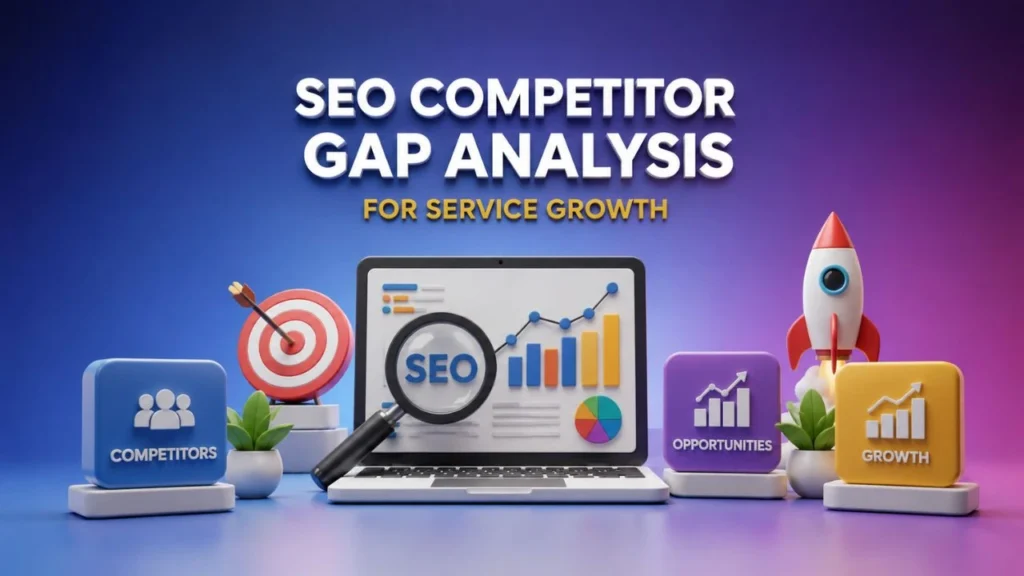
In competitive service markets, simply publishing content and optimizing a website is no longer enough. Businesses that consistently generate leads through organic search often succeed because they understand something their competitors do not. They identify gaps, uncover opportunities, and act on insights before others notice them.
This is where SEO competitor gap analysis becomes a valuable part of a modern digital marketing strategy.
Whether you operate a local service business, a consulting firm, an agency, or any company that relies on online visibility, understanding what your competitors are ranking for can reveal opportunities that may be limiting your growth. Instead of guessing which keywords to target or which content to create, you can use real competitive data to guide your decisions.
A well-executed SEO competitor gap analysis helps uncover missing keywords, content opportunities, backlink prospects, and search intent gaps that may be preventing your website from reaching its full potential. These insights can support stronger rankings, improved lead generation, and sustainable service growth over time.
In this guide, we will explore how competitor research can uncover hidden opportunities, improve your search visibility, and help you build a long-term SEO growth strategy.
Table of Contents
What Is SEO Competitor Gap Analysis?
SEO competitor gap analysis is the process of comparing your website’s SEO performance against competing websites to identify areas where they are outperforming you.
The goal is not to copy competitors. Instead, the goal is to discover opportunities that can strengthen your own SEO strategy.
A typical competitor gap analysis examines:
- Keyword gaps
- Content gaps
- Backlink gaps
- Search visibility gaps
- Search intent gaps
- Technical SEO differences
By analyzing these areas, businesses can uncover opportunities that contribute directly to organic traffic growth and stronger online visibility.
SEO Competitor Analysis vs Competitor Gap Analysis
Many marketers use these terms interchangeably, but they serve different purposes.
| SEO Competitor Analysis | SEO Competitor Gap Analysis |
| Studies competitors overall | Focuses on missing opportunities |
| Reviews strengths and weaknesses | Identifies actionable gaps |
| Looks at ranking strategies | Finds opportunities for improvement |
| Provides competitive insights | Generates growth opportunities |
While SEO competitor analysis provides a broad understanding of the market, SEO competitor gap analysis focuses specifically on what is missing from your current strategy.
Why Service Businesses Need Competitor Gap Analysis?
Service businesses often operate in highly competitive local and national markets. Customers compare multiple providers before making decisions, and search engines frequently display dozens of alternatives for the same service.
Without a clear understanding of competitor performance, businesses may:
- Miss valuable keyword opportunities
- Overlook emerging market trends
- Publish content that does not address customer needs
- Lose visibility to competitors
- Struggle with lead generation
A structured SEO competitor gap analysis helps eliminate these challenges by revealing opportunities supported by actual search data.
Why SEO Competitor Gap Analysis Matters for Service Growth?
Many businesses invest heavily in SEO without understanding where the biggest opportunities actually exist. This can lead to wasted resources and slower growth.
When businesses perform regular SEO competitor gap analysis, they gain insights that directly support service growth.
Identify Hidden SEO Opportunities
Competitors often rank for keywords and topics that your website has not yet targeted.
These opportunities may include:
- High intent service keywords
- Industry specific questions
- Long tail search queries
- Location based searches
- Emerging trends
A detailed SEO opportunity analysis can uncover keyword opportunities that attract qualified visitors who are actively searching for solutions.
Improve Organic Traffic Growth
Traffic growth rarely happens by accident. Most successful websites achieve consistent growth because they regularly identify and target competitor keyword gaps.
Through effective competitor keyword analysis, businesses can discover:
- Missing keywords
- High value keywords
- Untapped search queries
- Ranking keyword comparison opportunities
- Search intent gaps
These insights often become the foundation for sustained organic traffic growth.
Strengthen Search Visibility
Search visibility is one of the most important indicators of SEO success.
A comprehensive search visibility analysis helps businesses understand:
- How often they appear in search results
- Which competitors dominate specific topics
- Which content assets perform best
- Where visibility improvements are possible
Greater visibility often translates directly into more website visits, leads, and conversions.
Support Lead Generation SEO
- For service businesses, rankings alone are not enough.
- The ultimate objective is generating inquiries and customers.
- When competitor research is aligned with lead generation SEO, businesses can create content and service pages that attract visitors who are closer to making purchasing decisions.
- This makes SEO a valuable customer acquisition strategy rather than simply a traffic generation channel.
How to Perform SEO Competitor Gap Analysis?
A successful SEO competitor gap analysis follows a structured process. Skipping steps often results in incomplete insights and missed opportunities.
Step 1: Identify Your True SEO Competitors
One of the biggest mistakes businesses make is assuming that their business competitors are also their SEO competitors. In reality, search competitors are often different.
For example, a digital marketing agency may compete with:
- Industry publications
- Educational websites
- Software companies
- SEO blogs
- Marketing directories
This is why SERP competitor analysis is essential. Search Google for your primary service keywords and identify websites that consistently appear on the first page. These websites become your primary competitors for SEO purposes.
Step 2: Conduct Competitor Keyword Analysis
Once competitors are identified, the next step is analyzing their keyword profiles. A thorough competitor keyword analysis reveals valuable keyword opportunities that your website may not currently target.
Focus on:
- Competitor keyword gaps
- Missing keywords
- Keyword overlap analysis
- Ranking keyword comparison
- Search intent gaps
- High value keywords
The objective is not to target every keyword competitors rank for. Instead, prioritize keywords that align with your services and audience needs.
Example Keyword Gap Analysis Table
| Keyword | Your Site | Competitor A | Competitor B | Opportunity |
| SEO Audit Services | No | Yes | Yes | High |
| Technical SEO Consulting | No | Yes | No | Medium |
| Local SEO Services | Yes | Yes | Yes | Low |
| Enterprise SEO Solutions | No | Yes | Yes | High |
This type of keyword gap analysis often reveals immediate opportunities for content creation and service page optimization.
Content Gap Analysis for Service Websites
While keyword research reveals what people are searching for, content gap analysis helps identify topics your competitors cover that your website currently does not.
Many service businesses focus heavily on service pages and overlook informational content. As a result, competitors often capture traffic from potential customers who are still researching solutions.
A comprehensive content gap analysis can reveal:
- Missing blog topics
- Unanswered customer questions
- Industry-specific content opportunities
- Educational resources competitors provide
- Search intent gaps within your content strategy
When these gaps are addressed, businesses can strengthen their topical authority and improve organic search performance.
What Is Content Gap Analysis?
Content gap analysis is the process of identifying topics, questions, and content assets that competitors rank for but your website does not.
The purpose is to uncover content gap opportunities that align with your audience’s needs and business objectives.
Rather than creating content randomly, businesses can focus on topics that already demonstrate search demand.
Why Content Gap Analysis Matters for Service Growth?
Search engines increasingly reward websites that demonstrate expertise across an entire subject area. For service businesses, this means publishing content beyond basic service pages.
A strong content strategy helps:
- Build trust with potential customers
- Improve search engine rankings
- Increase website engagement
- Support lead generation efforts
- Establish industry authority
This approach contributes directly to business growth through SEO.
Identifying Content Gaps
The easiest way to discover content gaps is by comparing your website against top-ranking competitors.
Look for:
Service-Specific Topics
Competitors may publish content around specific service challenges, processes, or outcomes that you have not addressed.
Industry Guides
Comprehensive guides often attract informational search traffic and build authority.
Frequently Asked Questions
Many businesses overlook FAQ content even though it performs well for voice search and featured snippets.
Comparison Content
Comparison articles often target high-intent users evaluating different solutions.
Local Content Opportunities
For businesses serving specific regions, localized content can significantly improve visibility.
Using Topic Cluster Analysis
Modern SEO relies heavily on topical authority.
Instead of creating isolated articles, businesses should organize content into topic clusters.
A topic cluster consists of:
- One pillar page
- Multiple supporting articles
- Internal links connecting related content
For example, a digital marketing agency may create a pillar page around SEO services and supporting articles covering:
- Technical SEO
- Local SEO
- Keyword research
- Competitor analysis
- Content optimization
- Link building
This type of topic cluster analysis helps search engines understand your expertise and improves ranking potential across related keywords.
Content Strategy Planning Based on Competitor Research
Effective content strategy planning combines competitor insights with audience needs.
Before publishing new content, ask:
- Does this topic address a customer question?
- Is there measurable search demand?
- Can we provide more value than competitors?
- Does it support our services?
- Can it help move users toward conversion?
By answering these questions, businesses can create content that supports both rankings and revenue growth.
Competitor Backlink Analysis and Backlink Gap Analysis
- Content and keywords are only part of the equation.
- Backlinks remain one of the strongest ranking signals in search engine optimization.
- This is why competitor backlink analysis is a critical component of SEO competitor gap analysis.
What Is Competitor Backlink Analysis?
Competitor backlink analysis involves studying the websites linking to your competitors.
The goal is to identify link opportunities that could also benefit your website.
A backlink profile reveals:
- Industry partnerships
- Guest posting opportunities
- Directory listings
- Resource page mentions
- Editorial links
- Local citations
These insights often uncover opportunities that are difficult to identify through traditional link-building methods.
Understanding Backlink Gap Analysis
Backlink gap analysis focuses specifically on websites that link to competitors but do not link to your website.
These websites represent potential outreach targets because they have already demonstrated interest in content within your industry.
Benefits of backlink gap analysis include:
- Faster link acquisition opportunities
- Stronger domain authority growth
- Improved search engine rankings
- Better competitive positioning
Competitor Benchmarking Through Backlink Research
Backlink analysis also supports competitor benchmarking.
Businesses can compare:
| Metric | Your Website | Competitor Average |
| Referring Domains | 120 | 350 |
| Authority Links | 25 | 90 |
| Industry Mentions | 40 | 110 |
| Local Citations | 50 | 85 |
| Guest Post Links | 15 | 70 |
This comparison helps establish realistic SEO growth targets.
Domain Authority Comparison
Although domain authority is a third-party metric, it can provide useful context when evaluating competitors.
A domain authority comparison can reveal:
- Competitive strength
- Link-building requirements
- Ranking difficulty
- Market maturity
Businesses should use this metric as a benchmark rather than a direct ranking factor.
Building a Sustainable Link Acquisition Strategy
The objective is not simply obtaining more backlinks.
Focus on earning links from:
- Industry publications
- Professional associations
- Relevant blogs
- Local organizations
- Resource pages
- Educational content hubs
This approach supports long-term SEO performance and stronger online visibility.
Search Visibility Analysis and SEO Performance Benchmarking
Visibility is often a better measurement of SEO success than rankings alone.
A website may rank first for a few keywords but still struggle to generate meaningful traffic.
A detailed search visibility analysis provides a broader understanding of market performance.
What Is Search Visibility?
Search visibility measures how frequently a website appears in search results for relevant keywords.
Higher visibility generally leads to:
- Increased traffic
- Greater brand awareness
- More lead opportunities
- Improved customer acquisition
Conducting Competitor Ranking Analysis
A proper competitor ranking analysis compares your performance against competing websites.
Areas to evaluate include:
- Ranking positions
- Featured snippet ownership
- Local pack visibility
- AI Overview appearances
- FAQ visibility
- Organic traffic estimates
This information helps prioritize future SEO efforts.
SEO Performance Benchmarking
Successful SEO campaigns require measurable benchmarks.
Track metrics such as:
Organic Traffic Growth
Monitor traffic trends over time.
Keyword Rankings
Track movement across target keywords.
Lead Generation
Measure inquiry volume generated through organic search.
Conversion Rates
Evaluate how effectively SEO traffic converts into customers.
Search Visibility Scores
Track overall market presence.
Regular SEO performance benchmarking helps determine whether your strategy is moving in the right direction.
Conducting Market Competitor Research
SEO does not exist in isolation.
Comprehensive market competitor research helps identify:
- Industry trends
- Emerging competitors
- New service opportunities
- Customer expectations
- Content trends
Businesses that consistently monitor competitors are often better positioned to adapt to changing market conditions.
Leveraging Competitive Intelligence
The insights gathered during competitor research contribute to broader competitive intelligence.
Rather than focusing only on rankings, businesses can understand:
- Content strategies
- Customer targeting approaches
- Brand positioning
- Service differentiation
- Market expansion opportunities
These insights support smarter marketing decisions and stronger business growth.
Best Tools for SEO Competitor Gap Analysis
Performing an effective SEO competitor gap analysis becomes much easier when you use the right tools. While strategy remains the most important factor, these platforms can help uncover keyword gaps, content opportunities, backlink prospects, and competitive insights that may otherwise go unnoticed.
Ahrefs for Competitor Keyword Analysis
Ahrefs is widely used for competitive SEO research because of its extensive keyword and backlink database.
It can help businesses:
- Conduct competitor keyword analysis
- Identify keyword opportunities
- Perform backlink gap analysis
- Discover content gap opportunities
- Analyze organic search competitors
One of the most valuable features is the ability to compare multiple competitors simultaneously and identify keywords that competitors rank for while your website does not.
Semrush for Comprehensive SEO Opportunity Analysis
Semrush offers powerful competitive intelligence features designed specifically for market analysis.
Businesses can use it for:
- Keyword gap analysis
- Competitor ranking analysis
- SERP competitor analysis
- Search visibility analysis
- Domain authority comparison
Its keyword gap tools make it easier to identify competitor keyword gaps and prioritize opportunities based on traffic potential and ranking difficulty.
Google Search Console for Search Visibility Analysis
Google Search Console provides direct insights into how your website performs in search results.
It helps marketers:
- Monitor keyword rankings
- Discover emerging search queries
- Evaluate click-through rates
- Identify underperforming pages
- Improve content optimization
When combined with competitor research, Search Console data can reveal opportunities that support organic traffic growth.
Google Analytics for Organic Traffic Growth
Google Analytics helps businesses understand how organic visitors interact with their websites.
Key benefits include:
- Tracking user behavior
- Measuring conversions
- Evaluating landing page performance
- Identifying high-value traffic sources
- Monitoring customer acquisition trends
These insights help ensure SEO efforts contribute to measurable business outcomes.
Moz Pro for Competitor Benchmarking
Moz Pro offers valuable tools for competitor benchmarking and search performance monitoring.
Businesses can use it to:
- Compare domain authority
- Track rankings
- Analyze backlinks
- Monitor keyword opportunities
- Evaluate search visibility
It is particularly useful for understanding overall competitive positioning.
Screaming Frog SEO Spider for Technical Gap Discovery
Many SEO gaps are technical rather than content-related.
Screaming Frog SEO Spider helps identify:
- Broken links
- Missing metadata
- Crawlability issues
- Duplicate content
- Internal linking opportunities
Technical improvements often enhance the effectiveness of keyword and content strategies.
SEO Tools Comparison Table
| Tool | Keyword Gap Analysis | Content Gap Analysis | Backlink Analysis | Technical SEO | Competitor Benchmarking |
| Ahrefs | Excellent | Excellent | Excellent | Moderate | Excellent |
| Semrush | Excellent | Excellent | Excellent | Good | Excellent |
| Google Search Console | Good | Limited | No | Good | Limited |
| Google Analytics | Limited | Limited | No | No | Limited |
| Moz Pro | Good | Moderate | Good | Limited | Good |
| Screaming Frog SEO Spider | No | No | No | Excellent | Limited |
Common Mistakes in SEO Competitor Gap Analysis
Many businesses invest time and resources into competitor research but fail to achieve meaningful results because they make avoidable mistakes.
Understanding these pitfalls can improve the effectiveness of your SEO growth strategy.
Focusing Only on Competitors
- Competitor research should inform your strategy, not define it.
- Successful businesses focus on customer needs and search intent rather than simply copying competitors.
Ignoring Search Intent Gaps
- A keyword may generate traffic but fail to attract qualified prospects.
- This is why identifying search intent gaps is critical.
Always ask:
- What is the user trying to accomplish?
- Does the keyword align with our services?
- Can the content solve the user’s problem?
Overlooking Content Gap Analysis
- Some businesses focus exclusively on keywords while ignoring broader content opportunities.
- Without proper content gap analysis, websites may struggle to establish topical authority.
Neglecting Backlink Gap Analysis
- Many SEO campaigns prioritize content creation but ignore link acquisition.
- Without authority-building efforts, even high-quality content may struggle to rank.
Tracking Rankings Instead of Business Outcomes
Higher rankings are valuable, but they are not the ultimate objective.
Focus on metrics that directly impact growth:
- Leads
- Conversions
- Revenue
- Customer acquisition
- Service inquiries
Failing to Update Competitor Research
- SEO landscapes change constantly.
- New competitors emerge, search behavior evolves, and algorithms continue to develop.
- Regular competitive SEO research helps businesses stay ahead of these changes.
Competitive SEO Strategies for Service Companies
The insights gained from SEO competitor gap analysis become valuable only when they are transformed into action.
Below are practical strategies service businesses can implement.
Build Topic Clusters Around Core Services
Topic clusters help strengthen topical authority and improve search visibility.
For example, a business offering SEO services may create content covering:
- SEO audits
- Keyword research
- Local SEO
- Technical SEO
- Link building
- Competitor analysis
This structure helps search engines understand expertise across related topics.
Improve Service Page Optimization
Many competitors focus heavily on blog content while neglecting service pages.
Strong service page optimization includes:
- Clear service descriptions
- Customer-focused messaging
- Internal links
- Frequently asked questions
- Conversion-focused calls to action
Optimized service pages support both rankings and lead generation.
Target High-Value Keyword Opportunities
Not all keywords deserve equal attention.
Prioritize keywords that:
- Match service offerings
- Demonstrate commercial intent
- Have manageable competition
- Support lead generation goals
This approach improves ROI from SEO investments.
Create Conversion Focused SEO Content
- Traffic alone does not drive business growth.
- Effective content should help visitors move toward action.
Examples include:
- Service comparison guides
- Industry-specific resources
- Decision-making content
- Cost-related content
- Process explanations
This aligns SEO efforts with broader customer acquisition goals.
Strengthen Internal Linking
Internal links help search engines understand content relationships and distribute authority throughout the website.
A strong internal linking structure supports:
- Better crawling
- Improved rankings
- Enhanced user experience
- Stronger topical authority
Prioritize Continuous Content Optimization
SEO is not a one-time activity.
Regularly updating content can improve:
- Search engine rankings
- User engagement
- Content relevance
- Organic search performance
Continuous optimization often delivers faster results than creating entirely new content.
The Future of SEO Competitor Gap Analysis in AI Search
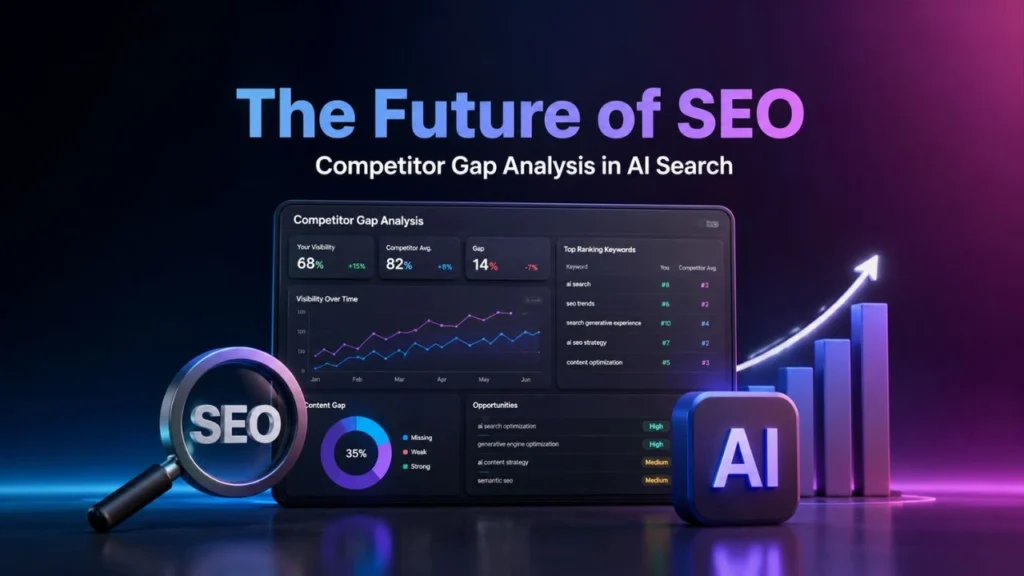
- Search is evolving rapidly.
- Traditional search engines now incorporate AI-generated answers, while AI platforms increasingly provide direct responses to user questions.
- As a result, businesses must adapt their competitor research strategies.
SEO Competitor Gap Analysis for GEO
Generative Engine Optimization focuses on improving visibility within AI-generated responses.
Competitor research can reveal:
- Frequently cited topics
- Missing entity coverage
- Question-based content opportunities
- Structured data improvements
These insights help businesses become more visible in AI-driven search environments.
Improving Visibility in Answer Engines
Answer engines prioritize concise, trustworthy, and well-structured content.
Businesses can improve visibility by:
- Addressing specific questions
- Providing direct answers
- Using structured headings
- Including FAQ sections
- Demonstrating expertise
This strengthens AEO performance.
Voice Search Optimization Through Competitor Analysis
- Voice search continues to influence content strategy.
- Users often phrase voice searches as complete questions.
Examples,
- What is SEO competitor gap analysis?
- How do I perform competitor keyword analysis?
- Why is content gap analysis important for service businesses?
Creating content that directly answers these questions improves voice search visibility.
Entity SEO and Semantic Optimization
Search engines increasingly evaluate relationships between topics, entities, and concepts.
Businesses should build content around:
- SEO competitor analysis
- Keyword gap analysis
- Content optimization
- Lead generation SEO
- Service industry SEO
- Competitive intelligence
This creates stronger semantic relevance and improves search performance.
Building a Digital Growth Strategy for the Future
The most successful businesses view SEO competitor gap analysis as an ongoing process rather than a one-time project.
Regular competitor research supports:
- Service business expansion
- Customer acquisition strategy
- Online visibility improvement
- Organic traffic growth
- Sustainable competitive advantage
As search evolves, businesses that continuously identify and act on opportunities will remain positioned for long-term growth.
Conclusion
In today’s competitive digital landscape, relying solely on traditional keyword research is no longer enough to achieve consistent growth. Search engines, AI-powered platforms, and voice search technologies continue to evolve, making it essential for businesses to understand not only what their audience wants but also how competitors are meeting those needs.
A well-executed SEO competitor gap analysis provides that advantage.
By combining competitor keyword analysis, content gap analysis, backlink gap analysis, search visibility analysis, and competitor benchmarking, businesses can uncover opportunities that would otherwise remain hidden. These insights help prioritize SEO efforts, improve content strategies, strengthen authority, and create a more effective customer acquisition strategy.
The most successful service businesses do not simply react to competitors. They use competitive intelligence to identify opportunities, build stronger content ecosystems, optimize service pages, and improve organic search performance over time.
Frequently Asked Questions
What is SEO competitor gap analysis?
SEO competitor gap analysis is the process of comparing your website with competing websites to identify missed opportunities in keywords, content, backlinks, search visibility, and user intent. The goal is to discover areas where competitors are outperforming you and develop strategies to close those gaps.
How to perform SEO competitor gap analysis?
To perform an effective SEO competitor gap analysis, follow these steps:
Identify your true SEO competitors.
Conduct competitor keyword analysis.
Perform keyword gap analysis.
Evaluate content gap opportunities.
Analyze competitor backlinks.
Compare search visibility metrics.
Prioritize opportunities based on business impact.
Implement and monitor improvements.
This process helps uncover actionable opportunities that contribute to service growth and organic traffic growth.
What is competitor keyword analysis?
Competitor keyword analysis involves examining the keywords that competing websites rank for in search engines. It helps identify keyword opportunities, competitor keyword gaps, missing keywords, and high-value search terms that can improve your visibility and rankings.
What is keyword gap analysis?
Keyword gap analysis compares your website’s keyword rankings against competitors to identify terms they rank for that you do not. This process reveals untapped search queries and opportunities to expand your keyword targeting strategy.
Why is content gap analysis important?
Content gap analysis helps businesses discover topics, questions, and resources competitors cover that are missing from their own websites. Addressing these gaps strengthens topical authority, improves search engine rankings, and supports long-term organic search performance.
What is backlink gap analysis?
Backlink gap analysis identifies websites that link to your competitors but do not link to your website. These websites often represent potential outreach opportunities that can strengthen your backlink profile and improve domain authority.
How often should businesses conduct competitor gap analysis?
Most service businesses should perform competitor gap analysis quarterly. Highly competitive industries may benefit from monthly reviews to identify emerging opportunities and respond to market changes more quickly.
Can SEO competitor gap analysis improve lead generation?
Yes. By identifying keyword opportunities, optimizing service pages, improving content coverage, and strengthening search visibility, businesses can attract more qualified visitors who are actively searching for their services. This often leads to increased inquiries, conversions, and customer acquisition.
How does competitor research support service growth?
Competitor research helps businesses understand market trends, customer interests, search demand, and competitive positioning. These insights support smarter SEO decisions that contribute directly to service growth and business expansion.
What is the difference between content gap analysis and keyword gap analysis?
Keyword gap analysis focuses on identifying missing keywords, while content gap analysis focuses on identifying missing topics, resources, and content assets. Both are important components of a comprehensive SEO growth strategy.
How does SEO competitor gap analysis help with AI search optimization?
AI search platforms often prioritize authoritative, comprehensive, and well-structured content. SEO competitor gap analysis helps identify missing information, entity relationships, and question-based content opportunities that improve visibility in AI-generated search results.