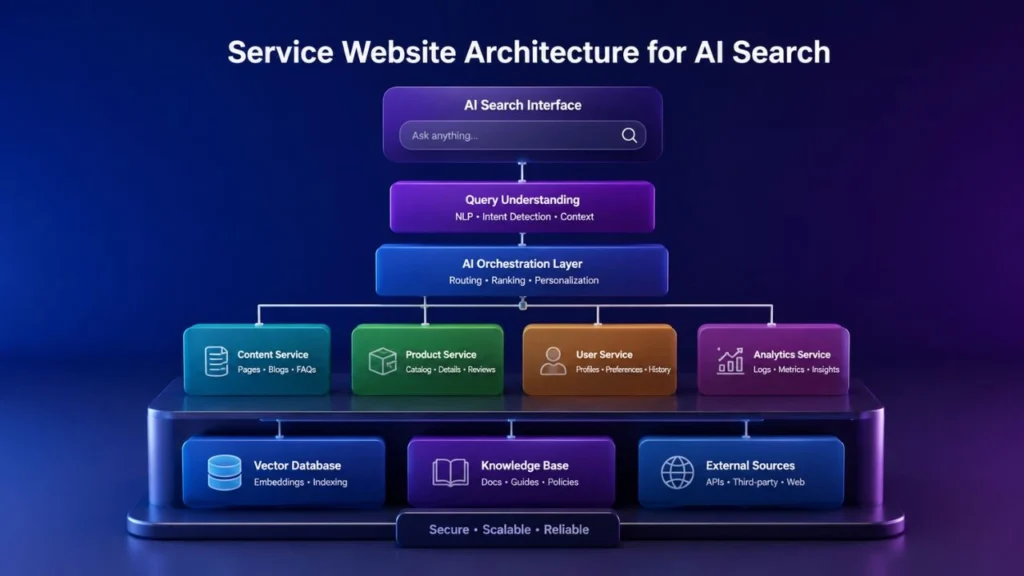
Search is evolving faster than ever. Traditional search engines are no longer the only way people discover information online. Today, AI driven search engines, conversational AI platforms, and large language models are becoming primary sources of information retrieval. Users are increasingly asking questions in natural language and receiving direct answers rather than browsing through dozens of search results.
This shift has created a new challenge for businesses. A website that performs well in traditional search may not automatically perform well in AI search environments. To remain visible, businesses must rethink their service website architecture and build websites that can be understood, interpreted, and cited by both search engines and AI systems.
A strong service website architecture is no longer just about organizing pages. It now plays a critical role in AI search optimization, AI discoverability, LLM search visibility, and generative engine optimization. Modern websites must provide clear content relationships, semantic signals, structured information, and machine readable website structure that helps AI systems understand expertise and context.
In this guide, you will learn how to build a future ready website architecture for generative AI, improve AI search visibility, strengthen your service website SEO strategy, and create a website that is optimized for traditional search engines, AI answer engines, voice search platforms, and emerging AI technologies.
Table of Contents
Traditional SEO vs AI Search Architecture
| Factor | Traditional Search | AI Search |
| Content Evaluation | Keywords and Pages | Entities and Context |
| Ranking Signals | Backlinks and Relevance | Knowledge Relationships |
| Crawling Method | Search Bots | AI Crawlers |
| Discovery Process | Search Results | Direct Answers |
| Content Structure | Important | Critical |
| Internal Linking | Authority Distribution | Relationship Mapping |
| Schema Usage | Helpful | Essential |
| User Queries | Keywords | Natural Language Questions |
What Is Service Website Architecture?
Service website architecture refers to the strategic organization of pages, content, navigation, internal links, categories, and semantic relationships across a website.
A well planned service website architecture helps users find information quickly while allowing search engines and AI systems to understand how different pieces of content connect to one another.
For digital marketing websites, architecture directly impacts:
- Website structure SEO
- Search engine friendly site structure
- AI search optimization
- Content discoverability
- User journey optimization
- Search experience optimization
Without a clear architecture, valuable service pages may become difficult for users and AI crawlers to discover.
Core Components of a Strong Website Architecture
Website Taxonomy
Website taxonomy refers to how content is categorized and organized. Service pages, industry pages, resources, blogs, and supporting content should follow a logical hierarchy.
Content Hierarchy Optimization
Content hierarchy optimization ensures that important pages receive the greatest visibility and authority within the website.
URL Hierarchy Optimization
A clean URL structure helps both users and search systems understand content relationships.
Example:
yourdomain.com/seo-services/local-seo/
is generally easier to understand than
yourdomain.com/page?id=245
Navigation Architecture
Navigation architecture helps visitors move seamlessly across the website while improving website crawlability.
Internal Linking Structure
A strategic internal linking structure strengthens semantic relationships between related pages and supports AI content retrieval.
Why AI Search Engines Need a Different Website Architecture?
The rise of AI search engines has fundamentally changed how information is discovered.
Instead of simply matching keywords, modern AI systems analyze context, entities, relationships, and user intent. They attempt to understand topics in the same way humans do.
How AI Driven Search Engines Understand Websites?
AI systems rely heavily on:
- Entity based SEO
- Semantic website architecture
- Content relationship mapping
- Knowledge graph optimization
- Structured data optimization
Rather than viewing each page as an isolated document, AI systems evaluate how every page contributes to an overall knowledge framework.
For example, if your digital marketing website contains SEO service pages, local SEO guides, technical SEO resources, and content marketing articles that are interconnected through contextual linking, AI systems can more easily identify topical authority.
This increases AI discoverability and improves the chances of being cited within AI generated answers.
The Foundation of AI Search Architecture
An effective AI search architecture begins with creating a semantic website architecture.
Every page should have a clear purpose, connect naturally to related topics, and contribute to a broader knowledge ecosystem.
Elements of an AI Friendly Website Structure
Semantic Website Architecture
Content should be organized around topics rather than isolated keywords.
Machine Readable Website Structure
AI systems need clearly structured information that can be processed efficiently.
Crawlable Website Architecture
Important pages should be accessible within a few clicks from the homepage.
Information Architecture for AI Search
A strong information architecture improves:
- Content discoverability
- Topic relevance signals
- AI knowledge extraction
- Information retrieval optimization
When your website follows a logical content structure, AI systems can identify expertise more effectively.
Topic Cluster Architecture for Service Websites
- One of the most effective approaches to AI search optimization is topic cluster architecture.
- Topic clusters help search engines and AI systems understand the breadth and depth of your expertise.
What Is Topic Cluster Architecture?
A topic cluster architecture consists of:
- Pillar pages
- Supporting cluster pages
- Contextual linking
- Content relationship mapping
Together, these components create a semantic content cluster that strengthens topical authority building.
Example for a Digital Marketing Website
| Pillar Topic | Supporting Content |
| SEO Services | Technical SEO, Local SEO, Ecommerce SEO |
| PPC Services | Google Ads, Remarketing, Conversion Tracking |
| Content Marketing | Blogging, Content Strategy, Copywriting |
| Social Media Marketing | Instagram Marketing, Facebook Advertising |
This structure supports content hubs while helping AI systems understand the relationship between related services.
Why Topic Clusters Improve AI Search Visibility?
Topic clusters contribute to:
- AI search visibility
- LLM search visibility
- Generative engine optimization
- Content discoverability
- Search indexing optimization
As AI systems increasingly rely on semantic understanding, topic clusters become an essential component of future proof website architecture for AI search engines.
Entity Based SEO and Knowledge Graph Optimization
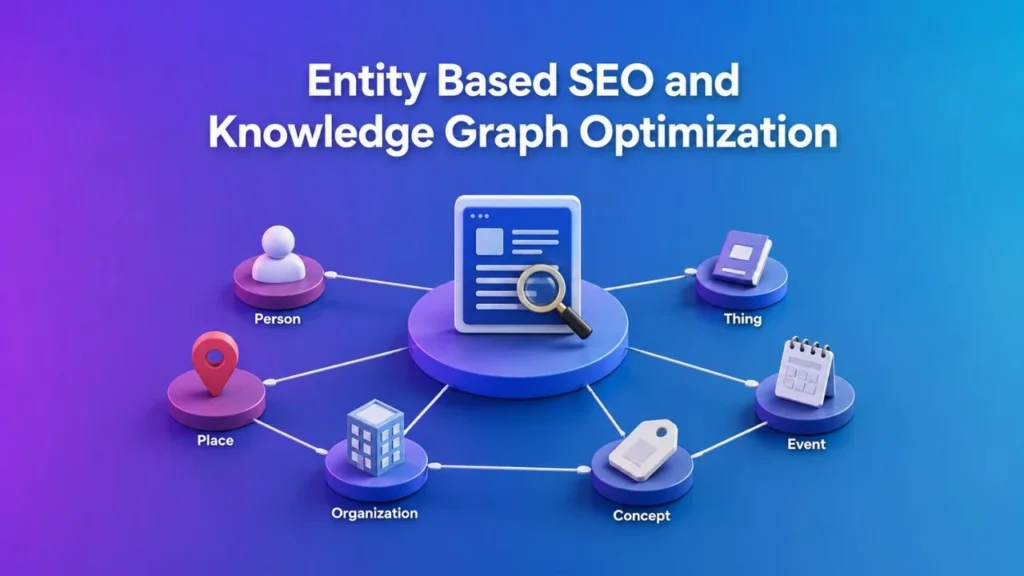
- Entities are rapidly becoming the foundation of modern search.
- An entity can be a service, company, concept, person, product, location, or topic that search engines recognize independently.
- Entity based SEO helps AI systems understand what your website is about beyond simple keyword matching.
For digital marketing websites, important entities may include:
- Search engine optimization
- Content marketing
- Local SEO
- Conversion rate optimization
- Technical SEO
- Lead generation
When these entities are connected through semantic relationships, AI systems can build stronger confidence in your expertise.
This process directly supports knowledge graph optimization and improves AI citation optimization opportunities.
Internal Linking Structure for AI Search Visibility
Internal links have always been important for SEO, but their role has expanded significantly in AI search environments. Modern AI systems use links to understand content relationships, entity connections, and topical depth.
A well-designed internal linking structure helps AI crawlers navigate content efficiently while strengthening semantic relationships across your website.
For digital marketing websites, internal links should not be treated as simple navigation elements. Instead, they should function as signals that explain how topics, services, resources, and supporting content connect.
AI Search Friendly Internal Linking Strategy
An AI search friendly internal linking strategy focuses on context rather than volume.
Instead of adding links randomly, every link should reinforce topical relevance and content relationship mapping.
Effective linking supports:
- AI search visibility
- Content discoverability
- Information retrieval optimization
- Topic relevance signals
- AI content retrieval
For example, an SEO Services page can naturally link to Technical SEO, Local SEO, Keyword Research, and Website Audit pages. This helps AI systems understand the broader subject area.
Contextual Linking vs Traditional Linking
- Traditional linking often focuses on passing authority.
- Contextual linking focuses on building semantic relationships.
- AI systems place significant value on contextual linking because it provides clues about how topics relate to one another.
Benefits include:
- Improved semantic website architecture
- Stronger entity optimization
- Better content entity mapping
- Enhanced search indexing optimization
Creating Semantic Relationships Through Links
Parent to Child Pages
Pillar pages should connect directly to supporting cluster pages.
Child to Parent Pages
Supporting content should link back to primary service pages.
Cluster to Cluster Links
Related topics should reference one another where relevant.
Service Page Linking
- Each service page should connect to complementary services.
- This approach strengthens both website crawlability and AI discoverability.
Service Page Architecture for AI Discovery
- Many businesses focus heavily on blog content while overlooking the architecture of service pages.
- However, service page architecture plays a critical role in AI search optimization because these pages often represent the primary commercial intent of a website.
Best Service Website Structure for AI Visibility
An optimized service page should answer user questions clearly while providing structured information that AI systems can interpret easily.
A recommended service page structure includes:
- Service Overview
- Business Challenges
- Solutions Offered
- Key Benefits
- Process Breakdown
- Frequently Asked Questions
- Related Services
- Industry Applications
- Contact Information
This format supports both user centric architecture and AI knowledge extraction.
Essential Sections Every Service Page Needs
Service Overview
Explain the service clearly and concisely.
Benefits Section
Highlight practical outcomes rather than generic features.
Process Section
Break down service delivery into understandable steps.
FAQ Section
Support conversational search optimization and voice search visibility.
Related Services
Strengthen contextual linking and content discoverability.
Search Intent Mapping for Service Pages
Every service page should address multiple intent types.
| Search Intent | Content Focus |
| Informational | Education and awareness |
| Commercial | Service comparison |
| Transactional | Conversion focused content |
| Conversational | Question based answers |
Proper search intent mapping improves search experience optimization while supporting AI answer engines.
Technical SEO Framework for AI Search Optimization
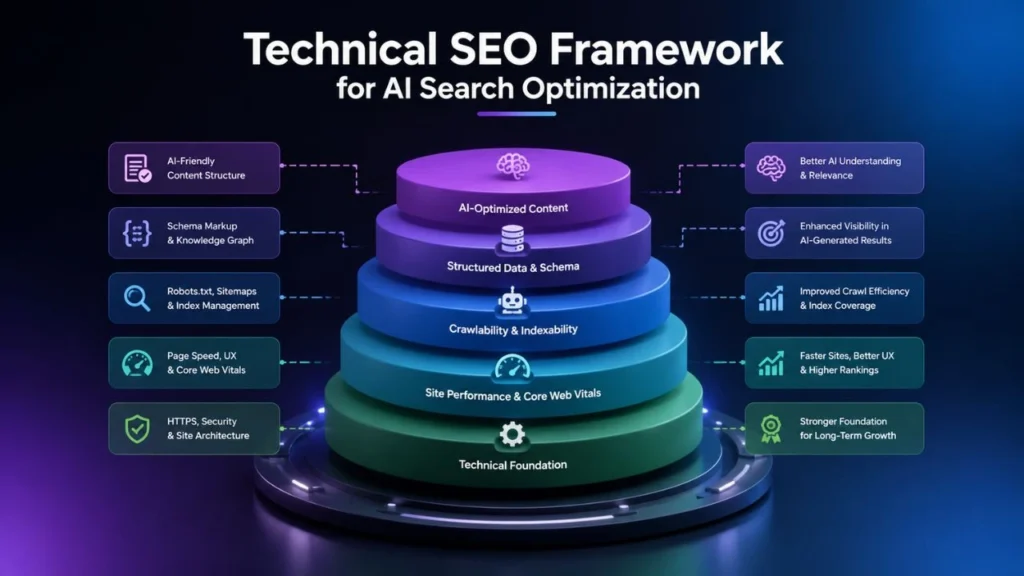
- Even the most organized website architecture can struggle if technical SEO issues prevent efficient crawling and indexing.
- A strong technical SEO framework ensures that AI crawlers and search engines can access, interpret, and retrieve content effectively.
Structured Data Optimization
- Structured data provides machine readable website structure that helps AI systems understand page meaning.
- Important schema types for service websites include:
Schema Markup Implementation Best Practices
When implementing schema:
- Maintain consistency across pages
- Use accurate entity references
- Avoid incomplete markup
- Keep data updated
Strong schema markup implementation improves AI citation optimization and AI search visibility.
XML Sitemap Optimization
An XML sitemap acts as a roadmap for crawlers.
Best practices include:
- Include all important pages
- Exclude duplicate URLs
- Update automatically
- Submit through search platforms
Proper XML sitemap optimization supports faster content discovery and improved search indexing optimization.
Canonicalization Strategy
- Duplicate content can confuse both search engines and AI systems.
- A clear canonicalization strategy helps establish the preferred version of a page and prevents indexing conflicts.
Benefits include:
- Improved crawl budget optimization
- Better indexing efficiency
- Stronger authority consolidation
Crawl Budget Optimization
- Large websites often waste crawl resources on low-value pages.
- Crawl budget optimization ensures that important service pages, pillar content, and topic clusters receive priority attention.
Strategies include:
- Removing unnecessary pages
- Fixing redirect chains
- Optimizing internal links
- Reducing duplicate content
Website Crawlability Improvements
Website crawlability directly affects content accessibility.
Important considerations include:
- Logical navigation architecture
- Clean URL hierarchy optimization
- Fast page loading
- Mobile responsiveness
- Internal linking structure
Improved crawlability enhances AI crawler optimization and search indexing performance.
Common Website Architecture Mistakes That Hurt AI Search Visibility
- Many websites unintentionally limit their AI discoverability due to poor architectural decisions.
- Understanding these mistakes can help businesses avoid costly visibility issues.
Weak Content Hierarchy
When important pages are buried deep within a website, AI systems may struggle to recognize their significance.
Content hierarchy optimization ensures critical pages receive proper visibility.
Poor Website Taxonomy
Confusing categories create uncertainty for both users and AI crawlers.
A well-defined website taxonomy improves:
- Navigation
- Content organization
- Information retrieval
Broken Semantic Relationships
- Disconnected content weakens semantic website architecture.
- Every major topic should connect naturally to related resources.
- Strong internal linking structure helps eliminate orphan pages.
Poor Content Discoverability
- Even excellent content can struggle if users and AI systems cannot find it easily.
- Content discoverability should be a priority during website planning.
Orphan Pages
Orphan pages have no meaningful internal links pointing to them.
These pages often suffer from:
- Poor crawlability
- Limited indexing
- Weak discoverability
Weak Internal Linking Structure
Random linking patterns fail to establish meaningful topic relationships.
Instead, businesses should focus on contextual linking and semantic relationships.
Missing Structured Data
- Without structured data optimization, AI systems may have difficulty understanding content meaning and entity relationships.
- Schema markup implementation remains a critical component of modern service website SEO.
Conclusion
The future of digital marketing will be shaped by AI search engines, conversational AI, large language models, and generative search experiences. As these technologies evolve, the importance of service website architecture will continue to grow.
A modern service website architecture must go beyond traditional website structure SEO. It should incorporate semantic website architecture, topic cluster architecture, entity based SEO, structured data optimization, AI crawler optimization, content relationship mapping, and knowledge graph optimization.
Businesses that invest in AI search architecture today will be better positioned to improve AI search visibility, strengthen LLM search visibility, support generative engine optimization, and increase AI discoverability across emerging search platforms.
Frequently Asked Questions
What is service website architecture?
Service website architecture is the framework used to organize service pages, content, navigation, categories, and internal links in a way that improves user experience, search visibility, and AI discoverability.
How does AI search architecture differ from traditional SEO?
Traditional SEO often focuses on keywords and rankings, while AI search architecture emphasizes entities, semantic relationships, structured information, and content retrieval.
What is the best service website structure for AI visibility?
The best service website structure for AI visibility includes topic clusters, pillar pages, semantic content clusters, strong internal linking, structured data, and clear content hierarchy optimization.
Why is entity based SEO important for AI search?
Entity based SEO helps AI systems understand concepts, relationships, and expertise beyond simple keyword matching. It improves AI search visibility and knowledge graph optimization.
How can businesses improve AI discoverability?
Businesses can improve AI discoverability through:
Semantic website architecture
Structured data optimization
Topic cluster architecture
Contextual linking
AI crawler optimization
What is generative engine optimization?
Generative engine optimization is the practice of improving visibility within AI generated answers by making content easier for AI systems to discover, understand, retrieve, and cite.
How do AI crawlers evaluate websites?
AI crawlers analyze:
Content structure
Semantic relationships
Entity connections
Schema markup
Internal linking patterns
Topic relevance signals
What role does structured data play in AI search?
Structured data helps create a machine readable website structure, making it easier for AI systems to interpret content accurately.
Is voice search optimization still important?
Yes. Voice search optimization supports conversational search optimization and improves visibility across AI assistants and answer engines.
How can businesses future proof their website architecture?
Businesses can future proof their website architecture by focusing on semantic SEO, entity optimization, content hubs, topic clusters, knowledge graph optimization, and user centric architecture.