
Thin Content can quietly weaken your search visibility before you even notice a major traffic drop. One day your pages may seem indexed, active, and properly optimized. Then gradually, impressions decline, rankings slip, and competitors begin taking over queries you once had a chance to win.
The problem is not always technical SEO. It is not always backlinks either. Many times, the real issue is content quality.
Thin Content usually means a page does not provide enough useful, original, complete, or satisfying information for the searcher. It may be too short, too generic, copied from other sources, repeated across many pages, or created only to target keywords without genuinely helping the reader.
If your website has too many weak pages, search engines may start seeing your site as less helpful overall. That can affect rankings, crawling, indexing, conversions, and even your ability to appear in AI search results, answer engines, and voice search responses.
The good news is that Thin Content can be fixed. You can audit weak pages, improve valuable content, merge duplicate pages, remove low-value URLs, and rebuild your site’s trust over time. In this guide, we will explain how to spot Thin Content, correct it properly, and restore rankings with practical Google penalty recovery strategies.
Table of Contents
What Is Thin Content?
Thin Content is content that provides little or no meaningful value to users. It may not answer the search query properly, may lack originality, or may only exist to attract search traffic without solving the reader’s problem.
However, Thin Content is not only about word count. A short page can still be useful if it answers a simple query clearly. On the other hand, a long article can still be thin if it repeats generic points, avoids depth, or fails to satisfy search intent.
For example, a 400-word page that clearly answers a direct question can perform well. But a 2,000-word blog post filled with repeated statements, vague tips, and no practical guidance may still be considered Thin Content from a quality perspective.
In simple words, Thin Content is not content that is short. It is content that is weak.
Thin Content vs Short Content
Many website owners confuse short content with Thin Content. This is a mistake. Search engines care about usefulness, not just length.
| Factor | Short Content | Thin Content |
| Word count | Usually brief | Can be short or long |
| User value | May answer the query clearly | Often fails to satisfy the query |
| Originality | Can be unique | Often generic, copied, or repeated |
| Search intent | May match intent well | Usually misses user intent |
| SEO impact | Not always harmful | Can weaken rankings |
| Fix needed | Not always | Usually yes |
A contact page, pricing note, glossary answer, or simple service detail may not need thousands of words. But if a page targets a competitive SEO keyword, service keyword, or problem-solving query, it needs enough depth to satisfy users better than competing pages.
That is why you should not judge Thin Content by word count alone. You should judge it by usefulness, originality, intent match, and trust.
Why Thin Content Hurts SEO Performance?
Thin Content can hurt SEO because it sends weak quality signals. When users land on a page and do not find enough helpful information, they may leave quickly, return to search results, or choose a competitor instead.
Search engines want to rank pages that solve user problems. If your content does not do that, your rankings may suffer.
Thin Content can create several SEO problems:
| Problem | How It Affects SEO |
| Poor search intent match | Users do not get the answer they expected |
| Duplicate pages | Search engines struggle to choose the best page |
| Low engagement | Visitors leave without reading or converting |
| Weak topical authority | Your site looks less trustworthy in the niche |
| Index bloat | Search engines waste crawl attention on low-value URLs |
| Ranking drops | Better pages from competitors replace yours |
If your site has only one or two weak pages, the damage may be limited. But if your site has hundreds of low-value pages, duplicate location pages, thin service pages, or generic blog posts, the impact can become much bigger.
This is where fixing Thin Content becomes an important part of long-term SEO recovery.
Common Types of Thin Content
Thin Content can appear in many forms. Some are obvious, while others are hidden inside normal-looking pages.
Pages With Very Little Useful Information
These pages usually contain only a few lines of generic text. They may define a topic but do not explain it properly. They do not include causes, benefits, steps, examples, FAQs, or practical advice.
For example, a service page that only says “We provide SEO services to help your business grow” is too vague. It does not explain the process, benefits, pricing factors, deliverables, problems solved, or reasons to trust the service.
Duplicate or Near-Duplicate Pages
Duplicate content is one of the most common Thin Content issues. This often happens when businesses create many pages for different locations, services, categories, or products but use almost the same text everywhere.
For example, if you create separate city pages and only change the city name, those pages may look thin because they do not provide unique local value.
Thin Affiliate Pages
Affiliate pages can become thin when they only contain product links, copied descriptions, and basic summaries. To be valuable, affiliate content should include original insights, comparisons, pros and cons, buying guidance, FAQs, and helpful decision-making support.
If the page only exists to send users elsewhere, it may not be strong enough to rank.
Scraped or Rewritten Content
Scraped content is copied from another website. Rewritten content may look slightly different, but it often says the same thing without adding original value.
Search engines do not need another version of the same information. They need content that adds something useful, clearer, deeper, more current, or more practical.
Doorway Pages
Doorway pages are created mainly to rank for similar keywords or locations. They often target many keyword variations but lead users to the same destination or offer the same basic information.
For example, creating dozens of nearly identical pages for different cities without unique local content can create a doorway-style issue.
AI-Generated Low-Value Pages
AI tools can help with content creation, but AI-generated content becomes risky when it is published without human review, originality, fact-checking, or real value.
If a site publishes hundreds of generic AI pages only to target keywords, those pages may become Thin Content. The problem is not that AI was used. The problem is that the final content does not help users enough.
How to Spot Thin Content on Your Website?
Finding Thin Content requires more than checking word count. You need to review performance, intent, quality, originality, and indexing value.
Start With Google Search Console
Google Search Console is one of the best places to begin. Look for pages that have:
- Falling impressions
- Declining clicks
- Low average ranking position
- High impressions but poor click-through rate
- Pages indexed but receiving no traffic
- Queries that do not match the page intent
If a page used to perform but has dropped over time, it may need a content quality review.
Review Analytics Data
Analytics tools can help you understand how users behave after landing on your pages.
Check for:
- Very low engagement time
- High bounce rate
- Low scroll depth
- Poor conversions
- Low page views
- No assisted conversions
- No meaningful user action
A page with traffic but no engagement may not be satisfying users.
Check Indexed Pages With No Traffic
Every indexed page should have a purpose. If a page is indexed but gets no impressions, clicks, leads, sales, or internal value, ask whether it deserves to stay indexed.
Some pages may be useful for users but not search. Those can be noindexed. Others may have no real value at all and can be removed or merged.
Look for Duplicate Search Intent
Sometimes, a site has too many pages targeting the same topic. This creates keyword cannibalization and weakens ranking potential.
| Page 1 | Page 2 | Problem |
| How to fix Thin Content | Thin Content recovery guide | Similar intent |
| SEO penalty recovery tips | Google penalty recovery strategies | Overlapping topic |
| Content audit checklist | Thin Content audit checklist | May need merging |
| Manual action recovery | Fixing manual actions and algorithm hits | Could compete |
If two pages answer the same query, consider merging them into one stronger page.
Review Pages Manually
Tools can help you find weak pages, but manual review is still important. Ask these questions:
- Does the page answer the main query clearly?
- Is the information original?
- Is the content updated?
- Does it explain the topic deeply?
- Does it include practical steps?
- Does it have useful headings?
- Does it include FAQs?
- Does it provide trust signals?
- Would a user need to visit another website after reading it?
If the answer to the last question is yes, your content may not be complete enough.
Thin Content Audit Checklist
Use this checklist to review each important page.
| Audit Point | What to Check | Action Needed |
| Search intent | Does the page match what users want? | Rewrite or restructure |
| Content depth | Does it explain the topic fully? | Add missing sections |
| Originality | Does it add unique value? | Add insights, process, or data |
| Duplicate content | Is it too similar to another page? | Merge or canonicalize |
| Engagement | Are users staying on the page? | Improve readability and value |
| Internal links | Is it connected to related pages? | Add relevant internal links |
| Index value | Should this page be indexed? | Keep, noindex, or remove |
| Trust signals | Is the content credible? | Add author, sources, updates |
| Conversion path | Does it guide the next action? | Add CTA or helpful links |
This checklist helps you move from guessing to making clear content decisions.
How to Correct Thin Content?
Fixing Thin Content does not mean adding random paragraphs. It means improving the page so it becomes more useful, complete, and trustworthy.
Improve the Page With Real Value
Start by identifying what is missing. A weak page may need:
- Better introduction
- Clear definition
- Step-by-step explanation
- Updated information
- Comparison table
- FAQs
- Internal links
- Expert insights
- Visuals or diagrams
- Stronger conclusion
- Better CTA
The goal is not to make the page longer. The goal is to make it more helpful.
Match Search Intent Properly
Every page should be built around a clear user intent.
| Search Intent | User Wants | Content Should Include |
| Informational | Learn something | Definitions, explanations, FAQs |
| Commercial | Compare options | Benefits, features, pricing factors |
| Transactional | Take action | Service details, CTA, trust signals |
| Local | Find nearby help | Location relevance, local FAQs |
| Problem-solving | Fix an issue | Steps, mistakes, tools, recovery plan |
If the user searches “how to fix Thin Content,” they want a process. If your page only defines the topic, it will not satisfy the query.
Merge Similar Pages
If multiple pages cover the same topic, merging them can create a stronger asset.
Here is a simple process:
- Choose the strongest URL.
- Combine the best content from all similar pages.
- Remove repeated or weak sections.
- Add missing subtopics.
- Redirect weaker URLs to the main page.
- Update internal links.
- Refresh title tags and meta descriptions.
- Submit the updated page for indexing.
This helps search engines understand which page should rank.
Remove or Noindex Low-Value Pages
Not every page should be improved. Some pages are not worth keeping in the index.
| Page Type | Best Action |
| Duplicate tag pages | Noindex |
| Empty category pages | Improve or noindex |
| Outdated announcements | Remove or noindex |
| Scraped pages | Remove and replace |
| Weak blog posts | Merge, rewrite, or delete |
| Internal utility pages | Noindex |
Be careful before deleting pages. If a page has backlinks, traffic, or historical value, redirect it properly.
Add Original Value
Original value is one of the best ways to turn Thin Content into strong content.
You can add:
- Unique explanations
- Expert commentary
- Practical checklists
- Custom tables
- Step-by-step workflows
- Original images
- Updated FAQs
- Real business insights
- Clear examples
- Better formatting
Search engines already have access to thousands of generic pages. Your page needs to offer something better.
Fixing Manual Actions and Algorithm Hits

When rankings drop, you need to understand whether the issue is a manual action or an algorithmic decline. Fixing manual actions and algorithm hits requires different recovery steps.
Manual Action vs Algorithmic Hit
| Factor | Manual Action | Algorithmic Hit |
| Notification | Visible in Search Console | Usually no direct message |
| Cause | Human review found a violation | Ranking systems reassessed quality |
| Recovery | Fix issue and request review | Improve quality and wait |
| Speed | Can improve after approval | Usually gradual |
| Documentation | Required for reconsideration | Not required but useful |
| Example | Thin pages with little value | Sitewide content quality decline |
A manual action is more direct. You will usually see a message in Google Search Console. An algorithmic hit is less obvious. You may notice ranking drops after quality updates, spam updates, or major search system changes.
How to Handle a Thin Content Manual Action?
If you receive a manual action related to low-value content, do not panic. Follow a structured process.
Step 1: Read the Search Console Message
Check what type of issue Google has identified. Understand whether the problem affects the whole site or only specific sections.
Step 2: Identify Weak Pages
Audit the pages that may be causing the issue. Look for copied content, doorway pages, thin affiliate pages, duplicate service pages, and low-value blog posts.
Step 3: Decide the Right Fix
Each page should be assigned one of these actions:
| Page Status | Action |
| Valuable but weak | Improve |
| Similar to another page | Merge |
| No search value but useful | Noindex |
| No value at all | Delete |
| Has backlinks but poor quality | Improve or redirect |
Step 4: Document Every Change
Keep a record of what you changed. Include removed URLs, improved pages, redirects, noindex decisions, and rewritten content.
Step 5: Submit Reconsideration Request
Once the issues are fixed, submit a clear reconsideration request. Explain what caused the problem, what you corrected, and how you will prevent it in the future.
How to Handle an Algorithmic Content Drop
Algorithmic recovery usually takes longer because there is no reconsideration request. You need to improve site quality and wait for search engines to recrawl, reprocess, and reassess your pages.
Focus on:
- Improving weak pages
- Removing low-value indexed URLs
- Updating outdated content
- Strengthening internal links
- Improving topical authority
- Fixing duplicate intent pages
- Enhancing user experience
- Adding clearer answers and FAQs
Algorithmic recovery is rarely instant. But consistent quality improvement can help your site regain visibility over time.
Google Penalty Recovery Strategies for Thin Content
Strong Google penalty recovery strategies focus on quality, clarity, structure, and trust. You need to show search engines that your website now provides better value than before.
Strategy 1: Create a Content Quality Map
A content quality map helps you organize pages by action.
| Category | Meaning | Action |
| Keep | Strong page with value | Update lightly |
| Improve | Useful topic but weak execution | Rewrite and expand |
| Merge | Similar to another page | Combine content |
| Noindex | Useful but not search-worthy | Keep out of index |
| Delete | No value | Remove or redirect |
This prevents random editing and helps you make better decisions.
Strategy 2: Rebuild Around Search Intent
Thin Content often happens because the page was built around a keyword, not the user’s actual need.
Instead of asking, “How can we rank for this keyword?” ask, “What does the user need to know before they are satisfied?”
For example, a strong page about Thin Content should explain:
- What Thin Content is
- Why it hurts rankings
- How to find it
- How to fix it
- When to merge pages
- When to noindex pages
- How to recover after a ranking drop
- When to use thin content penalty recovery services
That is how you build content around intent, not just keywords.
Strategy 3: Improve Topical Authority
One strong article is helpful, but a full topic cluster is stronger.
Create supporting content around:
- Thin Content audit checklist
- Content pruning guide
- Google penalty recovery strategies
- Manual action recovery
- Helpful content optimization
- Duplicate content fixes
- SEO content audit process
- Fixing manual actions and algorithm hits
Then link these pages together naturally. This helps search engines understand that your site covers the topic in depth.
Strategy 4: Strengthen Internal Linking
Internal links help users and search engines discover your important pages. They also help distribute authority across your site.
Use natural anchor text like:
- Thin Content audit
- content quality issues
- Google penalty recovery strategies
- fixing manual actions and algorithm hits
- SEO content recovery
- content pruning process
Avoid forcing exact-match anchor text everywhere. Keep it natural.
Strategy 5: Refresh Outdated Content
Outdated content can become thin even if it was once useful. SEO changes, Google systems evolve, and user expectations shift.
Update old pages by adding:
- Current best practices
- Better examples
- Fresh FAQs
- Clearer headings
- Stronger internal links
- Improved title and meta description
- Better formatting
- More direct answers
A content refresh can often improve rankings faster than publishing a completely new post.
When to Use Thin Content Penalty Recovery Services
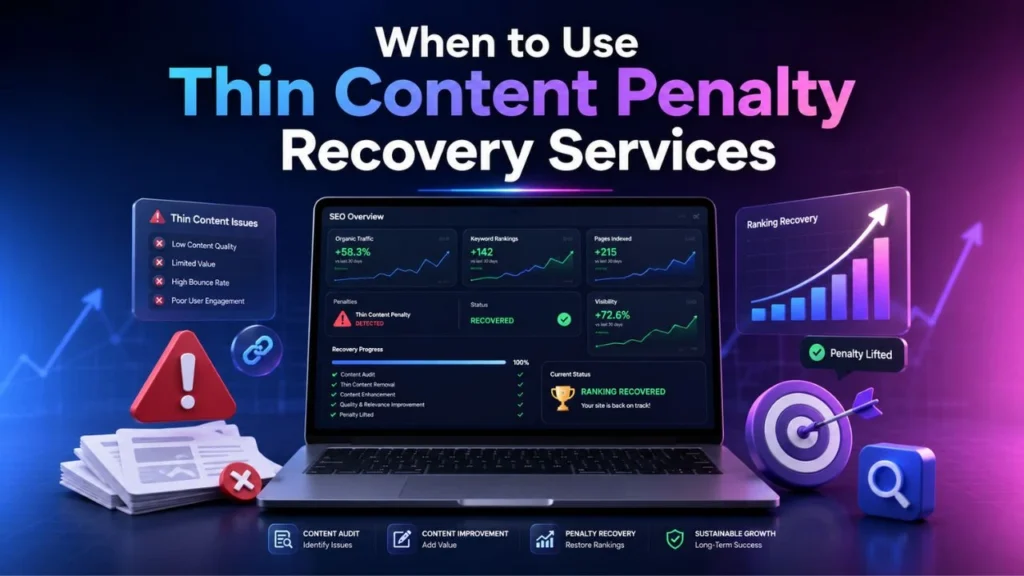
Some websites can fix Thin Content internally. But in serious cases, professional thin content penalty recovery services may be useful.
You may need expert help if:
- Your site has received a manual action
- Organic traffic dropped suddenly
- You have hundreds or thousands of weak pages
- You are unsure whether to delete, merge, noindex, or rewrite pages
- Your previous recovery attempts failed
- You have many duplicate location or service pages
- Your site depends heavily on organic leads or revenue
Good thin content penalty recovery services should include more than basic rewriting. They should provide a complete recovery process.
| Service Area | What It Should Include |
| Content audit | Find weak, duplicate, outdated, and low-value pages |
| Manual action review | Check Search Console issues |
| Recovery planning | Decide improve, merge, noindex, delete, or redirect |
| Content rewriting | Improve value, structure, and search intent |
| Technical SEO review | Check indexing, canonicals, redirects, and internal links |
| Documentation | Track all changes for recovery |
| Reconsideration support | Help prepare a clear request if needed |
The goal is not only to remove the penalty or recover traffic. The real goal is to build a stronger site that can compete long term.
How to Restore Rankings After Fixing Thin Content?
Fixing Thin Content is only the first stage. After that, you need to help search engines discover, understand, and trust your improved pages.
Step 1: Reindex Important Pages
After updating major pages, use Google Search Console to request indexing. This can help search engines revisit the page sooner.
You do not need to request indexing for every small edit. Focus on important pages that were significantly improved.
Step 2: Update Internal Links
Link to your improved pages from relevant existing pages. This helps search engines understand that the page is important.
For example, if you improved a Thin Content recovery guide, link to it from pages about SEO audits, Google penalties, content pruning, and technical SEO.
Step 3: Refresh Your XML Sitemap
Your XML sitemap should include valuable, indexable pages. Remove deleted, noindexed, redirected, or low-value URLs.
A clean sitemap helps search engines focus on the pages that matter.
Step 4: Monitor Ranking Recovery
Track your progress using:
- Google Search Console
- Analytics data
- Keyword tracking tools
- Crawl reports
- Indexed page counts
- Engagement metrics
- Conversion data
Do not only look at rankings. Also check whether improved pages are getting better impressions, clicks, engagement, and leads.
Step 5: Improve User Experience
A page may have strong information but still perform poorly if it is hard to read.
Improve readability with:
- Short paragraphs
- Clear H2 and H3 headings
- Bullet points
- Tables
- FAQs
- Summary boxes
- Strong opening answers
- Clear calls to action
Better content structure helps both users and search engines.
Thin Content Recovery Workflow
Here is a simple workflow you can follow:
| Step | Action | Goal |
| 1 | Export all indexed URLs | Build your audit list |
| 2 | Check traffic and rankings | Find weak pages |
| 3 | Review search intent | Understand user needs |
| 4 | Identify duplicate pages | Reduce content overlap |
| 5 | Classify each URL | Keep, improve, merge, noindex, or delete |
| 6 | Improve important pages | Add value and depth |
| 7 | Redirect merged pages | Preserve authority |
| 8 | Update internal links | Strengthen crawl paths |
| 9 | Submit reconsideration if needed | Recover from manual action |
| 10 | Monitor results | Track recovery |
This process gives you a clear plan instead of random fixes.
How to Make Your Content Stronger for AI Search and Voice Search?

If you want your content to rank across search engines, AI search tools, and voice search, structure matters.
Add Direct Answer Blocks
Include short answer sections near the top of important headings.
Example:
What is Thin Content?
Thin Content is content that provides little useful, original, or complete information to users. It often fails to satisfy search intent and can weaken SEO performance.
This type of answer helps AEO and voice search.
Use Question-Based Headings
Add headings that match how people search.
Examples:
- What causes Thin Content?
- How do you find Thin Content?
- Can Thin Content hurt rankings?
- Should you delete Thin Content?
- How long does ranking recovery take?
These headings make your content easier for answer engines to understand.
Add Tables and Checklists
Tables help compare ideas quickly. Checklists help users take action. Both formats also make your content easier to scan and extract.
Use Natural Language
Voice search works best with conversational wording. Avoid robotic phrasing. Write like you are explaining the topic to a real person.
For example, instead of saying:
“Thin Content remediation must be executed via quality enhancement protocols.”
Say:
“To fix Thin Content, improve the page so it answers the user’s question better than before.”
Simple language wins.
Common Mistakes to Avoid While Fixing Thin Content
Adding Words Without Adding Value
This is one of the biggest mistakes. More words do not automatically create better content. If the added text repeats the same idea, the page is still thin.
Add useful sections, not filler.
Deleting Pages Without Checking Data
Before deleting a page, check whether it has backlinks, traffic, conversions, or internal link value. If it does, you may need to improve or redirect it instead.
Ignoring Search Intent
A page can be well-written and still fail if it answers the wrong intent. Always compare your content with what users actually expect.
Keeping Duplicate Pages Indexed
If several pages target the same query, they may compete with each other. Merge or restructure them to create one stronger page.
Publishing AI Content Without Review
AI can help you draft content, but the final page should include human judgment, accuracy, originality, and brand-specific insight.
Forgetting Internal Links
After improving content, link to it from relevant pages. Otherwise, search engines may not understand its importance.
Practical Example of a Thin Content Fix
Suppose you have a service page targeting “SEO penalty recovery.” The page has only 300 words, no process, no FAQs, and no explanation of manual actions or algorithmic drops.
A stronger version should include:
| Weak Page Element | Improved Page Element |
| Generic service intro | Clear explanation of penalty recovery |
| No process | Step-by-step recovery workflow |
| No trust signals | Experience, approach, and transparency |
| No FAQ | Answers to common recovery questions |
| No internal links | Links to content audit, technical SEO, and Google updates |
| No CTA | Clear next step for users |
This turns a weak page into a useful resource.
Conclusion
Thin Content is not just a small SEO issue. It can affect rankings, trust, indexing, user experience, conversions, and your visibility across search engines, AI search tools, answer engines, and voice search.
The solution is not to add random words. The solution is to make each important page more useful, original, complete, and aligned with search intent.
Start by auditing your indexed pages. Identify which pages should be improved, merged, noindexed, deleted, or redirected. Then rebuild your content around user needs, not just keywords. Add clear answers, helpful tables, practical steps, FAQs, and stronger internal links.
If your site has suffered from a manual action or a major ranking decline, use structured Google penalty recovery strategies and focus on fixing manual actions and algorithm hits with patience and consistency.
When you correct Thin Content properly, you do more than recover rankings. You build a stronger website that users trust, search engines understand, and AI-powered search tools can confidently recognize as valuable.
FAQs
What is Thin Content in SEO?
Thin Content in SEO refers to pages that provide little useful, original, or complete information. These pages may be too brief, duplicated, generic, outdated, or poorly matched to search intent. Thin Content can make it harder for your website to rank well.
Can Thin Content hurt rankings?
Yes, Thin Content can hurt rankings because it may fail to satisfy users. If search engines find that your pages do not provide enough value, they may rank stronger, more helpful pages above yours.
Is Thin Content the same as duplicate content?
No, they are not exactly the same. Duplicate content is one type of Thin Content, but Thin Content can also include shallow pages, doorway pages, low-value affiliate pages, copied content, or generic AI-generated content.
How do I find Thin Content on my website?
You can find Thin Content by reviewing Google Search Console data, analytics reports, indexed pages with no traffic, duplicate intent pages, low-engagement URLs, and pages that do not fully answer user queries.
How do I fix Thin Content?
To fix Thin Content, improve useful pages, merge similar pages, noindex pages that should not appear in search, delete pages with no value, and strengthen internal links. The right action depends on the page’s purpose and performance.
Should I delete Thin Content?
Not always. Some Thin Content should be improved or merged instead of deleted. Delete a page only if it has no useful value, no traffic, no backlinks, and no clear purpose. If it has value, consider rewriting or redirecting it.
How long does it take to recover rankings after fixing Thin Content?
Ranking recovery can take weeks or months. It depends on how quickly search engines recrawl your site, how serious the issue was, how much quality improved, and how competitive your keywords are.
What are thin content penalty recovery services?
Thin content penalty recovery services help identify low-value pages, fix content quality issues, handle manual actions, improve weak pages, manage redirects or noindexing, and support ranking recovery through structured SEO improvements.
What is the difference between a manual action and an algorithmic hit?
A manual action is a direct penalty that appears in Google Search Console. An algorithmic hit usually happens when search systems reassess your site quality, but you may not receive a direct message. Both require quality improvements, but the recovery process is different.
What are the best Google penalty recovery strategies?
The best Google penalty recovery strategies include auditing all indexed pages, removing policy violations, improving Thin Content, merging duplicate pages, strengthening internal links, updating outdated content, and submitting a reconsideration request if there is a manual action.