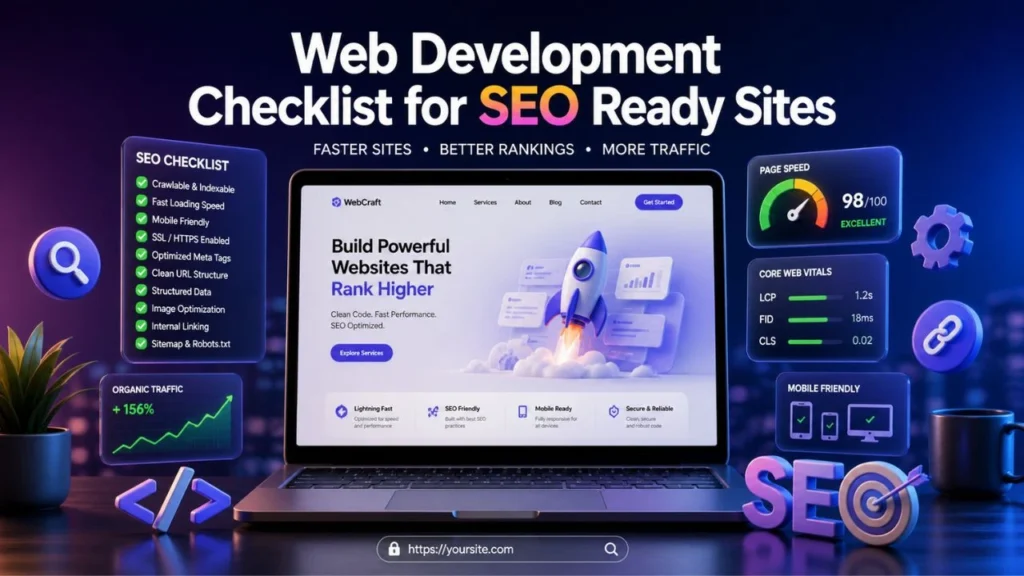
If you want your website to rank, attract the right visitors, and stay visible across search engines, AI driven search tools, and voice assistants, you need more than a good design. You need a smart foundation. That is where a strong Web Development Checklist becomes essential.
Many websites look polished on the surface but struggle to perform in search because important technical and structural elements were missed during development. A site may have great visuals, but if it loads slowly, hides important content from search engines, or lacks a clear content structure, it becomes much harder to compete online.
A well planned Web Development Checklist helps you build a site that is not only visually appealing but also ready for indexing, ranking, answering user queries, and supporting long term growth. When you follow the right process from the beginning, you make it easier for search engines to understand your pages, easier for users to navigate your site, and easier for AI tools to surface your content in relevant responses.
In this guide, we will walk through a practical Web Development Checklist for SEO ready sites so you can create a website that performs well in modern search environments and delivers real value to your audience.
Table of Contents
What Is a Web Development Checklist for SEO Ready Sites?
A Web Development Checklist is a structured set of tasks that ensures your website is built with performance, usability, search visibility, and long term scalability in mind. For SEO ready sites, this checklist goes beyond coding and design. It covers everything from site speed and mobile responsiveness to crawlability, indexing, structured data, content layout, and internal linking.
This matters because development choices directly affect how well your site can rank. If your pages are difficult to crawl, slow to load, poorly organized, or unclear in structure, search engines may struggle to interpret them correctly. Users may also leave quickly, which reduces engagement and weakens the overall performance of the site.
A strong Web Development Checklist gives you a roadmap. It helps developers, marketers, business owners, and content teams work toward the same goal, which is building a site that is ready to perform in both traditional search and newer AI powered discovery systems.
Why SEO Ready Development Matters Before You Publish
SEO does not begin after launch. It begins the moment your site structure, templates, navigation, and page layout are being planned. If those pieces are built without search visibility in mind, you may spend months fixing problems that could have been avoided early.
A proper Web Development Checklist allows you to prevent issues before they affect rankings. It ensures your pages are accessible, mobile friendly, easy to understand, and technically sound. This makes a major difference because search engines reward websites that deliver strong user experience and clear page value.
It also matters for answer engine optimization and voice search. People now search using natural language questions. AI tools and voice assistants look for concise, structured, and trustworthy answers. If your site content is hard to scan or buried inside poor layouts, you lose those opportunities.
When development and SEO work together from the start, your website becomes far more competitive.
Web Development Checklist for Technical Foundation
The first part of any Web Development Checklist should focus on technical stability. Your website needs a strong base before content and promotion can do their job.
Start with secure hosting and HTTPS. Users expect secure browsing, and trust begins with a safe connection. Your site should also have clean code, fast server response, and a stable environment that can handle traffic without slowing down.
Next, pay attention to page speed. A slow website creates friction for both users and search engines. Compress images, reduce unnecessary scripts, remove bloated plugins, and keep your codebase as clean as possible. Speed is not just a technical metric. It shapes the first impression people have of your brand.
Your Web Development Checklist should also include mobile first responsiveness. Most users now browse on phones, so every page should adapt smoothly to different screen sizes. Text should be readable, buttons should be easy to tap, and layouts should stay usable without zooming or awkward scrolling.
Finally, focus on navigation. A website should never make users guess where to go next. Clear menus, logical categories, and consistent layouts help both people and search engines understand your site more easily.
Web Development Checklist for Crawlability and Indexing
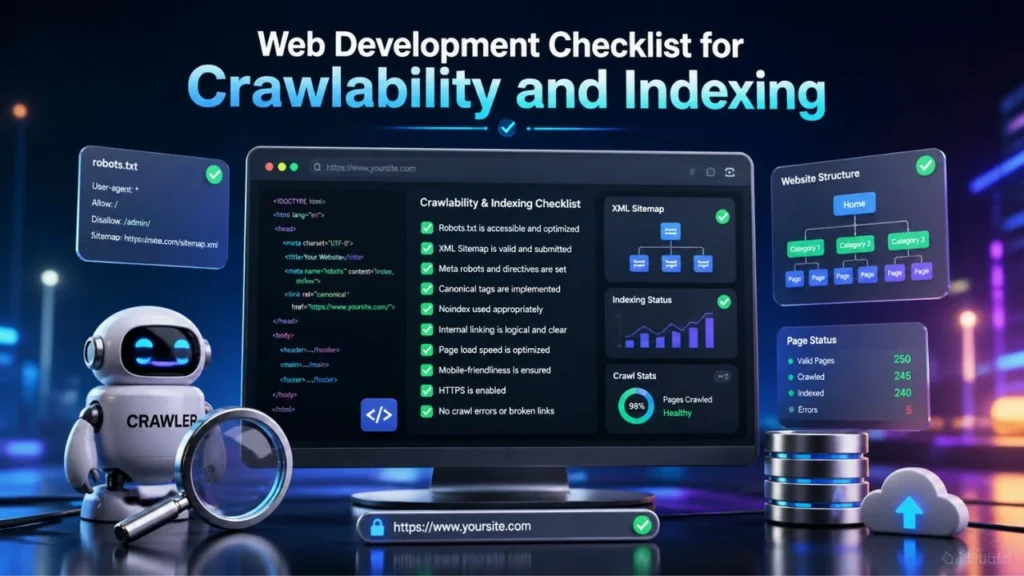
A site can only rank if search engines can crawl and index it properly. That is why crawlability must be a core part of your Web Development Checklist.
Make sure your robots.txt file is properly configured. It should guide search engines without blocking important pages. At the same time, create and submit a clean XML sitemap so search engines can discover your content more efficiently.
Canonical tags are also important. They help search engines understand the preferred version of a page and reduce duplication issues. If your site has filters, parameters, or similar pages, canonicals become even more valuable.
Another important item in your Web Development Checklist is handling redirects and broken pages. If old URLs exist, redirect them properly. If pages are removed, manage them carefully. Broken links and error pages create poor user experience and weaken site trust.
You should also review how JavaScript is used. If critical content depends heavily on scripts that are not rendered properly, search engines may not see the full page as intended. Important text, headings, and links should always be accessible.
Web Development Checklist for Site Architecture
Strong site architecture helps search engines understand relationships between your pages. It also helps users move naturally from one topic to another. That is why site structure deserves a prominent place in your Web Development Checklist.
Your homepage should connect clearly to your most important categories or services. From there, supporting pages should be grouped logically under those main areas. This creates a hierarchy that makes sense for both navigation and indexing.
Internal linking is a major part of this process. When relevant pages link to each other naturally, you help distribute authority and guide users deeper into the site. A strong Web Development Checklist should encourage contextual internal links, not random ones. Each link should help the user learn more, compare options, or take the next step.
Breadcrumb navigation can also improve clarity. It shows where a user is within the site and helps search engines interpret the page structure. This becomes especially useful as your site grows.
If you want a site that performs well over time, never treat architecture as an afterthought. It is one of the quiet factors that often separates average sites from strong ranking websites.
Web Development Checklist for On Page SEO Essentials
On page SEO is where content and structure meet. Even the best design will struggle if pages are missing key optimization elements. That is why every Web Development Checklist must include on page basics.
Each page should have a unique title tag that clearly reflects the page topic. Your meta descriptions should support click through by explaining the value of the page in a concise and appealing way. Headings should be structured properly with one clear H1 and helpful H2s and H3s underneath it.
A good Web Development Checklist also includes optimized images. Use descriptive file names where appropriate, compress images to improve load time, and write alt text that adds context rather than stuffing keywords.
Readability matters just as much. Keep paragraphs manageable, use clear language, and break complex ideas into sections. Readers should be able to scan the content quickly and still understand the main message. This is especially important for mobile users and voice style search behavior.
You should also make sure your pages include meaningful calls to action, trust signals, and content that matches the search intent behind the keyword. Ranking is not just about being found. It is about being useful once users arrive.
Web Development Checklist for Structured Data and AI Readiness
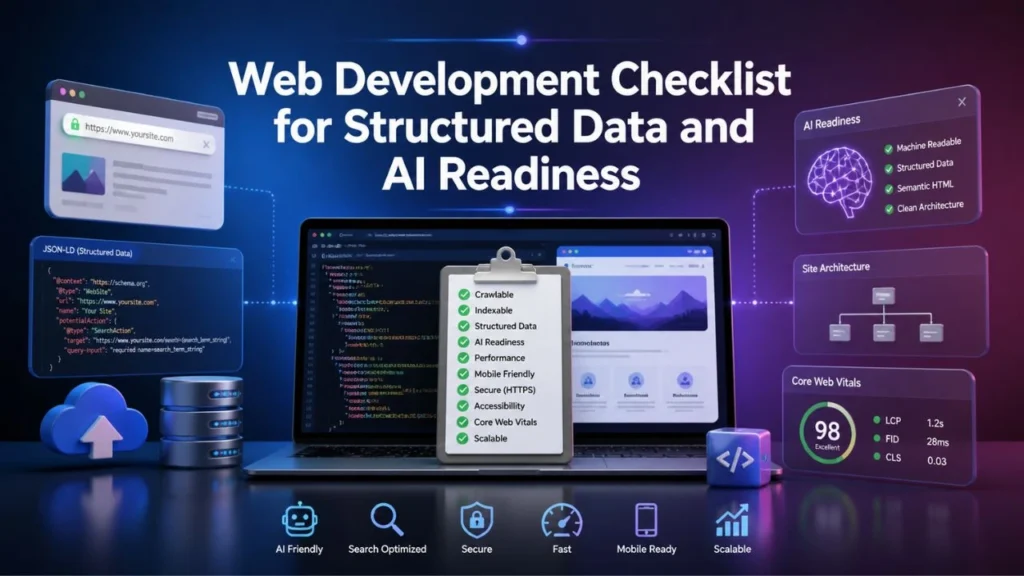
Search visibility is evolving, and websites now need to communicate clearly not only with search engines but also with AI systems that summarize and surface information. That is why a modern Web Development Checklist should include structured data and content clarity.
Structured data helps define what a page is about. Depending on the page type, you may use article, breadcrumb, organization, service, FAQ, or local business markup. This gives search engines stronger signals and helps them interpret page elements more accurately.
For AI search and answer engines, content formatting matters a lot. A good Web Development Checklist should encourage clear headings, short answer blocks, concise definitions, and well organized supporting information. AI tools often favor content that is easy to extract, summarize, and cite.
You should also keep business details consistent across the site. Brand name, contact details, service information, and category language should remain clear and uniform. This improves trust and makes your site easier to understand across different discovery systems.
When your site is technically clean and content rich, it becomes more likely to appear in both search results and AI assisted search experiences.
Web Development Checklist for Voice Search Optimization
Voice search is more conversational than typed search. People ask full questions, expect quick answers, and want information in a natural format. That is why voice search deserves a place in your Web Development Checklist.
Start by using question based headings where relevant. Then answer those questions directly in the first few lines below each heading. This creates a format that works well for both readers and voice assistants.
A strong Web Development Checklist should also include conversational phrasing. Your content should sound natural, not overly formal or robotic. Use language that reflects how real people ask things. This helps your content connect with long tail queries and spoken searches.
Page speed and mobile usability also matter here. Many voice searches happen on mobile devices, and users expect fast results. If your website loads slowly or feels clunky, it becomes less competitive in those moments.
Adding FAQ sections can also strengthen voice search optimization. FAQs mirror the way people speak and search, which makes them useful for capturing direct informational intent.
Pre Launch and Post Launch Checks
No Web Development Checklist is complete without launch preparation and follow up review. Before going live, check every important technical setting. Make sure pages meant for indexing are open to search engines. Test your forms, navigation, internal links, structured data, metadata, and mobile layouts.
Review page speed, image compression, and content formatting. Ensure that analytics and webmaster tools are connected properly so you can monitor performance from day one.
After launch, keep using your Web Development Checklist as a living document. Track crawl errors, indexing status, user behavior, and page performance. Refresh underperforming content, improve internal links, and continue refining the user experience.
A website is never truly finished. The strongest sites grow because they are reviewed, updated, and improved consistently.
Common Mistakes That Hurt SEO Ready Sites
Even a promising site can underperform if certain issues are ignored. One common mistake is focusing too much on design while neglecting structure. Another is using heavy scripts that slow down pages or hide important content.
Some sites publish pages without clear search intent. Others skip internal linking, forget metadata, or launch with duplicate content issues. In many cases, businesses invest in content but ignore the technical foundation that allows that content to rank.
That is why a practical Web Development Checklist is so valuable. It keeps your priorities clear and helps you catch problems before they become expensive to fix.
Final Thoughts
If you want your website to compete in modern search, you need more than attractive pages. You need a strategy that combines user experience, technical quality, content clarity, and search readiness from the start. A well built Web Development Checklist helps you do exactly that.
When you treat development as part of SEO rather than separate from it, your site becomes easier to crawl, easier to understand, and more useful to the people you want to reach. That creates a stronger foundation for rankings, better visibility across AI search experiences, and a smoother path to long term growth.
So if you are planning a new website or improving an existing one, do not wait until after launch to think about visibility. Build with purpose from the beginning. A complete Web Development Checklist is not just a development tool. It is a growth tool.
Frequently Asked Questions
01. What is a Web Development Checklist in SEO?
A Web Development Checklist in SEO is a step by step framework used to build websites that are fast, crawlable, mobile friendly, well structured, and ready to rank in search results.
02. Why is a Web Development Checklist important for SEO ready sites?
A Web Development Checklist helps ensure that key technical and on page elements are handled properly before and after launch, which improves visibility, usability, and long term search performance.
03. How does a Web Development Checklist support AI search?
A Web Development Checklist supports AI search by helping you create clear page structures, concise answers, consistent entity information, and technically accessible content that AI systems can understand more easily.
04. Can a Web Development Checklist help with voice search?
Yes, a Web Development Checklist can help with voice search by encouraging natural language formatting, question based headings, mobile usability, and fast loading pages.
05. What should be included in a Web Development Checklist?
A Web Development Checklist should include technical setup, crawlability, indexing, site architecture, internal linking, on page SEO, structured data, mobile responsiveness, page speed, and launch quality che