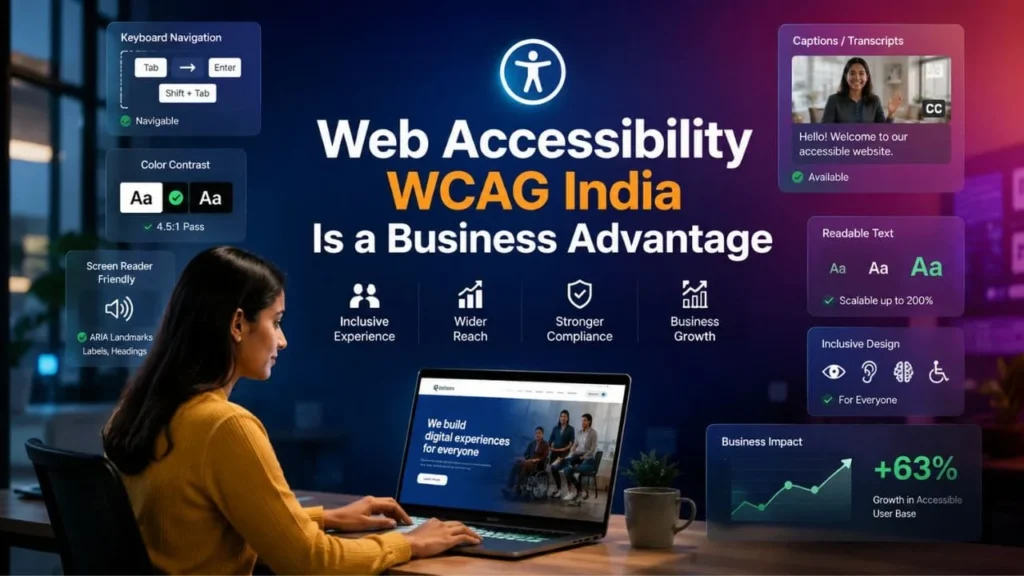
A website should not only look attractive. It should also be easy to read, simple to navigate and usable for people with different abilities. This is why web accessibility WCAG India has become an important topic for modern businesses. A website that blocks users because of poor design, weak contrast, confusing forms or missing labels can lose trust before the visitor even takes action.
Many Indian businesses still think accessibility is only a technical requirement. In reality, web accessibility India is now connected with user experience, search visibility, brand credibility and business growth. This is especially important for businesses offering website design services in Kolkata, where user friendly digital experiences can directly influence enquiries and conversions. When a website follows recognised accessibility principles, it becomes easier for more people to use. It also becomes easier for search engines, AI systems and voice assistants to understand.
For businesses that depend on online enquiries, sales, bookings or leads, web accessibility WCAG India is not just about compliance. It is a better way to serve users and create a website that works for everyone.
Table of Contents
What is web accessibility WCAG India?
Web accessibility WCAG India means designing and improving websites through user focused website design so people with different abilities can access, understand and use digital content. WCAG stands for Web Content Accessibility Guidelines. These guidelines explain how websites can become more usable for people who depend on screen readers, keyboard navigation, captions, readable text and clear page structure.
The goal is simple. A website should not create barriers. Users should be able to read content, move through pages, fill forms, click buttons and understand information without unnecessary difficulty.
In the Indian market, digital accessibility India is becoming more important because businesses are serving users across different devices, age groups, languages, internet speeds and ability levels. A person may be using a screen reader. Another person may be browsing on a small mobile screen. Someone else may have difficulty reading low contrast text. Accessibility helps all of them.
Why web accessibility WCAG India matters for business
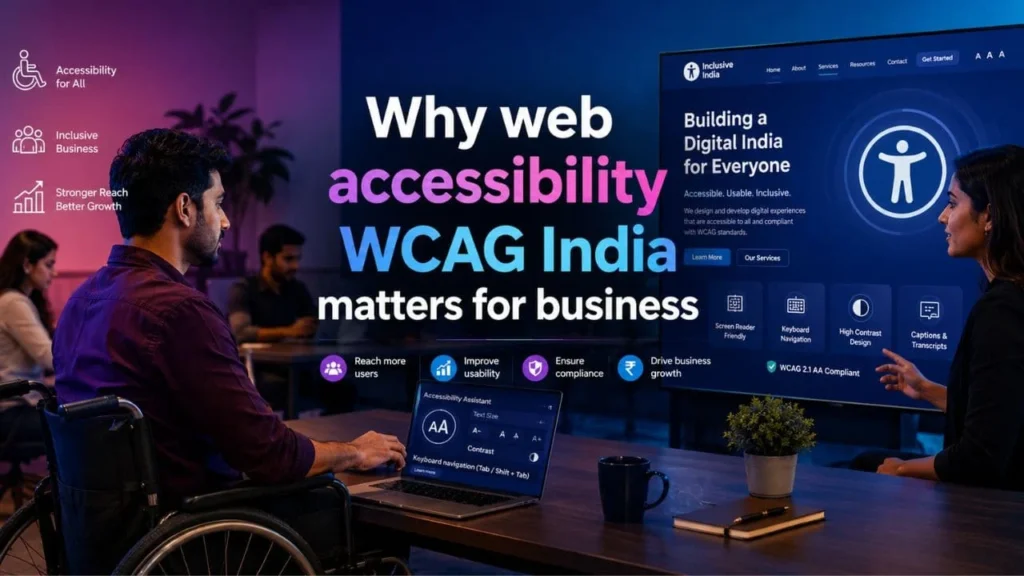
The online journey of a customer often starts with a website. If that website is difficult to use, the visitor may leave quickly. This affects enquiries, conversions and trust. That is why why web accessibility WCAG India matters for business is an important question for every brand with a digital presence.
A more accessible website can help users complete actions with less confusion. It can make service pages easier to understand, product pages easier to browse and contact forms easier to submit. A proper website audit checklist can also help identify usability gaps and accessibility issues before they affect customer experience. It can also improve how users feel about the brand.
The business benefits of web accessibility are practical and measurable. Accessibility can support better engagement, lower frustration, clearer communication and stronger customer confidence. It also helps businesses build digital experiences that are more inclusive and future ready.
Why is WCAG compliance important for businesses?
WCAG compliance India is important because it gives website owners a clear framework for improving accessibility. Instead of guessing what makes a website usable, businesses can follow structured guidelines related to text, images, buttons, forms, videos, navigation and page layout.
WCAG guidelines for websites are based on four main ideas. Content should be perceivable, operable, understandable and robust. In simple words, users should be able to see or hear the content, use the website easily, understand what is happening and access the site through different technologies.
For businesses, this means fewer usability problems. It also means a website can support more users without forcing them to struggle with basic actions.
Business benefits of accessible web design
Accessible web design India can improve how people experience a website from the first visit. It helps users move from one page to another with less effort. It also helps them understand service details, read content and complete contact actions.
Here are the main benefits of WCAG compliance for Indian websites:
| Business Area | Accessibility Improvement | Business Benefit |
|---|---|---|
| User experience | Clear headings, readable text and easy navigation | Visitors understand the website faster |
| Lead generation | Simple forms, visible buttons and helpful error messages | More users can complete enquiries |
| Trust building | Inclusive design and accessible content | Users feel the business is more reliable |
| SEO performance | Better structure, alt text and internal clarity | Search engines can understand content better |
| Mobile usability | Larger tap areas, better spacing and readable layouts | Mobile visitors get a smoother experience |
| Brand reputation | Website works for more users | Business appears responsible and user focused |
The benefits of accessible web design are not limited to people with disabilities. Better spacing helps mobile users. Clear headings help busy readers. Captions help users who watch videos without sound. Simple forms help everyone who wants to complete an action quickly.
How does web accessibility help Indian websites?
Indian websites serve a large and varied audience. Users may visit from phones, tablets, desktops or assistive devices. Some may use slow networks. Some may prefer voice search. Some may have visual, hearing, movement or cognitive challenges. Web accessibility WCAG India helps websites become easier for all these users.
A website with readable fonts, proper contrast, clear buttons and simple navigation can reduce friction. This can increase time on page, improve engagement and make key actions easier.
How does web accessibility improve user experience? It removes avoidable barriers. Instead of forcing users to guess where to click or how to complete a form, accessible design gives them a clear path.
Accessibility and SEO work together
Web accessibility for SEO and user experience is a smart approach because all three areas value clarity, performance, and usability. Search engines need clean page structure. Users need clear content. Accessibility supports both, while technical SEO and Core Web Vitals ensure websites are fast, stable, and technically optimized.
For example, proper heading structure helps users scan the page and helps search engines understand the topic hierarchy. Descriptive image alt text helps screen reader users and also gives search engines more context. Clear anchor text improves navigation and internal linking. Technical SEO improves crawlability, indexing, structured data, and site architecture. Core Web Vitals focus on loading speed, visual stability, and responsiveness. Fast, readable, and mobile friendly pages strengthen accessibility, user experience, and SEO together.
The importance of accessibility in modern web design is also growing because search behaviour is changing. Users now find answers through Google, AI tools, voice assistants and featured snippets. Pages that are well structured, direct and easy to understand have a better chance of being selected for answer based results.
How accessibility supports GEO, AEO and voice search
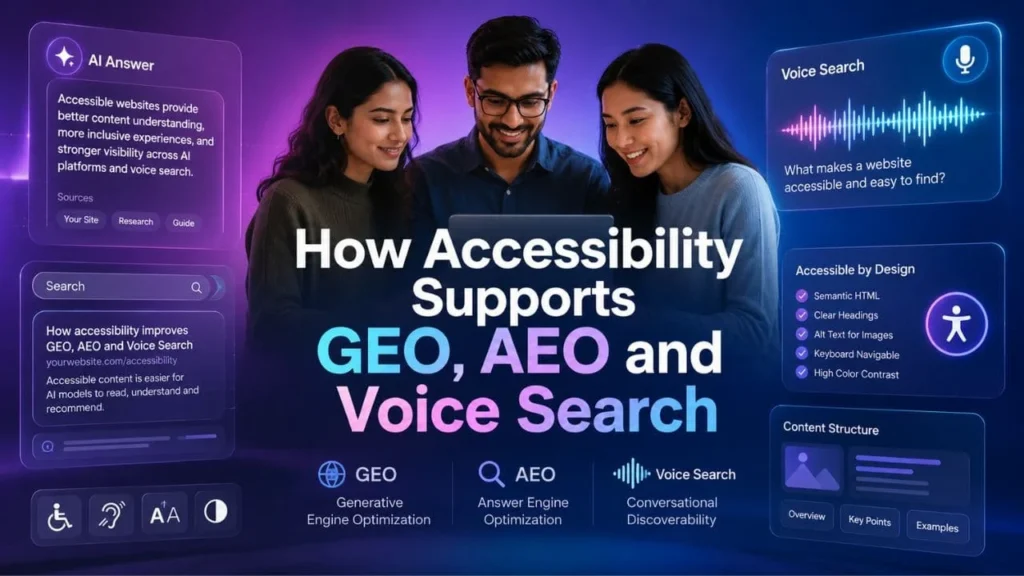
GEO means Generative Engine Optimization. AEO means Answer Engine Optimization. Both depend on content clarity, structure and usefulness. Accessibility can support these goals because an accessible page usually has better headings, direct answers, meaningful labels, structured data, AI friendly formatting and clean content organization.
Voice search also depends on simple and conversational answers. When users ask questions like “What is web accessibility WCAG India?” or “How can businesses make websites accessible?” the content should answer clearly.
A website that includes question based headings, short answers, structured sections, FAQ content and AEO focused content signals becomes easier for voice assistants and AI systems to interpret.
Common accessibility issues on business websites
Many websites look professional but still create accessibility problems. These issues may seem small, but they can block users from completing important actions. A proper mobile first indexing checklist can also help identify usability gaps that affect both accessibility and performance.
Common problems include:
- Text with poor colour contrast
- Images without meaningful alt text
- Buttons with vague labels
- Forms without clear field names
- Error messages that do not explain the problem
- Menus that cannot be used with a keyboard
- Videos without captions
- Small text on mobile screens
- Popups that interrupt navigation
- Links that only say click here
- Content that is placed inside images instead of readable text
These issues affect accessibility compliance for websites and can also harm user trust. When users cannot complete basic tasks, they may leave and choose another business.
WCAG compliance checklist for business websites
A practical checklist can help businesses understand where to start. This website accessibility audit and WCAG compliance checklist for business websites covers important areas that should be reviewed during design, development, and content updates.
| Accessibility Area | What to Check | Why It Matters |
|---|---|---|
| Page headings | Use one clear H1 and logical H2, H3 and H4 headings | Helps users and search engines understand page flow |
| Alt text | Add useful descriptions for meaningful images | Supports screen reader users and image context |
| Colour contrast | Make text easy to read against the background | Helps users with low vision and mobile users |
| Keyboard access | Make menus, links, forms and buttons usable without a mouse | Supports users with mobility needs |
| Form labels | Add visible labels and clear instructions | Helps users complete forms correctly |
| Error messages | Explain what went wrong and how to fix it | Reduces confusion and form abandonment |
| Button text | Use clear action words | Helps users understand the next step |
| Video content | Add captions or transcripts | Supports users who cannot hear audio |
| Mobile layout | Use readable text, proper spacing and easy tap areas | Improves usability across devices |
| Link text | Use descriptive anchor text | Helps navigation, SEO and screen reader users |
This checklist does not replace a full accessibility audit, but it gives businesses a strong starting point.
How accessible web design builds customer trust
A website is often the first place where a customer judges a business. If the website is confusing, difficult to read, hard to use, or fails to optimize contact forms, the customer may lose confidence. How accessible web design builds customer trust is simple. It shows that the business cares about user needs.
Trust is built when users can:
- Read content without strain
- Understand services clearly
- Navigate without confusion
- Complete forms without frustration
- Use the website on mobile easily
- Access information in different ways
Inclusive web design India is not only about supporting a specific group. It is about creating a better digital space for every visitor. When a website feels easy and respectful, users are more likely to stay longer and take action.
Case study: Accessibility improvements on a service based website
A service based business had a modern looking website, but users were not spending much time on important pages. The contact form received traffic, but many users did not complete it. A basic review found several issues. The text contrast was weak, form fields had no clear labels, image alt text was missing and the page headings were not properly arranged.
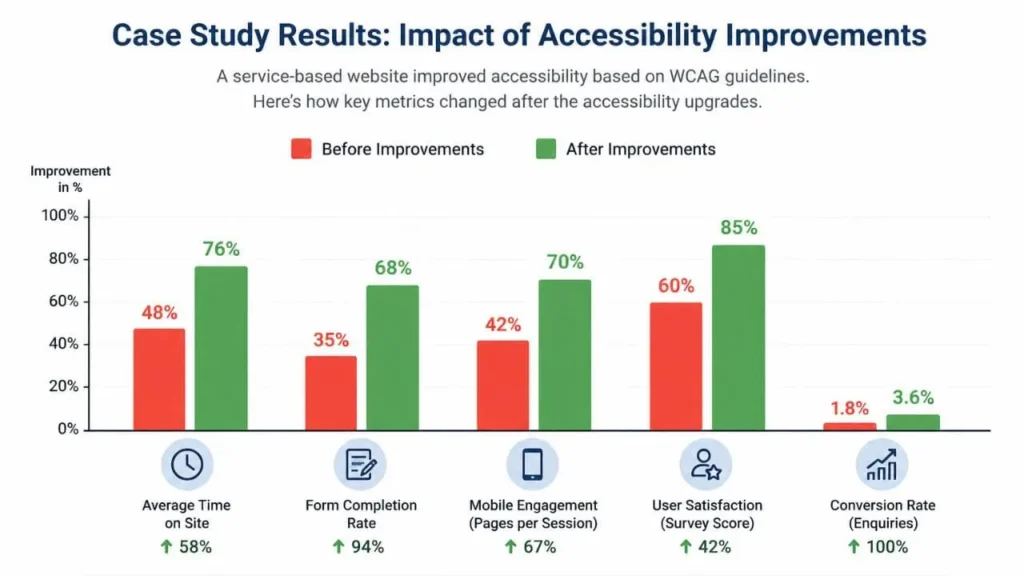
The website team made practical changes. They improved colour contrast, added descriptive alt text, fixed the heading structure, made button text clearer and simplified the contact form. They also tested the pages on mobile and checked whether the main navigation could be used with a keyboard.
After these improvements, users found it easier to move through the website. The service pages became clearer, the contact form became less confusing and mobile visitors had a smoother experience. The business also found that the content became easier to explain because the structure was more organised.
The key learning is clear. Accessibility improvements do not only help a small group of users. They improve the overall website experience and make the business look more reliable.
Website accessibility standards India businesses should follow
Website accessibility standards India are useful because they help businesses avoid guesswork. Instead of designing only for appearance, teams can focus on usability, clarity and access.
A good accessibility process should include:
Clear content structure
Every page should have a logical flow. Headings should explain what each section covers. Paragraphs should be short enough to read easily.
Readable visual design
Text should have enough contrast. Font size should be comfortable. Important information should not depend only on colour.
Simple navigation
Menus, links and buttons should be easy to find and use. A visitor should not feel lost on the website.
Accessible forms
Forms should have visible labels, clear instructions and helpful error messages. This is especially important for enquiry pages and lead generation pages.
Assistive technology support
Websites should work with screen readers, keyboards and other assistive tools. This helps users who do not browse in the usual way.
Is WCAG compliance required in India?
Is WCAG compliance required in India? The answer depends on the type of organisation, sector and digital service involved. However, even when a business is not directly required to follow a specific rule, accessibility is still a wise business decision.
Indian businesses should not wait for complaints or technical problems before improving access. A website that follows web accessibility guidelines for Indian businesses can serve more users and avoid many common usability issues.
Accessibility is also becoming a sign of digital maturity. Businesses that invest in accessible websites show that they care about long term usability, trust and inclusion.
How can businesses make websites accessible?
How can businesses make websites accessible? The best approach is to start with the most important pages. These usually include the home page, service pages, product pages, contact page, pricing page and blog content.
Businesses can begin with these steps:
Run a basic accessibility review
Check colour contrast, headings, image alt text, forms, buttons and mobile layout.
Improve content readability
Use simple sentences, clear headings and direct answers. Avoid long blocks of text.
Fix forms and enquiry paths
Make sure every form field has a visible label. Explain errors clearly. Keep the form simple.
Make buttons and links clear
Avoid vague phrases. Use meaningful text that tells users what action will happen.
Test with keyboard navigation
Try using the website without a mouse. Every important action should still be possible.
Review pages regularly
Accessibility is not a one time task. New pages, new images and new forms should also follow accessibility best practices.
Why businesses in India need accessible websites
Why businesses in India need accessible websites is linked to reach, trust and usability. The online audience is not the same for every brand. Some users may be elderly. Some may have limited vision. Some may use voice search. Some may browse from small screens. A good website should be ready for these different situations.
WCAG compliant website design in India can help businesses create a more stable digital foundation. It can support content visibility, improve visitor experience and make the website easier to manage over time. When combined with topical clustering content SEO, businesses can also organize information in a way that improves discoverability and creates a better content structure for users.
Businesses that ignore accessibility may lose users without even knowing it. A visitor who cannot read a page or submit a form may not complain. They may simply leave.
Practical tips for better accessibility
Here are simple ways to improve a website:
- Use clear and readable fonts
- Keep enough spacing between text and buttons
- Add alt text to meaningful images
- Use proper headings on every page
- Make CTA buttons visible and easy to understand
- Avoid placing important text only inside images
- Add captions to videos
- Use descriptive links
- Make forms short and clear
- Test every important page on mobile
- Avoid popups that block users
- Keep content simple and useful
These steps can help businesses improve web accessibility WCAG India and include a Core Web Vitals audit without making the process feel too complex.
Mistakes to avoid
Businesses often make accessibility harder by treating it as an afterthought. This creates extra work later. It is better to include accessibility during planning, design, development and content writing.
Avoid these mistakes:
- Depending only on automated tools
- Using colour alone to show important information
- Ignoring keyboard users
- Writing vague button text
- Adding images without alt text
- Using long and confusing forms
- Forgetting mobile users
- Publishing videos without captions
- Treating accessibility as a one time project
Accessibility works best when it becomes part of the website process.
Conclusion
Web accessibility WCAG India is a business advantage because it improves usability, trust, search clarity and digital inclusion. A website that is easier to read, navigate and use can support more visitors and create a stronger first impression.
Accessibility should not be seen as an extra feature. It should be part of good web design, good SEO and good customer experience. When a business follows accessible design practices, it creates a website that works better for everyone.
For Indian businesses, the message is clear. A more accessible website can support users, improve digital trust and help the brand build a stronger online presence.
FAQ
Q: What is web accessibility WCAG India?
Web accessibility WCAG India means making websites easier for people with different abilities to use while following recognised accessibility guidelines such as WCAG. It includes readable content, clear navigation, alt text, keyboard access, proper forms and support for assistive technology.
Q: Why is WCAG compliance important for businesses?
compliance is important because it gives businesses a clear way to improve website usability. It helps users access information, complete actions and understand content without unnecessary barriers.
Q: How does web accessibility help Indian websites?
Web accessibility helps Indian websites by improving readability, mobile usability, navigation, form completion and user trust. It also supports SEO, AI search understanding and voice search visibility.
Q: What are the benefits of accessible web design?
The benefits of accessible web design include better user experience, wider audience reach, stronger trust, improved form usability, clearer content structure and better support for users on different devices.
Q: Is WCAG compliance required in India?
WCAG compliance may depend on the type of organisation and digital service. However, Indian businesses should still follow accessibility best practices because they improve usability, trust and long term website quality.
Q: How can businesses make websites accessible?
Businesses can make websites accessible by improving headings, colour contrast, alt text, keyboard navigation, forms, button labels, captions, mobile layout and content readability. Regular accessibility reviews can help maintain quality.
Q: What is included in accessibility compliance for websites?
Accessibility compliance for websites usually includes readable design, proper headings, descriptive links, alt text, keyboard access, accessible forms, captions, contrast checks and support for assistive tools.
Q: Does accessibility help SEO?
Yes, accessibility can help SEO because accessible websites often have clearer structure, better headings, descriptive alt text, readable content and improved navigation. These elements make the page easier for both users and search engines to understand.