
Search is no longer only about matching words on a page. Search engines, answer engines, voice assistants, and AI search tools now try to understand meaning, context, entities, and user intent before showing a result. This is where structured data AI AEO becomes important for modern content visibility.
Structured data gives search systems clearer information about your page. It tells them what the content is about, who created it, what business or topic it relates to, which questions it answers, and how different parts of the page connect with each other. Google says structured data helps it understand page content and can make pages eligible for richer search results. Using JSON LD schema markup for AI search visibility also makes your content easier for AI tools, answer engines, and search systems to interpret accurately.
For businesses that want better visibility across Google Search, AI Overviews, voice search, and answer engines, structured data is no longer just a technical add on. It is part of a smarter content strategy that helps your website become easier to read for both humans and machines.
Table of Contents
What Is Structured Data
Structured data AI AEO is a standard format of code added to a webpage to explain the meaning of the content. It helps search engines understand whether a page is a blog post, service page, product page, local business page, FAQ page, review page, or guide.
Schema.org provides a shared vocabulary that webmasters can use to add structured data to web pages for search engines and other applications. It supports formats such as JSON LD, Microdata, and RDFa.
In simple terms, structured data works like a clear label for your content. A normal paragraph can tell users what you offer, but structured data can tell search engines the same thing in a format they understand quickly.
For example, your blog may explain answer engine optimization. With schema markup, you can also show search engines the article title, author, date, main topic, FAQ section, business identity, and related services.

Why Structured Data Matters for AI Search
Structured data AI AEO search tools do not only read keywords. They look for meaning, trust signals, relationships, and clear answers. If your content is useful but not properly structured, AI systems may struggle to understand the full context.
Structured data AI AEO helps connect your content with search intent. It can support search engines in identifying:
- What your page is about
- Who the content is for
- What question the content answers
- Which business or brand owns the content
- Which service, product, or topic is being discussed
- How the page fits within your website
Google has separate guidance for AI features in Search, including AI Overviews and AI Mode, from a site owner point of view. This shows why content clarity and search friendly structure matter more as AI search grows.
How Structured Data Helps AI Understand Your Content
It Gives Clear Page Context
A webpage can contain text, images, headings, links, reviews, FAQs, author details, and service information. Without structured data, search engines must interpret all of this from the page alone.
Schema markup gives a clearer signal. It tells search engines that your page is an article, your FAQ section contains questions and answers, your business is a local service provider, and your service page belongs to a specific category. This is where structured data AI AEO helps improve content clarity for search engines, answer engines, and AI search tools.
This is especially useful for websites that publish many blogs around SEO, Technical SEO, Local SEO services, Digital marketing services, and social media marketing services.
It Builds Stronger Entity Signals
An entity can be a brand, person, place, service, product, topic, or organization. AI systems use entities to understand relationships.
For example, Dakshraj Enterprise can be connected with SEO services, AEO, structured data, Kolkata, technical optimization, and digital marketing. When these connections are clear in content and schema, search engines can better understand the website topic, which makes structured data AI AEO more useful for improving content clarity and search visibility.
This helps create stronger topical relevance.
It Helps Answer Engines Find Direct Answers
Answer engines prefer content that is easy to understand and easy to summarize. With structured data AI AEO, your page can answer common user questions through clear headings, short responses, and FAQ schema, making it easier for answer engines to process and surface your content.
This does not guarantee placement in AI answers, but it improves clarity.

Structured Data AI AEO and Search Visibility
Structured data AI AEO brings three important ideas together.
SEO helps your content rank in search engines.
AEO helps your content answer questions directly.
Structured data helps search engines and AI tools understand the content behind those answers.
When these work together, your content becomes more useful for:
- Search results
- AI Overviews
- Featured snippets
- Voice search answers
- Local search results
- Knowledge based discovery
- Rich results
- Brand visibility
This is why structured data should be part of your content planning, not something added only after publishing.
Types of Schema Markup That Support AI and AEO
| Schema Type | Best Used For | AI and AEO Benefit |
|---|---|---|
| Article Schema | Blog posts and news content | Helps AI understand headline, author, date, and topic |
| FAQ Schema | Question and answer sections | Supports direct answer extraction |
| HowTo Schema | Step by step guides | Helps AI understand process based content |
| Organization Schema | Business identity | Builds brand and entity clarity |
| LocalBusiness Schema | Local service businesses | Supports local search and voice discovery |
| Product Schema | Ecommerce pages | Clarifies product name, price, rating, and availability |
| Review Schema | Review based content | Helps search engines understand trust signals |
| Breadcrumb Schema | Site structure | Improves page hierarchy understanding |
Benefits of Structured Data for AI Search and AEO
Better Content Understanding
Structured data AI AEO gives search engines extra context. It helps them understand what your content means, not only what words appear on the page.
This is useful when many websites cover similar topics. If your page has clear schema, accurate headings, helpful answers, strong internal links, and tracks SEO metrics and KPIs that matter, it becomes easier to interpret and measure for better search visibility.
Better Eligibility for Rich Results
structured data AI AEO can make your page eligible for rich results. These may include review snippets, FAQ style results, product information, breadcrumbs, article details, and other enhanced search features.
Eligibility does not mean guaranteed visibility. Search engines decide when a rich result is useful for a query. Still, correct schema gives your page a better technical foundation.
Stronger Support for Voice Search
Voice search often depends on direct answers. People ask questions such as:
- What is structured data in SEO
- How does schema markup help AI search
- Which schema is best for blog posts
- Can structured data improve AEO
- How does JSON LD help search engines
When your content includes clear answers and FAQ schema, voice assistants can understand it more easily.
Better AI Search Readiness
AI tools need clear, accurate, and well organized content. Structured data helps them identify key facts, page purpose, business identity, and answer format.
For AEO and GEO, structured data AI AEO matters because AI search systems often summarize content instead of showing only traditional blue links.
Better Website Architecture
Structured data AI AEO also encourages better website structure. When you add schema properly, you are forced to think about page type, main topic, author information, business details, and internal links.
That helps both users and search engines.
Structured Data Strategy for Different Page Types
| Page Type | Recommended Schema | Content Strategy |
|---|---|---|
| Blog Post | Article, FAQ, Breadcrumb | Add clear headings, author details, updated date, FAQs |
| Service Page | Service, Organization, LocalBusiness, FAQ | Explain service, location, process, benefits, and questions |
| Local SEO Page | LocalBusiness, Organization, FAQ | Add NAP details, service area, reviews, and local intent |
| Ecommerce Page | Product, Review, Breadcrumb | Add price, availability, ratings, and product details |
| Guide Page | Article, HowTo, FAQ | Use steps, definitions, short answers, and summary blocks |
| Tool Page | SoftwareApplication, FAQ | Explain tool use, features, output, and user benefit |
How to Create a Structured Data AI AEO Strategy
Start With Search Intent
Before adding schema, understand what the user wants.
A person searching for structured data may want a definition. A person searching for schema markup for AI search may want a method. A person searching for AEO services may want professional help.
Your content should match that intent clearly.
Choose the Right Schema Type
Do not add random schema to a page. The markup should match the visible content.
Use Article schema for blog posts. Use FAQ schema when the page has real FAQs. Use LocalBusiness schema for local business information. Use Service schema for service pages. This approach supports structured data AI AEO by helping search engines and AI tools understand each page type more clearly.
This keeps your content honest and easier to validate.
Use JSON LD for Better Management
JSON LD is one of the most common structured data formats because it is easier to manage than inline markup. It can be added to the page without changing every visible content block, and a schema markup generator free tool can help create accurate JSON LD code faster.
Keep Schema and Page Content Consistent
Your schema should describe what users can actually see on the page.
If your FAQ schema includes a question, that question should appear on the page. If your schema mentions a service, that service should be explained clearly in the content. This keeps your structured data AI AEO strategy accurate, useful, and easy for search engines and AI tools to understand.
Search engines value consistency because it reduces confusion.
Add Helpful FAQ Sections
FAQs are useful for AEO and voice search because they match how people ask questions.
Strong FAQs should:
- Answer one question at a time
- Use simple language
- Avoid keyword stuffing
- Give direct answers first
- Add context after the main answer
- Match real search queries
Improve Entity Clarity
Mention your brand, service category, topic, and location where relevant. For example, a business offering SEO services can connect structured data with Technical SEO, Local SEO services, Digital marketing services, and social media marketing services.
These connections help build topical depth.
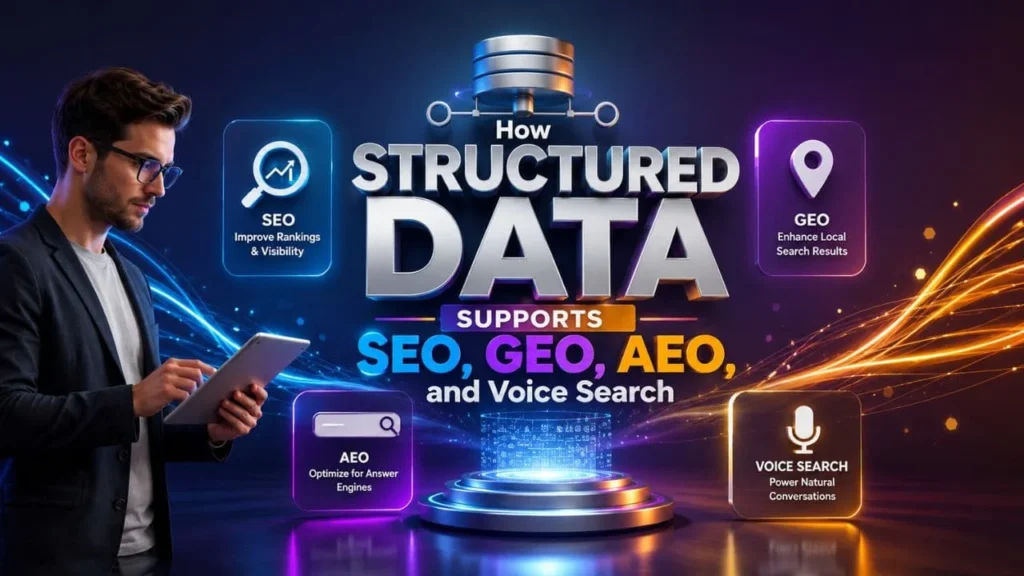
How Structured Data Supports SEO, GEO, AEO, and Voice Search
SEO Support
structured data AI AEO supports SEO by helping search engines understand page purpose and content type. It also helps improve search appearance when rich results are shown.
For blog posts, Article schema and Breadcrumb schema can support better indexing and page hierarchy.
For service pages, Service schema and Organization schema can help clarify business offerings.
GEO Support
GEO focuses on making content easier for generative AI systems to understand, summarize, and reference. Clear headings, short answer sections, structured data, entity based content, and a strong brand cited AI GEO strategy can help your page become more useful for AI search tools.
This is why content should be clear, factual, and well organized.
AEO Support
AEO focuses on answering user questions, while schema markup supports answer engine optimization for AI citations by helping answer engines identify question and answer pairs, page purpose, and content meaning.
This is where structured data AI AEO becomes valuable. It combines content clarity with technical markup so search engines and AI tools can understand the answer more confidently.
Voice Search Support
Voice search users often ask full questions. They want short and useful answers. Strong voice search optimization for Siri Alexa and Google depends on clear content, accurate business details, and answers that match how people naturally speak.
To improve voice search readiness:
- Use natural question based headings
- Add direct answers near the top of each section
- Keep sentences easy to understand
- Include FAQ sections
- Add LocalBusiness schema for location based pages
- Keep business information accurate

Role of Structured Data in Technical SEO
Technical SEO is about helping search engines crawl, understand, index, and rank your website more effectively. Structured data is an important part of that process because it adds meaning to the HTML page and supports crawl budget SEO for AI search visibility.
A strong Technical SEO plan should include:
- Valid schema markup
- Clean page structure
- Fast loading pages
- Mobile friendly design
- Proper internal linking
- Indexing control
- Canonical tags
- XML sitemap management
- Clear URL structure
Structured data AI AEO alone cannot fix weak content or technical problems, but it can improve how search engines read a well built page.
Structured Data for Local SEO Services
Local businesses need to show search engines who they are, where they serve, and what they offer. LocalBusiness schema can support this by adding business name, address, phone number, opening hours, service area, and other local details.
For Local SEO services, structured data helps connect your website with local intent. It can support Google Maps visibility, voice search discovery, and local service relevance.
For better results, follow NAP consistency local SEO practices by keeping your business name, address, and phone details accurate across your website, Google Business Profile, directories, and social platforms.
Structured Data for Digital Marketing Services
Websites that offer Digital marketing services often have many service pages. These may include SEO, content marketing, PPC, web design, social media, and online reputation management.
Structured data AI AEO can help separate these services clearly. Service schema can explain each page purpose, while Organization schema can connect those pages with the main brand.
This helps search engines understand the full service structure of the website.
Structured Data for SEO Services
If your website offers SEO services, schema markup can support content clarity across service pages and blogs. It can help define the service type, business identity, FAQs, and related topics.
For example, an SEO service page can include Service schema, Organization schema, Breadcrumb schema, and FAQ schema. Blog posts can use Article schema and FAQ schema.
This creates a stronger connection between your educational content and your service pages.
Structured Data for Social Media Marketing Services
Social media marketing services also benefit from structured data when the page is part of a broader digital marketing website.
Service schema can help search engines understand that the page is about social media strategy, platform management, content planning, audience engagement, and campaign support.
When combined with internal links, the page can also connect with related services such as SEO, content marketing, online reputation management, and conversion optimization.
Internal Linking Suggestions for This Article
Internal linking helps search engines understand your topic clusters. It also guides users to more useful resources.
Use these links naturally in the article:

Common Structured Data Mistakes to Avoid
Using the Wrong Schema Type
Every page needs the right schema. Adding Product schema to a normal blog post or FAQ schema without visible questions can create confusion, and a proper robots txt configuration guide for AI search can also help ensure search engines and AI tools access the right pages.
Adding Schema Without Useful Content
Structured data AI AEO supports content. It cannot replace helpful writing. If the content is thin, unclear, or repetitive, schema alone will not make it strong.
Overusing Keywords in Schema
Schema should describe the page honestly. Do not force keywords into every field. Search engines are better at understanding natural language now.
Forgetting to Validate Markup
Always test your schema before publishing. Use trusted validation tools to check errors and warnings.
Not Updating Old Schema
Old schema can become inaccurate when content changes. Review your markup when you update blog posts, service pages, pricing, FAQs, or business details.
Best Practices to Help AI Surface Your Content
To improve content visibility across traditional search and AI search tools, follow these best practices:
- Write clear page titles
- Use simple H2 and H3 headings
- Add direct answers below important questions
- Use schema that matches the page
- Add FAQ sections where useful
- Keep business details accurate
- Use internal links with descriptive anchor text
- Update old content regularly
- Validate structured data
- Avoid keyword stuffing
- Write for users first
- Support each page with topical depth
Structured data AI AEO works best when it supports useful content. The goal is not only to add code. The goal is to help search engines and AI systems understand why your content matters.

How to Write Content That Works With Structured Data
Search engines and AI tools need clarity. Your content should be easy to scan, easy to summarize, and easy to trust.
Use this structure:
Start With a Clear Answer
After every important heading, answer the query directly in the first few lines.
Add Supporting Details
After the direct answer, explain the topic with context, benefits, and practical points.
Use Lists for Complex Ideas
Lists help users and search systems understand important points quickly.
Add Tables Where Helpful
Tables make comparisons easier. They also help users understand schema types, page types, and content strategy.
End With FAQs
FAQs support voice search, AEO, and long tail queries.
Why Structured Data Should Be Part of Your AEO Plan
AEO is about making your content useful for answer based search. When someone asks a question, your page should provide a clear, trustworthy, and complete answer.
Structured data AI AEO supports that goal by adding technical clarity behind the content.
For a business website, this can help connect blogs with service pages. A blog about schema markup can support an AEO service page. A guide about AI search visibility can support Technical SEO and SEO services pages. A local search guide can support Local SEO services.
This creates a stronger content network.
Conclusion
Search engines and AI tools are becoming better at understanding meaning, context, and user intent. Your content needs to be clear enough for users and structured enough for machines.
Structured data AI AEO helps search systems understand your page, connect it with the right entities, identify useful answers, and surface it in more relevant search experiences.
It does not replace quality content. It supports it.
If your website already has strong content, schema markup can make that content easier to understand. If your website is planning a better SEO, GEO, AEO, and voice search strategy, structured data should be part of the foundation.
For stronger results, combine helpful writing, clean Technical SEO, accurate schema markup, natural internal linking, and user focused answers. That gives your content a better chance to perform across Google Search, AI search tools, answer engines, and voice search.
FAQs
What is structured data in SEO?
Structured data AI AEO is a standard format of code that helps search engines understand webpage content. It explains page type, topic, author, business details, FAQs, services, products, and other important information.
How does structured data help AI search?
Structured data AI AEO helps AI search tools understand page meaning, key entities, answers, and relationships. This makes your content easier to interpret and summarize.
Is structured data important for AEO?
Yes. Structured data supports AEO because it helps answer engines identify clear questions, direct answers, page purpose, and content context.
Which schema is best for blog posts?
Article schema, FAQ schema, Breadcrumb schema, and Organization schema are commonly useful for blog posts. The right choice depends on the page content.
Can structured data improve voice search visibility?
Structured data AI AEO can support voice search by helping search systems understand FAQs, local business details, services, and direct answers.
Does schema markup guarantee rich results?
No. Schema markup can make a page eligible for rich results, but search engines decide when to show them.
Why is JSON LD useful for schema markup?
JSON LD is useful because it is easier to add, manage, and update. It keeps structured data clear without changing the visible page layout.
How often should structured data be checked?
Structured data AI AEO should be checked whenever you publish a page, update content, change business details, add FAQs, or improve service pages.