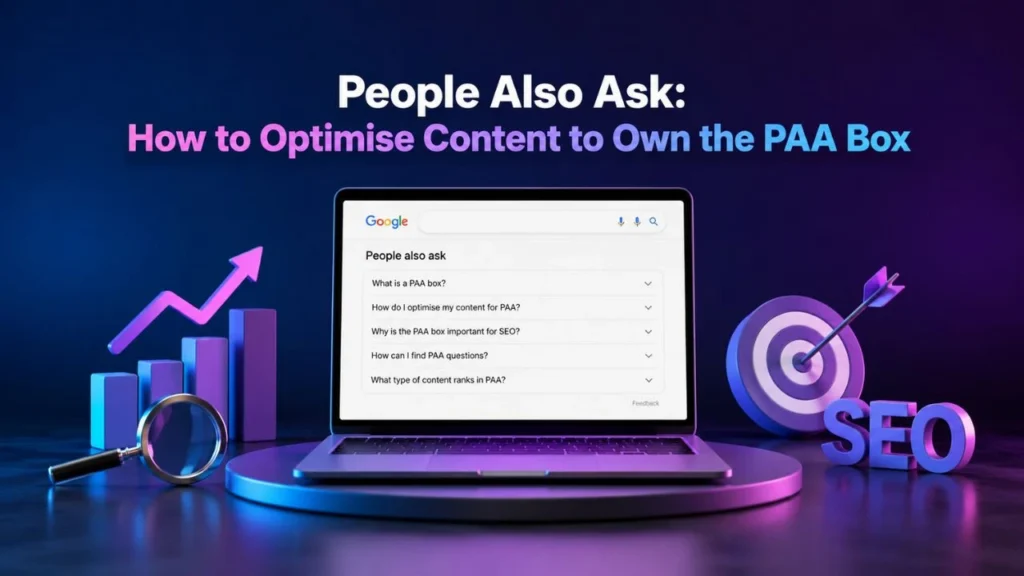
Search is changing faster than ever. Traditional rankings still matter, but modern SEO is no longer limited to blue links on a search engine results page. Today, visibility comes from multiple Google SERP features, AI generated summaries, voice assistants, and answer based search experiences. Among these features, the PAA Box has become one of the most valuable opportunities for brands, marketers, and publishers that want to increase organic visibility.
If you have noticed expandable question boxes appearing in Google search results, you have already seen the Google PAA Box in action. These question based results are designed to help users find quick answers without needing to perform multiple searches. For digital marketers, this creates a major opportunity to attract visibility, authority, and traffic from highly relevant audiences.
The best part is that optimising for the PAA SEO also improves your overall SEO strategy. It supports Featured snippets visibility, enhances voice search performance, strengthens Semantic SEO, and increases the chances of appearing in AI generated search answers.
In this guide, you will learn how to optimise content to own the PAA Box using practical strategies built around search intent optimization, conversational search, topic clustering, FAQ schema, and AI focused SEO techniques.
Table of Contents
What Is the PAA Box?
The PAA Box, also known as the Google PAA Box, stands for “People Also Ask.” It is a dynamic search feature that displays related questions connected to the user’s original search query.
When someone clicks on a question, Google expands the answer and often generates additional related questions underneath it. This creates an interactive search experience that encourages deeper exploration.
The PAA SEO has become one of the most prominent Google SERP features because it helps users quickly discover relevant information while allowing Google to satisfy multiple search intents within one search session.
Why the Google PAA Box Matters?
The Google PAA Box is important because it appears across informational, commercial, and transactional searches. It often shows above organic rankings, which means even websites not ranking in the top three positions can gain visibility.
For digital marketers, this creates several advantages:
| Advantage | Impact |
| Increased SERP visibility | More brand exposure |
| Higher click opportunities | Better engagement |
| Improved topical authority | Stronger SEO performance |
| Voice search visibility | Better AI assistant reach |
| Position zero opportunities | Enhanced trust and credibility |
The PAA SEO is especially valuable because it supports both traditional SEO and modern AEO for AI-powered search citations.
Why the PAA Box Is Essential for Modern SEO?
Search engines are evolving toward answer based experiences. Users no longer want to scan multiple pages for information. Instead, they expect immediate, direct, and conversational answers.
That shift is one reason why zero click searches continue to grow. In many cases, users get their answers directly from search results without visiting a website. While this may seem challenging, it actually creates a new visibility opportunity.
If your content appears inside the PAA SEO, you can still establish authority, improve brand recognition, and attract highly qualified clicks.
Connection Between PAA Box and Featured snippets
Many marketers treat Featured snippets and the PAA Box as separate strategies, but they are closely connected.
Featured snippets usually provide a direct answer at the top of search results, while the People Also Ask expands into multiple related questions. Google often pulls both answers from pages that demonstrate strong semantic relevance and clear content structure.
This means optimising for one often improves your chances of ranking for the other.
Understanding Search Intent Optimization
One of the biggest reasons content fails to rank in the People Also Ask is poor search intent optimization.
Google wants to display answers that directly satisfy user expectations. If your content does not align with what users actually want, your chances of appearing in Google SERP features become much lower.
Types of Search Intent
| Search Intent | Example Query | Best Content Type |
| Informational | What is a PAA Box | Educational guides |
| Navigational | Best SEO tools | Brand pages |
| Commercial | Best SEO strategy for PAA | Comparisons and reviews |
| Transactional | Hire SEO services | Service pages |
For the PAA Box, informational and commercial intent are usually the strongest opportunities.
How to Match Search Intent Correctly?
To improve your search intent optimization:
- Answer questions directly
- Use natural conversational language
- Avoid unnecessary fluff
- Provide value immediately
- Structure content clearly
- Anticipate follow up questions
Google increasingly prefers content that mirrors conversational search behaviour because users now search using more natural language queries.
How Semantic SEO Improves PAA Rankings?
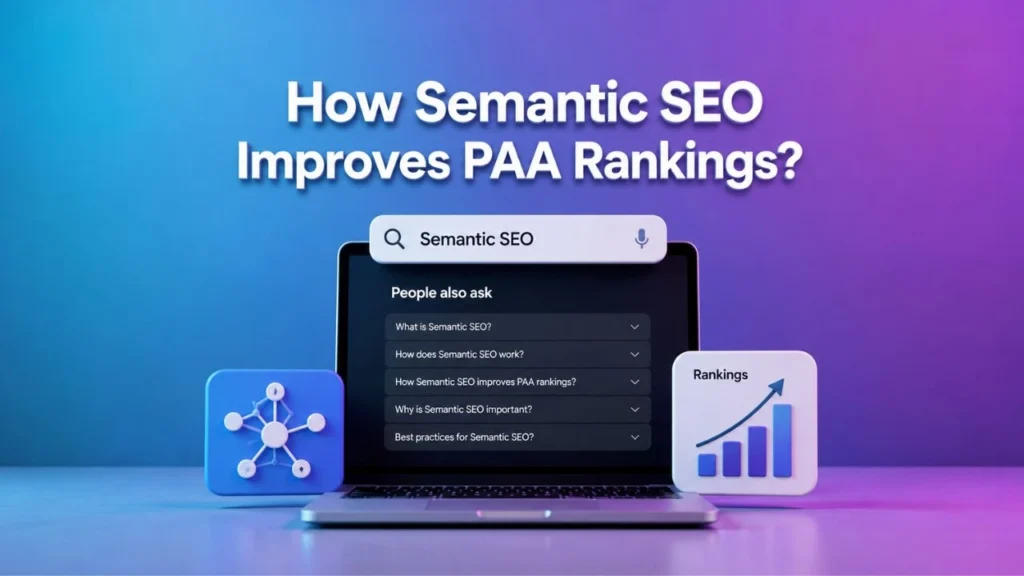
Semantic SEO is no longer optional. Search engines now rely heavily on context, relationships, and meaning rather than exact keyword repetition.
If your content only targets isolated keywords without contextual relevance, it becomes harder for Google to understand topical depth.
What Is Semantic SEO?
Semantic SEO focuses on building contextual relationships between concepts, entities, and topics. Instead of writing only about the PAA Box, strong semantic content also naturally discusses:
- Google PAA Box
- Featured snippets
- FAQ schema
- Conversational search
- Zero click searches
- Topic clustering
- Search intent optimization
- Voice search SEO
- AI powered search citations
This creates stronger semantic relevance signals.
Why Semantic SEO Helps the PAA Box?
The PAA Box relies heavily on context. Google wants answers that comprehensively address user needs.
Semantic SEO helps by:
- Improving topic depth
- Strengthening contextual understanding
- Increasing topical authority
- Enhancing AI readability
- Supporting conversational search patterns
When combined with position zero SEO and semantic relevance strategies, your content becomes significantly more competitive.
How to Structure Content for the PAA Box?
Content structure plays a major role in PAA visibility. Google prefers pages that are easy to scan, easy to understand, and easy to extract answers from.
Use Question Based Headings
One of the simplest ways to improve PAA Box visibility is by using question based headings.
For example:
What Is the Google PAA Box?
How Does Semantic SEO Help PAA Rankings?
Why Is FAQ Schema Important?
These headings align naturally with how users search.
Answer Questions Immediately
- Google prefers concise answers placed directly beneath headings.
- The ideal answer length for many PAA opportunities is between 40 and 60 words.
What Is Conversational Search?
Conversational search refers to natural language search behaviour where users type or speak queries in a more human way. It plays a major role in voice search optimisation and helps search engines understand user intent more accurately.
This format improves extractability for both the PAA Box and Featured snippets.
Why Topic Clustering Matters?
- Topic clustering is one of the most effective ways to build topical authority.
- Instead of publishing isolated articles, you create interconnected content around a broader subject area.
Example Topic Cluster for the PAA Box
| Pillar Topic | Supporting Topics |
| PAA Box | FAQ schema |
| PAA Box | Semantic SEO |
| PAA Box | Featured snippets |
| PAA Box | Voice search optimisation |
| PAA Box | Conversational search |
This structure helps Google understand your expertise more clearly.
Benefits of Topic Clustering
Topic clustering improves:
- Internal linking
- Semantic relevance
- Crawl efficiency
- User engagement
- Authority signals
It also supports long term scalability for SEO and AI search visibility.
FAQ Schema and FAQ Rich Snippets
Structured data is critical for modern SEO. If search engines struggle to understand your content structure, your visibility potential becomes limited.
What Is FAQ Schema?
FAQ schema is structured markup added to web pages to help search engines identify question and answer sections more effectively.
It improves your chances of generating FAQ rich snippets within search results.
Benefits of FAQ Schema
| Benefit | SEO Impact |
| Better content understanding | Improved indexing |
| Rich snippet eligibility | Higher visibility |
| Enhanced CTR | More engagement |
| Better AI extraction | Improved AEO performance |
FAQ schema is especially important for conversational search because it mirrors how users naturally ask questions.
Optimising for Conversational Search and Voice Search
Voice search continues to influence SEO strategy. People increasingly use smartphones, smart speakers, and AI assistants to search conversationally. This changes how content should be written.
How Conversational Search Works
Conversational search focuses on natural language patterns.
Instead of typing:
“PAA Box SEO”
Users now ask:
“How do I optimise content for the PAA Box?”
This means your content should sound natural, direct, and human.
Voice Search Optimisation Tips
Use Natural Language
Write as if you are speaking directly to the reader.
Include Long Tail Questions
Question based keywords often align closely with voice search behaviour.
Provide Concise Answers
AI assistants prefer short and direct responses.
Focus on Semantic SEO
Semantic relevance helps AI systems understand context more accurately.
Position Zero SEO and Semantic Relevance
- Position zero refers to search visibility above traditional organic listings.
- Owning the PAA Box or Featured snippets often places your content in this premium visibility area.
Why Position Zero Matters?
Position zero SEO increases:
- Organic visibility
- User trust
- Click opportunities
- Brand authority
- AI citation potential
It is especially valuable for digital marketing brands trying to dominate competitive SERPs.
How Semantic Relevance Supports Position Zero?
- Search engines analyse relationships between topics, entities, and user intent.
- Strong semantic relevance helps your content appear more authoritative and comprehensive.
- This is why modern SEO requires more than keyword placement alone.
AEO for AI-Powered Search Citations
- AI driven search experiences are becoming more common across search engines and AI platforms.
- Generative AI systems rely heavily on well structured, semantically relevant content.
What Is AEO?
- AEO stands for Answer Engine Optimization.
- It focuses on optimising content so AI systems can easily extract, understand, and cite information.
Why AEO Matters?
AEO helps improve visibility across:
- AI search platforms
- Voice assistants
- Conversational AI tools
- AI generated summaries
- Search engine answer panels
Best Practices for AEO
| AEO Strategy | Why It Works |
| Clear question based headings | Easier extraction |
| Concise answers | Better readability |
| Semantic SEO | Improved contextual understanding |
| FAQ schema | Structured content signals |
| Topic clustering | Strong authority building |
AEO is becoming increasingly connected with PAA and featured snippet optimization services because both rely on structured answer based content.
Common Mistakes That Hurt PAA Rankings
Many websites fail to rank in the PAA Box because they overlook important optimisation factors.
Keyword Stuffing
Overusing the PAA Box keyword unnaturally damages readability and trust.
Weak Structure
Poor heading hierarchy makes it harder for Google to understand content flow.
Ignoring Search Intent
Even high quality content can fail if it does not satisfy user expectations.
Thin Content
Shallow articles struggle to demonstrate semantic relevance.
No FAQ Schema
Without structured data, search engines may miss important contextual signals.
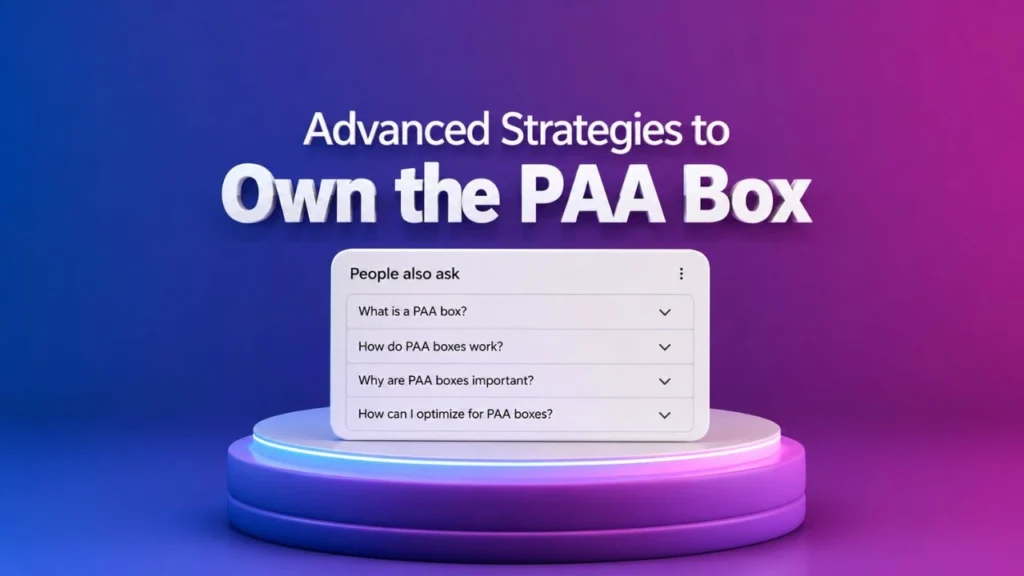
Advanced Strategies to Own the PAA Box
Refresh Existing Content
Google values freshness. Updating content regularly can improve visibility.
Improve Internal Linking
Strong internal linking helps search engines understand topical relationships.
Add Tables and Lists
Structured formatting improves snippet eligibility.
Monitor Question Trends
Search behaviour changes constantly. Tracking emerging PAA questions helps maintain relevance.
Benefits of PAA Box Optimisation for Digital Marketing
The benefits of PAA Box optimisation extend beyond rankings alone.
Better Brand Authority
Appearing in the Google PAA Box builds credibility.
Increased Organic Reach
You gain visibility across multiple related questions.
Stronger AI Search Presence
AI systems often reference structured answer based content.
Better Engagement
Question focused content aligns more closely with user behaviour.
Long Term SEO Growth
Semantic SEO and topic clustering create sustainable authority.
Future of the PAA Box in AI Search
The future of SEO is increasingly connected to AI generated answers and conversational experiences.
Search engines are becoming more focused on:
- Natural language understanding
- Semantic relationships
- User intent prediction
- AI generated summaries
- Voice based interactions
This means the PAA Box will likely become even more important over time.
Brands that optimise early for conversational search, AEO, and semantic relevance will gain a significant competitive advantage.
Final Checklist for PAA Box Optimisation
| Checklist Item | Completed |
| Search intent optimization implemented | Yes |
| Conversational search phrases included | Yes |
| Semantic SEO strategy applied | Yes |
| FAQ schema added | Yes |
| Topic clustering structure used | Yes |
| Featured snippets optimisation completed | Yes |
| Voice search optimisation added | Yes |
| AI friendly formatting implemented | Yes |
Conclusion
The PAA Box has become one of the most powerful visibility opportunities in modern digital marketing. It supports traditional SEO, voice search optimisation, AI search visibility, and answer engine optimisation all at the same time.
If you want your content to perform across Google SERP features, AI powered search experiences, and conversational search platforms, you need more than basic keyword targeting.
You need structured content, search intent optimization, Semantic SEO, FAQ schema, topic clustering, and clear conversational answers.
The brands that adapt to this shift early will be better positioned to dominate not only traditional search results but also the future of AI driven discovery.
FAQs
What is the PAA Box in Google?
The PAA Box, or People Also Ask section, is a Google SERP feature that displays related questions and answers connected to a user’s search query.
Why is the PAA Box important for SEO?
The PAA Box improves search visibility, increases organic reach, supports zero click searches, and helps websites gain authority in Google SERP features.
How can I optimise content for the Google PAA Box?
You can optimise for the Google PAA Box by using question based headings, concise answers, Semantic SEO, FAQ schema, and search intent optimization.
What is the difference between Featured snippets and the PAA Box?
Featured snippets usually provide one highlighted answer, while the PAA Box contains multiple expandable questions and answers within search results.
How does Semantic SEO help PAA rankings?
Semantic SEO improves contextual relevance by connecting related topics, entities, and search intent, helping search engines understand content more effectively.
Why is FAQ schema important for PAA optimisation?
FAQ schema helps search engines identify question and answer sections clearly, improving eligibility for FAQ rich snippets and PAA visibility.
How does conversational search affect SEO?
Conversational search focuses on natural language queries, making it important to create content that sounds human, direct, and easy to understand.
What are zero click searches?
Zero click searches occur when users get answers directly from search results without clicking on a website link.
What is topic clustering in SEO?
Topic clustering is a content strategy where related articles are internally linked around a central topic to improve authority and semantic relevance.
How does voice search relate to the PAA Box?
Voice assistants often pull answers from concise and structured content, making PAA optimisation useful for voice search visibility.