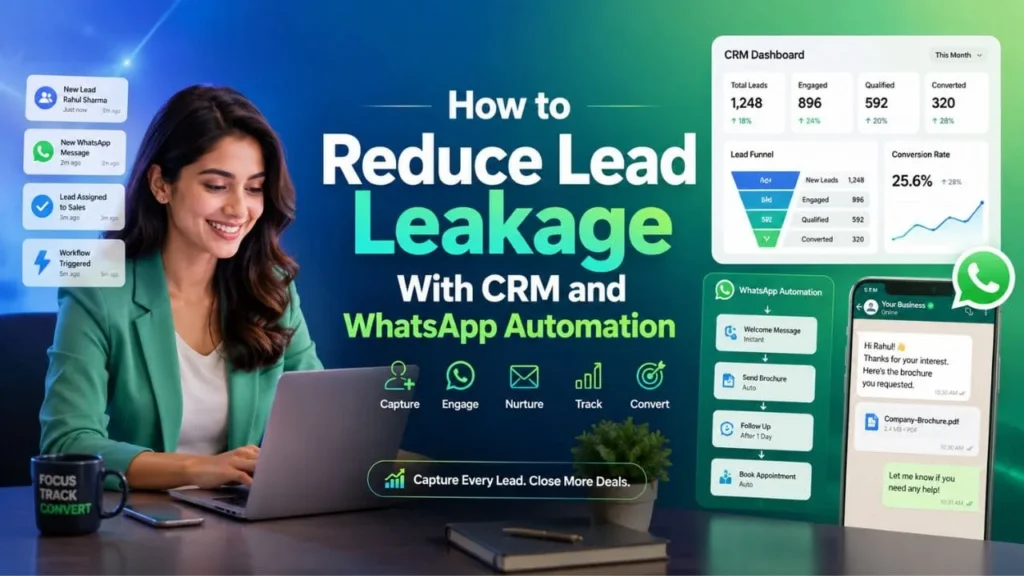
Lead generation is one of the most important parts of digital marketing, but generating leads is only the beginning. Many businesses invest in SEO, Google Ads, Meta Ads, landing pages, social media campaigns, content marketing and WhatsApp campaigns, yet still lose many potential customers before the sales conversation even begins. This problem is known as reduce lead leakage CRM.
Reduce lead leakage CRM happens when a potential customer shows interest but is not captured, contacted, qualified or followed up properly. It directly affects digital marketing leads and sales growth because every missed inquiry can reduce the value of SEO, paid ads, landing pages and WhatsApp campaigns. It may happen when a website form is ignored, a WhatsApp message is not answered, a sales call is missed, or a paid ad lead is not added to the CRM on time.
For businesses that depend on digital marketing services, lead leakage can reduce campaign performance, increase cost per conversion and make marketing reports look weaker than they should. A strong CRM system combined with WhatsApp automation can help businesses respond faster, manage leads better and improve conversion opportunities.
Table of Contents
What Is Lead Leakage?
Reduce lead leakage CRM means losing potential customers during the lead management process. A person may visit your website, fill out a form, click on a WhatsApp button, call your team or submit details through an ad campaign. If that inquiry is not handled properly, the lead may lose interest and contact another business.
In digital marketing, reduce lead leakage CRM often happens between marketing and sales. Marketing brings the inquiry, but the system fails to move that lead into a proper follow up process.
Common Signs of Lead Leakage
You may have a reduce lead leakage CRM problem if your business faces these issues:
• Website inquiries are not answered quickly
• WhatsApp messages remain unread for hours
• Sales teams are unsure who should call a lead
• Follow ups are missed after the first conversation
• Leads from SEO, ads and social media are stored in different places
• No one knows which campaign generated the best leads
• Old leads are forgotten after a few days
• Interested prospects are marked as lost without enough follow up
• Reports show leads but sales teams cannot trace them
When these problems continue, digital marketing campaigns may appear less effective than they actually are. The issue is not always lead quality. Sometimes, the issue is poor lead handling.
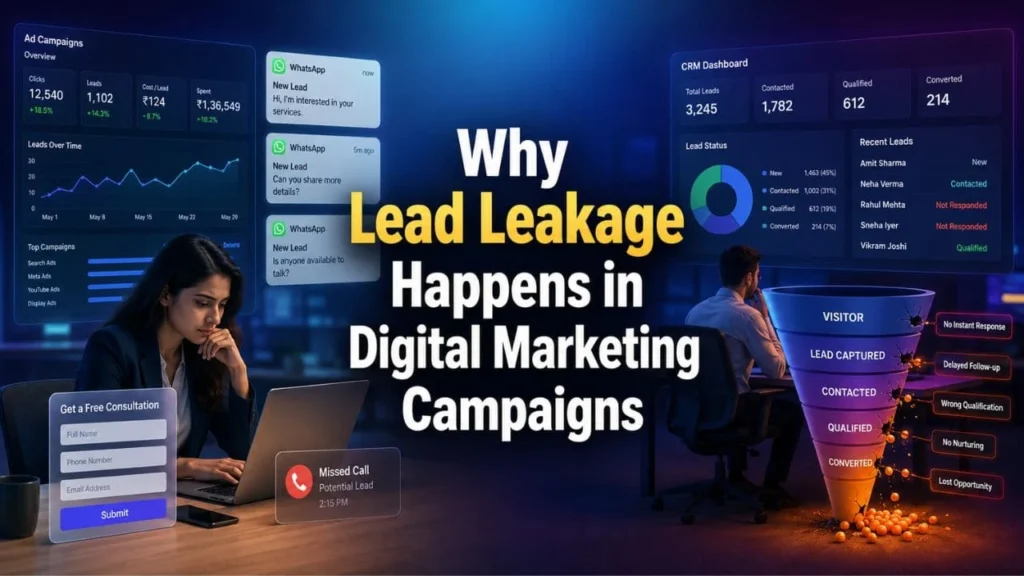
Why Lead Leakage Happens in Digital Marketing Campaigns
Most businesses use several channels to generate inquiries. Leads can come from organic search, paid ads, Google Business Profile, social media, landing pages, email campaigns and WhatsApp links. A proper Google Ads setup for lead generation can bring high intent inquiries, but without a connected system, it becomes difficult to manage every lead properly.
Slow Response Time
People searching online usually contact more than one business. If your team takes too long to reply, the lead may already choose another provider. Fast response is especially important for service based businesses where users want quick answers about pricing, availability, process and consultation.
Manual Lead Handling
Manual lead handling creates gaps. A person may copy leads from Facebook forms into a sheet, another person may check WhatsApp, while someone else may handle calls. This creates confusion and increases the chance of lead leakage.
No Central Lead Database
If your leads are scattered across inboxes, spreadsheets, ad accounts and WhatsApp chats, your team cannot see the full customer journey. A CRM helps store every inquiry in one place so each lead can be tracked from first contact to conversion.
Weak Follow Up Process
Many leads do not convert after the first message. They need reminders, answers, service details and clear next steps. Without automated follow up, interested prospects may go silent.
Poor Sales And Marketing Coordination
Digital marketing teams may generate leads, but sales teams may not know the source, campaign, service interest or urgency level. This makes the conversation less relevant and reduces the chance of conversion.
Why Fast Lead Response Matters
Fast response builds trust. When a user submits an inquiry and receives a quick reply, they feel that the business is active and reliable. A delay can create doubt. CRM and WhatsApp automation help reduce lead leakage by making sure every lead receives a response without waiting for manual action.
Common Lead Leakage Points And Automation Fixes
| Lead Leakage Point | Why It Happens | CRM and WhatsApp Automation Fix |
|---|---|---|
| Website form leads ignored | No instant notification | Auto assign leads to sales team |
| WhatsApp inquiries missed | Manual checking | Instant WhatsApp auto reply |
| Paid ad leads not followed | No central lead database | Sync ads with CRM |
| Follow ups forgotten | No reminder system | Automated follow up sequence |
| Hot leads treated like cold leads | No lead scoring | CRM based lead qualification |
| Sales team confusion | No lead ownership | Assign leads based on rules |
How CRM Helps Reduce Lead Leakage
A CRM is not just a contact storage tool. For digital marketing services, it works as a lead management system that connects marketing efforts with sales actions, while B2B email marketing automation supports timely follow ups, lead nurturing and better communication across the sales funnel.
Centralized Lead Capture
CRM helps capture leads from multiple digital channels, including:
• Website contact forms
• Landing pages
• SEO inquiries
• Google Ads
• Meta Ads
• WhatsApp clicks
• Google Business Profile calls
• Email campaigns
• Social media messages
When every inquiry enters one system, lead leakage becomes easier to control. Your team can see who contacted the business, when they contacted, what service they need and what action has been taken.
Lead Source Tracking
Lead source tracking is important for digital marketing reporting. A CRM can show whether leads came from SEO, Google Ads, social media, referral traffic, WhatsApp campaigns or landing pages.
This helps businesses understand which marketing channels bring better inquiries. It also supports smarter budget planning, campaign improvement and better comparison with ROAS benchmarks for paid campaigns.
Automated Lead Assignment
When leads enter the CRM, they can be assigned automatically based on service interest, location, campaign source, lead type or team availability. This reduces confusion and makes sure each lead has a clear owner.
For example, a lead interested in SEO services can go to the SEO sales team, while a lead interested in paid ads can go to the performance marketing team.
Lead Status Management
A CRM lets your team update lead status at every stage. Common lead stages include:
• New lead
• Contacted
• Qualified
• Proposal shared
• Follow up required
• Converted
• Not interested
• Lost
This gives better visibility into the sales funnel and helps prevent lead leakage after the first contact.
CRM Metrics Businesses Should Track
To reduce lead leakage CRM, businesses should track lead response time, follow up completion rate, lead source quality, conversion rate, lost lead reasons, sales pipeline value and CPA in digital marketing to understand how much each qualified inquiry costs.
• Lead response time
• Lead source quality
• Follow up completion rate
• Lead conversion rate
• Lost lead reasons
• Sales pipeline value
• Number of unanswered inquiries
• Time taken from lead capture to first reply
These metrics help you understand where leads are dropping and what needs to be improved.
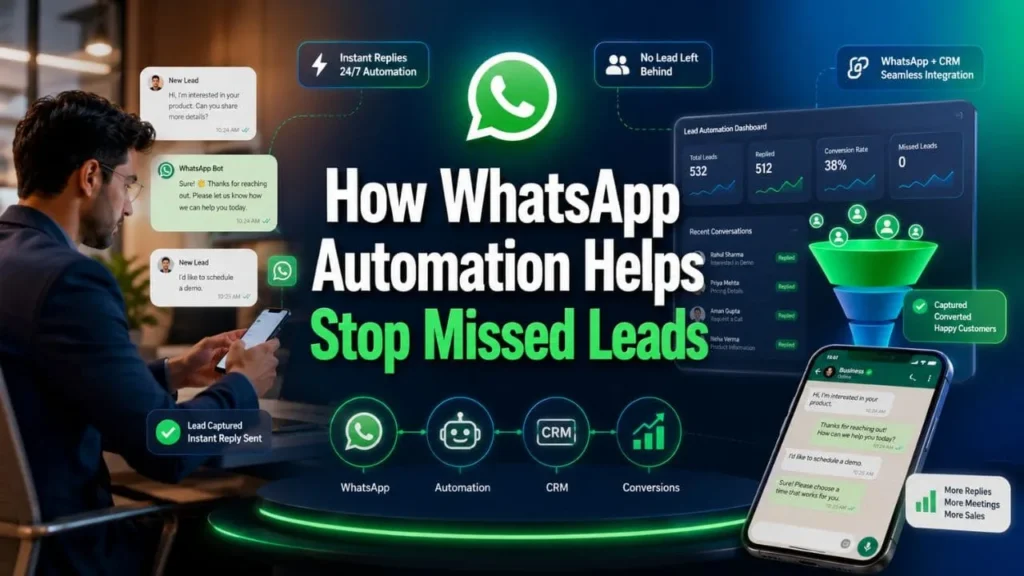
How WhatsApp Automation Helps Stop Missed Leads
WhatsApp has become an important communication channel for digital marketing leads. Many users prefer WhatsApp because it feels fast, simple and familiar.
When WhatsApp is connected with automation, businesses can reply instantly, qualify leads and keep the conversation active.
Instant Auto Replies For New Leads
When a lead clicks your WhatsApp button from a website, ad or landing page, automation can send an instant reply. This confirms that the inquiry has been received and tells the user what to expect next.
A simple message can say:
“Thank you for contacting us. Please share your service requirement and our team will assist you shortly.”
This small step can reduce lead leakage because the prospect receives immediate confirmation.
Automated Follow Up Messages
Not every lead replies immediately. WhatsApp automation can send follow up messages after a set time. These messages can remind users, ask useful questions, support lead nurturing workflows or offer a callback option.
The goal is not to spam the user. The goal is to keep the conversation helpful and relevant.
Lead Qualification Through WhatsApp
WhatsApp automation can ask simple questions to understand the lead better, such as:
• Which service are you looking for?
• What is your business category?
• Do you need SEO, PPC, social media or website support?
• What is your preferred time for a callback?
• Are you looking for monthly service or one time support?
This helps the sales team understand the lead before calling.
Appointment And Callback Scheduling
Many users prefer to choose a callback time instead of talking immediately. WhatsApp automation can guide them to select a time slot. This reduces missed calls and improves the chance of a proper conversation.
Reminder Messages For Interested Leads
Sometimes a lead may show interest but delay the decision. Automated reminders can help bring them back into the conversation.
A helpful reminder can share:
• Service details
• Next step
• Consultation option
• Required documents
• Meeting reminder
• Proposal reminder
WhatsApp Automation For Better Customer Conversations
WhatsApp automation supports faster communication, but human involvement is still important. Automation should handle the first response, reminders and basic qualification. The sales team should handle deeper conversations, pricing, strategy and trust building. For service based businesses, Google reviews in local SEO also support trust because prospects often check customer feedback before responding or booking a consultation.
How CRM And WhatsApp Automation Work Together
CRM and WhatsApp automation are most effective when they work together. CRM manages lead data, while WhatsApp automation manages fast communication.
Step 1: Lead Comes From A Digital Marketing Channel
A user may come from SEO, Google Ads, Meta Ads, Google Business Profile, social media or a landing page.
Step 2: CRM Captures The Lead
The CRM stores the lead name, phone number, service interest, source and campaign details.
Step 3: WhatsApp Sends An Instant Response
The lead receives a message confirming that the inquiry has been received.
Step 4: CRM Assigns The Lead
The CRM assigns the lead to the right sales person or team.
Step 5: Follow Up Begins
WhatsApp automation sends helpful follow up messages based on lead behaviour and response status.
Step 6: Sales Team Updates The CRM
The sales team updates the lead status, conversation notes, next action and result.
This connected process reduces lead leakage because no inquiry remains invisible.
CRM And WhatsApp Automation Workflow For Digital Marketing Leads
| Stage | Automation Action | Benefit |
|---|---|---|
| Lead capture | CRM records lead details | No inquiry is missed |
| Instant response | WhatsApp sends welcome message | Faster engagement |
| Qualification | WhatsApp asks service related questions | Better lead filtering |
| Assignment | CRM assigns lead to sales person | Clear ownership |
| Follow up | Automated reminders are triggered | Better consistency |
| Reporting | CRM tracks source and status | Better marketing decisions |
Best CRM And WhatsApp Automation Strategy For Digital Marketing Services
A good lead management setup should match the way digital marketing leads are generated. Businesses should not treat all leads the same because each channel has different intent.
Connect Website Forms With CRM
Website forms should send details directly into the CRM. This includes contact forms, service inquiry forms, quote request forms and landing page forms.
The CRM should capture:
• Name
• Phone number
• Email address
• Service interest
• Page URL
• Lead source
• Campaign name
• Submission time
This makes every website inquiry trackable.
Integrate Google Ads And Meta Lead Forms
Paid ad leads need fast action because users may be comparing several options. Connecting ad forms with CRM helps avoid manual delays.
When a paid lead enters the CRM, WhatsApp automation can send an instant message and the sales team can receive a task reminder.
Add Click To WhatsApp Buttons On Landing Pages
Click to WhatsApp buttons can increase inquiries, especially for service pages and landing pages. But every WhatsApp click should be tracked properly. Without tracking, it becomes hard to know which page or campaign created the inquiry.
Use Lead Scoring For High Intent Prospects
Lead scoring helps your team focus on leads that are more likely to convert. A lead from a pricing page may have higher intent than a general blog visitor. A lead that asks for a callback may be more ready than someone who only downloads a guide.
CRM can score leads based on:
• Source
• Page visited
• Service interest
• Form details
• WhatsApp response
• Call request
• Budget indication
Create Follow Up Sequences Based On Intent
A lead looking for SEO services may need a different follow up than a lead asking for social media marketing. CRM and WhatsApp automation should support service specific messages.
Suggested WhatsApp Follow Up Flow
A simple flow can look like this:
• First message: Confirm inquiry and ask service requirement
• Second message: Ask business category and location
• Third message: Offer callback or consultation time
• Fourth message: Share service process in simple words
• Fifth message: Send reminder if there is no reply
• Sixth message: Ask if the user still needs help
This approach keeps the follow up useful and respectful.
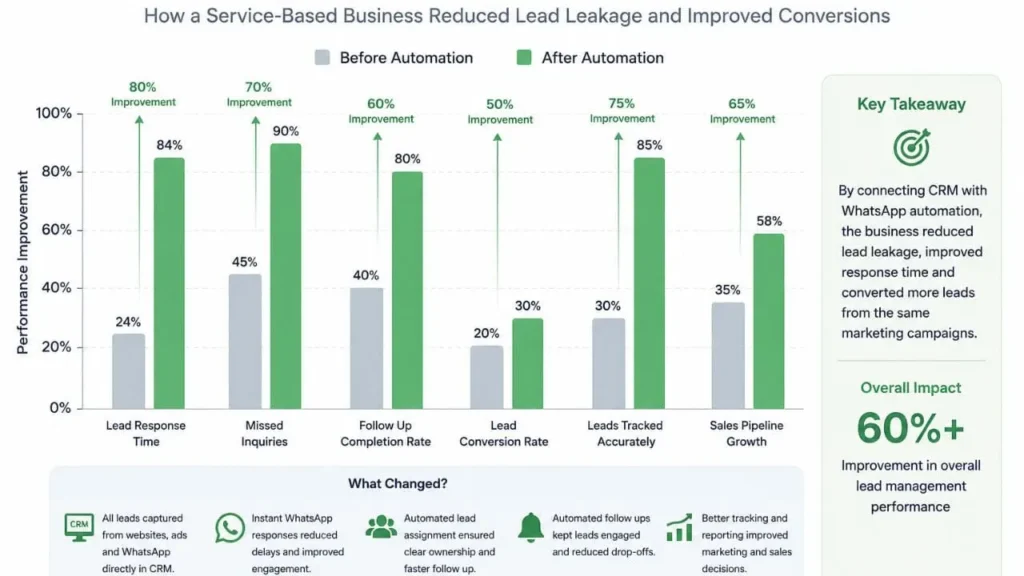
Case Study: How A Service Based Business Reduced Lead Leakage
A service based business was running SEO, paid ads and social media campaigns to generate inquiries. The marketing campaigns were bringing leads, but many inquiries were not converting because the team had no proper lead management process.
The Problem
Leads were coming from website forms, WhatsApp messages, ad forms and phone calls. Some leads were saved in spreadsheets, some remained in WhatsApp chats, and some were only discussed verbally.
The main issues were:
• Delayed response to new inquiries
• No clear lead owner
• Missed WhatsApp messages
• No follow up reminder
• No source tracking
• No proper record of lost leads
As a result, the business could not understand whether the problem was marketing quality or sales handling.
The CRM And WhatsApp Automation Setup
The business connected its website forms, paid ad leads and WhatsApp inquiries with CRM. Every new inquiry was recorded automatically. The CRM captured the lead source, service interest and contact details.
WhatsApp automation was added for instant replies, qualification questions and reminders. The sales team received alerts for new leads and follow up tasks.
The Result
After setting up CRM and WhatsApp automation, the business saw clear improvement in lead handling.
The main changes included:
• Faster response to new inquiries
• Fewer missed WhatsApp messages
• Better tracking of SEO and paid ad leads
• More consistent follow up
• Clear lead ownership
• Better reporting on lead source and status
• Improved quality of sales conversations
Key Learning From The Case Study
Lead generation alone is not enough. A business also needs a system to capture, qualify, follow up and track every inquiry. CRM and WhatsApp automation help reduce lead leakage by connecting marketing activity with sales action.
Mistakes To Avoid When Using CRM And WhatsApp Automation
CRM and WhatsApp automation can improve lead management, but they must be used properly.
Sending Too Many Automated Messages
Too many messages can irritate users. Keep messages useful, short and relevant. Every message should help the lead take the next step.
Using Generic WhatsApp Templates
Generic messages feel cold. WhatsApp messages should match the service interest of the lead. A person asking for SEO should not receive the same message as someone asking for web design.
Not Updating CRM Lead Status
If the sales team does not update lead status, the CRM becomes less useful. Every call, message, proposal and follow up should be recorded.
Ignoring User Consent
WhatsApp communication should respect user consent, privacy and DPDP Act and lead generation guidelines. Businesses should communicate only with users who have shown interest or given clear permission.
Depending Only On Automation
Automation can support speed and consistency, but it cannot replace human trust. A real conversation is still needed for service explanation, pricing and decision making.
SEO, GEO, AEO And Voice Search Value Of This Topic
This topic has strong search value because many businesses are investing in digital marketing but struggling to convert leads. They search for practical answers around CRM automation, WhatsApp automation, lead management, lead leakage and tools like AI Search Readiness Checker to improve visibility in search and answer engines.
Why This Topic Works For SEO
People search for terms such as:
• How to reduce lead leakage
• CRM automation for lead management
• WhatsApp automation for business leads
• Automated lead follow up system
• WhatsApp CRM for digital marketing
• How to track digital marketing leads
• How to improve lead conversion rate
A blog on this topic can target both informational and commercial search intent without sounding promotional.
Why This Topic Works For GEO And AEO
Answer engines prefer content that gives clear, direct and structured answers. This topic can answer common user questions in simple language.
For example:
Reduce lead leakage CRM by capturing every lead in one system, assigning it to the right person and tracking each follow up.
WhatsApp automation reduces lead leakage by sending instant replies, reminders and qualification messages to new inquiries.
Together, CRM and WhatsApp automation help digital marketing leads move from inquiry to conversation without being lost.
Voice Search Questions This Blog Can Answer
• How can I stop losing leads from my website?
• How does CRM reduce lead leakage?
• Can WhatsApp automation improve follow up?
• How do I track leads from digital marketing campaigns?
• What is the best way to manage WhatsApp leads?
• Why are my paid ad leads not converting?
• How can I improve lead response time?
How To Build A Better Lead Management Process
Reduce lead leakage CRM requires a clear process. Businesses should not depend on memory, manual sheets or scattered chats.
Map Every Lead Source
List all places where leads come from:
• Organic search
• Paid ads
• Social media
• Website forms
• Landing pages
• WhatsApp buttons
• Google Business Profile
• Email campaigns
• Referral traffic
Once every source is mapped, connect each one with CRM.
Create Service Based Lead Categories
Digital marketing leads can have different needs. Categories may include:
• SEO services
• Local SEO
• Google Ads
• Social media marketing
• Website design
• Content marketing
• Performance marketing
• Conversion rate optimization
This helps your team send more relevant replies.
Set Response Time Rules
Create a rule for how fast each lead should be contacted. For example, high intent leads from paid ads and WhatsApp should receive faster attention.
Review Lost Lead Reasons
Lost leads should not be ignored. CRM reports can show why leads did not convert. Common reasons include budget mismatch, delayed response, no requirement, poor follow up or wrong service fit.
This information helps improve both marketing and sales.
FAQ
Q: What Is reduce lead leakage CRM?
Ans: Lead leakage is the loss of potential customers during the lead capture, follow up or sales process. It happens when inquiries are missed, delayed, poorly tracked or not followed up properly.
Q: How Does CRM Reduce Lead Leakage?
Ans: CRM reduces lead leakage by storing every lead in one place, tracking lead source, assigning leads to the right person and showing the status of each inquiry.
Q: How Does WhatsApp Automation Help In Lead Management?
Ans: WhatsApp automation helps by sending instant replies, asking qualification questions, sending reminders and keeping leads engaged until the sales team responds.
Q: Can CRM And WhatsApp Automation Improve Digital Marketing ROI?
Ans: Yes, CRM and WhatsApp automation can improve digital marketing ROI by reducing missed leads, improving response time and helping businesses convert more inquiries from existing campaigns.
Q: Is WhatsApp Automation Useful For Service Based Businesses?
Ans: Yes, WhatsApp automation is useful for service based businesses because many users prefer quick chats before making a decision. It helps businesses respond faster and manage follow ups better.
Q: What Types Of Leads Can Be Tracked In CRM?
Ans: A CRM can track leads from SEO, Google Ads, Meta Ads, website forms, landing pages, WhatsApp, Google Business Profile, social media and email campaigns.
Q: How Often Should Automated Follow Ups Be Sent?
Ans: Automated follow ups should be sent at reasonable intervals. The messages should be helpful, not repetitive. A good sequence may include an instant reply, one reminder after a few hours and another follow up after a day or two.
Q: Why Do Digital Marketing Leads Get Lost?
Ans: Digital marketing leads get lost due to slow response, no CRM, scattered lead sources, weak follow up, missed WhatsApp messages and poor coordination between marketing and sales teams.
Conclusion
Lead leakage can quietly reduce the value of your digital marketing campaigns. A business may receive leads from SEO, paid ads, social media, landing pages and WhatsApp, but without proper tracking and follow up, many of those inquiries may never turn into real conversations.
CRM and WhatsApp automation help solve this problem by connecting lead capture, instant response, qualification, assignment and follow up in one clear process. CRM gives your team structure and visibility. WhatsApp automation gives your leads faster communication and better engagement.
For businesses that depend on digital marketing services, reducing lead leakage is not just a sales improvement task. It is also a marketing performance improvement task. When every inquiry is captured, tracked and followed up properly, your campaigns can produce better results from the leads you already generate.