A lead magnet is not just a free PDF, checklist, or template. In 2026, a lead magnet needs to solve a real problem, attract the right audience, and help people take the next step with confidence. That is why lead generation services matters more than just collecting random email addresses.
Many businesses create lead magnets because they want more leads from their website. But the real challenge is not only getting someone to fill out a form. The real challenge is getting the right person to take action. A good lead magnet should connect with user intent, offer clear value, and support the full lead generation funnel.
If your website gets traffic but visitors leave without taking action, a better lead magnet strategy can help. It can turn blog readers, service page visitors, social media users, and paid traffic into qualified leads. But for strong lead magnet conversion, the offer, landing page, form, CTA, thank you page, and follow up sequence must work together.
Table of Contents
What Is Lead Magnet Conversion?
Lead magnet conversion is one of the important SEO metrics and KPIs that measures the percentage of visitors who sign up for your lead magnet after seeing the offer. For example, if 100 people visit your lead magnet landing page and 12 people submit the form, your lead magnet conversion rate is 12 percent. Tracking this metric helps evaluate the effectiveness of your landing page, offer, and overall lead generation strategy.
However, conversion rate alone does not tell the full story. A lead magnet can get many downloads but still fail if those leads are not relevant. That is why businesses should measure both conversion rate and lead quality.
A successful lead magnet should do three things:
- Attract people who have a real problem
- Offer a useful resource that solves part of that problem
- Move the user toward a meaningful next step
In simple words, lead magnet conversion is not only about getting more form submissions. It is about converting website visitors into people who are genuinely interested in your service, product, or solution.
Why Lead Magnet Conversion Matters in 2026
Users in 2026 are more careful with their time and data. They do not want to give their email for weak content. They compare information quickly, read reviews, use AI search tools, and expect instant value.
That means a basic ebook may not be enough anymore. A high-converting lead magnet needs to feel useful before the user even downloads it. The title, page copy, design, and CTA should clearly show what the person will get and why it matters. Businesses that align their lead magnets with a strong first-party data strategy can also build more meaningful audience relationships while collecting information that supports future marketing efforts.
Strong lead magnet conversion can help a business in many ways. It can grow an email list, improve lead capture, support lead nurturing, and increase qualified enquiries. For service based businesses, it can also help educate prospects before a sales call.
The best lead magnets in 2026 are specific, practical, and easy to use. People prefer resources that help them save time, make a decision, calculate something, check a problem, or follow a simple process.
| Lead Magnet Type | Best For | Why It Converts | Example Idea |
| Free Checklist | Beginners and busy business owners | Easy to use and quick to complete | Website lead generation checklist |
| Free Template | Users who want faster execution | Saves time and reduces guesswork | Landing page copy template |
| ROI Calculator | Decision makers and B2B buyers | Shows business value clearly | Lead generation ROI calculator |
| Interactive Quiz | Awareness stage users | Feels personal and engaging | Which lead magnet suits your business |
| Free Audit | Service based businesses | Gives direct insight into a problem | Website conversion audit |
| Email Mini Course | Users who need education before buying | Builds trust over several days | 5 day lead generation course |
| Case Study PDF | Middle funnel readers | Shows practical improvement | How one business improved enquiry quality |
| Resource Toolkit | Advanced readers | Gives multiple useful assets together | Lead magnet planning toolkit |
What Makes a Lead Magnet Convert?
A lead magnet converts when the offer matches the audience’s intent. If the user is looking for a quick answer, a long report may not work. If the user is comparing services, a checklist or assessment may work better. If the user wants to understand costs, a calculator can be more useful.
A strong lead magnet conversion strategy starts with one clear question:
What does the user want to solve right now?
When you know the answer, the lead magnet becomes easier to plan. You can choose the right format, write a better headline, design a better landing page, and create a smoother follow up process.
Key Elements of a High Converting Lead Magnet
A high converting lead magnet usually includes these elements:
- A clear promise
- A specific audience
- A practical outcome
- A simple format
- A short opt in form
- A strong CTA
- A useful thank you page
- A follow up email sequence
Each part affects lead magnet conversion. If the offer is good but the form is too long, users may leave. If the landing page is clear but the follow up is weak, leads may lose interest. If the content is useful but not connected to a business goal, it may not bring real enquiries.
| Conversion Area | What to Check | Why It Matters |
| Offer Clarity | Is the value clear in 5 seconds | Users decide quickly |
| Audience Fit | Does it explain the outcome | Clear promise improves action |
| Form Length | Are fields limited to essentials | Less friction can improve opt ins |
| CTA Text | Is the action clear | Users should know what happens next |
| Mobile Design | Is the form easy to complete on mobile | Many users browse from phones |
| Thank You Page | Does it guide the next step | Helps continue the lead journey |
| Follow Up Email | Is the first email sent quickly | Keeps the user engaged |
| CRM Tracking | Are leads tagged by source | Helps measure lead quality |
| A/B Testing | Are headlines and CTAs tested | Improves performance over time |
Best Lead Magnet Ideas for 2026
Choosing the right lead magnet idea is one of the most important steps. The format should match the user’s problem and stage in the buying journey.
1. Free Checklist
A free checklist works well because it is simple and easy to complete. It can help users identify gaps, follow steps, or prepare for a task. For example, a website lead generation checklist can help business owners review their landing pages, forms, CTAs, and follow up process.
Checklists are useful for lead magnet conversion because they feel quick and practical.
2. Free Template
A free template saves time. It helps users take action without starting from zero. Templates can work well for content planning, landing page copy, email follow up, social media calendars, audit reports, and campaign planning.
A template can improve lead magnet conversion when it gives the user something they can use immediately.
3. ROI Calculator
An ROI calculator is useful for users who want to understand cost, return, and business value. It is especially helpful for B2B lead generation and service business lead generation.
A calculator can increase lead magnet conversion because it gives a personalized result. Users feel they are getting something more useful than general advice.
4. Interactive Quiz
An interactive quiz works well when users are unsure about their problem or next step. A quiz can help them discover what type of service, strategy, or solution suits them.
For example, a quiz titled “What Type of Lead Magnet Should Your Business Use?” can capture interest and segment leads based on answers.
5. Free Audit
A free audit can work well for businesses that offer SEO, web design, advertising, or conversion rate optimization. It gives users direct insight into what is wrong and what can be improved.
For strong lead magnet conversion, the audit should be simple to request and should explain what the user will receive.
6. Short Guide
A short guide can still work if it is focused. Instead of a 50 page ebook, a 5 to 8 page guide with practical steps may perform better.
The goal is not to overwhelm the reader. The goal is to help them understand one topic clearly.

How to Choose the Right Lead Magnet for Your Audience
The right lead magnet depends on the audience, problem, intent, and business goal. Before creating anything, ask these questions:
- Who is the target reader?
- What problem are they trying to solve?
- What stage of the funnel are they in?
- What would feel useful enough to exchange contact details?
- What action should they take after downloading?
For better lead magnet conversion, do not create a generic offer for everyone. A lead magnet for a startup founder should look different from a lead magnet for an ecommerce store owner. A lead magnet for a local service provider should look different from one made for an enterprise buyer.
Match the Offer With Search Intent
Search intent matters because people arrive on your website for different reasons. Some want information. Some compare options. Some are ready to contact a provider.
For informational intent, use checklists, guides, and templates. For comparison intent, use scorecards, calculators, and decision frameworks. For commercial intent, use audits, assessments, and consultation based offers.
When the offer matches the intent, lead magnet conversion becomes easier.

How to Build a Lead Magnet That Actually Converts
Building a lead magnet is not only about creating a downloadable file. It is about creating a complete conversion path.
Step 1 Identify One Clear Problem
Start with one problem your audience cares about. Do not try to solve everything in one resource. A focused lead magnet usually performs better because the value is easier to understand.
For example, “Website Conversion Checklist” is clearer than “Complete Digital Marketing Guide.”
The more specific the problem, the easier it becomes to improve lead magnet conversion.
Step 2 Choose a Practical Format
The format should help the user act quickly. A checklist, template, quiz, calculator, worksheet, or short audit can work better than long content when the goal is lead capture.
Your format should also match your business model. If you offer SEO services, a website audit checklist can work. If you offer web design, a landing page improvement template can work. If you offer marketing services, a lead generation funnel planner can work.
Step 3 Write a Clear Promise
The promise should explain what the user will get. Avoid vague lines like “Download our free guide.” Instead, focus on the result.
Examples:
- Get a checklist to find gaps in your lead generation funnel
- Download a template to plan your first lead magnet
- Calculate your website lead generation potential
- Find out why your contact form is not converting
A clear promise supports lead magnet conversion because users instantly understand the value.
Step 4 Keep the Resource Easy to Use
A lead magnet should not feel like homework. If it is too long or confusing, users may download it and never use it.
Use short sections, bullet points, examples, simple language, and action steps. Make the design clean. Add instructions where needed. Keep the file mobile friendly if users may open it from a phone.
Step 5 Connect It to the Next Step
A lead magnet should not end after the download. Add a natural next step. This can be a thank you page, email sequence, related blog post, service page, email marketing services, consultation offer, or contact form.
This is where many businesses lose potential leads. They get the email address but do not guide the user properly. Good follow up can improve lead magnet conversion from download to enquiry.

How to Design a Lead Magnet Landing Page
The landing page plays a major role in lead magnet conversion. Even a useful offer can fail if the page is confusing, making conversion rate optimization and A/B testing essential for improving results.
Use a Benefit Focused Headline
Your headline should explain the outcome. It should tell users what they will gain.
Example:
Improve Your Lead Magnet Conversion With This Free Planning Checklist
This headline works because it is clear, specific, and outcome focused.
Explain What Is Included
Users want to know what they are getting before they submit a form. Add a short list of what the lead magnet includes.
For example:
- Lead magnet planning steps
- Landing page checklist
- CTA examples
- Form optimization tips
- Follow up email ideas
This makes the offer feel more useful.
Keep the Form Simple
A long lead capture form can reduce submissions. Ask only for the information you truly need. For many early-stage offers, a name and email address may be enough. For a business audit, details such as a phone number, website URL, or business type can provide additional context. Optimize contact forms for qualified leads by balancing simplicity with the information needed to identify potential customers and support effective follow-up.
The goal is to balance form simplicity with lead quality.
Use One Clear CTA
Do not add too many buttons with different actions. Keep one clear CTA.
Good CTA examples include:
- Download the Free Checklist
- Get the Free Template
- Start the Free Assessment
- Calculate Your Lead Score
A direct CTA can improve lead magnet conversion because users know exactly what will happen.
Add Trust Signals
Trust matters because users are sharing contact details. Add a short privacy note, professional design, simple proof points, and clear brand information.
A simple line like “We respect your privacy and will not share your details” can reduce hesitation.

Common Mistakes That Reduce Lead Magnet Conversion
Many lead magnets fail because the idea is too broad or the page is not clear. Here are the most common mistakes.
Creating a Generic Offer
A generic ebook may not give users enough reason to sign up. Instead of creating “The Complete Marketing Guide,” create a more specific resource like “Lead Generation Checklist for Service Businesses.”
Specificity helps lead magnet conversion because users can quickly understand the value.
Asking for Too Much Information
If the form asks for too many details, users may leave. Long forms can work for high intent offers, but they are not always suitable for early stage resources.
Start with fewer fields and collect more information later through lead nurturing or CRM lead management.
Weak Landing Page Copy
If the page only says “Download Now,” users may not understand why they should care. Explain the problem, the benefit, what is included, and what happens after the form is submitted.
No Follow Up Sequence
A lead magnet without follow-up is incomplete. Send a welcome email, deliver the resource, explain how to use it, and guide the lead to a helpful next step. A structured CRM process helps reduce lead leakage and ensures every prospect receives timely engagement.
A short email follow up sequence can improve lead magnet conversion beyond the first form submission.
Ignoring Lead Quality
Do not judge success only by the number of downloads. Track which leads become enquiries, calls, proposals, or customers. This will help you improve the offer over time.
How to Measure Lead Magnet Conversion
To improve lead magnet conversion, you need to track the right metrics and follow a Google Search Console SEO audit guide to identify opportunities for better performance.
Opt In Rate
This shows how many landing page visitors submit the form. It helps you understand whether the page and offer are attractive.
Lead Quality
Lead quality shows whether the people signing up are relevant to your business. A small number of qualified leads can be more valuable than hundreds of low quality contacts.
Traffic Source
Track whether leads come from SEO, paid ads, social media, email, referral traffic, or blog posts. This helps you understand which channels bring better results.
Email Engagement
Measure open rate, click rate, reply rate, and booked calls from the follow up sequence. This shows whether your lead nurturing process is working.
Final Conversion
The most important metric is business outcome. Track how many leads become enquiries, consultations, sales calls, or paying customers.
Case Study How a Service Based Business Improved Lead Magnet Conversion
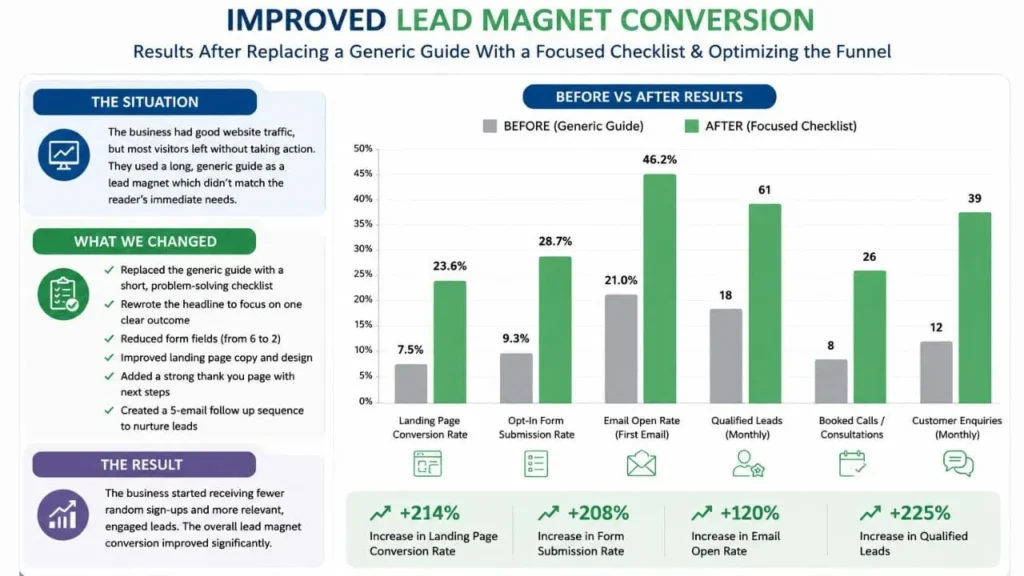
A service-based business was getting regular blog traffic, but most visitors were leaving without contacting the team. The website had a downloadable guide, but the guide was broad and did not solve one clear problem. To improve lead generation, the business also explored reels vs shorts in India which leads to understand which short-form content format attracted more qualified prospects and engagement.
The business replaced the guide with a short checklist. The new checklist focused on helping visitors find problems in their landing page and contact form. The headline was rewritten to show a clear outcome. The opt in form was reduced to fewer fields. The thank you page added a simple next step. A short email sequence was also added to explain how to use the checklist.
After these changes, the business received fewer random sign ups but more relevant enquiries. The improvement came from better audience fit, clearer page copy, a simpler form, and stronger follow up.
The lesson is simple. Lead magnet conversion improves when the offer, landing page, form, and follow up process support the same goal.
How to Improve Lead Magnet Conversion Over Time
A lead magnet should not be created once and ignored. To support zero click funnel lead generation, review, update, and improve it regularly to keep it relevant, engaging, and effective for your audience.
Test the Headline
Try different headlines that focus on the outcome. Small changes in wording can affect lead magnet conversion.
Improve the CTA
Test action based CTA text. “Get the Free Checklist” is usually clearer than “Submit.”
Review Form Fields
Remove fields that are not necessary. If lead quality drops, add one useful qualifying field.
Refresh the Resource
Update old screenshots, outdated tips, weak examples, and unclear instructions. Fresh resources feel more trustworthy.
Segment Your Leads
Tag leads based on interest, source, and topic. This helps you send more relevant follow up emails and improve CRM lead management.
FAQ About Lead Magnet Conversion
Q: What is lead magnet conversion?
Lead magnet conversion is the percentage of visitors who sign up for a lead magnet after seeing the offer. It shows how well your resource, landing page, form, and CTA encourage users to take action.
Q: What makes a lead magnet successful?
A lead magnet becomes successful when it solves one clear problem, attracts the right audience, offers practical value, and leads users toward a relevant next step.
Q: What is a good lead magnet idea for 2026?
Good lead magnet ideas for 2026 include free checklists, templates, calculators, quizzes, assessments, audits, worksheets, and short email courses. The best idea depends on your audience and their intent.
Q: How can I improve lead magnet conversion rate?
You can improve lead magnet conversion by making the offer more specific, improving the headline, reducing form fields, adding trust signals, improving mobile design, and creating a useful follow up sequence.
Q: Should every blog post have a lead magnet?
Not every blog post needs a lead magnet, but important traffic pages should have a relevant next step. A blog post about lead generation can offer a checklist, while a post about conversion rate optimization can offer an audit template.
Q: Should a lead magnet be gated or ungated?
A lead magnet should be gated when it offers enough value to justify asking for contact details. Simple educational content can stay open, while templates, calculators, audits, and toolkits can be gated.
Q: How long should a lead magnet be?
A lead magnet should be long enough to solve the problem but short enough to use easily. A practical two page checklist can sometimes perform better than a long guide.
Conclusion
Building a lead magnet that converts in 2026 is about relevance, clarity, trust, and follow-up. A strong lead magnet does not only collect emails. It helps the right users solve a problem, supports an effective content marketing funnel strategy, and guides them toward the next step.
For better lead magnet conversion, start with one clear audience problem. Choose a practical format. Write a simple promise. Build a focused landing page. Keep the form easy to complete. Add a helpful thank you page and follow up sequence.
When all these parts work together, your lead magnet becomes more than a free resource. It becomes a useful part of your lead generation funnel and helps your website turn visitors into qualified leads.