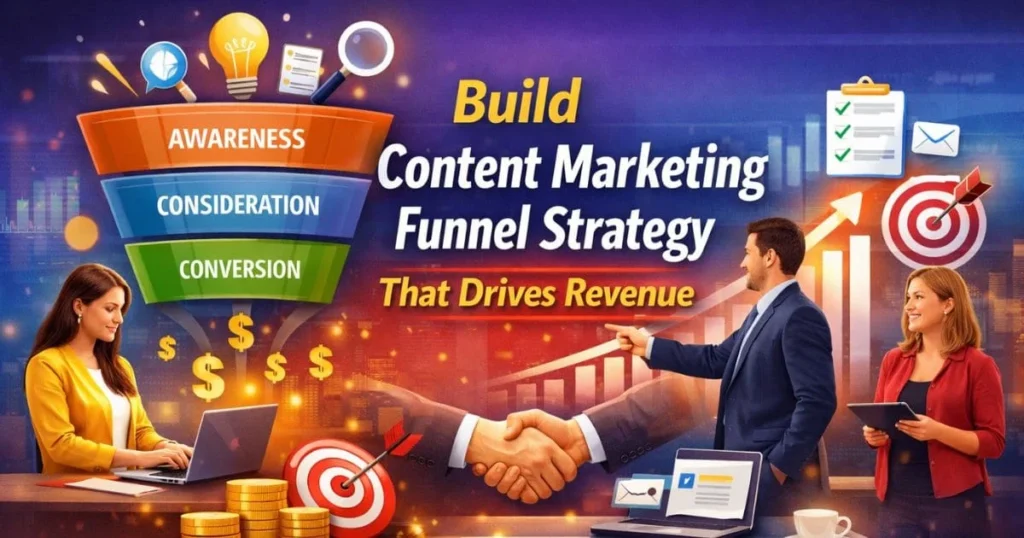
A strong content marketing funnel strategy helps you turn attention into trust, and trust into enquiries, leads, and revenue. Many businesses publish blog posts, service pages, and social content without a clear path for the reader. As a result, traffic may come in, but meaningful action often stays low. That gap is where a smart content marketing funnel strategy makes a real difference.
At its core, a content marketing funnel strategy connects every content asset to a stage of the buyer journey. It helps you reach people when they are learning, support them when they are comparing options, and guide them when they are ready to take action. Instead of treating content as a separate activity, you use it as a system that supports growth.
For brands that want better visibility across search engines, AI search tools, answer engines, and voice queries, this matters even more. Search is no longer only about rankings. It is also about whether your content is clear enough to be quoted, summarised, and trusted. A well planned content marketing funnel strategy gives your pages that structure.
If you offer Digital marketing services, content should not only bring visitors. It should explain value, answer questions, remove doubt, and point readers toward the next step. That is how content starts to support revenue instead of just page views.
Table of Contents
What Is a Content Marketing Funnel Strategy
A content marketing funnel strategy is a plan that matches content to user intent at different stages of the buying journey. It helps you create the right content for the right reader at the right time.
Some readers are only starting to understand a problem. Others are comparing providers, solutions, or services. A few are ready to contact you. Your content should reflect those differences. A blog post for awareness will not do the same job as a service page built for conversion. A strong content marketing funnel strategy respects that and gives every page a clear purpose.
This also improves SEO, GEO, AEO, and voice search performance because search engines and AI systems prefer content that is easy to understand. When your site shows topic depth, intent alignment, and clear pathways, it becomes easier for both users and machines to follow.
For businesses selling SEO services, this is especially useful. SEO content that only targets traffic often misses buyers who are already looking for a solution. A better content marketing funnel strategy closes that gap by supporting both discovery and decision making.

Why a Content Marketing Funnel Strategy Matters
Without a structured approach, content often becomes scattered. One article chases broad awareness. Another pushes a service too early. A third gets traffic but sends readers nowhere. This leads to missed opportunities.
A focused content marketing funnel strategy solves that by giving your content a shared role in growth.
Main benefits of a content marketing funnel strategy
• Brings in more relevant traffic
• Supports better internal linking
• Improves trust through useful information
• Helps readers move from awareness to enquiry
• Makes content easier to organise and measure
• Strengthens topical authority
• Improves how AI systems understand your pages
• Creates better alignment between blogs and service pages
If you provide Local Seo services, this structure also helps you publish content that serves local search intent, comparison intent, and conversion intent without repeating the same message on every page.
The Three Main Stages of a Content Marketing Funnel Strategy
Most funnel based planning works best when you separate content into three main stages. Each stage supports a different type of reader and a different business goal.
Top of funnel content
This stage focuses on awareness. The reader may be searching for definitions, how to guides, common mistakes, or broader informational topics. Your goal here is to help, educate, and attract the right people.
Useful formats include:
• Educational blog posts
• Beginner guides
• Industry explainers
• Question based pages
• Trend focused content
At this stage, your content marketing funnel strategy should answer real questions in clear language. This supports featured snippets, AI summaries, and voice responses.
Middle of funnel content
This stage focuses on consideration. Readers already understand the topic and now want to compare approaches, understand process, or see what kind of solution may work for them.
Useful formats include:
• Strategy guides
• Service comparison content
• Checklists
• Framework based articles
• Content planning guides
In the middle stage, your content marketing funnel strategy should move beyond basic definitions and show practical direction. This is where you can connect informational articles to service intent in a natural way.
Bottom of funnel content
This stage focuses on conversion. The reader is close to making contact, booking a consultation, or requesting a proposal. Your content should reduce confusion and make action easier.
Useful formats include:
• Service pages
• Consultation pages
• Pricing related pages
• FAQ sections with decision support
• Lead focused landing pages
A good content marketing funnel strategy makes sure these pages are not isolated. They should be supported by earlier stage content through relevant internal links and consistent messaging.
If your business also offers social media marketing services, funnel planning helps you connect blog education with service pages and enquiry focused content in a more organised way.

How to Build a Content Marketing Funnel Strategy
A revenue focused content marketing funnel strategy needs more than topic ideas. It needs a process that connects audience intent, keyword research, structure, and conversion planning.
Know who you want to reach
Start with the audience. Think about what they need to know, what problem they want to solve, what questions they ask, and what might stop them from contacting you.
The clearer your audience understanding is, the stronger your content marketing funnel strategy becomes.
Map keywords to intent
Not every keyword serves the same goal. Some keywords are educational. Some show comparison intent. Others suggest service intent.
You can group keywords like this:
• Awareness keywords for introductory blog posts
• Consideration keywords for comparison and strategy pages
• Conversion keywords for service and lead pages
A good content marketing funnel strategy uses all three, not just one group.
Build topic clusters
Instead of writing isolated articles, create topic groups around a main service or theme. This shows search engines that your site covers the topic with depth.
A topic cluster may include:
• One main service page
• Supporting educational blog posts
• FAQ rich articles
• Conversion driven pages
• Related guides that answer nearby questions
This approach helps your content marketing funnel strategy support both rankings and user flow.
Add clear conversion paths
Every article should guide the reader to a logical next step. That could be another blog, a service page, or a consultation prompt. Content that stops without direction rarely supports revenue.
Within a smart content marketing funnel strategy, CTAs should feel natural. They should match the stage of the reader rather than pushing action too early.
Funnel Stage and Content Role
| Funnel stage | User intent | Best content types | Primary goal | Suggested CTA |
| Top of funnel | Learn and explore | blog posts, explainers, beginner guides, trend articles, question based content | attract relevant traffic | read related guide |
| Middle of funnel | Compare and evaluate | strategy posts, checklists, comparison pages, process guides, expert insights | build trust and move interest forward | explore service or book audit |
| Bottom of funnel | Decide and act | service pages, consultation pages, pricing pages, proof driven pages | generate leads and enquiries | request free analysis |
| Retention | improve and expand | FAQs, email nurture, support content, advanced guides | increase lifetime value | contact for growth plan |
Best Content Types for a Content Marketing Funnel Strategy
A strong content marketing funnel strategy depends on format as much as topic. Choosing the right format improves clarity, engagement, and conversion potential.
Blog posts for awareness
Blog posts help you answer broad questions and attract people at the start of the journey. They are useful for building topical authority and visibility.
Good blog themes include:
• What is a content marketing funnel strategy
• Benefits of content planning for business growth
• Common content mistakes that block conversions
• How content supports lead generation
• How search intent shapes content performance
Strategy pages for consideration
These pages work well when readers want more depth. They help connect information with action.
Examples include:
• How to build a content marketing funnel strategy
• How to align content with the buyer journey
• How to connect blog posts with service pages
• How to measure content marketing ROI
Service pages for conversion
A strong content marketing funnel strategy does not stop at education. It needs commercial pages that explain value clearly, answer objections, and support action.
Service pages should include:
• Clear service overview
• Benefits and process
• Decision support FAQs
• Trust building copy
• Strong CTA placement
Benefits of a Content Marketing Funnel Strategy for Revenue Growth
The biggest strength of a content marketing funnel strategy is that it connects content to business outcomes. It gives every page a reason to exist and a role in growth.
How it supports revenue
• Brings in readers who match your service offering
• Warms them up before they contact you
• Helps reduce friction in the decision stage
• Improves lead quality by aligning content with intent
• Makes internal linking more purposeful
• Supports long term visibility across organic search
When your content marketing funnel strategy is clear, your content becomes easier to expand. You can create supporting articles around one service without losing focus. This builds stronger topical relevance and makes your site easier to understand.
How it supports search visibility
A well structured content marketing funnel strategy also improves how your site performs in modern search environments.
It helps because:
• Search engines can follow topic relationships more easily
• AI systems can summarise direct answers more accurately
• Answer engines can extract useful sections faster
• Voice search tools prefer clear question and answer structure
This is why a good content marketing funnel strategy should use clear headings, concise opening definitions, scannable sections, and useful FAQs.
Common Mistakes That Weaken a Content Marketing Funnel Strategy
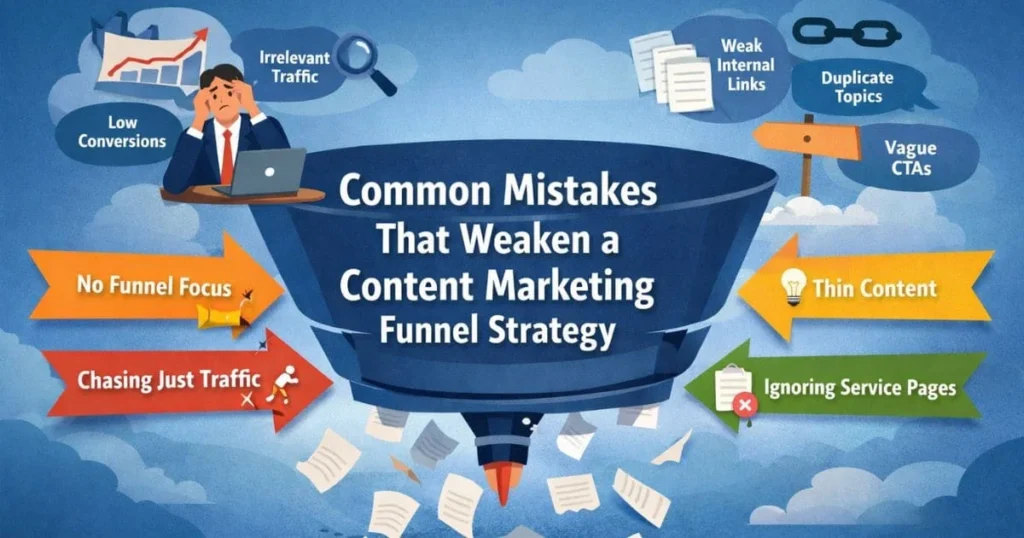
Many sites publish content consistently but still struggle to convert visitors. Often, the issue is not effort. It is structure.
Common mistakes to avoid
• Writing articles with no funnel stage in mind
• Chasing traffic without checking business relevance
• Repeating similar topics without a distinct purpose
• Ignoring internal links to service pages
• Adding weak or vague CTAs
• Publishing content that answers questions but gives no next step
• Creating service pages without supporting blog content
A content marketing funnel strategy works best when awareness content, consideration content, and conversion content support each other.
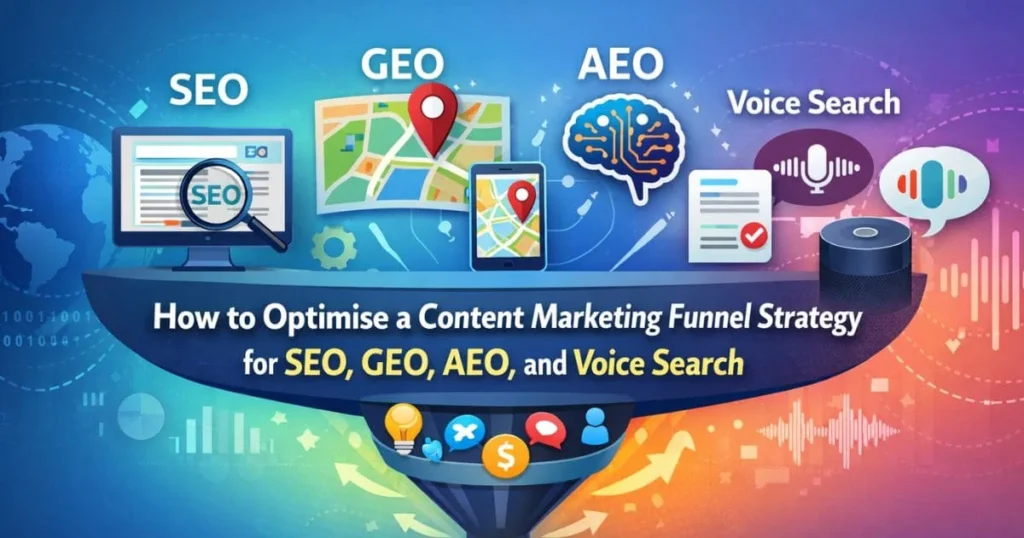
How to Optimise a Content Marketing Funnel Strategy for SEO, GEO, AEO, and Voice Search
Today, content needs to do more than rank. It needs to be understood, quoted, and recommended. That means your content marketing funnel strategy should be built for both readers and machines.
SEO optimisation
Use clear topic targeting, strong heading structure, and relevant internal links. Make sure each section answers the query it targets.
GEO optimisation
Keep sections easy to summarise. Use direct explanations near the top. Add clear subtopics and practical guidance. This makes your content more useful for AI-driven search experiences. AI Humanizer can help refine AI-written drafts so they sound more natural and perform better across SEO, GEO, and AEO systems.
AEO optimisation
Use question-based headings and short answer sections. Add FAQ blocks that solve specific user questions in plain language.
Voice search optimisation
Use conversational wording. Answer common spoken queries directly. Keep key definitions concise and easy to repeat.
A modern content marketing funnel strategy supports all of these by making your content easier to understand and easier to trust.
Internal Linking Plan for the Blog
| Placement in article | Anchor text | Destination page on Dakshraj | Why it helps |
| Introduction | content marketing funnel strategy | Content Marketing service page | sends relevance to your target commercial page |
| Section on AI ready content | generative engine optimization | Generative Engine Optimization for Your Business | supports GEO angle and AI search visibility |
| Section on direct answer formatting | AI Overviews optimization | Google AI Overviews Optimization Tips for 2026 Growth | supports answer engine and summarization angle |
| Section on site structure and clusters | SEO checklist for new websites | Complete SEO Checklist to Help New Websites Rank on Google | supports internal linking, structure, and search readiness |
| Section on lead generation impact | b2b lead generation strategies | 12 Outbound Tactics: b2b lead generation strategies | connects funnel content with pipeline and revenue |
| Conclusion or CTA section | content marketing services | Content Marketing service page | reinforces commercial path near the end |
How to Measure the Success of a Content Marketing Funnel Strategy
If content is meant to support revenue, measurement should go beyond traffic alone. A complete content marketing funnel strategy should be reviewed at every stage.
Awareness metrics
• Organic impressions
• Click through rate
• New users
• Page views from search
Consideration metrics
• Time on page
• Internal link clicks
• Return visits
• CTA interactions
Conversion metrics
• Form submissions
• Consultation requests
• Assisted conversions
• Qualified leads
• Revenue influenced by content
When you measure your content marketing funnel strategy this way, you can see which topics attract the right people and which pages help them move forward.
Conclusion
A well planned content marketing funnel strategy gives your content a job beyond visibility. It helps each page support a stage of the buyer journey, connect users to the next step, and contribute to revenue in a clear way.
Instead of publishing random pieces and hoping they perform, you build a content system with intent, structure, and purpose. That system can improve organic reach, support AI search visibility, strengthen internal linking, and create better conversion paths for your business.
If you want your content to do more than attract traffic, a focused content marketing funnel strategy is the right place to start.
FAQ
Q: What is a content marketing funnel strategy?
Ans: A content marketing funnel strategy is a structured plan that matches content to user intent at different stages of the buyer journey, from awareness to conversion.
Q: Why does a content marketing funnel strategy matter?
It matters because it helps content attract the right audience, build trust, and guide readers toward an enquiry or business action.
Q: How does a content marketing funnel strategy drive revenue?
Ans: A content marketing funnel strategy drives revenue by aligning content with search intent, supporting decision making, and creating clear paths from blog content to service pages and CTAs.
Q: What content belongs at the top of the funnel?
Ans: Top of funnel content usually includes educational blog posts, beginner guides, and question based pages that help readers understand a topic.
Q: What content works best in the middle of the funnel?
Middle of funnel content includes strategy pages, checklists, comparison style articles, and deeper guides that help readers evaluate options.
Q: What content should appear at the bottom of the funnel?
Ans: Bottom of funnel content includes service pages, consultation pages, and FAQ rich pages that support decision making and lead generation.
Q: How can I make a content marketing funnel strategy better for voice search?
Ans: Use natural language, direct answers, question based headings, and concise explanations that are easy for voice tools to read back.
Q: How do internal links support a content marketing funnel strategy?
Ans: Internal links help connect awareness content with consideration and conversion pages. This improves user flow, search clarity, and lead potential.