Email marketing is still one of the most useful channels for Indian businesses, but the way customer data is collected and used is changing. The DPDP Act email marketing India topic matters because businesses now need to think beyond open rates, clicks, and conversions. They also need to think about consent, privacy, data rights, CRM hygiene, responsible communication, and how email marketing services are managed under proper data protection practices.
The Digital Personal Data Protection Act, 2023 was enacted on August 11, 2023, and it applies to digital personal data processing in India. The official law describes its purpose as balancing an individual’s right to protect personal data with the need to process data for lawful purposes. The Digital Personal Data Protection Rules, 2025 were later notified, and the government stated that individuals can access, correct, update, erase, and nominate someone for their personal data rights. Data Fiduciaries must respond to such requests within a maximum of 90 days.
For digital marketing teams, this means email campaigns must become more transparent, permission based, and better managed. If your business collects email addresses through contact forms, lead magnets, newsletters, landing pages, CRM tools, or marketing automation, this guide will help you understand what needs attention.
Table of Contents
What Is the DPDP Act and Why Does It Matter for Email Marketing in India
The DPDP Act is India’s data protection law for digital personal data. In simple words, it controls how businesses collect, store, use, share, and delete personal data in digital form.
Email marketing uses personal data because an email address can identify or connect to a person. When a business stores names, phone numbers, email addresses, job titles, company details, purchase interests, form submissions, and campaign behavior, it is handling personal data.
That is why DPDP Act email marketing India is an important topic for every digital marketing service provider, business owner, and marketing team.
Why email marketing uses personal data
Email marketing usually depends on:
- Name
- Email address
- Phone number
- Location
- Company name
- Job role
- Website form data
- Campaign interest
- Newsletter preference
- Click behavior
- Purchase or inquiry history
This data helps businesses send relevant communication. However, it also creates responsibility. If users do not know why their data is collected, how it will be used, or how they can withdraw consent, the campaign may create privacy risks.
How the DPDP Act changes digital marketing campaigns
The DPDP Act does not stop email marketing. It encourages businesses to make email communication more responsible through consent based email marketing.
Instead of collecting every possible detail from a user, businesses should collect only what is needed. Instead of adding every lead to every campaign, marketers should respect user preference. Instead of keeping outdated lists forever, teams should review, clean, and manage contact records.
For a digital marketing agency or service business, this shift can improve both compliance and campaign quality.
How DPDP Act Email Marketing India Rules Affect Business Communication
The DPDP Act affects how businesses collect consent, explain data use, manage withdrawal requests, and use customer information in email marketing.
According to DLA Piper’s India electronic marketing overview, the DPDP Act and DPDP Rules allow Data Principals to withdraw consent and restrict personal data processing for purposes such as email marketing. (DLA Piper Data Protection) This is highly relevant for newsletters, promotional emails, CRM follow ups, and automated campaigns.
Consent before sending marketing emails
Consent means the user has agreed to share data for a clear purpose. For email marketing, this may include receiving newsletters, offers, service updates, event invites, reports, or promotional communication.
A vague form that only says “submit” is not enough for a strong email marketing process. Businesses should clearly mention what the user is signing up for.
Clear notice before collecting email addresses
A notice should tell users:
- What personal data is being collected
- Why it is being collected
- How it may be used
- Whether it may be shared with service providers
- How the user can withdraw consent
- Where the privacy policy can be read
This is useful for website forms, newsletter signup forms, consultation forms, landing pages, downloadable resources, webinar registrations, and privacy policy pages.
Purpose based data collection for campaigns
If a user gives an email address for a quotation, that does not automatically mean the user wants weekly promotional emails. Businesses should separate service communication from marketing communication.
For DPDP Act email marketing India, purpose clarity is important because the same email address may be used in different ways. A user may agree to receive a proposal but may not agree to receive promotional newsletters.
Easy withdrawal of consent and unsubscribe options
Every marketing email should give users a simple way to stop receiving such emails. The withdrawal process should not be confusing, hidden, or difficult.
Good email marketing respects user choice. When people can unsubscribe easily, spam complaints reduce and sender reputation improves.
Email Marketing Activities Affected by the DPDP Act
| Email Marketing Activity | Personal Data Used | DPDP Related Concern | What Businesses Should Do |
|---|---|---|---|
| Newsletter signup | Name and email address | Consent and notice | Add clear opt in text and privacy notice |
| Lead magnet download | Name, email, phone, company | Purpose limitation | Mention why the data is collected |
| CRM segmentation | Email, location, interest, purchase history | Data processing transparency | Keep consent records and segment responsibly |
| Promotional campaign | Email and behavior data | Marketing consent | Send only to users who agreed to marketing |
| Re engagement email | Old email list data | Outdated or unclear consent | Reconfirm consent before sending |
| Automated email sequence | Email, clicks, form data | Profiling and automation transparency | Explain how user data supports communication |
| Unsubscribe request | Email address | Withdrawal of consent | Remove or suppress the contact quickly |
DPDP Act Compliance Checklist for Email Marketing in India
A compliance checklist helps businesses convert legal expectations into daily marketing actions. The goal is not to make email marketing complex. The goal is to make it clear, fair, and easy to manage.
Collect consent before adding users to email lists
Add clear consent text near forms. A user should know whether they are signing up for a newsletter, a consultation, a download, a demo, or a promotional campaign.
Keep proof of consent in your CRM or email tool
Your CRM or email platform should record:
- Date of consent
- Source of consent
- Form name
- Page URL or campaign source
- Consent category
- User preference
- Withdrawal request, if any
This makes marketing easier to audit and manage.
Use clear privacy notices on forms and landing pages
Every lead generation page should have clear language about data collection. Long legal text near a form may reduce clarity. Instead, use a short notice with a link to the full privacy policy.
Add unsubscribe links in every marketing email
An unsubscribe link helps users control their inbox. It also protects email reputation. If users cannot unsubscribe, they may mark the message as spam.
Avoid buying random email databases
Purchased email lists may include users who never gave permission to receive your marketing emails. This can harm sender reputation, reduce engagement, and create privacy concerns.
For DPDP Act email marketing India, it is safer to build a list through website forms, newsletter signups, webinars, gated resources, and clear consent based campaigns.
Review old email lists before running campaigns
Old lists can create risk because consent may be unclear. Before sending a campaign to an old database, check how the data was collected and whether the contact agreed to receive marketing communication.
Limit data collection to what is needed
If an email newsletter only needs an email address, do not ask for a phone number, address, company size, and budget at the same step. Collecting less data often improves trust and form completion.
DPDP Email Marketing Compliance Checklist
| Compliance Area | Where to Apply It | Why It Matters for Digital Marketing | Priority |
|---|---|---|---|
| Consent collection | Website forms, popups, landing pages | Helps avoid sending emails without permission | High |
| Privacy notice | Contact forms, lead magnets, signup pages | Tells users why their data is collected | High |
| Consent record | CRM, email marketing software | Helps prove when and how consent was collected | High |
| Unsubscribe option | Every marketing email | Allows users to withdraw consent easily | High |
| Data minimisation | Lead forms and campaign forms | Prevents unnecessary data collection | Medium |
| List cleaning | Old customer and prospect lists | Reduces risk from outdated contacts | Medium |
| Vendor review | CRM, automation, email tools | Checks how third party tools handle user data | Medium |
| Team training | Marketing, sales, support teams | Reduces mistakes in campaign execution | Medium |
What Indian Digital Marketing Teams Should Change in Email Campaigns
Digital marketing teams should treat DPDP compliance as part of campaign planning. It should not be left only to legal or admin teams because marketers are often the first people collecting and using customer data.
Replace forced signup with clear opt in
A forced signup can damage trust. Users should understand what they are agreeing to before submitting a form.
Better form language can say:
- I agree to receive marketing communication
- I agree to receive newsletters and service updates
- I understand that I can unsubscribe at any time
Separate marketing consent from service communication
A user may contact a business for a quote. That communication is different from a newsletter or promotional email. Keep both consent categories separate in the CRM.
This helps marketers avoid sending unrelated campaigns to people who only asked for service information.
Avoid pre checked consent boxes
Consent should come from a clear user action. A pre selected box can create confusion. A blank checkbox that users select themselves is more transparent.
Create consent based email segments
Email lists should be segmented by consent type, not only by interest or service category, and a clear email segmentation strategy helps businesses send more relevant and permission based campaigns.
Useful segments may include:
- Newsletter subscribers
- Consultation leads
- Existing customers
- Event registrants
- Promotional consent contacts
- Users who unsubscribed
- Users who requested deletion
This makes DPDP Act email marketing India easier to manage across campaigns.
Review email marketing tools
Many businesses use outside tools for email campaigns, CRM, landing pages, analytics, forms, and automation. You should know what customer data goes into each tool, who can access it, and how data can be deleted when needed.

DPDP Act and Lead Generation for Digital Marketing Services
Lead generation is a major part of digital marketing. Businesses collect leads through SEO pages, paid ads, social media campaigns, downloadable guides, webinars, and consultation forms.
The DPDP Act makes it important to collect leads responsibly.
How website forms should collect leads
A good lead form should be simple and transparent. It should ask for only useful details and explain the reason for data collection.
A contact form may include:
- Name
- Email address
- Phone number
- Service interest
- Message box
- Consent checkbox
- Privacy policy link
What to mention near contact forms
Near the form, add a short message explaining how the user data may be used. It should be easy to understand.
A simple notice can mention that the submitted information will be used to respond to the inquiry and, only with consent, send relevant marketing communication.
Why lead magnets need clear consent language
Lead magnets often collect email addresses in exchange for downloadable resources. If the user is also being added to a newsletter, say it clearly.
Do not hide marketing consent inside generic text. Clear wording helps build trust, supports better engagement, and makes zero click funnel lead generation more responsible for digital marketing campaigns.
How to handle B2B email leads responsibly
B2B marketing also uses personal data when a message is sent to a person’s business email address. A job title and business email can still connect to an individual.
That is why B2B marketers should also maintain clean lists, clear consent records, and easy unsubscribe options.
DPDP Act Impact on Email Automation and CRM Workflows
B2B email marketing automation can save time, but it can also multiply mistakes if consent settings are weak. A single wrong workflow rule can send emails to users who never agreed to receive them.
Welcome email sequences
A welcome email should match the user’s action. If someone signed up for a newsletter, send newsletter related onboarding. If someone asked for a quote, send service related communication.
Abandoned cart emails
For online businesses, abandoned cart emails may use behavior data. The business should make sure the user has been informed about such communication and tracking.
Re engagement campaigns
Re engagement campaigns should be handled carefully. If a contact has not engaged for a long period, reconfirm interest before sending frequent promotions.
Webinar follow up emails
If a user registers for a webinar, follow up emails about the webinar are expected. However, adding them to a general promotional list should depend on their consent.
Customer retention emails
Existing customers may receive service related updates, but marketing campaigns still need proper purpose clarity. Keep service communication and promotional messaging separate.
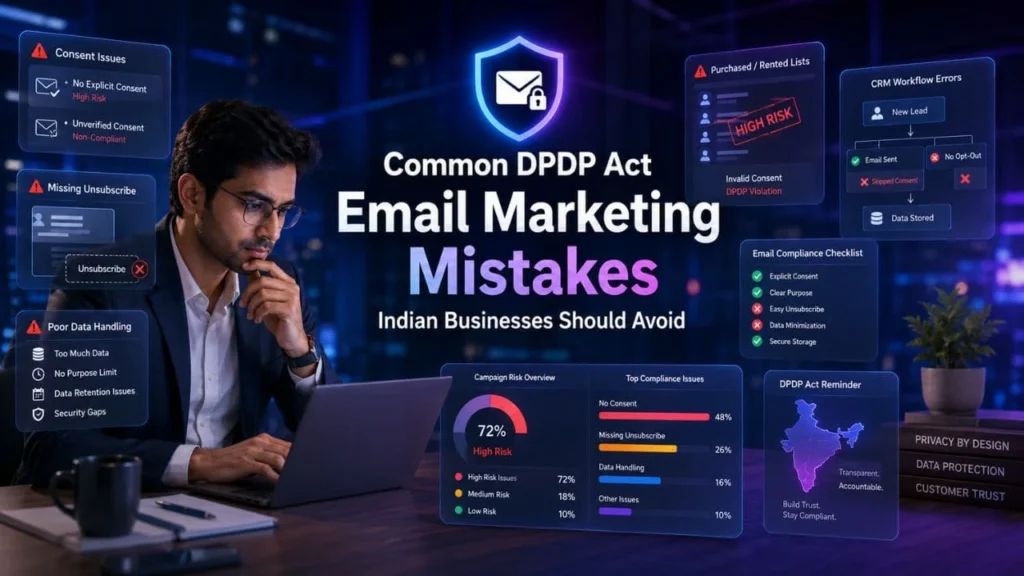
Common DPDP Act Email Marketing Mistakes Indian Businesses Should Avoid
Many businesses do not make mistakes intentionally. Problems happen because lists are old, tools are not connected properly, or teams do not understand consent.
Sending emails to purchased lists
Purchased lists may seem like a quick way to reach more people, but they often include low quality contacts and unclear permissions. This can reduce deliverability and trust.
Not storing consent proof
If your team cannot identify where consent came from, your list needs review. Store consent source inside your CRM or email platform.
Hiding the unsubscribe option
The unsubscribe option should be easy to find. A hidden or confusing unsubscribe process creates frustration and may increase spam complaints.
Collecting more data than needed
Long forms can reduce conversions and increase privacy risk. Ask only for the information needed for the purpose.
Using one consent for every marketing purpose
One checkbox should not cover every possible marketing activity. If you send newsletters, promotional offers, event invites, and partner communication, make the purpose clear.
Ignoring correction or deletion requests
Users may ask to correct, update, erase, or access their personal data. The official DPDP Rules communication states that Data Fiduciaries must respond to such requests within a maximum of 90 days.
How to Make Email Marketing More Trustworthy Under the DPDP Act
Good email marketing is not just about compliance. It is also about trust, clarity, and relevance. When users understand what they will receive, they are more likely to stay subscribed.
Use simple consent language
Avoid complicated language. Users should understand the consent message quickly.
Good consent text should explain:
- What the user will receive
- How often they may receive emails
- How they can unsubscribe
- Where they can read the privacy policy
Tell users what they will receive
If the user signs up for SEO tips, do not send unrelated promotional emails. If they sign up for service updates, avoid sending irrelevant messages.
Relevance improves trust and campaign performance.
Give users control over preferences
Preference centers help users choose what they want to receive. They may want newsletters but not promotional emails. They may want monthly updates but not weekly messages.
Send relevant emails instead of frequent generic emails
More emails do not always mean better results. Relevant emails usually perform better than frequent emails with weak value.
For DPDP Act email marketing India, relevance also supports better consent based communication.
Keep customer data secure across marketing tools
Marketing data often moves across several tools. This may include form plugins, CRM software, email platforms, analytics tools, landing page builders, and ad platforms.
Businesses should review access permissions and remove users who no longer need access.
DPDP Act Email Marketing India Case Study
How a Service Business Improved Email Compliance
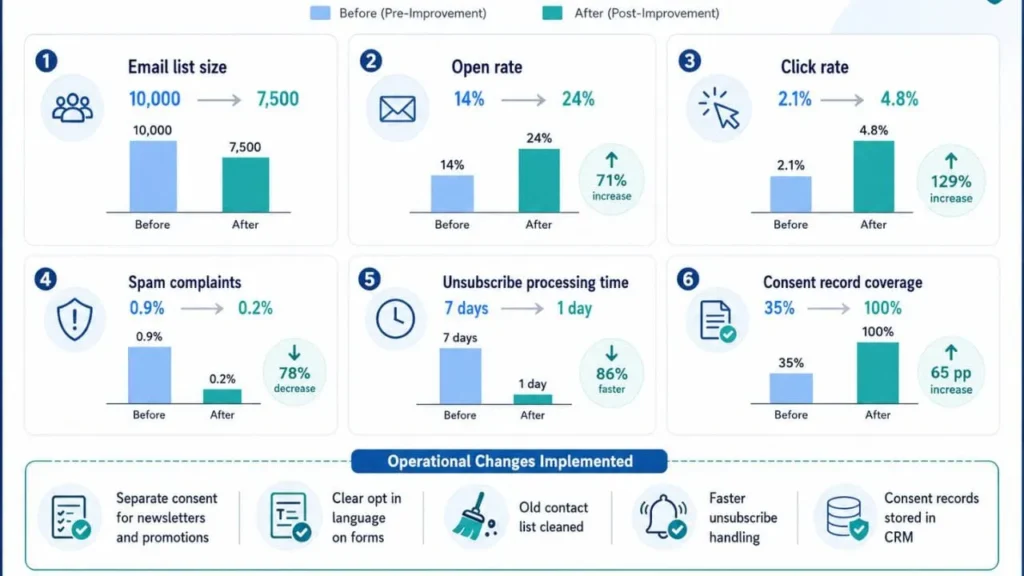
A service based Indian business was collecting leads through website forms, consultation requests, downloadable resources, and event registrations. The marketing team used the same email list for newsletters, promotional campaigns, and follow up emails.
After reviewing DPDP Act email marketing India requirements, the team changed its process. They added clear consent text to all lead forms. They separated newsletter consent from service inquiry communication. They cleaned old email lists and removed contacts where permission was unclear.
The team also improved its CRM setup. Each contact record included consent source, form type, date of submission, campaign category, and unsubscribe status. Marketing automation rules were updated so users received only the communication they had agreed to receive.
The email list became smaller, but the audience quality improved. Open rates became stronger, spam complaints reduced, and the sales team received better quality inquiries. The business also gained better control over customer data across its marketing systems.
This shows that compliance can support better marketing. A clean and consent based list can help businesses communicate with people who actually want to hear from them.
How DPDP Act Supports Better SEO, GEO, AEO and Voice Search Content
The DPDP Act also affects how businesses create content around data collection. Search engines and answer engines prefer clear, useful, and trustworthy information. When your website explains privacy, consent, and communication clearly, it builds confidence. Adding an AI Search Readiness Checker can also help businesses review whether their content is structured clearly for search engines, answer engines, and AI driven results.
SEO value of clear privacy communication
Pages with clear form text, privacy notices, and helpful user information can support better trust. A website that explains how user data is used may reduce hesitation and improve lead quality.
GEO value for AI search visibility
Generative engines look for structured, direct, and reliable answers. A page that explains email consent, DPDP requirements, unsubscribe process, CRM data handling, and user rights in a clear way can be easier for AI systems to understand. This is why businesses should structure content so AI Overviews quote your page when users search for clear answers about data privacy and email marketing compliance.
AEO value for direct answers
Answer engine optimization works best when content gives clear responses to common questions. This blog includes direct answers on consent, email lists, unsubscribe process, CRM data handling, and how to write FAQ sections that win featured snippets.
Voice search value
Voice search users ask natural questions such as:
- Is consent required for email marketing in India
- What is the DPDP Act for email marketing
- Can businesses send promotional emails in India
- How can users unsubscribe from marketing emails
- Does DPDP apply to digital marketing agencies
Using question based headings helps the content match these search patterns.

Best Practices for Digital Marketing Agencies Under the DPDP Act
Digital marketing agencies often manage data on behalf of clients. This may include email lists, CRM records, form submissions, ad leads, landing page leads, and campaign reports.
Agencies should make data handling part of their standard marketing process.
Important actions for agencies
- Review all client lead forms
- Add clear consent language
- Check CRM fields for consent tracking
- Separate service inquiries from marketing subscribers
- Clean old email lists before campaigns
- Add unsubscribe links to all promotional emails
- Review access permissions inside email tools
- Keep documentation for campaign data sources
- Train content, SEO, email, paid ads, and sales teams
When agencies manage email marketing responsibly, they protect both the client and the audience.
FAQs
Q: What is DPDP Act email marketing India?
Ans: DPDP Act email marketing India refers to how the Digital Personal Data Protection Act affects email campaigns, customer data collection, consent, unsubscribe handling, CRM records, and marketing automation in India.
Q: Is consent required for email marketing in India?
Ans: Consent is highly important when businesses process personal data for email marketing. Users should know why their data is collected and what communication they will receive.
Q: Can Indian businesses send marketing emails to existing customers?
Ans: Businesses should separate service related communication from promotional communication. Existing customers may receive service updates, but promotional emails should be based on clear consent and preference.
Q: Is it safe to use purchased email lists under the DPDP Act?
Ans: Purchased lists can create risk because the business may not have clear proof that users agreed to receive marketing communication. Building a consent based list is safer and usually performs better.
Q: What should be included in an email marketing consent form?
Ans: A consent form should explain what emails the user will receive, why their data is collected, how the data may be used, and how the user can unsubscribe or withdraw consent.
Q: How can users unsubscribe from marketing emails?
Ans: Users should be able to unsubscribe through a clear link in the email. The process should be simple and should not require unnecessary steps.
Q: How does the DPDP Act affect digital marketing agencies?
Ans: Digital marketing agencies need to manage lead data responsibly. They should review forms, CRM fields, email lists, automation rules, consent records, and unsubscribe requests.
Q: What should businesses do with old email lists?
Ans: Old email lists should be reviewed before use. If consent is unclear, businesses should clean the list or ask contacts to confirm their interest before sending campaigns.
Q: Does the DPDP Act apply to B2B email marketing in India?
Ans: B2B email marketing may still involve personal data when emails identify an individual. Businesses should manage B2B contact data with care and provide clear unsubscribe options.
Q: How can CRM data be managed under DPDP compliance?
Ans: CRM data should include consent source, consent date, communication preference, unsubscribe status, and request history. Access should be limited to people who need the data for business purposes.
Conclusion
The DPDP Act does not end email marketing in India. It pushes businesses toward better consent, clearer communication, cleaner lists, and stronger data responsibility.
For digital marketing teams, this is a good time to review every step of the email marketing process. Check how leads are collected, how consent is recorded, how CRM data is used, how unsubscribe requests are handled, and how automation rules are managed.
A strong DPDP Act email marketing India strategy can help businesses build trust, improve campaign quality, and reduce privacy related risk. When users know what they are signing up for and can control their preferences, email marketing becomes more respectful and more effective.