Search behavior is changing faster than ever. People are no longer relying only on traditional search results. Today, users ask questions directly to AI tools, voice assistants, and search engines that generate instant summaries. Because of this shift, businesses and marketers need content that is structured, conversational, and easy for machines to understand. This is where FAQ Sections become incredibly valuable.
Well written FAQ Sections help search engines identify clear answers, improve visibility in Featured Snippets, and increase the chances of appearing in AI generated responses. They also support voice search queries and improve content discoverability across modern search experiences.
For digital marketing blogs, FAQ Sections are no longer optional additions at the bottom of a page. They are strategic SEO assets that strengthen topical relevance, improve user engagement, and support answer engine optimization for AI citations.
In this guide, you will learn how to create frequently asked questions that are optimized for search engines, AI search tools, voice assistants, and generative AI systems while maintaining strong user experience and semantic relevance.
Table of Contents
Why FAQ Sections Matter in Modern Search
The Evolution of Search Behavior
Traditional SEO focused heavily on ranking webpages through keywords and backlinks. While those factors still matter, search engines have become smarter at understanding intent, context, and conversational queries.
Users now search in ways like:
- What is answer engine optimization?
- How do Featured Snippets work?
- Why are frequently asked questions important for SEO?
- How can I optimize content for AI search tools?
These conversational searches have increased because of:
- AI powered search experiences
- Voice assistants
- Mobile search habits
- Natural language processing
- Generative AI tools
Modern algorithms prefer content that directly answers questions in a structured format. frequently asked questions naturally fit this requirement.
How frequently asked questions Improve Search Visibility?
frequently asked questions help both users and search engines quickly understand your content. They simplify complex topics into direct answers while improving crawlability and semantic understanding.
Benefits include:
- Better eligibility for Featured Snippets
- Higher visibility in AI generated answers
- Improved voice search optimization
- Stronger topical authority
- Enhanced user experience
- Increased keyword coverage
- Better engagement metrics
When implemented correctly, FAQ Sections support both traditional SEO and newer AI driven search ecosystems.
Benefits of Frequently Asked Questions for SEO, GEO, AEO and Voice Search
| Optimization Area | How FAQ Sections Help | SEO Benefit |
| Featured Snippets | Provides concise answers | Improves position zero visibility |
| Voice Search | Matches natural speech queries | Enhances assistant discoverability |
| AI Search Engines | Creates machine friendly answers | Supports AI citations |
| Semantic SEO | Covers related entities and topics | Strengthens topical relevance |
| User Experience | Quickly resolves user questions | Reduces bounce rates |
| AEO | Helps AI systems extract answers | Improves answer visibility |
Understanding Featured Snippets and AI Answers
What Are Featured Snippets?
Featured Snippets are highlighted search results that appear above standard organic listings. They are often called “position zero” because they occupy the most visible section of search results.
Search engines extract these answers directly from webpages that provide clear and structured information.
Common Featured Snippet formats include:
Paragraph Snippets
These provide direct answers in short paragraphs.
List Snippets
These display steps, rankings, or instructions.
Table Snippets
These organize comparisons and structured information.
Video Snippets
These highlight timestamps from videos answering user queries.
What Are AI Answers?
AI answers are generated responses created by search engines and AI platforms using information gathered from multiple sources.
These answers appear in:
- AI Overviews
- Conversational search engines
- Voice assistants
- Generative AI search experiences
To improve visibility within these systems, your content must be easy to interpret, semantically rich, and clearly structured.
This is why FAQ Sections are becoming essential for answer engine optimization for AI citations.
Why FAQ Sections Increase Snippet Opportunities?
Search engines prefer content that is:
- Easy to scan
- Structured logically
- Written conversationally
- Focused on direct answers
FAQ Sections naturally satisfy these conditions.
They improve:
- Semantic clarity
- Search intent alignment
- Machine readability
- NLP interpretation
- Voice search compatibility
Well optimized FAQ Sections also strengthen position zero SEO with semantic relevance because they connect related concepts in a highly organized way.
Keyword Research for High Performing FAQ Sections
Find Real User Questions
Effective FAQ Sections begin with strong keyword research. Instead of focusing only on short keywords, identify the exact questions users ask.
Useful sources include:
- Google autocomplete
- People Also Ask results
- Search Console data
- Community forums
- AI search suggestions
- Voice search queries
These sources reveal conversational intent and help create user focused answers.
Use Long Tail Conversational Keywords
Long tail keywords improve semantic coverage and align with natural language queries.
Examples include:
- How do FAQ Sections help SEO?
- What is AEO and featured snippet optimization?
- Why are Featured Snippets important?
- How does answer engine optimization for AI citations work?
These phrases improve both SEO relevance and voice search performance.
Mapping Search Intent to FAQ Sections
| Search Intent | Example Question | Optimization Goal |
| Informational | What are Featured Snippets? | Increase visibility |
| Transactional | Which SEO tool is best? | Improve conversions |
| Navigational | How to use Search Console? | User guidance |
| Conversational | How do AI search engines work? | Voice search optimization |
How to Structure FAQ Sections for Featured Snippets?
Use Question Based Headings
Every FAQ should begin with a clear question.
For example:
- What is semantic SEO?
- How do Featured Snippets work?
- Why are FAQ Sections important?
Question based headings help search engines recognize the purpose of the content instantly.
They also align perfectly with conversational search behavior.
Write Direct and Concise Answers
Search engines prefer short and focused answers for Featured Snippets. Aim for answers between 40 and 60 words whenever possible.
Good example:
“Featured Snippets are highlighted search results that provide direct answers to user queries. They appear above traditional organic listings and improve visibility, click through rates, and authority.”
Avoid unnecessary filler or overly complicated explanations.
Add Lists and Tables
Structured formatting improves readability and snippet potential.
Use:
- Bullet points
- Numbered lists
- Comparison tables
- Step based instructions
Search engines often extract lists and tables directly into Featured Snippets.
Include Semantic Keywords Naturally
Modern SEO relies heavily on context and topical relevance.
Instead of repeating one keyword excessively, include related terms naturally.
Examples:
- Featured Snippets
- AEO and featured snippet optimization
- answer engine optimization for AI citations
- position zero SEO with semantic relevance
This improves semantic understanding without keyword stuffing.
Best Practices for Writing FAQ Sections
Match Conversational Search Queries
Voice search users speak differently compared to traditional typing behavior.
For example:
Typed query:
- best SEO strategy 2026
Voice search query:
- What is the best SEO strategy for ranking in 2026?
Your FAQ Sections should reflect natural language patterns.
Keep Answers Updated
Search trends evolve quickly.
Outdated FAQ content reduces credibility and ranking potential.
Regularly update:
- Statistics
- Algorithm references
- AI search trends
- SEO practices
Fresh content improves trust and search performance.
Avoid Thin FAQ Content
Low quality FAQ Sections can hurt SEO performance.
Avoid:
- Duplicate questions
- Generic answers
- Keyword stuffing
- One sentence filler content
Every answer should provide genuine value
Focus on Topical Authority
Strong FAQ Sections support broader topical coverage.
For digital marketing blogs, include related concepts such as:
- Technical SEO
- Semantic search
- AI search optimization
- Voice SEO
- Structured data
- User intent analysis
This builds contextual authority around your primary topic.
Case Study: How Optimized FAQ Sections Improved AI Search Visibility
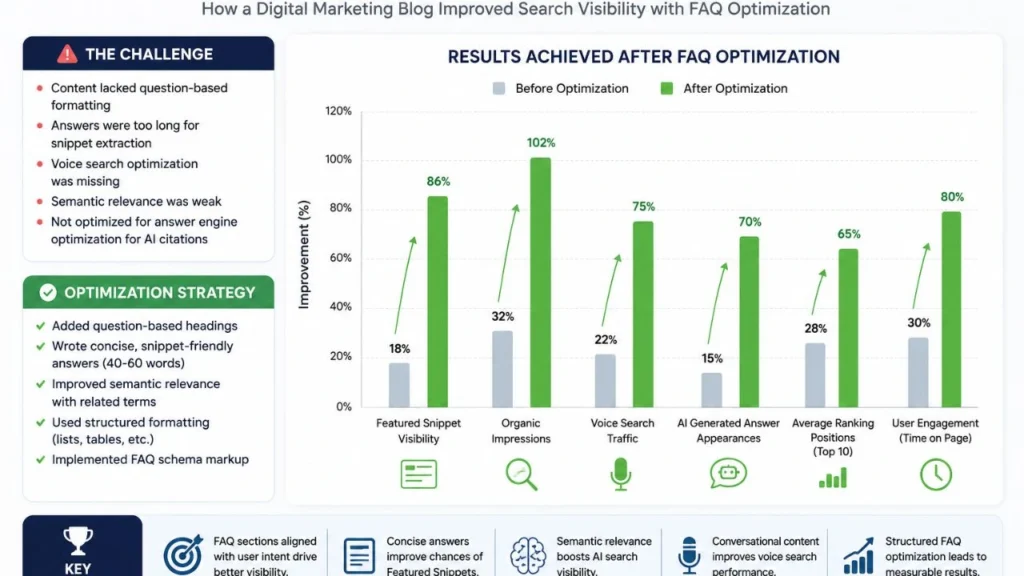
A digital marketing blog in a competitive SEO niche was struggling to gain visibility for informational keywords related to search optimization and AI driven search behavior. Although the blog published detailed long form articles regularly, most pages were ranking between positions 8 and 15 on search engines.
The content team decided to restructure their articles by adding strategically optimized FAQ Sections focused on conversational search intent, semantic relevance, and Featured Snippets opportunities.
Challenges Faced
Before optimization, the blog had several issues:
- Content lacked direct question based formatting
- Most answers were lengthy and difficult for search engines to extract
- Voice search optimization was missing
- Important semantic entities were not connected properly
- Articles were not optimized for answer engine optimization for AI citations
Because of these problems, search engines struggled to identify concise answers suitable for Featured Snippets and AI generated responses.
Optimization Strategy Used
The team implemented a structured FAQ optimization plan across multiple articles.
1. Added Question Based Headings
Instead of generic subheadings, they introduced conversational questions such as:
- What are Featured Snippets?
- How does semantic SEO work?
- Why are FAQ Sections important for AI search?
This improved alignment with real user queries.
2. Wrote Concise Snippet Friendly Answers
Each FAQ answer was rewritten between 40 and 60 words to improve extraction potential for Featured Snippets.
The answers:
- Started with direct definitions
- Removed unnecessary filler
- Focused on intent clarity
- Used conversational language
3. Improved Semantic Relevance
The content team naturally incorporated related concepts including:
- Featured Snippets
- voice search optimization
- AI search visibility
- semantic SEO
- position zero SEO with semantic relevance
This strengthened topical authority and contextual depth.
4. Added Structured Formatting
The blog used:
- Bullet points
- Numbered lists
- Tables
- FAQ schema markup
This made the content easier for search engines and AI systems to interpret.
Results Achieved After Optimization
Within a few months, the blog started seeing measurable improvements.
| Performance Area | Result |
|---|---|
| Featured Snippet visibility | Increased significantly |
| Organic impressions | Improved steadily |
| Voice search traffic | Increased noticeably |
| AI generated answer appearances | Improved across multiple queries |
| Average ranking positions | Moved closer to top search results |
| User engagement | Higher time on page |
Several pages began appearing in position zero for informational search queries related to digital marketing and SEO.
The FAQ Sections also improved visibility within AI generated search summaries because the content became easier for AI systems to extract and cite.
Key Takeaways From This Case Study
This example highlights several important lessons:
- FAQ Sections work best when aligned with conversational search intent
- Structured answers improve Featured Snippets eligibility
- Semantic optimization strengthens AI search visibility
- Concise formatting helps voice assistants extract answers
- AEO and featured snippet optimization should work together
The results also showed that modern search visibility depends heavily on how well content communicates with both users and AI systems.
For digital marketing blogs, optimized FAQ Sections can become a strong competitive advantage in search engines, AI search platforms, and voice search ecosystems.
Case Study: How Optimized FAQ Sections Improved AI Search Visibility
A digital marketing blog in a competitive SEO niche was struggling to gain visibility for informational keywords related to search optimization and AI driven search behavior. Although the blog published detailed long form articles regularly, most pages were ranking between positions 8 and 15 on search engines.
The content team decided to restructure their articles by adding strategically optimized FAQ Sections focused on conversational search intent, semantic relevance, and Featured Snippets opportunities.
Challenges Faced
Before optimization, the blog had several issues:
- Content lacked direct question based formatting
- Most answers were lengthy and difficult for search engines to extract
- Voice search optimization was missing
- Important semantic entities were not connected properly
- Articles were not optimized for answer engine optimization for AI citations
Because of these problems, search engines struggled to identify concise answers suitable for Featured Snippets and AI generated responses.
Optimization Strategy Used
The team implemented a structured FAQ optimization plan across multiple articles.
1. Added Question Based Headings
Instead of generic subheadings, they introduced conversational questions such as:
- What are Featured Snippets?
- How does semantic SEO work?
- Why are FAQ Sections important for AI search?
This improved alignment with real user queries.
2. Wrote Concise Snippet Friendly Answers
Each FAQ answer was rewritten between 40 and 60 words to improve extraction potential for Featured Snippets.
The answers:
- Started with direct definitions
- Removed unnecessary filler
- Focused on intent clarity
- Used conversational language
3. Improved Semantic Relevance
The content team naturally incorporated related concepts including:
- Featured Snippets
- voice search optimization
- AI search visibility
- semantic SEO
- position zero SEO with semantic relevance
This strengthened topical authority and contextual depth.
4. Added Structured Formatting
The blog used:
- Bullet points
- Numbered lists
- Tables
- FAQ schema markup
This made the content easier for search engines and AI systems to interpret.
Results Achieved After Optimization
Within a few months, the blog started seeing measurable improvements.
| Performance Area | Result |
|---|---|
| Featured Snippet visibility | Increased significantly |
| Organic impressions | Improved steadily |
| Voice search traffic | Increased noticeably |
| AI generated answer appearances | Improved across multiple queries |
| Average ranking positions | Moved closer to top search results |
| User engagement | Higher time on page |
Several pages began appearing in position zero for informational search queries related to digital marketing and SEO.
The FAQ Sections also improved visibility within AI generated search summaries because the content became easier for AI systems to extract and cite.
Key Takeaways From This Case Study
This example highlights several important lessons:
- FAQ Sections work best when aligned with conversational search intent
- Structured answers improve Featured Snippets eligibility
- Semantic optimization strengthens AI search visibility
- Concise formatting helps voice assistants extract answers
- AEO and featured snippet optimization should work together
The results also showed that modern search visibility depends heavily on how well content communicates with both users and AI systems.
For digital marketing blogs, optimized FAQ Sections can become a strong competitive advantage in search engines, AI search platforms, and voice search ecosystems.
Schema Markup for FAQ Sections
What Is FAQ Schema?
FAQ schema is structured data that helps search engines understand question and answer content. It improves machine readability and increases the likelihood of enhanced search visibility.
FAQ schema can support:
- Rich results
- AI extraction
- Search interpretation
- Voice assistant responses
How FAQ Schema Supports AI Search?
AI systems rely heavily on structured information.
Schema markup improves:
- Content classification
- Entity recognition
- Semantic interpretation
- Answer extraction
This makes FAQ Sections more valuable for answer engine optimization for AI citations.
Common FAQ Schema Mistakes
Avoid these errors:
- Marking hidden content
- Using irrelevant questions
- Adding misleading answers
- Creating spammy FAQ blocks
Search engines prioritize authentic and helpful structured content.
AEO and Featured Snippet Optimization
What Is Answer Engine Optimization?
Answer Engine Optimization focuses on creating content that AI systems and search engines can easily interpret and cite.
Unlike traditional SEO, AEO emphasizes:
- Direct answers
- Structured formatting
- Semantic clarity
- Contextual depth
AEO and featured snippet optimization often work together because both rely on concise, machine readable answers.
Writing Content for AI Citations
AI systems prefer trustworthy and context rich content.
To improve citation potential:
- Use factual language
- Maintain clarity
- Structure content logically
- Add semantic entities
- Cover related subtopics
Strong FAQ Sections help AI tools identify precise answers quickly.
Combining SEO, GEO and AEO
| Strategy | SEO | GEO | AEO |
| Question based headings | Yes | Yes | Yes |
| Conversational answers | Yes | Yes | Yes |
| Semantic entities | Yes | Yes | Yes |
| Structured formatting | Yes | No | Yes |
| FAQ schema | Yes | No | Yes |
Position Zero SEO With Semantic Relevance
What Is Position Zero SEO?
- Position zero refers to Featured Snippet placements above traditional organic results.
- These placements attract significant visibility because users often see them before anything else.
Position zero SEO with semantic relevance focuses on building content that:
- Answers queries directly
- Covers related concepts
- Matches search intent
- Uses contextual entities naturally
Build Semantic Relevance in FAQ Sections
Semantic relevance helps search engines understand relationships between topics.
To improve semantic strength:
- Include related subtopics
- Use contextual phrases
- Cover supporting questions
- Maintain logical structure
For example, a blog about FAQ Sections should also discuss:
- AI search
- voice SEO
- semantic SEO
- Featured Snippets
- answer engines
- search intent
This creates stronger topical associations.
Voice Search Optimization Through FAQ Sections
Why Voice Search Depends on FAQ Content
Voice assistants prioritize concise conversational answers. FAQ Sections naturally support this format because they mirror spoken language.
Voice searches often begin with:
- What
- Why
- How
- Which
- When
Well structured FAQs increase the likelihood of appearing in voice search results.
Best Practices for Voice Search Optimization
Use Natural Language
Write the way people actually speak.
Keep Answers Short
Voice assistants prefer concise responses.
Focus on Intent
Understand what users truly want to know.
Add Conversational Questions
This improves voice search compatibility.
Common Mistakes to Avoid
Keyword Stuffing
- Repeating keywords unnaturally reduces readability and trust.
- Use semantic variations naturally instead.
Writing Robotic Answers
- Content should feel human and conversational.
- Avoid overly technical or repetitive phrasing.
Ignoring User Intent
- Search engines prioritize content that satisfies intent completely.
- Every FAQ should solve a real problem or answer a meaningful question.
Creating Generic Questions
Avoid vague questions like:
- What is SEO?
- Why is marketing important?
Focus on detailed, intent driven questions instead.
Advanced Strategies for FAQ Sections
Use FAQ Sections Across Topic Clusters
FAQ content works especially well when integrated across related articles.
For example:
- AI SEO
- semantic SEO
- voice search optimization
- technical SEO
- content optimization
Internal linking between these pages strengthens topical authority.
Optimize FAQs for AI Crawlers
AI systems prefer:
- Clear formatting
- Logical structure
- Semantic depth
- Concise answers
- Reliable information
FAQ Sections make content easier for AI tools to interpret and cite.
Strengthen E-E-A-T Signals
Helpful FAQ content improves:
- Expertise
- Experience
- Authority
- Trustworthiness
When users consistently find accurate answers on your blog, credibility improves over time.
Tools That Help Improve FAQ Sections
| Tool Type | Purpose |
| Keyword Research Tools | Discover user questions |
| Search Console | Analyze query performance |
| NLP Optimization Tools | Improve semantic relevance |
| Schema Generators | Create FAQ markup |
| SERP Analysis Tools | Analyze Featured Snippets |
Future of FAQ Sections in AI Search
AI driven search will continue evolving rapidly.
Search engines increasingly prioritize:
- Conversational content
- Semantic understanding
- Structured answers
- Contextual relationships
Because of this, FAQ Sections will remain valuable for:
- SEO
- AI search optimization
- Voice search
- Featured Snippets
- Generative AI visibility
Brands that invest in structured, user focused FAQ content today will likely gain stronger visibility across future search ecosystems.
Conclusion
FAQ Sections are no longer simple additions placed at the end of a blog post. They are strategic SEO assets that improve discoverability across traditional search engines, AI platforms, and voice assistants.
Well optimized FAQ Sections help:
- Improve Featured Snippets visibility
- Support answer engine optimization for AI citations
- Strengthen semantic SEO
- Enhance voice search discoverability
- Improve user engagement
- Build topical authority
As search evolves toward AI driven experiences, structured question and answer content will become even more important.
If you want your digital marketing blog to compete in modern SERPs, AI search tools, and voice search ecosystems, building intelligent FAQ Sections should become a core part of your content strategy.
Frequently Asked Questions
01. How do FAQ Sections improve Featured Snippets?
FAQ Sections improve Featured Snippets by providing direct, concise, and structured answers that search engines can easily extract and display in position zero results.
02. What is answer engine optimization for AI citations?
Answer engine optimization for AI citations involves creating structured, semantically rich content that AI systems can easily understand, reference, and include in generated answers.
03. Why are FAQ Sections important for voice search?
FAQ Sections match conversational query patterns commonly used in voice searches, making them highly effective for voice assistant visibility.
04. What is position zero SEO with semantic relevance?
Position zero SEO with semantic relevance focuses on optimizing content for Featured Snippets while strengthening contextual relationships between related topics and entities.
05. How long should FAQ answers be?
Most snippet optimized answers perform well between 40 and 60 words, although complex topics may require slightly longer explanations.
06. Do FAQ Sections still help SEO in 2026?
Yes. FAQ Sections continue to improve semantic relevance, AI search visibility, voice search optimization, and Featured Snippets performance in modern SEO strategies.