Search is changing faster than most websites can adapt. A few years ago, ranking on traditional search engines mainly meant optimizing pages for keywords, backlinks, and technical SEO. Today, content is also being evaluated by AI systems, conversational search tools, voice assistants, and generative search experiences.
This shift has introduced a new challenge for brands, publishers, and marketers: how do you create content that AI models can easily understand without making it feel robotic for real people?
That is where writing for LLMs becomes important.
Modern content must work for both human readers and AI driven systems. It should answer questions naturally, provide contextual depth, maintain readability, and still remain technically optimized for search visibility. If your content only focuses on algorithms, readers lose interest. If it only focuses on humans without structure, AI systems may struggle to understand and surface it.
The future belongs to balanced content that communicates clearly with both audiences.
In this guide, you will learn how to create content that performs across traditional SERPs, AI search tools, voice assistants, and generative engines while still feeling authentic and engaging.
Table of Contents
Why Content Writing Is Changing in the AI Search Era?
The way people discover information online is evolving rapidly. Users no longer rely only on typing short keywords into search engines. They now ask detailed conversational questions through AI assistants, chatbots, voice devices, and generative search tools.
Instead of showing only blue links, search platforms increasingly generate direct summaries and recommendations.
This transformation changes how content should be written.
Traditional SEO focused heavily on ranking signals such as exact match keywords and backlinks. Modern AI systems focus more on context, semantic meaning, topical authority, and user intent.
That is why writing for LLMs has become an essential strategy rather than a niche concept.
Large Language Models analyze patterns, relationships, entities, context, and conversational relevance. They do not simply scan pages for repetitive keywords. They attempt to understand meaning.
At the same time, human readers still expect:
- Clear explanations
- Engaging language
- Readable formatting
- Helpful insights
- Authentic communication
If your article sounds machine generated or over optimized, readers leave quickly. Low engagement signals can hurt visibility across both search engines and AI systems.
The goal today is not choosing between humans and AI. The goal is optimizing for both together.
What Does Writing for LLMs Actually Mean?
Understanding Large Language Models in Search
Large Language Models are AI systems trained on massive datasets to understand and generate human like language.
These systems power:
- AI search assistants
- Conversational search engines
- AI overviews
- Voice assistants
- Generative answer engines
When users ask questions, these systems attempt to provide contextual answers instead of just displaying links.
This changes how content gets discovered.
Instead of focusing only on keyword repetition, AI systems evaluate:
- Topical relevance
- Contextual relationships
- Readability
- Structured formatting
- Semantic clarity
- Entity associations
That is why writing for LLMs involves creating content that is understandable not only for humans but also for AI systems interpreting meaning and context.
How LLMs Read and Interpret Content?
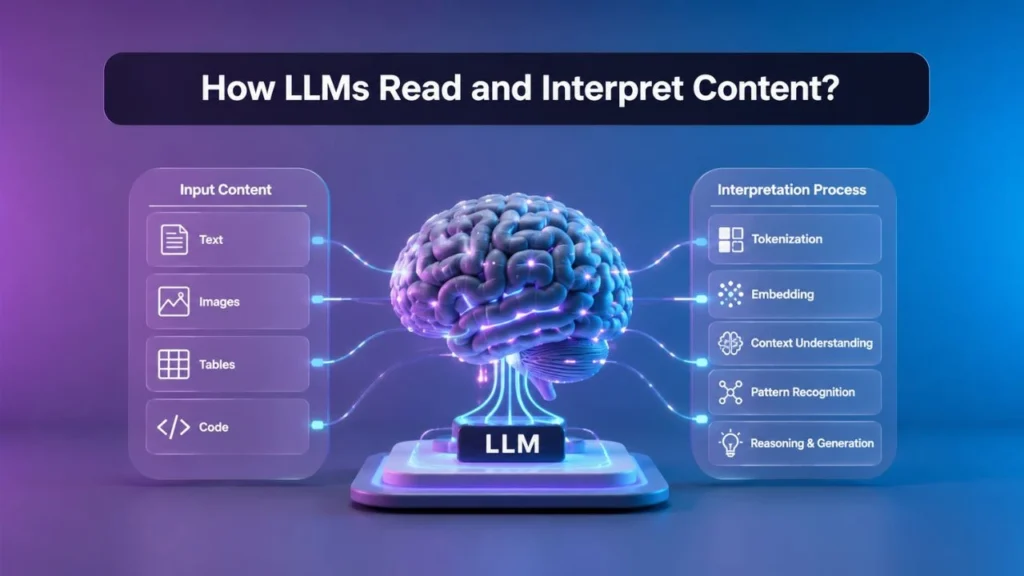
AI systems analyze content differently from traditional crawlers. They look for:
- Clear topic coverage
- Contextual depth
- Natural language flow
- Related entities
- Question based formatting
- Informational completeness
They also prefer content with logical organization.
For example, structured heading hierarchies help AI models identify the relationship between topics and subtopics. Lists, tables, FAQs, and concise explanations improve extraction accuracy.
This does not mean your content should sound artificial. It simply means your content should communicate clearly.
Why Human First Content Still Wins?
Many websites make the mistake of optimizing only for algorithms. They overload pages with keywords, publish thin AI generated articles, and repeat phrases unnaturally.
This strategy rarely works long term.
Search engines and AI systems increasingly prioritize user satisfaction. If readers do not engage with your content, rankings often decline over time.
Human centered content performs better because it creates:
- Better engagement signals
- Higher trust
- More shares and mentions
- Improved dwell time
- Greater brand authority
When readers genuinely find your content useful, AI systems are also more likely to recognize its value.
The strongest approach is simple:
- Write for humans first
- Structure for AI second
- Optimize for discoverability everywhere
Traditional SEO vs AI Era Optimization
The content landscape now requires more than traditional SEO tactics.
| Optimization Type | Traditional SEO | AI Search Optimization |
| Primary Goal | Rank pages | Become part of AI generated answers |
| Keyword Strategy | Exact matches | Semantic relevance |
| Search Queries | Short keywords | Conversational questions |
| Content Style | Search focused | Human conversational |
| Visibility | SERP listings | AI summaries and snippets |
| User Experience | Important | Essential |
| Entity Optimization | Limited | Critical |
| Intent Matching | Keyword based | Context based |
This does not mean traditional SEO is dead. Technical SEO, backlinks, page experience, and crawlability still matter. However, modern optimization must also support AI interpretation.
How to Create Content That AI Understands Naturally?
Use Conversational Language
AI systems are trained on natural human communication. That means content written in a conversational tone often performs better than stiff keyword heavy articles.
Instead of forcing awkward phrases repeatedly, use:
- Natural sentence structures
- Semantic keyword variations
- Question based phrasing
- Contextual explanations
This improves both readability and AI comprehension.
Voice search optimization also benefits from conversational writing because users speak differently than they type.
For example, users may search:
- “How does AI search rank content?”
- “What is the best way to optimize content for AI tools?”
- “Can content rank in AI chatbots and Google together?”
Content that directly answers these conversational questions is more likely to appear in voice and AI driven results.
Content Structure That Works for Humans and AI
Clear structure improves:
- Reader experience
- AI parsing accuracy
- Featured snippet opportunities
- Voice search visibility
Use Proper Heading Hierarchy
Organized headings help readers scan quickly while helping AI systems understand topic relationships.
A strong structure includes:
- H2 for major sections
- H3 for subtopics
- H4 for supporting details
This improves semantic organization.
Keep Paragraphs Short
Large blocks of text reduce readability. Short paragraphs improve:
- Mobile usability
- Voice search readability
- User engagement
- Information clarity
Add Lists and Tables
Structured formatting helps AI systems extract information accurately.
For example:
| Content Element | Why It Helps |
| Bullet Points | Easier scanning |
| FAQs | Better question matching |
| Tables | Improved comparison clarity |
| Definitions | Faster AI extraction |
| Step Lists | Voice search friendly |
Semantic SEO and Entity Optimization
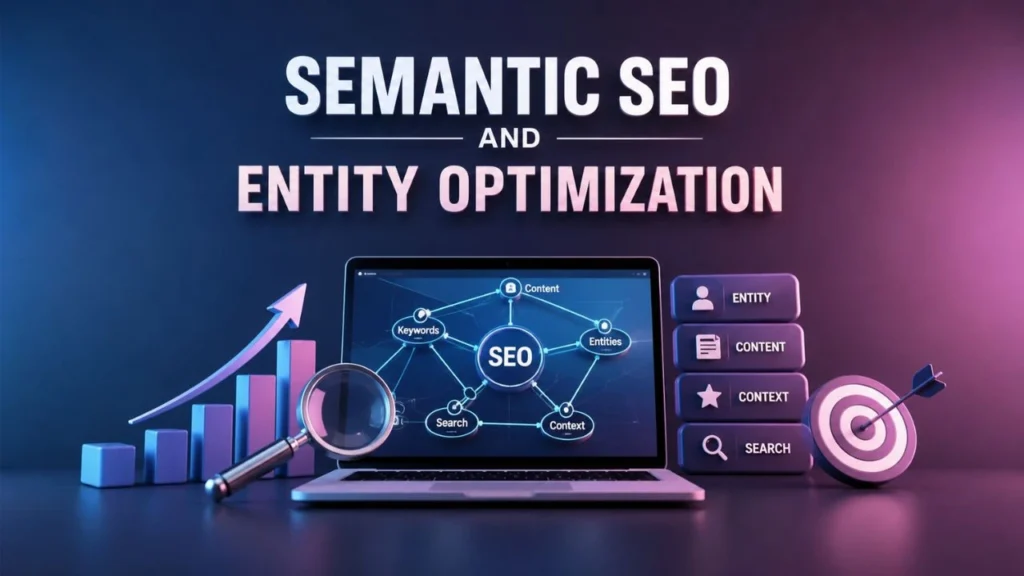
Modern search relies heavily on semantic understanding. Instead of focusing only on isolated keywords, AI systems analyze relationships between concepts, topics, and entities.
That means your content should naturally mention:
- Related concepts
- Supporting terminology
- Contextual explanations
- Associated topics
This creates topical depth.
How to Build Topical Authority?
Topical authority grows when your content consistently covers related themes comprehensively.
You can strengthen authority through:
- Content clusters
- Internal linking
- Comprehensive topic coverage
- Consistent terminology
- Semantic relevance
If your website repeatedly publishes high quality resources around AI search, semantic SEO, and conversational optimization, AI systems begin associating your domain with expertise in those areas.
LLM-ready Content and GEO Services Explained
- The rise of generative search has created demand for LLM-ready content and GEO services.
- GEO stands for Generative Engine Optimization.
- While SEO focuses on ranking in search engines, GEO focuses on increasing visibility inside AI generated responses.
This includes optimization for:
- AI search assistants
- Conversational engines
- AI answer systems
- Generative summaries
- Voice assistants
Why GEO Matters?
AI systems increasingly summarize information directly for users. If your content is not structured clearly, AI engines may ignore it even if your traditional SEO is strong.
That is why LLM-ready content and GEO services are becoming increasingly important for modern brands.
Effective GEO strategies focus on:
- Conversational formatting
- Semantic clarity
- Entity optimization
- Structured data
- Question based content
- Trustworthy information
The goal is making your content easy for AI systems to understand, extract, and reference.
RAG in SEO for AI Search Rankings
- Another important development is RAG in SEO for AI search rankings.
- RAG stands for Retrieval Augmented Generation.
- These AI systems retrieve external information sources before generating responses. Instead of relying only on training data, they pull relevant content from trusted websites.
- This changes optimization strategies significantly.
Why RAG Matters for SEO?
With RAG in SEO for AI search rankings, authority and trust become even more important.
AI systems prefer:
- Accurate information
- Reliable sources
- Updated content
- Contextual completeness
- Strong topical authority
This means websites should focus on:
- Publishing original insights
- Maintaining freshness
- Structuring content clearly
- Supporting claims with context
- Building semantic authority
Thin generic content struggles in RAG driven environments because AI systems prioritize useful and trustworthy resources.
AI Chatbots vs Google Search Ranking
The discussion around AI chatbots vs Google search ranking is becoming more important as search behavior evolves.
Traditional Google rankings still matter because search engines continue driving large amounts of traffic. However, AI chatbots are changing how users consume information.
How AI Chatbots Discover Content?
AI chatbots prioritize:
- Conversational relevance
- Semantic understanding
- Contextual answers
- Structured formatting
- Informational clarity
How Google Search Still Evaluates Content?
Google still considers:
- Technical SEO
- Backlinks
- Page experience
- Crawlability
- Authority signals
The reality is that modern content strategies should support both systems.
AI Chatbots vs Google Search Ranking Comparison
| Factor | AI Chatbots | Google Search |
| Search Style | Conversational | Query based |
| Result Format | Generated answers | Ranked pages |
| Content Preference | Contextual explanations | Optimized authority |
| Query Type | Natural language | Mixed intent |
| Visibility Goal | AI inclusion | SERP ranking |
Understanding AI chatbots vs Google search ranking helps brands create hybrid optimization strategies instead of relying on outdated SEO alone.
Voice Search Optimization for AI Driven Discovery
Voice search continues growing because users prefer conversational interactions. People ask voice assistants complete questions instead of typing fragmented keywords.
For example:
- “What is writing for LLMs?”
- “How do I optimize content for AI search?”
- “Why is semantic SEO important?”
This means content should include:
- Conversational phrasing
- Direct answers
- Question based headings
- Concise explanations
Voice Search Best Practices
- Use natural language
- Write clearly and simply
- Include FAQ sections
- Optimize for featured snippets
- Answer questions directly
Voice optimization supports both AI search visibility and user accessibility.
Technical SEO Still Matters
Even in AI driven search ecosystems, technical SEO remains critical.
AI systems still depend on accessible and crawlable websites.
Important Technical Factors
Structured Data
Schema markup helps AI systems understand:
- Articles
- FAQs
- Organizations
- Reviews
- Authors
Mobile Optimization
Most AI and voice searches happen on mobile devices.
Fast Loading Speed
Slow pages reduce engagement and visibility.
Internal Linking
Internal links strengthen contextual understanding and topical relationships.
Common Mistakes When Writing for LLMs
Many brands misunderstand modern optimization.
Keyword Stuffing
- Overusing keywords makes content unreadable.
- Instead of repeating phrases unnaturally, focus on contextual relevance.
Publishing Generic AI Content
Thin AI generated articles often lack:
- Originality
- Depth
- Human engagement
- Trust signals
Ignoring Readability
Dense paragraphs and robotic phrasing reduce user satisfaction quickly.
Chasing Algorithms Instead of Helping Readers
The best content solves real problems clearly.
Search engines and AI systems increasingly reward genuinely useful content.
Best Practices for Writing for LLMs Without Losing Human Readers
Successful content balances:
- Human readability
- AI accessibility
- Search optimization
- Conversational clarity
Focus on Clarity
Clear explanations improve comprehension for both readers and AI systems.
Build Contextual Depth
Cover topics comprehensively rather than superficially.
Maintain Conversational Tone
Use pronouns and natural phrasing to keep the content engaging.
Optimize for Multiple Discovery Channels
Modern content should support:
- Traditional search engines
- AI assistants
- Voice search
- Generative engines
- Conversational interfaces
Keep Updating Content
Freshness matters more in AI driven environments. Updated content often performs better in both search and AI systems.
Case Study: How AI Optimized Human First Content Increased Search Visibility
A mid sized informational website in the digital marketing niche noticed a steady decline in organic engagement despite publishing content regularly. Most of their articles were optimized heavily for traditional SEO, but they struggled to gain visibility in AI generated search summaries and conversational search tools.
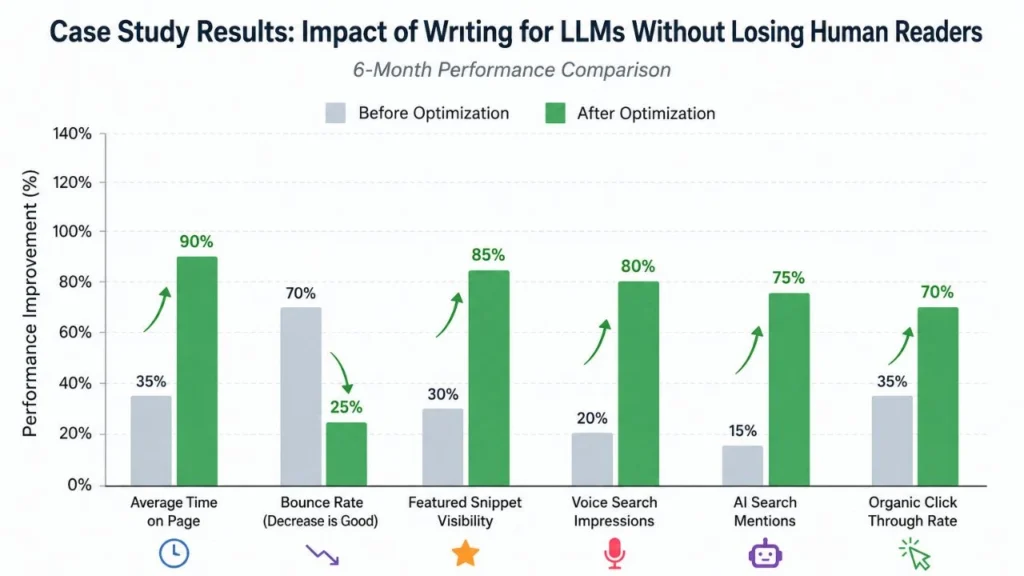
The website decided to rebuild its content strategy around writing for LLMs while maintaining a strong focus on human readability.
Challenges Faced
Before updating the strategy, the website experienced:
- Low engagement time
- High bounce rates
- Poor visibility in conversational search queries
- Weak featured snippet performance
- Limited voice search traffic
The existing articles relied heavily on:
- Exact match keyword repetition
- Long dense paragraphs
- Minimal semantic context
- Weak heading structure
- Generic AI generated wording
Although some pages ranked moderately on SERPs, they failed to appear consistently in AI driven search experiences.
Strategy Implemented
The editorial team redesigned their content approach using a hybrid optimization model focused on:
- Human readability
- Semantic SEO
- GEO optimization
- Voice search structure
- Conversational formatting
Key Changes Made
1. Improved Content Structure
The articles were rewritten with:
- Clear H2 and H3 hierarchy
- Short paragraphs
- FAQ sections
- Tables and bullet points
- Direct question based headings
This made the content easier for both readers and AI systems to process.
2. Focused on LLM-ready Content and GEO Services Principles
The team optimized content using strategies aligned with LLM-ready content and GEO services:
- Context rich explanations
- Conversational language
- Entity optimization
- Semantic topic coverage
- Natural keyword placement
Instead of repeating keywords excessively, they used related terminology and contextual phrases throughout the articles.
3. Applied RAG Focused Optimization
To support RAG in SEO for AI search rankings, the website:
- Updated outdated statistics
- Added factual clarity
- Expanded topical depth
- Improved internal linking
- Strengthened informational completeness
This helped AI systems retrieve more trustworthy contextual information from the website.
4. Optimized for AI Chatbots vs Google Search Ranking
The content strategy also addressed differences between AI chatbots vs Google search ranking by:
- Maintaining technical SEO standards
- Improving readability for conversational extraction
- Structuring answers clearly
- Supporting both SERP and AI visibility
The content became easier for AI systems to summarize while still performing well in traditional rankings.
Results After Six Months
After implementing the updated strategy, the website observed measurable improvements.
| Performance Metric | Before Optimization | After Optimization |
|---|---|---|
| Average Time on Page | Low | Significantly Improved |
| Bounce Rate | High | Reduced |
| Featured Snippet Visibility | Limited | Increased |
| Voice Search Impressions | Minimal | Noticeably Higher |
| AI Search Mentions | Rare | Frequently Appearing |
| Organic Click Through Rate | Moderate | Improved |
The website also noticed stronger engagement from users arriving through conversational search queries.
Key Takeaways From the Case Study
This case study demonstrates that modern optimization is no longer only about ranking pages with keywords.
Success increasingly depends on balancing:
- Human readability
- Semantic structure
- AI accessibility
- Contextual relevance
- Conversational clarity
The website achieved better visibility because it focused on creating genuinely useful content rather than writing only for algorithms.
The biggest lesson was simple:
Content optimized for AI should still feel natural, trustworthy, and engaging for real people.
The Future of Content Optimization
The future of digital visibility belongs to hybrid optimization strategies. Websites that only focus on old SEO tactics may struggle as AI driven discovery expands. At the same time, websites that ignore human readers while chasing AI optimization risk losing trust and engagement.
The strongest strategy combines:
- SEO
- GEO
- AEO
- Voice search optimization
- Semantic structuring
- Human centered communication
That is the real future of writing for LLMs.
Content should not sound robotic just because it is optimized for AI systems. The goal is creating useful, trustworthy, conversational, and structured information that both humans and AI engines can understand easily.
When you balance readability with semantic optimization, your content becomes more likely to:
- Rank on SERPs
- Appear in AI generated summaries
- Surface in voice search
- Gain visibility in conversational search tools
- Build long term topical authority
Conclusion
Search is entering a new phase where visibility depends on more than traditional SEO alone. Content is now being evaluated not just by search engine crawlers, but also by AI models, conversational engines, and voice assistants that aim to understand meaning, intent, and context.
That is why writing for LLMs is no longer optional for brands that want sustainable online visibility.
At the same time, readers still expect content that feels human, informative, and easy to understand. If your article sounds overly optimized or robotic, people disengage quickly. Modern content success comes from balancing semantic optimization with genuine communication.
Frequently Asked Questions
01. What is writing for LLMs?
Writing for LLMs means creating content that is easy for Large Language Models to understand, interpret, and reference while still remaining useful and engaging for human readers.
02. Why is conversational content important for AI search?
AI systems process natural language and conversational intent more effectively than robotic keyword heavy writing.
03. What are LLM-ready content and GEO services?
LLM-ready content and GEO services focus on optimizing content for generative AI engines and conversational search systems.
04. How does RAG in SEO for AI search rankings work?
RAG in SEO for AI search rankings involves AI systems retrieving external information from trusted websites before generating responses.
05. How is AI chatbots vs Google search ranking different?
The difference between AI chatbots vs Google search ranking lies in how information is delivered. Google ranks pages, while AI chatbots generate conversational summaries using contextual understanding.
06. Why is voice search optimization important?
Voice search optimization improves visibility for conversational queries asked through AI assistants and smart devices.
07. Can content rank in both AI search and traditional SERPs?
Yes. Content that combines readability, semantic depth, structured formatting, and strong SEO fundamentals can perform across both environments.