Search behavior is changing faster than ever. People no longer type only short keywords into search engines. Today, users ask complete questions, speak naturally to voice assistants, and interact directly with AI tools like chatbots and AI powered search engines. Because of this shift, businesses and marketers must rethink how they create content.
This is where Conversational Keywords become important.
Modern search engines now focus heavily on context, intent, and natural communication. Whether someone searches through Google, speaks to Siri, asks Alexa for recommendations, or uses AI chatbots for answers, search systems are becoming smarter at understanding human conversations. That means websites using natural and human friendly language have a stronger chance of visibility across traditional search engines, AI platforms, and voice search devices.
If you want your content to succeed in modern digital marketing, you need to optimize not only for Google rankings but also for AI search queries, conversational search phrases, and voice driven interactions. This approach helps your content remain discoverable in multiple search environments.
In this guide, you will learn how to use Conversational Keywords effectively, improve semantic relevance, align content with user intent, and strengthen your visibility across AI driven search systems.
Table of Contents
Why Search Is Changing in the AI Era?
Search engines have evolved from simple keyword matching systems into advanced contextual understanding platforms. Earlier, users searched with phrases like:
- “best SEO agency”
- “content marketing tips”
- “PPC service”
Now people search differently. They ask:
- “Which SEO strategy works best for local businesses?”
- “How can content marketing increase organic traffic?”
- “What is the best way to improve ad conversions?”
These are examples of human language search terms that sound more natural and conversational.
AI systems and modern search engines now prioritize understanding intent instead of only matching keywords. This shift has made natural language keywords and search intent phrases essential for modern SEO success.
At the same time, voice search usage continues to grow rapidly. Users speak differently than they type, which is why search engines now process conversational patterns more intelligently.
This is exactly why businesses must adapt their content strategies for:
- AI search queries
- conversational search phrases
- NLP keywords
- semantic search optimization
- voice search optimization for Siri, Alexa and Google
The brands that adapt early will gain stronger visibility while others struggle to keep up with the changing search ecosystem.
Traditional SEO vs Conversational SEO
| Traditional SEO | Conversational SEO |
| Focuses on short keywords | Focuses on natural questions |
| Exact keyword repetition | Human friendly language |
| Search engine focused | User experience focused |
| Limited context | Context aware optimization |
| Primarily text searches | AI and voice search compatible |
| Keyword density heavy | Intent based optimization |
| Static search patterns | Dynamic conversational interactions |
What Are Conversational Keywords?
Conversational Keywords are search phrases that mimic how people naturally speak and ask questions in real life. Instead of targeting robotic keyword structures, conversational optimization focuses on natural communication.
| Traditional Keyword | Conversational Keyword |
| digital marketing agency | Which digital marketing agency helps small businesses grow? |
| SEO services | How do SEO services improve rankings? |
| local SEO | What is the best local SEO strategy for businesses? |
These conversational phrases work better because they align with how modern users interact with search systems and AI tools.
Today’s search engines analyze:
- context
- intent
- meaning
- semantic relationships
- conversational patterns
As a result, content optimized with Conversational Keywords often performs better across AI powered platforms.
Case Study: How a Digital Marketing Blog Improved AI Visibility With Conversational Keywords
A mid sized digital marketing blog publishing SEO and content marketing articles noticed a gradual decline in organic visibility for informational keywords. Even though the website was publishing optimized articles regularly, many pages were struggling to rank consistently on competitive SERPs and rarely appeared in AI generated search responses.
The website mainly relied on traditional SEO methods such as exact match keyword targeting and short tail keyword optimization. While this approach worked earlier, user behavior had already started shifting toward conversational and voice based searches.
The editorial team decided to test a more realistic and user focused strategy centered around Conversational Keywords, semantic search optimization, and intent driven content writing.
Initial Problems Identified
After conducting a content audit, several issues became clear.
| Problem | Impact on Performance |
| Overuse of exact match keywords | Content sounded robotic |
| Weak topical depth | Low semantic relevance |
| Limited conversational search phrases | Poor AI understanding |
| Minimal FAQ optimization | Weak voice search visibility |
| Short paragraphs without contextual coverage | Lower engagement time |
The team realized that their content was optimized mainly for old search behavior instead of modern AI search queries and natural language interactions.
Realistic Strategy Implemented
Instead of completely rewriting the entire website overnight, the team adopted gradual improvements over several months.
1. Updating Existing Content Instead of Publishing Only New Blogs
The first step was improving older articles already receiving impressions.
The content team:
- rewrote headings into question based formats
- added conversational search phrases naturally
- improved readability
- expanded topical explanations
For example, instead of using:
- “SEO Strategy Tips”
they used:
- “How Can SEO Strategies Improve Organic Traffic?”
This aligned better with human language search terms and voice search behavior.
2. Focusing on User Intent Instead of Keyword Density
Earlier, articles were heavily optimized around repetitive exact match keywords.
The new strategy focused more on:
- answering real user questions
- solving search intent clearly
- improving content flow
- adding contextual explanations
The writers started using:
- natural language keywords
- search intent phrases
- NLP keywords
in a more natural and conversational manner.
As a result, the articles became easier to read and more engaging for users.
3. Building Content Around Semantic Search Optimization
- The team realized that AI systems analyze topic relationships, not just individual keywords.
- Instead of discussing only one isolated topic, each article covered multiple connected concepts.
For example, a blog about Conversational Keywords also included:
- AI search queries
- predictive search queries
- conversational SEO and voice search services
- ranking in the AI era
- voice search optimization for Siri, Alexa and Google
This improved contextual relevance significantly.
4. Improving Content Structure for AI Readability
The blog also improved formatting across articles.
Changes included:
- shorter paragraphs
- FAQ sections
- tables
- H2 and H3 hierarchy
- direct answers below headings
- bullet points for readability
This made the content easier for both users and AI systems to process.
5. Optimizing for Voice Search Gradually
Instead of creating separate voice search pages, the website integrated voice search optimization naturally into existing content.
The team focused on:
- conversational wording
- long tail questions
- local intent phrases
- mobile readability
- concise answers
This helped improve visibility for voice search optimization for Siri, Alexa and Google over time.
Results Observed After 6 Months
The improvements were gradual rather than instant, which reflects how SEO realistically works.
After six months of consistent optimization, the blog observed noticeable changes.
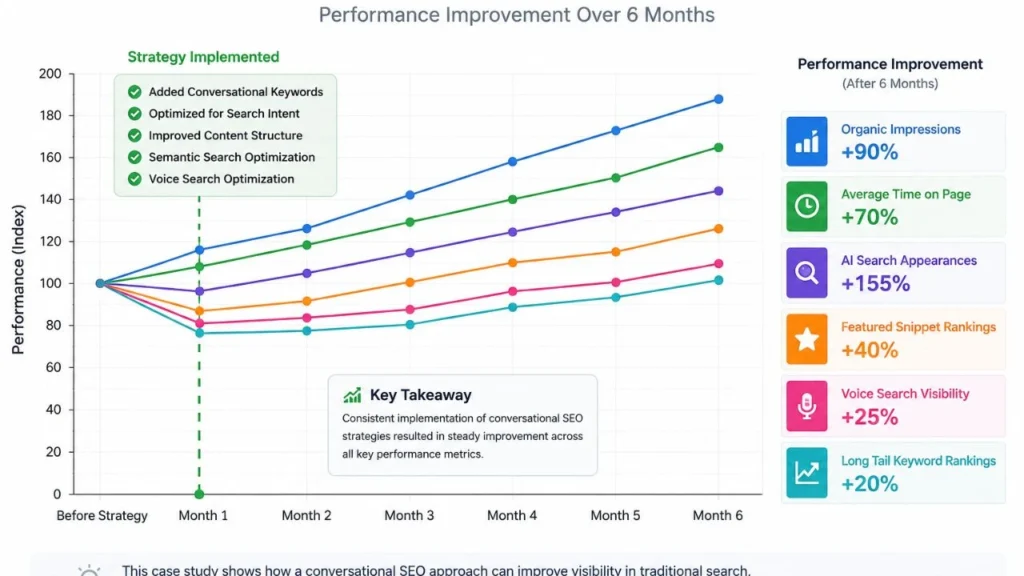
| Metric | Before Strategy | After 6 Months |
| Organic impressions | Moderate | Strong growth |
| Average time on page | Low | Improved steadily |
| Voice search visibility | Minimal | Noticeably higher |
| AI generated search appearances | Rare | More frequent |
| Featured snippet rankings | Limited | Increased |
| Long tail keyword rankings | Weak | Significant improvement |
One important observation was that conversational articles started attracting more diverse search traffic because the content matched how users naturally searched online.
Realistic Lessons From the Case Study
Conversational SEO Is a Long Term Strategy
The results did not appear within a few days. Search engines needed time to understand the updated content structure and semantic relevance.
Consistent optimization produced better outcomes over time.
Human Friendly Content Performs Better
The articles that sounded more natural achieved:
- better engagement
- lower bounce rates
- stronger visibility
AI systems increasingly reward readable and useful content.
Search Intent Matters More Than Exact Match Repetition
- Pages answering questions clearly outperformed pages overloaded with keywords.
- This shift became especially important for AI search queries and conversational search phrases.
Semantic Coverage Improves Authority
- Covering related topics comprehensively improved topical trust signals.
- This strengthened performance across both traditional SERPs and AI driven search systems.
Voice Search Optimization Is Becoming More Important
- The website noticed gradual traffic growth from conversational and mobile based searches.
- This reinforced the importance of optimizing for spoken language patterns.
Final Insight
This case study reflects a realistic approach to modern SEO.
There was no sudden overnight ranking increase or instant viral growth. Instead, the improvements came from:
- understanding changing search behavior
- creating genuinely useful content
- optimizing for natural communication
- improving semantic relevance
- focusing on user intent consistently
As AI powered search continues evolving, websites that prioritize Conversational Keywords, natural language optimization, and conversational user experiences will have a stronger chance of maintaining visibility across:
- traditional search engines
- AI chatbots
- voice assistants
- predictive search systems
The future of SEO is becoming increasingly conversational, contextual, and human focused.
Why Conversational Keywords Matter for AI Chatbot Ranking?
AI chatbots and intelligent search systems rely heavily on contextual understanding. They are designed to answer questions naturally rather than display pages based only on exact keyword matches.
This means your content should answer questions clearly and naturally.
When your blog includes:
- natural language keywords
- conversational search phrases
- search intent phrases
- NLP keywords
it becomes easier for AI systems to understand your content.
Modern AI systems analyze:
- topic depth
- semantic relevance
- content clarity
- contextual relationships
- conversational structure
This is where semantic search optimization becomes extremely important.
Instead of optimizing only for one keyword, semantic optimization helps search engines understand the complete meaning of your content.
For example, if your article discusses:
- AI search queries
- conversational SEO
- voice search
- user intent
- NLP
Google and AI systems recognize these topics as contextually related. This increases your chances of ranking in both traditional search and AI generated responses.
Understanding Search Intent in Conversational SEO
Search intent is the real purpose behind a search query. Modern search systems prioritize content that directly satisfies intent.
There are four main types of intent:
Informational Intent
Users want to learn something.
Example:
- “How do conversational keywords work?”
Commercial Intent
Users are comparing options.
Example:
- “Best conversational SEO tools”
Transactional Intent
Users are ready to take action.
Example:
- “Hire conversational SEO agency”
Navigational Intent
Users want a specific website or brand.
Example:
- “Google Search Console login”
Your content should align naturally with these search intent phrases. When intent alignment improves, your engagement metrics improve too, including:
- time on page
- click through rate
- user interaction
- AI recommendation probability
How AI Chatbots Understand Human Language?

AI chatbots use Natural Language Processing, commonly called NLP, to interpret and understand queries.
NLP helps machines analyze:
- sentence structure
- context
- relationships between words
- user intent
- conversational meaning
This is why NLP keywords matter in modern SEO.
Instead of focusing only on exact matches, search engines evaluate how naturally content addresses topics.
For example, if someone searches:
“Why is my website not ranking in AI search tools?”
Search engines now look for content discussing:
- AI visibility
- semantic optimization
- conversational search
- content relevance
- user intent
This is why content should include related terminology naturally throughout the article.
The Role of Semantic Search Optimization
- Semantic search optimization helps search engines understand meaning rather than isolated keywords.
- Earlier SEO strategies relied heavily on exact repetition. That approach is becoming less effective.
Today, search engines prefer:
- topic relevance
- contextual depth
- related entities
- intent satisfaction
- comprehensive coverage
If your blog discusses Conversational Keywords, it should also naturally include related concepts like:
- AI search queries
- natural language keywords
- conversational search phrases
- predictive search queries
- ranking in the AI era
This creates stronger topical relevance.
The more context your content provides, the easier it becomes for AI systems to trust and recommend your content.
How to Find Conversational Keywords?
Finding the right Conversational Keywords requires understanding how real people search.
Use Google Autocomplete
Google autocomplete suggestions reveal common conversational search behavior.
Start typing phrases like:
- “How to improve SEO”
- “Why is my website not ranking”
- “Best strategy for AI search”
These suggestions often reflect actual conversational search phrases.
Analyze People Also Ask Sections
Google’s People Also Ask feature provides excellent insight into user intent.
You can discover:
- common concerns
- question based queries
- long tail conversational phrases
This helps you build content that directly addresses audience needs.
Research Voice Search Queries
Voice search users speak naturally.
For example:
Typed search:
- “best SEO company Kolkata”
Voice search:
- “Which SEO company is best for local business growth?”
This difference is why voice search optimization for Siri, Alexa and Google is becoming increasingly important.
Study AI Search Queries
AI platforms are changing how people search for information. Users now ask AI tools complete questions instead of typing fragmented keywords.
For Examples,
- “How can I improve ranking in AI search?”
- “What are the best conversational SEO strategies?”
- “How do AI chatbots choose content?”
Optimizing for these patterns increases visibility across AI powered search tools.
Content Structure That Helps AI Understand Your Blog

- Content structure plays a major role in AI visibility.
- AI systems prefer organized and readable content.
Use Clear Headings
Question based headings improve understanding.
Examples:
- “How Does Conversational SEO Work?”
- “Why Are Natural Language Keywords Important?”
Write Direct Answers
- AI systems often extract concise answers for summaries and featured snippets.
- Provide clear responses early within sections.
Use Tables and Lists
- Structured formatting improves readability for both users and search engines.
- This also increases the likelihood of appearing in AI generated responses.
Create Topical Depth
- Avoid shallow content.
- Cover related concepts thoroughly to strengthen semantic authority.
How Voice Search Is Reshaping SEO?
Voice search continues to grow because users prefer convenience and speed. People use voice assistants while:
- driving
- shopping
- cooking
- traveling
- multitasking
This creates massive opportunities for conversational optimization.
Why Voice Search Queries Are Different
Voice searches are:
- longer
- more natural
- question focused
- location aware
That means your content should sound conversational rather than robotic.
Voice Search Optimization for Siri, Alexa and Google
Optimizing for voice assistants requires several adjustments.
Use Natural Language
Write the way people speak naturally.
Focus on Questions
Include:
- who
- what
- why
- when
- where
- how
based headings throughout your content.
Improve Mobile Experience
Most voice searches happen on mobile devices.
Ensure your website is:
- mobile friendly
- fast loading
- easy to navigate
Add FAQ Sections
- FAQ sections align perfectly with conversational search behavior.
- They also improve visibility for featured snippets and AI generated summaries.
Best Writing Practices for Ranking in the AI Era
- Modern SEO is no longer about stuffing keywords unnaturally.
- Success depends on creating content that feels useful, relevant, and human.
Write Like a Human
- Use conversational transitions and natural phrasing.
- Avoid robotic repetition.
Prioritize User Experience
Make content:
- easy to scan
- informative
- engaging
- actionable
Build Topical Authority
Comprehensive content performs better in AI systems because it demonstrates expertise.
Use Conversational Keywords Naturally
- Do not force keywords into every sentence.
- Use them where they fit contextually.
- This improves readability while still supporting SEO performance.
Technical SEO for Conversational Search
Technical optimization still matters greatly.
Implement Schema Markup
Schema helps search engines understand your content structure.
Useful schema types include:
- FAQ schema
- HowTo schema
- Article schema
Improve Core Web Vitals
- Fast websites provide better user experiences.
- AI systems increasingly consider engagement signals and usability.
Strengthen Internal Linking
- Internal links improve topical relationships across your website.
- This helps semantic understanding.
Optimize for Mobile
Mobile usability directly impacts:
- voice search performance
- engagement
- AI visibility
Common Mistakes to Avoid
Overusing Conversational Keywords
- Keyword stuffing still harms readability and trust.
- Use keywords naturally.
Ignoring User Intent
Ranking becomes difficult if content does not satisfy actual user needs.
Writing Only for Search Engines
- Human readability always matters most.
- Search engines increasingly reward user focused content.
Weak Semantic Coverage
- Thin content struggles in modern AI driven search systems.
- Comprehensive coverage improves authority.
Why Businesses Need Conversational SEO and Voice Search Services?
Businesses are realizing that traditional SEO alone is no longer enough.
Modern users interact through:
- AI chatbots
- voice assistants
- predictive search systems
- conversational interfaces
This has increased demand for:
- conversational SEO and voice search services
- semantic optimization strategies
- AI visibility consulting
- NLP driven content strategies
Companies investing early in conversational optimization gain stronger long term visibility.
Predictive Search Queries and the Future of Search
Predictive search systems attempt to understand user behavior before users finish typing.
Search engines now analyze:
- previous interactions
- behavioral patterns
- contextual relevance
- semantic relationships
This means future SEO strategies must become increasingly user focused. Content that anticipates questions and provides complete answers will perform better.
Ranking in the AI Era Requires a New SEO Mindset
- Search is no longer limited to blue links on search engine result pages. AI systems now summarize information directly for users.
- Voice assistants provide spoken answers instantly.
- Chatbots recommend content conversationally.
- Because of this evolution, ranking in the AI era requires businesses to think beyond traditional SEO tactics.
Success now depends on:
- contextual relevance
- semantic optimization
- conversational content
- user intent alignment
- voice search compatibility
Brands that adapt to this shift will gain stronger visibility across multiple digital channels.
Final Thoughts
The future of SEO is becoming increasingly conversational. Users want fast, accurate, and natural interactions. Search engines and AI systems are responding by prioritizing content that feels human, contextually relevant, and informative.
This is why Conversational Keywords are becoming essential for modern digital marketing strategies.
By using:
- natural language keywords
- conversational search phrases
- semantic search optimization
- AI search queries
- voice search optimization for Siri, Alexa and Google
you can position your content for stronger visibility across search engines, AI chatbots, and voice search platforms.
As AI driven discovery continues to grow, businesses that embrace conversational SEO strategies early will have a significant competitive advantage.
The goal is no longer just ranking on traditional SERPs. The real opportunity is becoming visible wherever users search, ask, speak, and interact online.
Frequently Asked Questions
What are Conversational Keywords?
Conversational Keywords are natural phrases and questions people use while speaking or searching online. They mimic real human conversation patterns.
Why are natural language keywords important?
Natural language keywords help search engines and AI systems understand content context and user intent more accurately.
What is semantic search optimization?
Semantic search optimization focuses on meaning and context rather than exact keyword repetition. It helps improve topical relevance.
How do AI search queries affect SEO?
AI search queries are more conversational and intent focused. Optimizing for them improves visibility in AI powered search systems.
Why is voice search optimization important?
Voice search continues to grow rapidly. Optimizing for voice search optimization for Siri, Alexa and Google improves discoverability across smart devices.
What are predictive search queries?
Predictive search queries are suggestions generated based on user behavior, intent, and search patterns.
How does conversational SEO help businesses?
Conversational SEO improves visibility across AI tools, voice search platforms, and modern search engines by aligning content with natural user behavior.