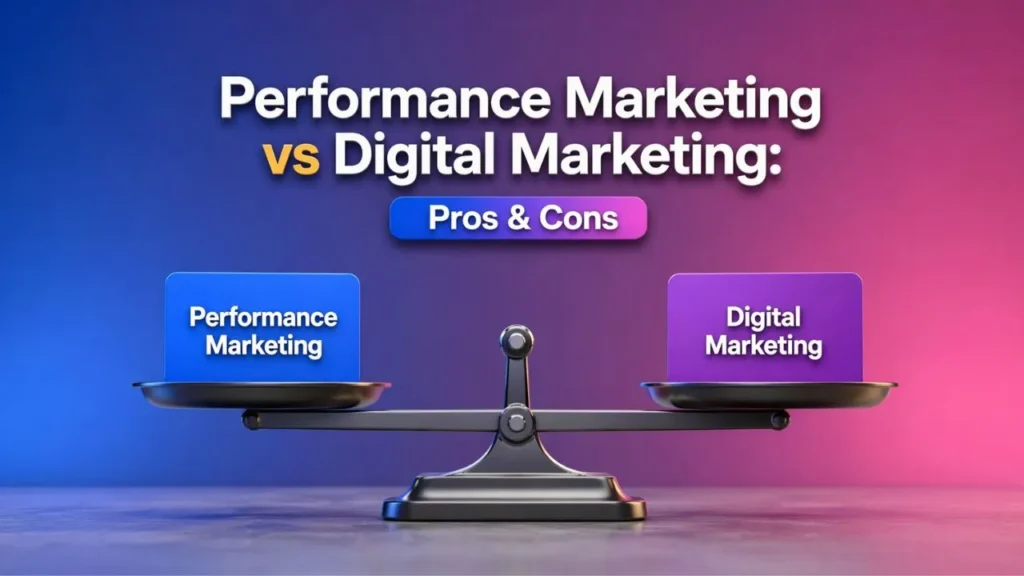
If you have ever felt confused about performance marketing vs digital marketing, you are not alone. Many businesses use these terms as if they mean the same thing, but they actually serve different purposes. When you understand performance marketing vs digital marketing properly, it becomes much easier to choose the right growth path for your brand.
At a practical level, digital marketing is the broader umbrella. It includes everything you do online to build visibility, trust, traffic, leads, and sales. Performance marketing, on the other hand, is more focused on measurable outcomes such as clicks, leads, app installs, or purchases. So when businesses compare performance marketing vs digital marketing, they are really asking a deeper question: do we need fast measurable results, long term brand growth, or a smart balance of both?
That is exactly what this guide will help you figure out. We will break down performance marketing vs digital marketing, explore the pros and cons of each approach, and show you how to use both in a way that improves reach, strengthens trust, and drives better results. If your goal is to improve Digital Marketing Performance, sharpen your strategy, and make your marketing spend work harder, this article is for you.
Table of Contents
What Is Digital Marketing?
Digital marketing is the complete ecosystem of online promotion. It includes SEO, content marketing, social media, email campaigns, paid ads, video marketing, Influencer Marketing, brand building, review management, and more. In simple words, digital marketing helps your business connect with people across different digital touchpoints.
When people search for performance marketing vs digital marketing, they often discover that digital marketing is the bigger picture. It focuses not only on immediate conversions but also on awareness, engagement, loyalty, and reputation. This matters because many buyers do not convert the first time they see your brand. They need time, trust, and repeated value.
A strong digital marketing strategy can include:
- Search engine optimization for organic visibility
- Social media content with support from an SMM Agency
- Email nurturing campaigns
- Video content and educational resources
- Review and trust building with an Online Reputation Management Agency
- Conversion focused landing pages
- Paid ad support when needed
Digital marketing is often the best choice when you want to build long term authority and sustainable visibility.
What Is Performance Marketing?
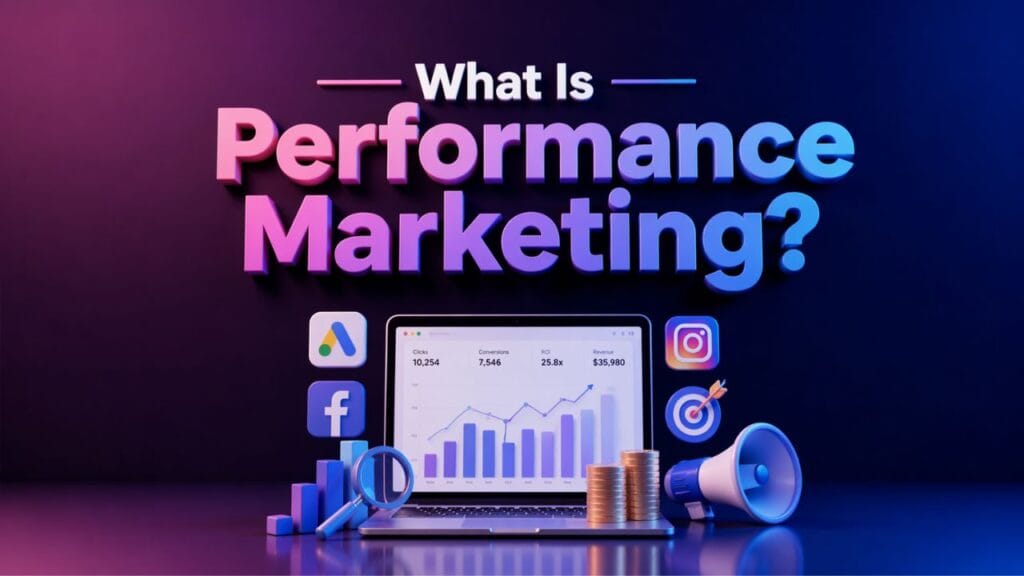
Performance Marketing is a result driven branch of digital marketing where businesses pay for specific actions. Those actions may include clicks, leads, sign ups, downloads, app installs, or sales. This is why the comparison of performance marketing vs digital marketing matters so much. One side is broad and brand focused, while the other is tightly linked to measurable outcomes.
The biggest strength of Performance Marketing is accountability. You can track campaign spend, cost per lead, return on ad spend, and conversion rate more closely. This makes it attractive for brands that want quick momentum and data backed decisions.
Common channels used in performance focused campaigns include:
- Search ads
- Paid social campaigns
- Display and retargeting ads
- Affiliate marketing
- Ecommerce promotions
- Conversion driven landing pages
- App install campaigns as part of a Mobile App Marketing Strategy
When businesses need fast lead generation, rapid testing, or short term sales lifts, they often lean toward Performance Marketing first.
Performance Marketing vs Digital Marketing: The Core Difference
The easiest way to understand performance marketing vs digital marketing is this: digital marketing is the full system, while performance marketing is one focused part of that system.
Digital marketing helps you build visibility, credibility, and market presence over time. Performance marketing helps you drive measurable actions faster. So the real discussion around performance marketing vs digital marketing is not about which one is universally better. It is about which one is better for your current goals.
Here are the major differences:
| Factor | Performance Marketing | Digital Marketing |
| Definition | Marketing focused on measurable actions like leads, sales, installs, or clicks | Broad online marketing umbrella covering awareness, engagement, leads, and sales |
| Main Goal | Immediate, trackable results | Long term brand growth plus lead generation |
| KPIs | CPA, CPL, ROAS, CAC, conversion rate | Traffic, rankings, engagement, brand searches, leads, conversions |
| Time to Results | Usually faster | Often slower but more sustainable |
| Best Channels | Paid ads, affiliates, retargeting, app campaigns | SEO, content, email, social, paid ads, ORM, influencer marketing |
| Budget Style | Spend tied closely to outcome targets | Budget spread across brand, content, paid, and lifecycle efforts |
| Strength | Strong accountability and measurable ROI | Stronger long term visibility and market presence |
| Weakness | Can become expensive without optimization | Can feel slower if expectations are too short term |
| Best For | Lead generation, ecommerce sales, app installs, rapid testing | Brand building, authority, trust, full funnel growth |
| Ideal Use Case | Businesses that want fast measurable outcomes | Businesses that want a balanced and scalable growth engine |
This table makes performance marketing vs digital marketing easier to evaluate because it shows how each approach serves a different role.
Pros of Performance Marketing
When you compare performance marketing vs digital marketing, one of the biggest advantages of performance marketing is speed. You can launch campaigns quickly, monitor results daily, and adjust based on data.
1. Clear and measurable ROI
You can see which ad, audience, or landing page is producing leads or sales. That kind of visibility helps improve marketing performance.
2. Faster testing and scaling
Performance marketing lets you test headlines, offers, creatives, and audiences at speed. If something works, you can scale it.
3. Strong for lead generation
If your business needs inquiries now, Performance Marketing is often the shortest path.
4. Easier to Optimize Conversion Rates
Since campaigns are highly measurable, you can Optimize Conversion Rates by improving landing pages, forms, calls to action, audience targeting, and creative alignment.
5. Useful for app and ecommerce campaigns
It is especially effective when you need a focused Mobile App Marketing Strategy or product driven sales campaigns.
Cons of Performance Marketing
Even though performance marketing vs digital marketing often sounds like a battle between speed and scale, performance marketing has limitations.
1. Costs can rise fast
Paid campaigns can become expensive, especially in competitive markets.
2. It may not build deep brand trust on its own
People may click an ad, but trust is usually built through consistent content, reviews, visibility, and brand experience.
3. Results can stop when ad spend stops
If you rely only on paid performance campaigns, your growth may slow the moment budgets are reduced.
4. It needs continuous attention
Campaigns need regular optimization. Without strong tracking and strategy, results can decline quickly.
Pros of Digital Marketing
Now let us look at the other side of performance marketing vs digital marketing. Digital marketing is broader and often more durable.
1. Builds long term visibility
SEO, helpful content, social presence, and review signals can keep driving visibility even after the initial effort.
2. Supports the full customer journey
Digital marketing does not only focus on clicks. It supports awareness, education, trust, conversion, and retention.
3. Strengthens brand authority
When your content is useful and your online reputation is strong, people are more likely to choose you.
4. Improves audience trust through Online Presence Analysis
A good Online Presence Analysis helps you understand how your brand appears across search, social, review sites, and local listings. That clarity helps you find gaps and build a stronger digital footprint.
5. Works well with reputation and social signals
An Online Reputation Management Agency can help strengthen trust, while social content and influencer activity can expand reach and credibility.
Cons of Digital Marketing
The broader nature of digital marketing also brings some challenges.
1. Slower results in some channels
SEO and content marketing usually take time before they show strong returns.
2. Attribution can be harder
When multiple channels influence one sale, it can be difficult to measure the exact impact of each step.
3. Requires consistency
Digital marketing works best when messaging, content, SEO, social, and user experience all support each other.
4. Can lose focus without strategy
If you try to do everything at once, your efforts can become scattered.
Which One Should You Choose?
The answer to performance marketing vs digital marketing depends on your business stage, goals, and timeline.
Choose performance marketing when:
- You need leads or sales quickly
- You have a clear offer and a conversion focused landing page
- You want measurable acquisition data
- You are launching a product, service, or app
- You need quick testing before scaling
Choose digital marketing when:
- You want long term visibility
- You need stronger brand authority
- Your business relies on trust and reputation
- You want organic traffic and sustainable growth
- You want to build a stronger presence across search and social
For many businesses, the smartest answer to performance marketing vs digital marketing is not one or the other. It is both.
Why a Hybrid Strategy Often Works Best?
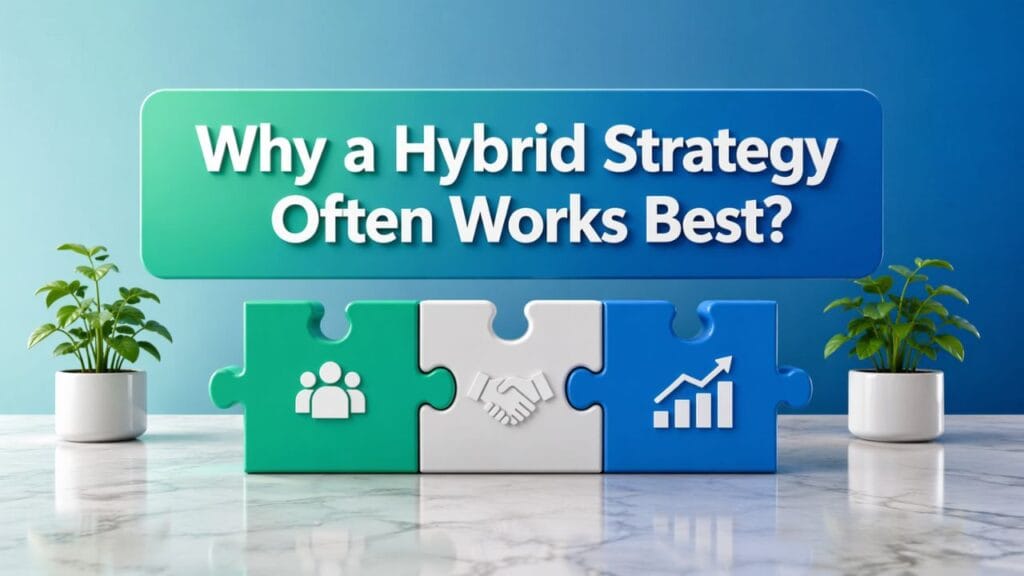
The most effective brands do not force a rigid choice between performance marketing vs digital marketing. They combine them.
For example, your business can use SEO and content to build long term visibility while also using paid campaigns to capture immediate demand. You can use social media for brand consistency, retargeting for conversions, and reputation management to strengthen decision making. You can work with an SMM Agency to improve content distribution and audience engagement, then add Influencer Marketing where it supports trust and reach.
This hybrid model gives you:
- Faster lead generation
- Stronger brand recall
- Better conversion support
- More stable growth across channels
- Improved Digital Marketing Performance over time
If you are a local business, service provider, ecommerce brand, or startup, this combined approach is usually the most practical path.
What About Local and Regional Businesses?
For businesses targeting location based markets, the conversation around performance marketing vs digital marketing becomes even more interesting. Local brands often need immediate inquiries, but they also need trust, reviews, visibility, and relevance.
That is where broader digital strategy supports paid campaigns. Many businesses exploring performance marketing services in Kolkata are not just looking for ad management. They also need landing page improvement, better content, stronger reviews, and consistent messaging. In many cases, performance marketing services in Kolkata deliver the best outcomes when they are supported by SEO, local optimization, and reputation management.
So if you are thinking about performance marketing vs digital marketing for a local business, do not separate speed from trust. Build both.
How to Measure Success the Right Way?

No matter which side of performance marketing vs digital marketing you lean toward, success depends on measurement.
Track these metrics for performance marketing:
- Cost per lead
- Return on ad spend
- Conversion rate
- Customer acquisition cost
- Revenue per campaign
Track these metrics for digital marketing:
- Organic traffic growth
- Keyword visibility
- Engagement quality
- Brand search increase
- Lead quality
- Review sentiment and trust signals
The best strategy does not just chase clicks. It improves real business outcomes.
Final Thoughts
When you look at performance marketing vs digital marketing, the real winner is the strategy that matches your goals. Performance marketing is excellent when you need measurable outcomes fast. Digital marketing is stronger when you want lasting visibility, authority, and brand trust. Together, they can create a smarter, more resilient growth engine.
If your business only focuses on short term wins, you may miss long term brand strength. If you only focus on brand building, you may delay valuable revenue opportunities. That is why the best way to approach performance marketing vs digital marketing is with balance, clarity, and a plan built around your actual objectives.
Get Free Strategy Call and find out which mix of performance marketing, SEO, content, social media, and reputation building is right for your business.
FAQs
What is the difference between performance marketing and digital marketing?
The difference between performance marketing vs digital marketing is that digital marketing covers the full online growth ecosystem, while performance marketing focuses on measurable actions like leads, clicks, installs, or sales.
Is performance marketing part of digital marketing?
Yes. Performance marketing is a part of digital marketing. It is a specialized approach within the broader digital marketing ecosystem.
Which is better for small businesses?
It depends on your goal. If you need quick leads, performance marketing may help faster. If you want long term trust and visibility, digital marketing is essential. Most small businesses benefit from both.
Can performance marketing improve conversions quickly?
Yes. Since campaigns are tracked closely, it is easier to identify what works and improve results faster.
Why is digital marketing important for long term growth?
Digital marketing helps build brand awareness, organic traffic, trust, credibility, and customer relationships over time.
Should I choose only one approach?
Not necessarily. In many cases, the best solution is a hybrid strategy that combines quick wins with long term growth.