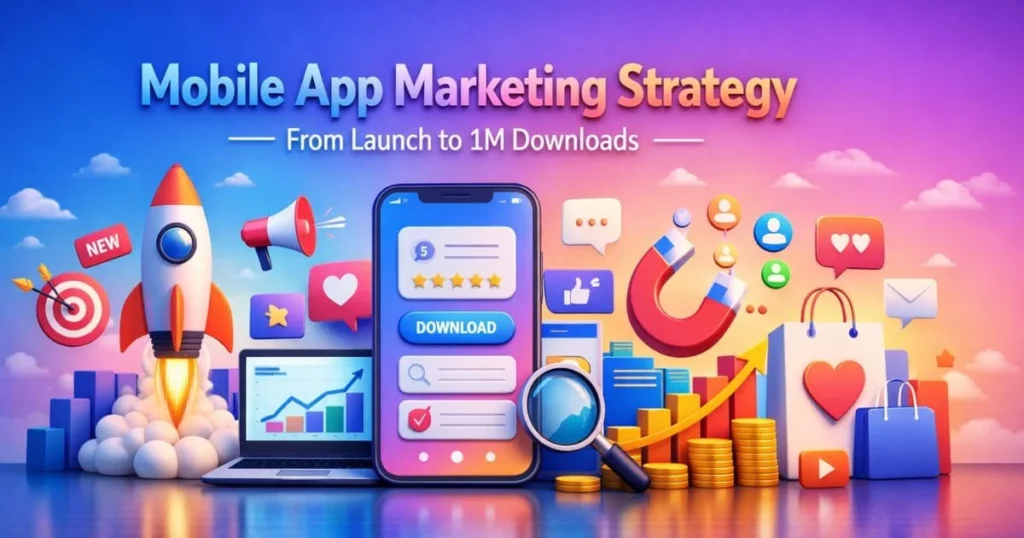
A strong mobile app marketing strategy can help an app move from early visibility to steady growth without relying on luck. Many app owners focus only on launch day traffic, but real growth usually comes from a clear plan that connects discovery, installs, activation, retention, and user trust. If your goal is to build momentum and work toward one million downloads, you need a mobile app marketing strategy that supports every stage of the user journey.
The best mobile app marketing strategy does more than drive installs. It helps the right users find your app, understand its value, try it with confidence, and come back again. This is where App Store Optimization, content marketing, paid promotion, reviews, onboarding, and return visit campaigns all begin to work together.
A useful mobile app marketing strategy should also fit the way people search today. People ask search engines direct questions. They use voice search on mobile devices. They compare options inside AI tools. They expect quick answers, clear benefits, and a smooth path from discovery to action. That means your blog content, app listing, landing pages, and campaign assets need to speak clearly and answer intent fast.
Table of Contents
What Is a Mobile App Marketing Strategy
A mobile app marketing strategy is a complete plan for attracting the right audience, guiding them to install the app, and helping them stay active over time. It starts before launch and continues long after the app becomes available in the App Store or Google Play.
What this strategy usually includes
• Audience research
• App positioning
• App Store Optimization
• Content creation
• Paid promotion
• Review generation
• Onboarding improvement
• Return visit campaigns
• Performance tracking
A mobile app marketing strategy should be practical, measurable, and easy to adapt. It should not focus only on downloads. It should also improve conversion, trust, and user value.
Why a Mobile App Marketing Strategy Matters From Day One
A mobile app marketing strategy matters because the app market is crowded, user attention is limited, and install decisions happen quickly. If your message is vague or your app page fails to build trust, many users will leave before they install.
A strong approach helps you:
• Reach people with real intent
• Improve App Store visibility
• Increase install conversion
• Build stronger user retention
• Grow ratings and reviews
• Reduce wasted ad spend
• Create stable organic growth
This is also where many businesses connect app promotion with wider digital marketing services. When search content, landing pages, app store assets, paid promotion, and email all support the same message, growth usually becomes more consistent.
Pre Launch Planning That Supports Future Growth
The smartest mobile app marketing strategy begins before the app goes live. Pre launch work shapes your messaging, keyword targeting, creative direction, and audience focus.
Research audience intent before launch
Start with the questions your audience is already asking. What problem are they trying to solve? What words do they use in search? What features matter most to them? These answers help you write better titles, descriptions, creatives, and blog content.
You should review:
• Search intent
• User pain points
• Competing apps
• Category trends
• Device behavior
• Regional demand
• Language preferences
Build clear app positioning
Strong positioning tells users what the app does, who it helps, and why it deserves attention. This message should stay consistent across the app title, subtitle, screenshots, descriptions, landing pages, and content.
Prepare launch assets early
A solid mobile app marketing strategy needs assets ready before release.
Useful launch assets include:
• App icon
• Screenshot set
• Preview video
• Keyword list
• Landing page
• Email sign up page
• Press notes
• Social media creative
If you already use social media marketing services, your launch assets can also support short video posts, teaser campaigns, feature highlights, and early awareness content.
App Store Optimization as the Core of Organic Growth
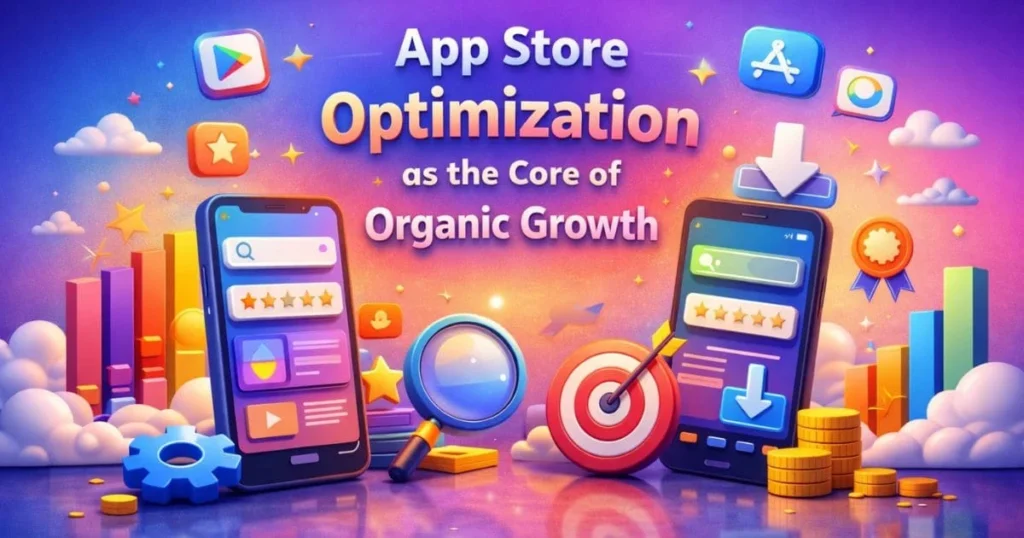
App Store Optimization is one of the most important parts of a mobile app marketing strategy. It improves visibility inside app marketplaces and also helps improve conversion when people reach your listing.
Why App Store Optimization matters
Users often decide within seconds whether an app looks relevant and trustworthy. Your title, visual assets, rating quality, and copy all shape that decision.
A well built App Store Optimization process supports:
• Better keyword targeting
• Higher listing visibility
• More qualified traffic
• Stronger install conversion
• Better understanding of user intent
Key elements of App Store Optimization
A strong listing should focus on:
• App title
• Subtitle or short description
• Keyword relevance
• Long description quality
• Screenshot clarity
• Icon appeal
• Category relevance
• Ratings and reviews
The mobile app marketing strategy should align the app listing with the same search intent you target through blog content and landing pages. This creates stronger topic relevance across your brand presence.
App Store copy should answer real questions
Users want fast answers such as:
• What does this app do
• Who is it for
• How is it useful
• Why should I trust it
• What makes it easier than other options
This question driven approach is useful for SEO, GEO services, AEO services, and voice search because it mirrors the way users ask and compare.
Content Marketing That Supports App Growth
Content remains a strong support channel for any mobile app marketing strategy because users often search for answers before they search for an app name. Informative blog posts and content marketing services can bring in people who are still learning, comparing, or looking for solutions.
Use blog content to attract problem aware users
A blog can rank for informational intent and guide users toward the app when the topic is a strong fit. This helps support app discovery beyond the app stores.
Useful blog topics include:
• How to solve a specific problem with mobile tools
• Common mistakes users make in your category
• Feature comparison topics
• Setup and onboarding guidance
• Industry tips and trends
This is where strong SEO services can help. Some users even search for SEO srvices when they are looking for the same support. Search focused blog content can attract users early in the journey and pass relevance to your app landing pages and service pages.
Connect content with app actions
Each article should guide readers toward one next step. That step may be visiting your app page, reading a feature page, joining a waitlist, or requesting a strategy session.
A content driven mobile app marketing strategy works even better when the article includes:
• Direct answers near the top
• Clear section headings
• Natural keyword use
• Helpful tables
• Common question sections
• Clear calls to action
Acquisition Channels That Help Increase Downloads
A mobile app marketing strategy becomes more effective when you use multiple channels with a single message, including a clear Google Ads setup strategy. Each channel should support a different part of the journey.
Organic search
Search can attract high intent users who already know the problem they want to solve. Strong search visibility also supports AI search tools because they often prefer pages that explain topics clearly and completely, especially when readers are evaluating a PPC vs SEO ROI comparison.
Paid promotion
Paid campaigns can help validate creatives, messaging, and audience segments. They are useful for speed, but they should not carry the whole strategy on their own.
Creator and community promotion
Communities can bring more trust than broad promotion alone. If the app serves a clear niche, discussion led visibility can bring qualified installs.
Email and return user channels
Email remains helpful for waitlists, launch alerts, feature updates, and return user messaging. It is especially effective when linked to onboarding goals.
Social platforms
Social channels help people see the app in action. This is one reason many brands combine app launch plans with social media marketing services. Clear product clips, short explainers, review snippets, and feature highlights can all support discovery.
How to Improve Conversion After Users Reach the App Page
Getting traffic is only part of the work. A mobile app marketing strategy must also improve conversion once users arrive at the app page or landing page.
Improve first impression with stronger visuals
Screenshots should not be generic. Each image should explain a core benefit, a user outcome, or a standout feature. Visual order matters because users scan quickly.
Write copy that is clear and benefit focused
The best app copy answers intent without sounding forced. Keep it simple. Focus on outcomes and usability. Remove vague claims that do not help users decide.
Build trust through ratings and reviews
People often read reviews before they install. A review strategy should be part of the mobile app marketing strategy from the beginning. Ask for feedback after the user receives value, not before.
Reduce friction in onboarding
If users install but do not activate, growth slows. Better onboarding and conversion optimization services can improve retention and review sentiment.
Useful onboarding checks include:
• Is sign up simple
• Is the first action obvious
• Is value visible early
• Are permissions requested at the right time
• Is the experience easy on smaller screens
The Role of Retention in Reaching One Million Downloads
Many app owners chase installs and ignore what happens after. A complete mobile app marketing strategy treats retention as a growth driver, not just a product metric.
When users return, review the app, share it, and recommend it, growth becomes more efficient. Return users can also improve paid campaign results because higher quality users often lead to better long term value.
Retention tactics that support stable growth
• Better first session experience
• Helpful push messages
• Timely feature education
• Personalised content inside the app
• Return visit campaigns
• Smooth deep linking from email and web pages
Brands that already invest in Local Seo services can also connect location based content with region specific app campaigns when local intent matters. This can be useful for apps that support bookings, store visits, service areas, or community activity.
Metrics Every Mobile App Marketing Strategy Should Track
A mobile app marketing strategy needs measurement at every stage. If you only track total downloads, you may miss weak conversion or poor retention.
Acquisition metrics
• Impressions
• Listing visits
• Install rate
• Cost per install
• Organic versus paid downloads
Activation metrics
• Sign up completion
• First key action
• Onboarding completion
• Early session depth
Retention metrics
• Day one retention
• Day seven retention
• Day thirty retention
• Session frequency
• Churn rate
Quality and revenue metrics
• Lifetime value
• Average revenue per user
• Review score trend
• Referral rate
• Return visit rate
| Stage | Primary goal | Key activities | KPIs to watch |
|---|---|---|---|
| Pre launch | Build market fit and demand | Research, positioning, store keyword planning, landing page, waitlist | Waitlist signups, landing page conversion, early audience interest |
| Launch | Maximize discoverability and installs | ASO, launch creatives, influencer outreach, email, paid campaigns | Impressions, install rate, CPI, rating volume |
| Growth | Improve acquisition efficiency | Content, SEO, ASO refresh, referral loops, paid optimization | Organic installs, channel conversion, CAC, activation rate |
| Retention | Turn installs into active users | Onboarding, deep linking, push, email marketing automation, review strategy | Day 1, Day 7, Day 30 retention, churn, LTV |
How Supporting Service Channels Can Strengthen App Growth
A mobile app marketing strategy often performs better when it is supported by related growth channels across the business.
Digital marketing services can connect your app campaigns with content, paid promotion, analytics, landing page improvement, and audience communication. This creates better consistency between what users search, what they read, and what they install.
SEO services can support ranking pages that explain the problems your app solves. This helps your site attract informational searches and channel those visitors toward the app.
Local Seo services may support city or service area campaigns for apps that depend on local demand, regional trust, or location based user actions.
Social media marketing services can strengthen app awareness, community discussion, product education, and repeat visibility across the customer journey.
A Practical Mobile App Marketing Strategy Framework
If you want a simple way to shape your growth plan, use this four phase framework.
Phase one discovery
Focus on keyword research, audience intent, App Store Optimization, and launch content. The goal is to make the app visible to the right audience.
Phase two conversion
Improve screenshots, copy, trust signals, and onboarding flow. The goal is to turn interest into quality installs and early activation.
Phase three retention
Improve push timing, feature education, deep links, and feedback loops. The goal is to turn installs into active users.
Phase four scale
Expand winning channels, test new creatives, improve referral paths, and strengthen content coverage. The goal is to grow without losing efficiency.
| Tactic | Helps downloads | Helps retention | Best used when |
|---|---|---|---|
| App store optimization services | High | Medium | Before launch and ongoing |
| Paid user acquisition | High | Low to Medium | Fast testing and scale |
| Deep linking | Medium | High | Multi channel journeys |
| Referral program | High | High | Apps with shareable value |
| Push notifications | Low | High | Re engagement and habit building |
| Content marketing | Medium | Medium | Long term organic growth |
| Ratings and review strategy | High | Medium | After strong user value moments |
Common Mistakes That Hurt App Growth
Even a promising app can struggle if the mobile app marketing strategy is incomplete or inconsistent.
Mistakes to avoid
• Launching without keyword research
• Ignoring App Store Optimization after release
• Using weak screenshots and unclear copy
• Sending all users to one generic page
• Asking for reviews before value is delivered
• Tracking installs but ignoring activation
• Spending on ads before fixing retention
• Publishing thin content that does not answer intent
A better mobile app marketing strategy treats every stage as connected. Discovery affects conversion. Conversion affects retention. Retention affects review quality. Review quality affects future growth.
FAQ
Q: What is a mobile app marketing strategy?
Ans: A mobile app marketing strategy is a plan for attracting the right users, increasing installs, improving activation, and growing retention over time.
Q: Why is App Store Optimization important?
Ans: App Store Optimization improves visibility and install conversion by making the listing more relevant, useful, and trustworthy.
Q: How can I increase app downloads organically?
You can improve organic growth through App Store Optimization, search focused content, review generation, clear app positioning, and stronger conversion assets.
Q: Which matters more, downloads or retention?
Ans: Both matter, but retention often decides whether growth remains efficient. High install volume with poor retention usually limits long term progress.
How do blog posts support app growth?
Ans: Blog posts can rank for user questions, attract problem aware visitors, and guide them toward the app through helpful and relevant content.
Q: Why should voice search and AI search matter for app marketing?
Ans: People now search with questions and expect fast answers. Clear headings, direct explanations, and useful structure help your content appear in search, AI tools, and voice driven results.
Conclusion
A successful mobile app marketing strategy is not built on one tactic. It comes from clear positioning, App Store Optimization, useful content, better conversion, stronger retention, and steady measurement. When each part supports the next, your app has a better chance to move from launch visibility to real scale.
If you want better results, focus on clarity, relevance, trust, and user value at every stage. That is what helps an app earn attention and keep it.