
When brands invest in creator partnerships, the biggest question is simple. Is the campaign actually delivering business value? That is where influencer marketing roi measurement becomes essential. Without a clear method, you may see likes, shares, and views, but still struggle to understand whether your campaign moved revenue, leads, trust, or long term brand growth.
Today, Influencer Marketing is no longer just about visibility. It sits inside a wider growth system that includes conversion tracking, brand search lift, audience trust, and full funnel performance. Strong influencer marketing roi measurement helps you connect creator activity to real outcomes so you can make better decisions, scale what works, and stop wasting budget on weak partnerships.
Table of Contents
What Is Influencer Marketing ROI Measurement?
At its core, influencer marketing roi measurement is the process of comparing what you spend on a campaign with what you gain from it. Those gains may include direct sales, qualified leads, demo bookings, app installs, subscriptions, branded search growth, or stronger audience trust.
A lot of marketers still reduce campaign analysis to engagement alone. That approach is incomplete. Proper influencer marketing roi measurement looks beyond surface numbers and asks whether the campaign created measurable business impact. In many cases, the return is not only immediate revenue. It can also include assisted conversions, better remarketing audiences, stronger customer perception, and improved conversion paths.
If someone asks, “How do you measure influencer campaign success?” the clearest answer is this: you measure cost, traffic quality, conversion value, assisted impact, and long term audience response together. That is what makes influencer marketing roi measurement useful instead of misleading.
Why Measuring Campaign Success Matters?
You cannot improve what you do not measure. That is why influencer marketing roi measurement matters for every brand, whether you are selling products, generating leads, or building authority in a niche market.
When you measure properly, you can:
- identify which creators bring qualified audiences
- compare campaign cost against real business outcomes
- improve creative direction for future campaigns
- allocate budget more confidently
- prove value to internal teams or clients
This is also where professional influencer marketing services can make a difference. A campaign may look strong on the surface but still underperform if the brand lacks attribution systems, landing page alignment, or strategic reporting. With the right Digital Strategy Consultation, you can connect creators to clear goals and avoid guessing what worked.
In other words, influencer marketing roi measurement is not just a reporting exercise. It is a decision making tool.
Set Clear Goals Before You Measure ROI
Before you track anything, decide what success actually means. Good influencer marketing roi measurement starts with a clear objective. If the goal is vague, your reporting will also be vague.
Awareness goals
If your campaign is built for brand visibility, watch for reach, impressions, brand mentions, search lift, video views, and share of voice. These numbers matter, but they should still connect to a bigger business purpose.
Engagement goals
If the campaign is designed to deepen interest, focus on comments, saves, shares, profile visits, click behavior, and Audience Retention and CTR. These indicators tell you whether the content made people pause and care.
Conversion goals
For performance campaigns, track leads, purchases, signups, cost per acquisition, revenue per creator, and assisted conversions. This is where influencer marketing roi measurement becomes especially important because it directly shapes future budget allocation.
Retention goals
Some campaigns are meant to build long term loyalty. In that case, measure repeat visits, returning users, email signups, community participation, and customer lifetime value trends.
Without goal clarity, even the best Influencer Marketing campaign can look confusing in reports.
Core Metrics for Influencer Marketing ROI Measurement
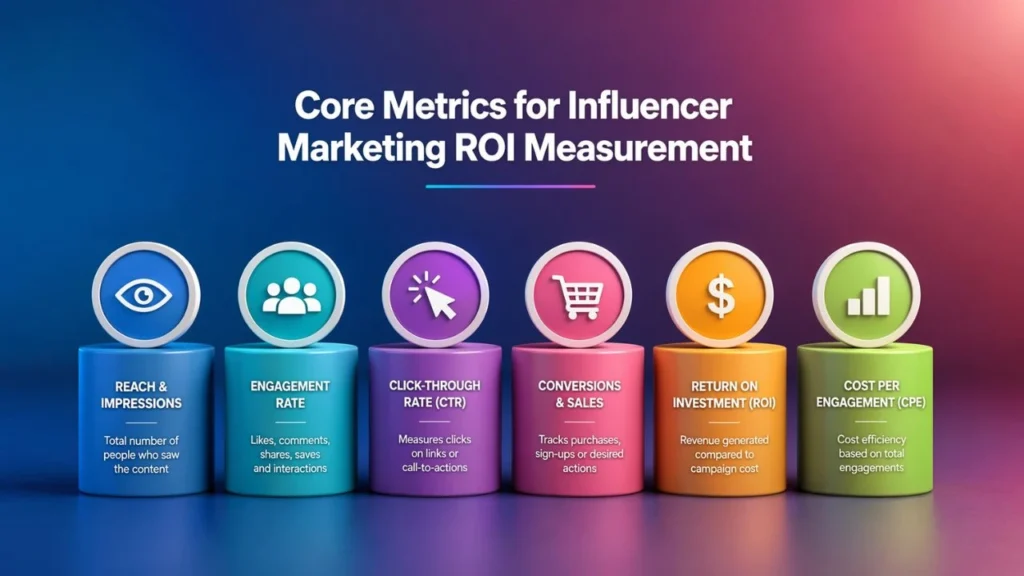
Strong influencer marketing roi measurement depends on choosing the right metrics. You do not need to track everything, but you do need to track what matters.
Cost metrics
Start with the basics:
- total creator fee
- content production cost
- gifting or product cost
- agency or management fee
- paid amplification cost
- cost per click
- cost per lead
- cost per acquisition
Engagement metrics
Engagement is still valuable when you read it properly. Look at:
- engagement rate
- comment quality
- saves
- shares
- sentiment
- click intent
Traffic metrics
This is where campaigns begin to show commercial value:
- landing page visits
- referral sessions
- engaged sessions
- time on page
- bounce rate
- returning users
Conversion metrics
Now you move into business outcomes:
- leads generated
- demo requests
- purchases
- pipeline contribution
- revenue
- assisted conversions
Content quality metrics
Many brands skip this, but it matters:
- watch time
- completion rate
- Audience Retention and CTR
- drop off points
- repeat views
When you combine these layers, influencer marketing roi measurement becomes far more reliable. You stop asking whether the post “performed well” and start asking whether it helped your business grow.
The Basic Formula for ROI
The standard formula is straightforward:
ROI = (Revenue from Campaign – Campaign Cost) / Campaign Cost × 100
That gives you a useful starting point, but real world influencer marketing roi measurement often requires a broader view.
For example, if a creator drives traffic today and the user converts through email next week, the campaign still influenced that sale. If your reporting only counts last click revenue, you may undervalue the campaign. That is why smart influencer marketing roi measurement often includes three layers:
Direct ROI
Revenue or leads that came straight from the campaign touchpoint.
Assisted ROI
Results influenced by the campaign but completed through another channel later.
Blended ROI
A fuller view that combines awareness, engagement, conversion, and long term value.
This matters even more for service businesses, higher ticket offers, and B2B campaigns where buyers rarely convert in one session.
How to Track Influencer Campaigns Properly?
Good reporting depends on good tracking. Even the best influencer marketing roi measurement can fail if your setup is weak from the start.
Use UTM parameters
Tagged links help you track traffic by source, creator, campaign, and content type. This is one of the easiest ways to improve campaign clarity.
Create dedicated landing pages
A focused page improves message match and gives your reporting a cleaner signal. It also helps you compare creator performance more accurately.
Use promo codes and affiliate links
These are helpful for direct attribution, especially in ecommerce or offer based campaigns.
Connect analytics with CRM systems
If you want meaningful influencer marketing roi measurement, you need more than platform data. You need to know whether traffic became a lead, whether the lead was qualified, and whether it moved through your funnel.
Track branded search and assisted action
Some users will not click right away. They may search your brand later, join your email list, or return after seeing a retargeting ad. That delayed response still matters.
This is where a Data-Driven Content Strategy becomes powerful. You are no longer guessing which creator drove value. You are mapping content performance to actual user behavior.
Why Audience Retention and CTR Matter More Than You Think
Many campaigns get judged by impressions alone. That can be misleading. If the audience does not stay engaged or click through with intent, reach alone does not prove impact.
Audience Retention and CTR tell you two important things. First, they show whether the content held attention. Second, they show whether it sparked action. High views with low retention often signal weak content fit. Strong retention with low clicks may suggest the creative worked but the offer or CTA needs improvement.
For better influencer marketing roi measurement, you should review Audience Retention and CTR at the content level, creator level, and landing page level. That helps you spot where the real friction is. Sometimes the creator is not the problem. The issue may be the hook, the format, the page speed, or the offer.
When you consistently analyze Audience Retention and CTR, your campaign decisions become sharper and your optimization cycles become faster.
The Role of Community Architecture in Long Term ROI
One of the most overlooked parts of influencer marketing roi measurement is audience quality. A creator with a smaller but deeply engaged audience may outperform a bigger profile with shallow attention. That is where Community Architecture comes in.
Community Architecture is the structure of trust, interaction, and relevance inside a creator’s audience. It is not just about follower count. It is about whether that audience believes the creator, responds meaningfully, and takes action when the creator recommends something.
Strong Community Architecture often shows up through:
- authentic comment patterns
- repeat audience interaction
- niche relevance
- trust based recommendations
- stronger conversion quality
If your brand ignores Community Architecture, your influencer marketing roi measurement may overvalue reach and undervalue trust. In practice, trust is often what drives the best results.
How Influencer Marketing Services Improve ROI Reporting?
Many brands run campaigns in a scattered way. One team handles creators, another team manages analytics, and nobody connects the full picture. That is why influencer marketing services can be valuable when the goal is long term improvement rather than one off campaign activity.
Experienced teams usually help with:
- creator selection based on audience fit
- campaign structure and messaging
- attribution planning
- landing page alignment
- reporting models
- optimization after launch
With proper Digital Strategy Consultation, brands can define goals early, align creators to buyer intent, and build systems that support clean influencer marketing roi measurement. This is especially helpful when campaigns need to support awareness and conversion at the same time.
If you want better reporting, clearer attribution, and a smarter campaign framework, Request Campaign Proposal.
Connecting Influencer Marketing to Broader Growth Channels
Great campaigns rarely work in isolation. Better influencer marketing roi measurement happens when you connect creator activity to the rest of your marketing ecosystem.
B2B Email Marketing Automation
Not every user converts after the first touch. Some need education and follow up. B2B Email Marketing Automation can nurture creator driven leads through targeted sequences, reminders, offer education, and conversion focused journeys. That makes your reporting more complete and your funnel more efficient.
Content Marketing Funnel Strategy
Creators can support every funnel stage when mapped correctly. A good Content Marketing Funnel Strategy helps you assign different creators and content formats to awareness, consideration, and conversion. This makes influencer marketing roi measurement more precise because you evaluate each asset against the right goal.
B2B SEO
Influencer campaigns can support B2B SEO in indirect but meaningful ways. They can increase branded search, improve engagement with target pages, drive content discovery, and strengthen demand around specific topics or offers. When search performance improves after strong campaign activity, your analysis should take that into account.
Digital PR
Integrated campaigns can also strengthen Digital PR. Creator mentions, wider brand conversation, social proof, and earned attention often contribute to visibility beyond the original post. That broader effect may not always show up in a simple platform dashboard, but it still matters in overall influencer marketing roi measurement.
Common Mistakes That Hurt Campaign ROI
A lot of campaigns fail in reporting before they fail in performance. Here are common mistakes that weaken influencer marketing roi measurement:
- relying only on likes and impressions
- choosing creators by follower count alone
- ignoring Community Architecture
- skipping UTM setup and attribution planning
- sending traffic to weak landing pages
- failing to track Audience Retention and CTR
- measuring too early and missing delayed conversions
- not aligning creator content to your funnel
- keeping Influencer Marketing separate from B2B SEO, Digital PR, or email nurture systems
When these mistakes pile up, you may end up cutting campaigns that were actually working or scaling campaigns that were never profitable.
A Simple Framework for Better Influencer Marketing ROI Measurement
If you want a practical approach, use this framework:
1. Define the campaign goal
Know whether you are aiming for awareness, engagement, leads, sales, or retention.
2. Match creators to audience intent
Do not chase popularity. Choose fit, trust, and relevance.
3. Build a tracking system before launch
Use UTMs, landing pages, promo codes, CRM tagging, and analytics dashboards.
4. Monitor content quality closely
Review watch time, Audience Retention and CTR, click behavior, and page engagement.
5. Measure both direct and assisted results
Good influencer marketing roi measurement should not ignore delayed impact.
6. Compare creators fairly
Look at cost, audience fit, traffic quality, and conversion value together.
7. Improve with every campaign
Use insights to strengthen your next brief, landing page, offer, and audience targeting. This is where a real Data-Driven Content Strategy pays off.
If you want a tailored system that connects creator campaigns to measurable business growth, Request Campaign Proposal.
Conclusion
If you want creator campaigns to drive real growth, you need more than views and likes. You need a clear system for influencer marketing roi measurement. That means setting the right goals, tracking the right metrics, understanding Community Architecture, analyzing Audience Retention and CTR, and connecting campaign activity to a wider growth framework that may include B2B Email Marketing Automation, Content Marketing Funnel Strategy, B2B SEO, and Digital PR.
When you treat reporting as a strategic tool, your campaigns become easier to improve and easier to scale. That is the real value of influencer marketing roi measurement. It gives you clarity, confidence, and a better path to measurable success.
Ready to build campaigns that perform beyond vanity metrics? Request Campaign Proposal.
Frequently Asked Questions
1. What is influencer marketing ROI measurement?
Influencer marketing roi measurement is the process of evaluating whether a creator campaign delivered meaningful business results compared with the money and resources invested in it.
2. How do you calculate influencer marketing ROI?
You calculate it by subtracting total campaign cost from total campaign return, dividing that number by campaign cost, and multiplying by 100. Strong influencer marketing roi measurement also considers assisted conversions and delayed impact.
3. What metrics matter most in Influencer Marketing?
The most useful metrics usually include traffic quality, conversion rate, revenue, lead quality, engagement depth, branded search lift, and Audience Retention and CTR.
4. Why are Audience Retention and CTR important?
They show whether people stayed engaged with the content and whether they took action. Both are critical for understanding whether attention turned into intent.
5. How does Community Architecture affect campaign success?
Community Architecture affects how much trust and influence a creator truly has. A stronger community often leads to better audience response and higher quality conversions.
6. Can influencer campaigns support B2B SEO and Digital PR?
Yes. Creator campaigns can contribute to B2B SEO through demand generation and brand search growth, and they can support Digital PR by expanding reach, relevance, and brand conversation.
7. How do influencer marketing services help?
Professional influencer marketing services improve creator selection, campaign structure, attribution setup, performance tracking, and optimization, which leads to stronger influencer marketing roi measurement.