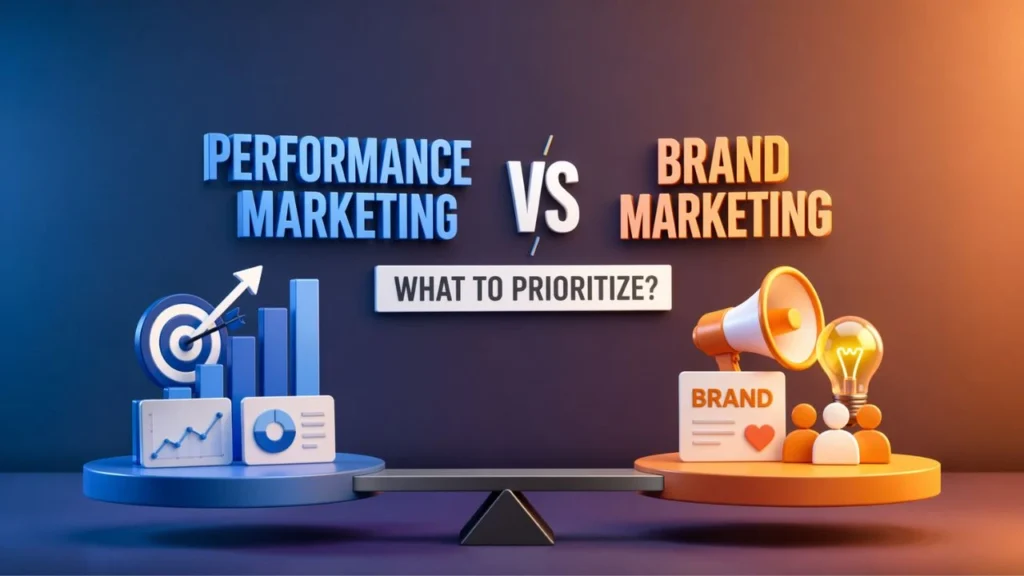
When businesses plan their marketing budgets, one question comes up again and again: performance marketing vs brand marketing, which one deserves priority? It is a valid question because both approaches influence growth, but they do it in very different ways.
If you want fast leads, measurable conversions, and tighter control over spend, Performance Marketing often looks like the obvious winner. If you want trust, recall, authority, and stronger long term demand, brand marketing becomes hard to ignore. That is why the discussion around performance marketing vs brand marketing matters so much today.
The truth is that businesses rarely grow at their best by choosing only one side. Still, depending on your goals, stage, budget, and sales cycle, one may deserve more attention right now. In this guide, we will break down performance marketing vs brand marketing in a practical way so you can decide what to prioritize, where to invest, and how to build a strategy that supports both immediate results and long term visibility.
Table of Contents
What Is Performance Marketing?
To understand performance marketing vs brand marketing, we need to start with clear definitions.
Performance Marketing is a results driven approach where you pay for specific outcomes such as clicks, leads, signups, app installs, or sales. It is built around measurable actions. You can track what is working, what is underperforming, and where your money is producing returns.
This is why many businesses invest in performance marketing services when they want speed, accountability, and data backed optimization. A strong PPC Strategy usually sits at the center of this model because paid search and paid social can quickly connect your brand with users who already show intent.
Common channels in Performance Marketing include paid search, display advertising, retargeting, paid social, affiliate campaigns, landing page testing, and conversion focused email funnels. When supported by strong creative, analytics, and targeting, Performance Marketing can help businesses scale demand capture in a highly controlled way.
What Is Brand Marketing?
Brand marketing focuses less on the immediate sale and more on how people remember, trust, and perceive your business over time. It is about creating recognition, credibility, consistency, and emotional connection.
In the performance marketing vs brand marketing debate, brand marketing is the side that helps people know who you are before they are ready to buy. It gives your business a stronger identity and makes your future acquisition efforts easier. When someone has already seen your videos, content, or social presence, they are more likely to click your ad, trust your message, and convert later.
Brand marketing can include storytelling, content strategy, community building, organic social, thought leadership, visual identity, and campaigns run through a Video Marketing Agency or Social Media Marketing Services partner. It can also include influencer marketing services, especially when the goal is to build authority and visibility through trusted creators. In those cases, Influencer Marketing ROI may not always appear instantly in the form of direct sales, but it can show up through assisted conversions, engagement quality, branded searches, and audience recall.
Performance Marketing vs Brand Marketing: Core Differences You Need to Know
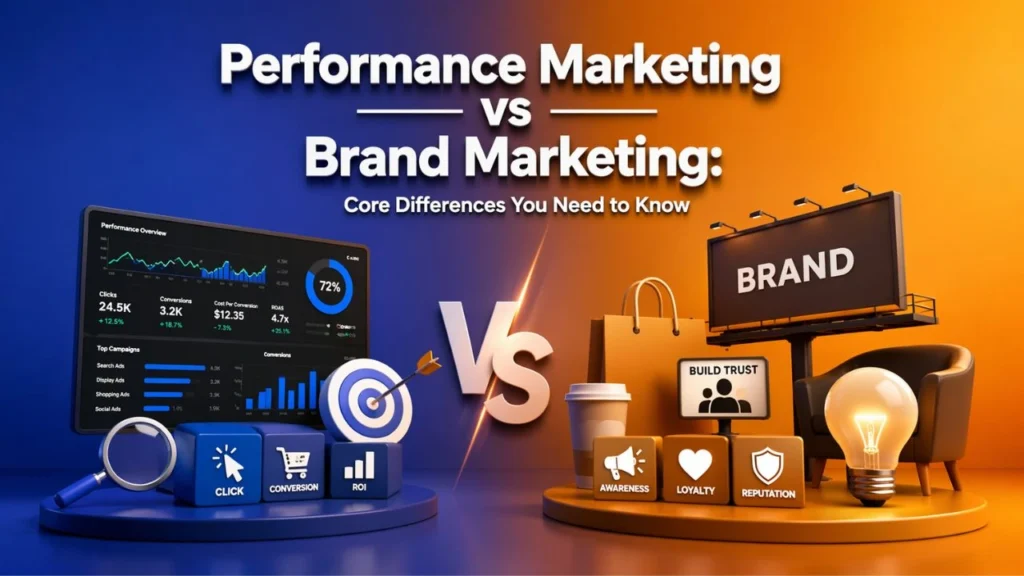
At the heart of performance marketing vs brand marketing is one major distinction: one captures demand, the other helps create it.
Here is the same comparison table from the outline:
| Factor | Performance Marketing | Brand Marketing |
| Primary goal | Leads, sales, conversions | Awareness, trust, recall |
| Time horizon | Short to medium term | Medium to long term |
| Measurement | Highly measurable | Often indirect but valuable |
| Core channels | Paid ads, retargeting, PPC | Content, video, social, influencers |
| Budget expectation | Efficient for quick testing | Valuable for long term positioning |
| KPI examples | CPA, ROAS, CTR, conversion rate | Reach, branded search, engagement, share of voice |
| Best for | Demand capture | Demand creation |
| Role of AI | Improves targeting, bidding, creative testing | Helps scale content and audience insights |
| Use of video | Conversion driven video ads | Storytelling and brand recall |
| Strategic outcome | Fast revenue acceleration | Long term market preference |
Why Performance Marketing Gets Prioritized So Often?
Many businesses prioritize Performance Marketing because the feedback loop is fast. You launch campaigns, test messaging, review numbers, and improve results. That speed is valuable when you need qualified traffic, booked calls, or revenue in the near term.
This is one reason performance marketing vs brand marketing often feels like a short term versus long term decision. If you are under pressure to prove results quickly, Performance Marketing usually gets the budget first.
A strong conversion system can make this approach even more powerful. With the right landing page, creative, audience segmentation, and PPC Strategy, businesses can identify winning offers and scale them with greater confidence. This is also where AI Content can support growth. It can help generate ad variations, support keyword mapped landing pages, speed up content production, and improve testing velocity when used with human oversight.
Performance Marketing also fits businesses that need:
- immediate lead flow
- measurable acquisition costs
- rapid experimentation
- clear reporting for management or stakeholders
- tighter budget control
That is why many brands turn to performance marketing services early in their growth journey.
Why Brand Marketing Still Deserves Serious Attention?
Although Performance Marketing can create quick wins, brand marketing strengthens the entire system. In the conversation around performance marketing vs brand marketing, this part is often undervalued because brand building does not always look impressive in a weekly report. But it changes how people respond to your business across every channel.
A stronger brand can improve click through rates, reduce hesitation, increase repeat engagement, and make your paid campaigns more efficient over time. When people know you, your ads do not have to work as hard. Your business starts with an advantage.
This is where Social Media Marketing Services, a Video Marketing Agency, and influencer marketing services can contribute beyond surface level visibility. Strong videos help people remember you. Strong creator partnerships improve trust. Strong social positioning keeps your brand relevant between buying moments. Together, they make your business easier to choose.
In practical terms, brand marketing supports:
- higher trust
- better recall
- stronger organic interest
- improved campaign efficiency
- greater long term customer value
So when we talk about performance marketing vs brand marketing, it is not wise to treat brand marketing as optional. It may not always be the first lever you pull, but it is often the reason your future performance improves.
When to Prioritize Performance Marketing?
If your business needs leads, appointments, demo requests, or purchases in the near term, Performance Marketing should usually take priority. This is especially true when your offer is validated and your website is ready to convert traffic.
In the performance marketing vs brand marketing decision, prioritize Performance Marketing when:
- you need measurable short term results
- you have a clear sales objective
- your funnel already converts reasonably well
- you want to test offers, audiences, and messages
- your management team expects direct attribution
This is also a smart choice when you already have some market awareness and just need better demand capture. In that case, performance channels can turn existing interest into action much faster.
When to Prioritize Brand Marketing?
There are also situations where brand marketing deserves more attention first. If your business is not well known, if trust is low, or if the buying cycle is longer and more considered, brand building can create the foundation you need before aggressive performance scaling.
In the performance marketing vs brand marketing framework, prioritize brand marketing when:
- your audience does not know or trust your business yet
- your category is crowded and hard to differentiate
- your sales cycle is long
- you rely on credibility, education, or authority to convert
- your paid campaigns feel expensive because people are unfamiliar with you
Brand marketing is also important when you want to build lasting visibility across search, social, AI search summaries, and voice led discovery. Consistent content, memorable messaging, and smart storytelling can help your brand stay present across those environments.
What Should Startups, Small Businesses, and Established Brands Do?
The answer to performance marketing vs brand marketing changes depending on business stage.
A startup often needs traction fast, so Performance Marketing may take the lead. But if the startup ignores brand completely, it risks becoming forgettable and overly dependent on paid acquisition.
A small business usually benefits from a blended approach. Local trust, search visibility, and direct response all matter. In that case, Social Media Marketing Services, strong content, and performance campaigns can work together.
An established brand has more room to invest in awareness, authority, and premium positioning while still using Performance Marketing to capture intent. In many cases, a Digital Marketing Agency can help decide how to allocate spend based on growth stage, competition, and audience behavior.
The Smartest Strategy Is Usually a Mix of Both
The most useful answer to performance marketing vs brand marketing is that both matter, but not always in equal proportion.
Performance Marketing captures demand. Brand marketing creates the conditions that make demand easier to convert. If you lean only on Performance Marketing, you may see results at first but struggle with rising costs and weak loyalty later. If you lean only on brand marketing, you may build awareness but miss clear commercial momentum.
That is why the smartest businesses combine both. They use performance marketing services to drive measurable outcomes and use brand building efforts to improve trust, recall, and future efficiency. They may work with a Video Marketing Agency to strengthen visual storytelling, use influencer marketing services to add social proof, and invest in AI Content to support content scale without losing strategy.
In other words, performance marketing vs brand marketing should not always be treated as a battle. It should be treated as a prioritization question based on what your business needs most right now.
Metrics That Matter for Each Approach
To manage both effectively, you need to measure them differently.
| Marketing Type | Core Metrics | Secondary Metrics |
| Performance Marketing | CPA, ROAS, CTR, conversion rate, CAC | bounce rate, landing page quality, lead quality |
| Brand Marketing | branded search volume, reach, engagement, direct traffic | assisted conversions, time on site, repeat visitors |
| Influencer Campaigns | clicks, tracked sales, coupon redemptions | engagement quality, creator fit, Influencer Marketing ROI |
| Video Campaigns | watch time, view through rate, click through rate | brand recall, assisted conversions |
A major mistake in performance marketing vs brand marketing is measuring both with the same expectations. Performance campaigns should be judged on direct outcomes. Brand efforts should also be evaluated through trust signals, audience response, and their effect on future acquisition efficiency.
Common Mistakes Businesses Make
Many businesses struggle with performance marketing vs brand marketing because they fall into one of two extremes. They either chase short term conversions without building a memorable brand, or they focus so much on visibility that they fail to convert interest into results.
Another common mistake is using AI Content without strategy. Speed is useful, but content still needs clarity, originality, audience alignment, and editorial control. The same applies to PPC Strategy, influencer campaigns, and video execution. Tactics alone do not create growth. Strategic alignment does.
Final Thoughts
If your business needs immediate pipeline, measurable conversions, and faster feedback, Performance Marketing should likely come first. If your market is crowded, your audience needs trust, or your growth depends on long term recall, brand marketing deserves stronger attention.
The best answer to performance marketing vs brand marketing is not based on trends. It is based on your goals, stage, audience, and budget. For many businesses, the right move is to prioritize one while steadily building the other in the background. That creates balance, protects future growth, and improves efficiency across channels.
If you want a strategy that connects short term results with long term brand strength, Book Strategy Call and build a smarter plan with the right mix of Performance Marketing, Social Media Marketing Services, influencer marketing services, video, and search led growth.
FAQs
1. What is the difference between performance marketing and brand marketing?
Performance marketing focuses on measurable actions like leads, clicks, and sales. Brand marketing focuses on awareness, trust, recall, and long term market positioning. That is the core of performance marketing vs brand marketing.
2. Which is better, performance marketing or brand marketing?
Neither is universally better. In the performance marketing vs brand marketing decision, the better choice depends on whether you need immediate conversions or stronger long term brand value.
3. Can a business invest in both performance marketing and brand marketing?
Yes. In fact, the strongest approach to performance marketing vs brand marketing is often a balanced one where one drives immediate outcomes and the other supports future growth.
4. Is influencer marketing part of performance marketing or brand marketing?
It can support both. With the right structure, influencer marketing services can drive awareness, engagement, direct response, and measurable Influencer Marketing ROI.
5. Does AI Content help in performance marketing and brand marketing?
Yes. AI Content can support ad testing, landing page creation, content ideation, and scalable publishing, but it works best when guided by a strong strategy and human editing.