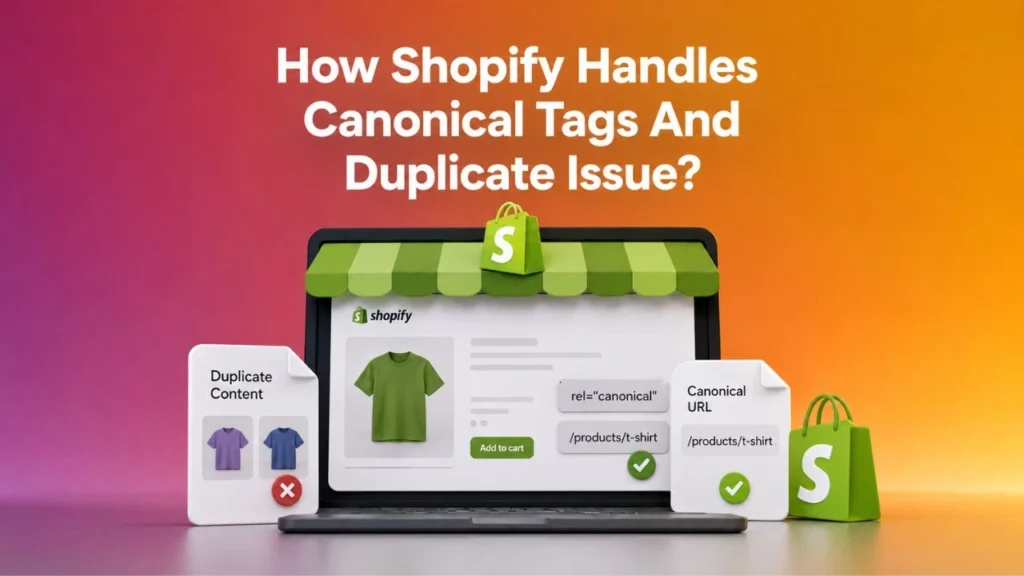
Managing duplicate content is one of the most important parts of ecommerce SEO. Online stores often create multiple URLs for similar products, filtered pages, collection paths, pagination, and variants. If search engines crawl too many duplicate pages, rankings can become unstable, crawl budgets can be wasted, and important product pages may lose visibility.
This is where rel canonical tag becomes essential. Shopify automatically includes canonical functionality within its platform, helping store owners reduce duplicate indexing problems while improving crawl efficiency. Understanding how Shopify handles Canonical Tags is critical for building a stronger ecommerce SEO strategy.
A well optimized Shopify store is no longer only about ranking on traditional search engines. Modern SEO also focuses on AI driven search systems, voice search optimization, answer engine optimization, and structured indexing. Search engines and AI crawlers both rely on clear signals to understand which version of a page should appear in search results. Proper Canonical Tags help provide that clarity.
This guide explains how Shopify manages canonical tag, how duplicate issues appear in ecommerce stores, and what technical improvements can strengthen Shopify SEO performance. It also explores how canonical optimization supports AI search visibility, voice search indexing, and technical optimization services for ecommerce businesses.
Table of Contents
What Are Canonical Tags In Shopify?
Canonical Tags are HTML elements that tell search engines which version of a page should be treated as the primary URL. Ecommerce websites frequently generate multiple versions of similar pages. Without Canonical Tag, search engines may struggle to determine which page deserves ranking priority.
Canonical implementation helps consolidate ranking signals, improve crawl efficiency, and reduce duplicate indexing.
Definition Of Canonical Tags
A canonical tag usually appears inside the <head> section of a webpage. It points search engines toward the preferred URL.
A canonical tag looks like this:
<link rel=”canonical” href=”https://example.com/product-page/” />
This tells search engines that the referenced URL is the main version that should receive ranking authority.
Canonical Tag is widely used in ecommerce because products may appear under multiple collection URLs, filtered URLs, or parameter based URLs.
Why Canonical Tags Matter For Ecommerce SEO?
Ecommerce websites naturally create duplicate URLs. A single product may appear in multiple categories, collections, and filtered search results. This creates indexing confusion.
Canonical Tags help by:
- Consolidating ranking authority
- Preventing keyword cannibalization
- Improving crawl efficiency
- Reducing duplicate indexing
- Supporting cleaner search engine signals
- Helping AI crawlers identify primary pages
For Shopify SEO, canonical management is especially important because ecommerce stores often contain thousands of dynamically generated URLs.
How Search Engines Interpret Canonical Tags?
Search engines treat Canonical Tag as strong hints about preferred indexing URLs. When several similar pages exist, the canonical version receives most ranking signals.
Benefits include:
| SEO Benefit | Impact |
| Consolidated authority | Improves ranking strength |
| Reduced duplication | Cleaner indexing |
| Better crawl efficiency | Faster discovery |
| Stronger keyword targeting | Reduced cannibalization |
| Improved AI indexing | Better entity understanding |
Canonical signals also support Answer Engine Optimization because AI systems rely on clean indexing structures to select reliable content sources.
Canonical URL Structure In Shopify
Shopify automatically generates canonical references for many ecommerce pages.
| Duplicate URL | Canonical URL |
| /collections/shoes/products/product-name | /products/product-name |
| /products/product-name?variant=123 | /products/product-name |
| /collections/all?page=2 | Canonicalized collection structure |
This structure helps Shopify SEO remain organized without requiring constant manual adjustments
How Shopify Automatically Handles Canonical Tags?
One reason many ecommerce businesses prefer Shopify is its built in SEO framework. Shopify automatically inserts index consolidation into themes using Liquid variables.
This simplifies duplicate management for store owners.
Shopify Default Canonical Tag System
Most Shopify themes include the following Liquid code:
<link rel=”canonical” href=”{{ canonical_url }}”>
The canonical_url object dynamically outputs the preferred URL for the current page.
Shopify automatically handles canonical references for:
- Product pages
- Collection pages
- Blog posts
- CMS pages
- Paginated URLs
This automation reduces the risk of incorrect canonical implementation.
Index Consolidation On Product Pages
Product pages often create duplicate paths because the same product may belong to multiple collections.
For example:
- /collections/shoes/products/running-shoe
- /collections/sale/products/running-shoe
Shopify typically canonicalizes these URLs back to:
- /products/running-shoe
This ensures ranking authority remains consolidated on the main product URL.
Canonical Tags On Collection Pages
Collections can generate duplication through sorting and filtering.
Common duplicate collection URLs include:
- ?sort_by=price
- ?filter=color
- ?page=2
Shopify generally canonicalizes collection pages toward cleaner base URLs, helping reduce indexing clutter.
This improves:
- Crawl efficiency
- Index quality
- Technical SEO performance
Canonical Tags For Blog Pages
Shopify blogs may also generate duplicate paths through tags and archives.
Canonical implementation helps consolidate signals across:
- Blog tag URLs
- Archive pages
- Category paths
This is particularly useful for content marketing strategies focused on Shopify SEO and ecommerce visibility.
Common Duplicate Content Issues In Shopify SEO
- Although Shopify automatically handles many canonical functions, duplicate issues can still occur.
- Understanding these issues is essential for stronger Shopify SEO optimization.
Product Variant URL Duplication
Variants can create multiple parameter based URLs.
Examples include:
- ?variant=size
- ?variant=color
Without proper index consolidation, search engines may index many duplicate product pages. Canonical implementation ensures ranking signals remain focused on the primary product URL.
Collection And Product Path Duplication
Products appearing in multiple collections generate duplicate paths.
For example:
| Collection Path | Duplicate Product URL |
| /collections/new-arrivals/products/item | Duplicate |
| /collections/featured/products/item | Duplicate |
| /products/item | Preferred canonical |
It helps search engines understand that the core product URL should receive authority.
Pagination Duplicate Issues
Pagination creates another major duplication challenge.
Collection pages such as:
- /collections/all?page=2
- /collections/all?page=3
may contain similar content. Pagination management is important because excessive indexing of paginated pages can dilute ranking strength.
Filtered URL Problems
Filtering options create dynamic URLs such as:
- ?color=black
- ?size=large
- ?brand=nike
These URLs can quickly multiply into thousands of crawlable combinations. Without proper canonical handling, crawl budgets become inefficient.
Search Result URL Indexing
Internal Shopify search pages may generate duplicate or low value URLs.
Examples include:
- /search?q=shoes
- /search?q=summer
These pages generally should not compete in organic rankings. Technical optimization services often focus heavily on managing search URL indexing issues.
Shopify SEO Best Practices For Canonical Tags
Even though Shopify automates canonical implementation, store owners still need strategic optimization.
Keep Product URLs Consistent
- Internal linking should consistently point toward primary URLs.
- Avoid linking to unnecessary collection paths whenever possible.
- Consistent linking strengthens canonical signals.
Optimize Collection Structure
Collection organization influences crawl efficiency.
A clean structure helps:
- Search engine navigation
- AI crawler understanding
- User experience
- Index hierarchy
Strong collection organization also supports better voice search indexing because structured pages are easier for AI systems to interpret.
Use Clean URL Parameters
Excessive URL parameters can create crawl inefficiencies.
Recommended practices include:
| URL Practice | SEO Benefit |
| Remove unnecessary parameters | Cleaner indexing |
| Limit filter combinations | Better crawl control |
| Maintain canonical consistency | Stronger ranking signals |
| Use structured navigation | Improved user flow |
Combine Canonical Tags With Noindex Carefully
Index consolidation and noindex directives serve different purposes.
| SEO Element | Purpose |
| Canonical Tags | Consolidate duplicate signals |
| Noindex | Prevent indexing entirely |
Using both strategically helps improve technical SEO performance.
Advanced Shopify SEO Optimization Guide
Advanced ecommerce SEO requires deeper technical control beyond default Shopify settings.
Customizing Index Consolidation In Shopify Themes
Developers can customize canonical behavior directly inside Shopify themes.
The main canonical reference usually exists inside:
- theme.liquid
Customizations may help manage:
- Faceted navigation
- International stores
- Dynamic collections
- Advanced filtering systems
Managing Canonical Tags For International Stores
International Shopify stores create additional duplication challenges.
Common issues include:
- Currency based URLs
- Language variations
- Regional collections
Combining Canonical Tags with hreflang implementation helps search engines understand regional targeting.
Index Consolidation For Faceted Navigation
Faceted navigation creates extensive URL combinations.
Examples include:
- Size filters
- Brand filters
- Color filters
- Price sorting
Without proper canonical management, ecommerce stores may generate millions of duplicate URLs. Technical optimization services often prioritize faceted navigation audits because these issues directly impact crawl budgets.
Technical SEO And Crawl Budget Optimization
- Large Shopify stores depend heavily on crawl efficiency.
- Search engines allocate limited crawl resources. Excessive duplication wastes those resources.
Canonical optimization helps search engines prioritize:
- Product pages
- Category pages
- Informational content
- Important landing pages
This strengthens overall Shopify SEO performance.
Shopify SEO And AI Search Optimization
- Modern SEO increasingly focuses on AI based discovery systems.
- AI crawlers rely heavily on structured signals to understand page relationships.
Canonical Tags help AI systems identify:
- Preferred URLs
- Primary content sources
- Content relationships
- Entity consistency
This improves visibility across AI driven search experiences.
Why Canonical Tags Matter For AI Crawlers
AI search systems process massive amounts of content.
Duplicate URLs create confusion for:
- Entity recognition
- Source attribution
- Content summarization
- Answer extraction
Canonical implementation provides cleaner indexing signals.
Canonical Tags And Voice Search Optimization
Voice search systems prioritize concise, authoritative content.
Canonical clarity improves:
- Page trust
- Search engine understanding
- Featured snippet potential
- Voice answer eligibility
Voice assistants prefer clearly indexed pages with consolidated authority.
Canonical Tags And Answer Engine Optimization
Answer Engine Optimization focuses on helping AI systems extract accurate answers.
Canonical Tags support AEO by:
- Reducing duplicate indexing
- Consolidating authority
- Improving content trust signals
- Strengthening structured indexing
AI systems often avoid duplicate URLs when selecting answers.
Shopify Technical SEO Elements Beyond Canonical Tags
- Canonical implementation is only one part of technical optimization.
- A complete Shopify SEO strategy includes several additional elements.
XML Sitemap Optimization
Shopify automatically generates XML sitemaps.
Sitemaps help search engines discover:
- Products
- Collections
- Blog posts
- CMS pages
Clean sitemap management improves indexing efficiency.
Robots.txt Optimization
Shopify allows limited robots.txt customization.
Robots directives help control crawling of:
- Parameter URLs
- Search pages
- Low value filters
Proper robots optimization supports crawl efficiency.
Structured Data Implementation
Structured data helps AI systems understand content context.
Important schema types include:
| Schema Type | SEO Purpose |
| Product Schema | Product indexing |
| FAQ Schema | Voice search visibility |
| Breadcrumb Schema | Navigation clarity |
| Article Schema | Blog visibility |
Structured data complements Canonical Tags by strengthening page understanding.
Page Speed Optimization
Technical performance influences ecommerce rankings.
Shopify SEO performance improves with:
- Faster loading times
- Optimized images
- Reduced script bloat
- Better mobile responsiveness
AI search systems increasingly evaluate user experience signals.
WordPress Vs Shopify SEO Comparison
- Many businesses compare Shopify with WordPress when planning ecommerce SEO strategies.
- Understanding platform differences helps clarify canonical management capabilities.
Canonical Management In Shopify
Shopify offers:
- Automatic Canonical Tags
- Simplified technical management
- Easier maintenance
- Consistent URL structures
This makes Shopify suitable for businesses seeking streamlined ecommerce SEO management.
Canonical Management In WordPress
WordPress typically relies on plugins for canonical control.
Common SEO plugins manage:
- Canonical references
- Metadata
- Indexing directives
However, plugin conflicts may occasionally create duplicate canonical issues.
WordPress Vs Shopify SEO Comparison Table
| Feature | Shopify | WordPress |
| Automatic Canonical Tags | Yes | Plugin dependent |
| Technical complexity | Lower | Higher |
| Maintenance effort | Lower | Higher |
| URL control | Moderate | Extensive |
| Duplicate management | Automated | Manual flexibility |
Which Platform Is Better For Ecommerce SEO?
Both platforms can perform well with proper optimization.
Shopify advantages include:
- Simpler technical management
- Automatic canonical support
- Faster setup
- Reduced maintenance complexity
WordPress advantages include:
- Greater customization
- Advanced plugin ecosystems
- Flexible technical control
The ideal platform depends on business goals and technical requirements.
Common Canonical Mistakes In Shopify SEO
Incorrect canonical implementation can create serious indexing problems.
Canonicalizing Every Page To Homepage
Some websites incorrectly point all pages toward the homepage.
This weakens:
- Product relevance
- Keyword targeting
- Category rankings
Canonical Tags should reference equivalent or closely related pages.
Multiple Canonical Tags On One Page
- Pages should contain only one canonical reference.
- Multiple canonical tags create confusion for search engines.
- Technical audits should regularly check for duplicate canonical declarations.
Incorrect Canonical URLs
Broken canonical references can:
- Waste crawl budgets
- Create indexing errors
- Reduce ranking efficiency
Regular SEO audits help identify incorrect canonical structures.
Ignoring Parameter Based URLs
Dynamic parameters can generate massive duplication.
Examples include:
- Tracking parameters
- Sorting parameters
- Session IDs
Technical optimization services frequently focus on parameter control because these URLs can overwhelm crawl resources.
Best Tools To Audit Canonical Tags In Shopify
Regular technical audits are essential for maintaining strong Shopify SEO.
Google Search Console
Google Search Console helps monitor:
- Indexed URLs
- Duplicate pages
- Canonical selection
- Crawl behavior
It provides insights into how Google interprets canonical signals.
Screaming Frog SEO Spider
Screaming Frog is widely used for technical audits.
It identifies:
- Missing Canonical Tags
- Duplicate canonicals
- Incorrect canonical references
- Indexing issues
Ahrefs Site Audit
Ahrefs helps detect:
- Duplicate pages
- Canonical inconsistencies
- Internal linking problems
- Crawl issues
Semrush Technical Audit
Semrush provides:
- Site health analysis
- Duplicate content reports
- Technical SEO monitoring
- Crawl diagnostics
Shopify SEO Apps
Several Shopify apps assist with technical optimization.
Features often include:
| Feature | Benefit |
| Canonical monitoring | Duplicate control |
| Metadata management | Better indexing |
| Structured data support | AI visibility |
| Technical audits | SEO maintenance |
How Technical Optimization Services Improve Shopify SEO
Many ecommerce businesses use technical optimization services to improve site performance.
These services often focus on:
- Crawl analysis
- Canonical auditing
- Duplicate content reduction
- Structured data implementation
- URL optimization
- Index management
Technical optimization services help ecommerce stores scale efficiently while maintaining strong SEO foundations.
The Relationship Between Canonical Tags And Crawl Budget
- Crawl budget refers to how many pages search engines allocate resources to crawling.
- Duplicate URLs waste crawl resources.
- Canonical Tags help improve crawl efficiency by consolidating duplicate paths.
This is especially important for large Shopify stores with:
- Thousands of products
- Dynamic collections
- Filter combinations
- Seasonal pages
Efficient crawling improves indexing quality.
Canonical Tags And Ecommerce Content Strategy
Content marketing also benefits from canonical optimization.
Shopify blogs may generate duplicate URLs through:
- Tags
- Categories
- Archives
- Pagination
Canonical management helps maintain clean indexing across content sections.
This strengthens:
- Blog rankings
- Topical authority
- AI visibility
- Internal linking structures
Shopify SEO Optimization Guide For Better Search Visibility
A strong Shopify SEO optimization guide should include both technical and content focused strategies.
Technical SEO Priorities
Technical priorities include:
- Canonical optimization
- Structured data
- XML sitemaps
- Mobile optimization
- Page speed
- Crawl management
Content SEO Priorities
Content optimization includes:
- Clear headings
- Semantic keyword usage
- Informational depth
- FAQ sections
- Conversational structure
- Voice search optimization
AI Search Optimization Priorities
AI focused SEO strategies include:
- Entity clarity
- Structured information
- Clean indexing
- Consolidated URLs
- Semantic organization
Canonical Tags support all of these areas.
How Canonical Tags Influence Search Rankings?
- Canonical Tags themselves do not directly boost rankings.
- However, they improve the efficiency of ranking signals.
Benefits include:
| Ranking Factor | Canonical Impact |
| Duplicate reduction | Stronger authority |
| Crawl optimization | Better indexing |
| URL consolidation | Improved relevance |
| AI understanding | Better content interpretation |
These indirect improvements strengthen overall SEO performance.
Voice Search Optimization And Canonical Structure
Voice search continues to influence ecommerce discovery.
Voice assistants prefer:
- Clear page hierarchy
- Concise answers
- Structured content
- Reliable indexing
Canonical Tags help maintain organized content structures. This improves voice search visibility across ecommerce queries.
Future Of Shopify SEO And Canonical Optimization
SEO continues evolving toward AI driven discovery systems.
Search engines increasingly focus on:
- Entity relationships
- Semantic understanding
- Structured indexing
- User intent
Canonical Tags remain important because they help define clear relationships between pages. As ecommerce websites grow larger and more complex, canonical optimization becomes even more valuable.
Why Canonical Tags Are Essential For Ecommerce SEO?
Ecommerce websites naturally create duplicate paths through:
- Product variants
- Collections
- Filters
- Sorting
- Pagination
Without proper Canonical Tags, these duplicate URLs can weaken SEO performance.
Canonical implementation supports:
- Crawl efficiency
- Index clarity
- Ranking consolidation
- AI search optimization
- Voice search visibility
For Shopify SEO, canonical management is one of the most important technical foundations.
Conclusion
Canonical Tags play a critical role in modern ecommerce SEO. Shopify simplifies canonical management through built in automation, helping businesses reduce duplicate indexing issues and improve crawl efficiency.
However, strong Shopify SEO still requires strategic technical optimization. Product variants, collection paths, filtered URLs, and pagination can all create duplication challenges that impact rankings and indexing quality.
As search evolves toward AI systems, voice assistants, and answer engines, structured indexing becomes even more important. Canonical Tags help search engines and AI crawlers identify preferred URLs, consolidate authority, and interpret ecommerce content more effectively.
A well structured Shopify SEO optimization guide should combine Canonical Tags with broader technical optimization services, structured data, crawl management, and content organization. Together, these elements support stronger visibility across traditional search engines, AI driven search platforms, and voice search systems.
Frequently Asked Questions
Does Shopify Automatically Add Canonical Tags?
Yes. Shopify automatically inserts Canonical Tags into most themes using the canonical_url Liquid object.
Why Are Canonical Tags Important For Shopify SEO?
Canonical Tags help prevent duplicate indexing, consolidate ranking signals, and improve crawl efficiency.
Can Canonical Tags Completely Remove Duplicate Content Problems?
Canonical Tags help manage duplicate indexing, but they do not physically remove duplicate pages. Additional technical optimization may still be necessary.
Do Canonical Tags Help AI Search Optimization?
Yes. Canonical Tags help AI systems identify preferred URLs and reduce indexing confusion.
Are Canonical Tags Important For Voice Search?
Yes. Voice search systems prefer clearly indexed pages with consolidated authority.
What Causes Duplicate URLs In Shopify?
Common causes include:
Product variants
Collection paths
Filtered URLs
Pagination
Internal search pages
What Is The Difference Between Canonical And Noindex?
Canonical Tags suggest the preferred version of a page, while noindex prevents a page from appearing in search results.
Why Do Businesses Use Technical Optimization Services?
Technical optimization services help improve crawl efficiency, duplicate management, structured data implementation, and overall SEO performance.