Local keyword research is one of the most important steps in building service pages that attract the right local customers. A service page cannot depend only on a service name and a city name. It needs a clear keyword plan that matches how people search, what they expect, and which action they may take after visiting the page.
For service-based businesses, local keyword research helps connect online visibility with real enquiries. When a customer searches for a nearby service, they usually have a specific need. They may search for a company, a solution, a price range, a location, or a trusted provider. This is why service pages need more than basic keywords. They need a complete structure built around search intent, location relevance, and useful answers.
A well-planned service page can improve visibility in organic search, support map-based discovery, and make the user journey easier. Local keyword research also helps avoid weak content, repeated pages, and unclear keyword targeting. When it is done properly, every service page has a clear purpose and a stronger chance of reaching the right audience.
Table of Contents
What Is Local Keyword Research?
Local keyword research is the process of finding search terms people use when they look for services in a specific city, area, or nearby location. These keywords often include a service name, a place name, and sometimes a clear buying signal.
For example, a user may search for “SEO services in Kolkata,” “website design company near me,” or “digital marketing agency in Salt Lake.” These searches show local intent because the user wants a result connected to a nearby area.
Local keyword research helps businesses understand these patterns before writing or improving service pages. Instead of guessing what customers type into Google, businesses can use keyword data, search suggestions, competitor pages, and customer questions to build stronger pages.

Why Local Keyword Research Matters for Service Pages
Local keyword research matters because service pages are often created to generate leads. A blog post may educate the reader, but a service page must help the user understand the service and take the next step.
When service pages are created without local keyword research, they may target broad keywords that are difficult to rank for. They may also miss high-intent local searches from people who are ready to contact a provider. This is where service area SEO becomes important, as it helps service pages connect with users searching from specific cities, areas, and nearby locations.
How It Helps Service Page SEO
Good local keyword research supports service page SEO by helping the page focus on the right terms. It guides the title, headings, URL, introduction, FAQs, internal links, and calls to action.
It also improves SEO for service pages because the content becomes more relevant to local users. A page about a service should clearly mention what is offered, where it is offered, and who it is for.
How It Improves Local Search Intent
Search intent is the reason behind a search. A person searching for “how to do SEO” may want information. A person searching for “SEO company in Kolkata” may be looking for a service provider.
Local keyword research helps separate informational searches from commercial searches. This makes it easier to decide which keywords belong on service pages and which keywords should be used in blogs.
Main Types of Local Keywords for Service Pages
Different local keywords serve different purposes. Some bring early-stage visitors, while others bring people who are closer to making an enquiry, and this is why local landing page SEO needs a clear keyword plan for each service and location.
Service Plus City Keywords
These are keywords that combine a service with a city. They are usually important for main service pages.
Examples include:
- SEO services in Kolkata
- website design company in Kolkata
- digital marketing agency in Kolkata
These city-based keywords help search engines and users understand the location focus of the page.
Service Plus Area Keywords
Area-based keywords are useful when a business wants to target specific local areas inside a city. These may include neighbourhoods, business districts, or service zones.
Examples include:
- SEO service in Salt Lake
- website design service in New Town
- digital marketing agency in Park Street
These keywords can support local service page optimization when used naturally in the content.
Near Me Keywords
Near me keywords are common in local searches because users often want quick access to nearby services. These keywords work well in FAQs and conversational sections.
Examples include:
- SEO agency near me
- website designer near me
- digital marketing company near me
A business should not overuse these terms. Instead, near me keywords should be added where they sound natural.
Buyer Intent Keywords
Buyer intent keywords show that the user may be close to choosing a provider. These keywords often include words such as best, trusted, affordable, professional, or top-rated, and they can help attract qualified leads from your website.
Examples include:
- best service provider near me
- affordable local services
- trusted service company
- professional service provider
- top-rated local company
These terms can help create stronger service sections, comparison points, and FAQs.
Local Keyword Types and Their Best Use
| Keyword Type | Example | Search Intent | Best Use on Service Page |
|---|---|---|---|
| Service plus city | SEO services in Kolkata | Commercial | Main service heading and title |
| Service plus area | SEO service in Salt Lake | Local commercial | Area coverage section |
| Near me search | SEO agency near me | Immediate local need | FAQ or short answer section |
| Buyer intent | trusted service company | Decision-making | Trust-building section |
| Problem-based | why my local ranking dropped | Informational | Blog or FAQ support |
| Competitor gap | missing local service terms | Research-based | Content improvement plan |
| Location modifier | service in nearby area | Local discovery | Internal page structure |
How to Do Local Keyword Research for Service Pages
Local keyword research should follow a simple but organised process. The goal is not to collect hundreds of keywords. The goal is to choose the right keywords for the right page.
Step 1: Start with Core Service Terms
Begin with the main services your business offers. These are broad terms that describe the service clearly.
Examples:
- SEO services
- local SEO
- website design
- Google Business Profile optimization
- digital marketing service
These terms create the base for local keyword research.
Step 2: Add Location Modifiers
After listing services, add location modifiers. These may include city names, area names, nearby localities, and service zones.
Examples:
- Kolkata
- Salt Lake
- New Town
- Park Street
- Howrah
- Behala
- Dum Dum
Location-specific keywords help the page show relevance for local searches.
Step 3: Identify Search Intent
Every keyword should be checked for intent. Some keywords are informational, while others are commercial. Service pages should mainly target commercial and local intent.
For example, “what is local SEO” is better for a blog. “local SEO services in Kolkata” is better for a service page.
This step makes local keyword research more practical because it avoids placing the wrong keyword on the wrong page. It also supports Search Intent SEO for service page rankings by helping each page match the exact purpose behind the user’s search.
Step 4: Find Long-Tail Local Keywords
Long-tail local keywords are more specific. They may have lower search volume, but they often bring better-quality visitors.
Examples:
- local SEO service for small businesses in Kolkata
- affordable website design company in Kolkata
- Google Maps ranking service for local business
- local keyword research for service pages
These terms can be used in headings, FAQs, and supporting paragraphs.
Step 5: Study Competitor Pages
Competitor research helps you understand what other pages are targeting. Local competitor keyword analysis can show which terms appear in titles, headings, FAQs, and service descriptions.
You can also find a competitor keyword gap by comparing your page with pages that rank well. This may reveal missing topics, weak headings, or service page keyword gaps.
Local SEO competitor research is not about copying content. It is about understanding what users and search engines expect from a strong local service page.
Keyword Mapping for Service Pages
| Service Page Type | Primary Keyword Focus | Supporting Keywords | Suggested Sections |
|---|---|---|---|
| Main SEO service page | SEO services in Kolkata | local organic SEO, local ranking keywords | Service overview, benefits, FAQs |
| Local SEO page | local SEO services in Kolkata | local search optimization, Google Business Profile keywords | Map ranking, citations, reviews |
| Website design page | website design company in Kolkata | service landing page SEO | Design process, features, local proof |
| Area page | SEO service in Salt Lake | geo-targeted keywords | Area relevance, services, FAQs |
| Blog support page | local keyword research | local SEO strategy | Guide, checklist, examples |
| Landing page | service page keywords | local landing page keywords | Offer, trust points, enquiry section |
Where to Use Local Keywords on Service Pages
Local keyword research only works when keywords are used in the right places. A service page should be clear, helpful, and easy to scan.
Page Title
The title should include the main service and location. It should be readable and not overloaded with repeated keywords.
Example:
SEO Services in Kolkata for Local Businesses
Meta Description
The meta description should explain the service, location, and benefit in a natural way.
Example:
Improve your local visibility with SEO services in Kolkata. Build stronger service pages, target better local keywords, and attract more relevant enquiries.
URL
A short URL is easier to understand.
Examples:
- /seo-services-kolkata/
- /local-seo-services-kolkata/
- /website-design-kolkata/
H1 Heading
The H1 should clearly describe the main topic of the page. It should include the main service and location.
H2 and H3 Headings
Supporting headings should use related terms naturally. This helps search engines understand the structure of the page.
Opening Paragraph
The first paragraph should quickly explain the service, location, and audience. This gives users a clear reason to continue reading.
FAQ Section
FAQs are useful for AEO and voice search. They help answer direct questions users may ask before contacting a service provider.

Local Keyword Research for Voice Search
Voice searches are usually conversational. People ask complete questions instead of typing short phrases.
For example, a typed search may be “SEO company Kolkata.” A voice search may be “Which SEO company is best for a small business in Kolkata?”
Local keyword research should include these natural questions. This helps service pages answer common search queries more clearly and supports better planning through an AI Search Readiness Checker.
Voice Search Keyword Examples
- Which service provider is near me?
- How do I find a trusted local company?
- What is the best way to improve local SEO?
- How can a service page rank in my city?
These questions can be placed in FAQs, short answer sections, and service explanations.
AEO and GEO Benefits of Local Keyword Research
AEO means answer engine optimization. It focuses on giving direct and useful answers. GEO means generative engine optimization. It helps content become easier for AI-driven search systems to understand and summarise.
Local keyword research supports both because it creates clear topic coverage. When a service page answers important questions directly, it becomes more useful for search users and answer-based systems. Using AEO content briefs for service page leads can also help organise questions, answers, keyword intent, and conversion-focused sections in a more structured way.
How to Make Content Easier to Understand
Use:
- Clear headings
- Short explanations
- Direct answers
- Useful examples
- Tables
- FAQs
- Local context
- Natural keyword usage
This makes the page more helpful for both readers and search engines.
Common Mistakes in Local Keyword Research
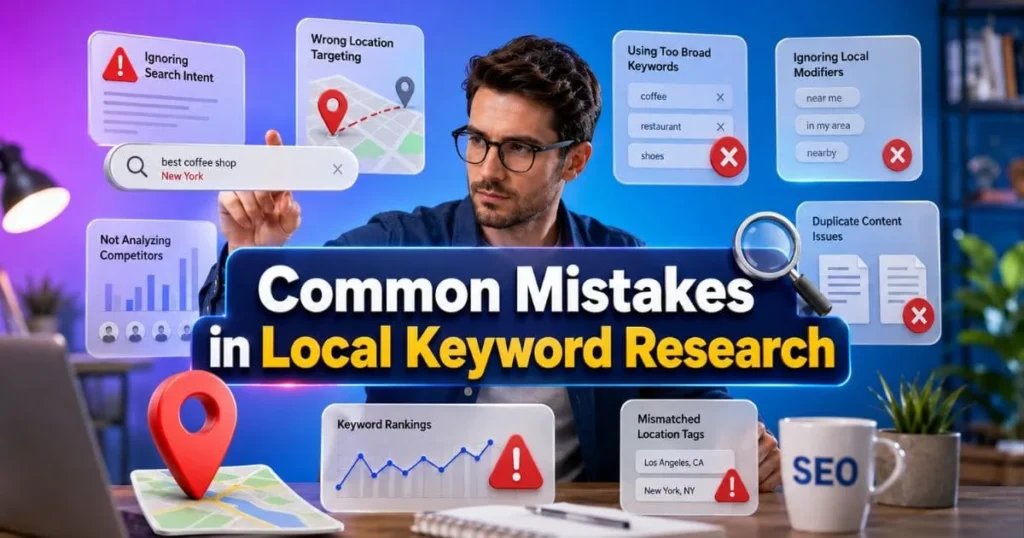
Many service pages fail because keywords are selected without proper planning. Avoid these common mistakes.
Using Only Broad Keywords
Broad keywords are difficult to rank for and may not bring local leads. A keyword like “SEO” is too general for a local service page.
Ignoring Local Intent
If a page does not clearly mention the city, area, or service region, it may fail to match local search intent.
Repeating the Same Keyword Too Often
Keyword stuffing makes the content difficult to read. Local keyword research should guide the content, not make it sound forced.
Creating Similar Pages for Every Area
Some websites create many pages with almost the same content and only change the location name. This can reduce quality and create duplication problems.
Not Mapping Keywords Properly
Keyword mapping helps decide which page should target which keyword group. Without mapping, multiple pages may compete with each other.
Case Study: How Local Keyword Research Improved Service Page Visibility
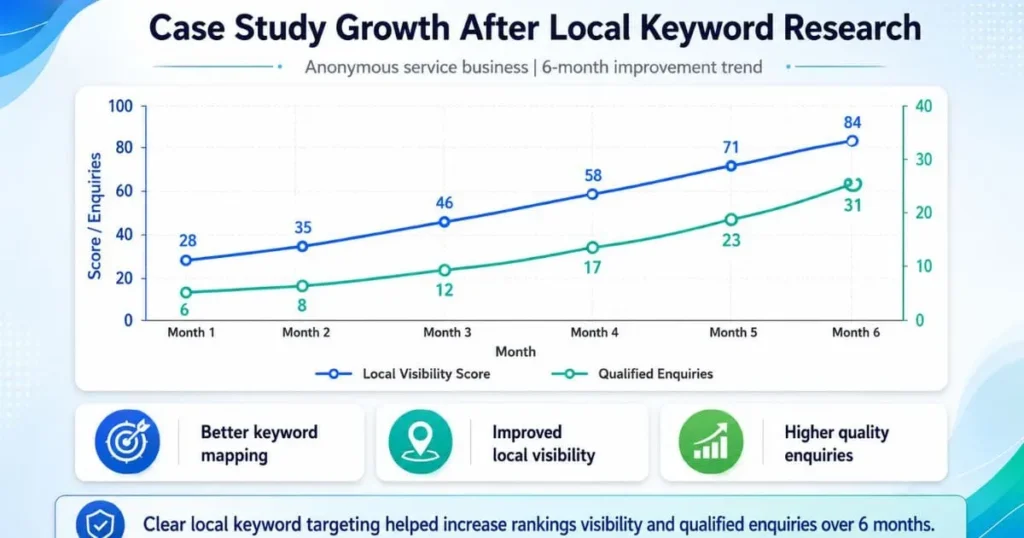
A local service business had several service pages, but the pages were not getting enough enquiries or qualified leads from your website. The content was written around broad service terms, and the city name appeared only once or twice. The pages also missed area names, customer questions, and buyer-focused search phrases.
The Problem
The business had three main issues:
- Service pages were targeting broad keywords
- Important local terms were missing
- Similar pages were competing for the same searches
- FAQs were too generic
- Internal links were weak
The Process
The business started with local keyword research. First, it listed all core services. Then it added city names, service areas, and customer search questions. After that, the keywords were grouped by service type.
Each page received one main keyword and a small set of supporting terms. The content was updated with clearer headings, better FAQs, and stronger local relevance. The business also added internal links from related blogs to service pages.
The Result
After improving the keyword structure, the service pages became easier to understand. They started matching local searches more clearly. The business also received better-quality enquiries because the pages were aligned with what nearby customers were actually searching for.
Key Learning
Local keyword research works best when every page has a clear goal. A service page should not target every keyword. It should target the right keyword group based on service, location, and search intent.
Local Keyword Research Checklist for Service Pages
Use this checklist before publishing or updating a service page.
H4: Keyword Planning Checklist
- Choose one main local keyword
- Add related secondary keywords
- Add city and area terms
- Check search intent
- Review competitor pages
- Find missing keyword opportunities
- Avoid repeating the same phrase too much
- Map each keyword group to one page
On-Page Optimization Checklist
- Add keyword to page title
- Add keyword to meta description
- Use a clear H1 heading
- Add useful H2 and H3 headings
- Include location details naturally
- Add FAQs
- Use internal links
- Add image alt text where relevant
- Keep the page useful and easy to read
FAQs
Q: What is local keyword research?
Ans: Local keyword research is the process of finding search terms people use when looking for services in a specific city, area, or nearby location. It helps service pages match local search intent and attract users who are searching for relevant local solutions.
Q: Why is local keyword research important for service pages?
Local keyword research is important because service pages need to reach people who are actively searching for nearby services. It helps businesses choose the right keywords, improve page relevance, and create content that answers local customer needs.
Q: How do I find local keywords for a service page?
Start with your main service term, then add city names, area names, and customer questions. You can also check Google suggestions, competitor pages, search volume, and keyword difficulty to find useful local terms.
Q: Should I use near me keywords on service pages?
Yes, but they should be used naturally. Near me keywords work well in FAQs and conversational sections. Avoid repeating them too often because that can make the content sound unnatural.
Q: How many keywords should one service page target?
A service page should usually target one main keyword and a small group of closely related secondary keywords. This keeps the page focused and avoids confusion for both users and search engines.
Q: What is keyword mapping in local SEO?
Keyword mapping means assigning the right keywords to the right pages. It helps avoid overlap, improves content planning, and gives every service page a clear search purpose.
Q: Can local keyword research improve enquiries?
Yes. When a service page targets the right local search terms, it can attract users who are already looking for that service in a specific area. This can improve enquiry quality and lead generation.
Conclusion
Local keyword research is not just about adding a city name to a service page. It is about understanding how local customers search, what they need, and which words help them find the right provider.
A strong service page uses local keyword research to match search intent, explain the service clearly, and guide users toward action. It also supports better page structure, stronger FAQs, and improved local relevance.
For service-based businesses, the right keyword plan can make a major difference. When every service page has a clear keyword group, useful content, and natural local signals, it becomes easier to reach people who are searching for nearby services.