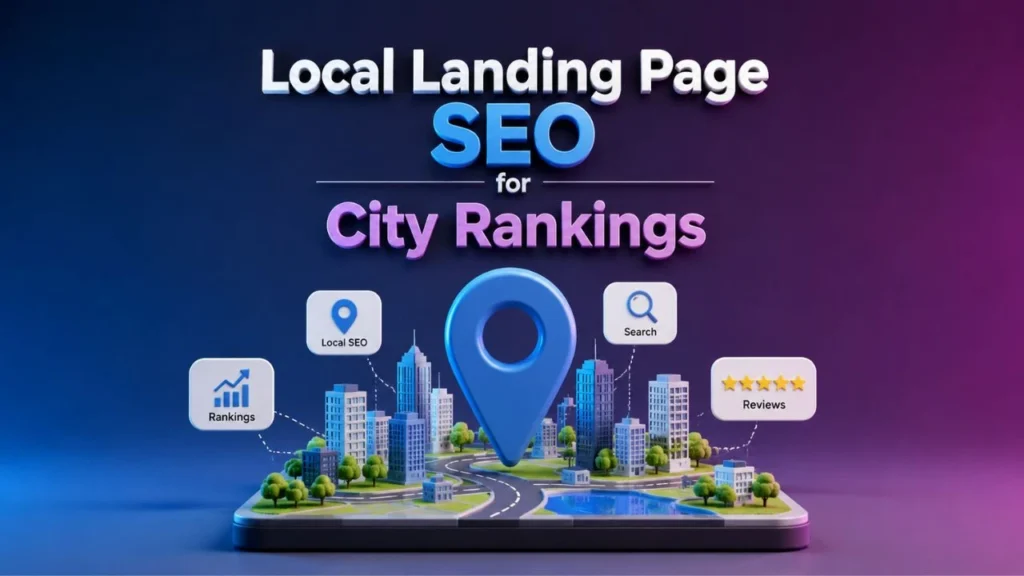
Struggling to outrank competitors in your target cities? Local landing page SEO transforms how search engines evaluate your presence across multiple markets. Your strategy must address keyword research, on-page optimization, and local authority signals that directly impact city-specific rankings. This guide examines how Google Business Profile integration, structured data implementation, and citation building drive measurable visibility gains across locations.
Before diving into implementation, what separates effective local landing pages from generic service pages? The distinction lies in how each page signals location authority to search engines. Local landing pages target specific cities or neighborhoods with tailored content and structured signals. Generic service pages focus only on offerings without geographic modifiers.
Start by examining your current page structure in your content management system. Navigate to the page editor and review the URL slug for the target location. A true local landing page includes the city name in the address, such as /plumbing-austin rather than /plumbing-services. Generic service pages often use broad slugs without location references.
Next, inspect the page content for location-specific elements. Check headings, body text, and footer sections for city name modifiers and neighborhood references. Geo-targeted landing pages mention specific areas, landmarks, or service zones multiple times throughout the content. Standard service pages mention locations only once or not at all.
Review the schema markup applied to the page. Access your structured data section and verify that LocalBusiness or Service schema includes an address property with the target city. Pages missing this structured data often fail to rank for near me searches or city-specific queries. Proper schema distinguishes location authority from topical authority by connecting the business entity to a physical place.
Table of Contents
Why City Rankings Matter for Local SEO
A business owner discovers their nearest competitor appears in every local query while their own listing remains invisible despite superior reviews. Their team built a local landing page seo approach that focused on city rankings instead of generic site pages. This change helped connect their service area directly to near me searches that people actually used.
Local Pack Rankings
Customers often choose the first option shown in the local pack rankings because proximity bias and distance signals influence what search engines display. The business noticed that competitors ranked higher even when located farther away. Their own pages lacked specific location-specific keywords that matched how people searched in their area.
GEO-Targeted Landing Pages
They created geo-targeted landing pages for each city they served and added city name modifiers throughout the content. This included service details, neighborhood references, and accurate nap citations that matched their google business profile. The updates helped search engines understand their actual service locations better.
The result showed more foot traffic from organic results because people found the business when searching for services by city. Their pages now appear for service + city combinations that match real local search intent. This direct connection between city rankings and customer visits became the foundation of their local seo strategy.
Keyword Research for City-Specific Pages
Which keyword patterns actually drive qualified local traffic instead of tire-kickers? Service plus city combinations often capture users ready to book while neighborhood keywords attract those comparing nearby options. Proximity search queries help surface intent from people already close to a location.
Each approach reveals different competition levels. Service plus city terms typically face established players with stronger local authority. Neighborhood keywords can expose gaps where fewer competitors optimize. Proximity searches frequently show lower volume but higher conversion potential.
Service plus city combinations connect directly to commercial intent. These patterns rank for queries like plumbing services in Austin where users seek immediate solutions. The competition tends toward larger companies with dedicated location pages.
Neighborhood keywords surface more specific searches. Terms like plumbing in downtown Austin reveal localized demand that broader city pages often miss. Proximity queries such as plumber near me with location modifiers create opportunities for businesses targeting users within specific distance ranges.
How do I find high-volume city keywords?
Search Console reveals patterns hidden beneath surface-level keyword planners. Performance data shows which city modifiers already generate impressions even when those exact phrases never appeared in planning tools. Pages performing well for one location often rank for similar nearby cities.
Existing page performance exposes location intent modifiers that keyword tools overlook. Review which city names appear in impressions alongside main service terms. These patterns indicate where search engines already associate a page with geographic relevance.
Filter Search Console reports by query to identify emerging city variations. Look for partial matches where users combine services with different locations. These insights help expand targeting beyond obvious city names to surrounding areas.
Compare impression data across multiple date ranges. Seasonal shifts in city-specific searches often appear before planning tools update their volume estimates. This timing advantage helps capture traffic during periods when competitors have not yet optimized.
What tools help with local keyword discovery?
Some tools surface city keywords through API connections while others crawl competitor location pages. Paid platforms typically integrate multiple data sources including search volume and competition metrics. Free browser extensions focus on extracting keywords directly from search results and competitor sites.
API-connected platforms pull data from multiple search engines simultaneously. They aggregate location-specific volume across different cities and compare competition levels. This approach requires subscription access but delivers structured datasets for analysis.
Browser extensions crawl visible search results and extract keywords from competitor pages. They identify which city modifiers competitors already target without requiring account credentials. This method reveals real-time ranking data but depends on what appears in search results.
Each category serves different workflow needs. Platform tools suit teams needing bulk data exports and historical tracking. Extension-based approaches work well for quick audits of specific competitor location pages. Both categories produce different keyword lists depending on their data sources.
Optimizing On-Page Elements for City Pages
Meta titles that load city names at the beginning versus the end produce measurable differences in click-through rates. Placement affects how search engines interpret location signals and how users scan results. Testing both approaches helps determine what works for specific service offerings.
Common mistakes for Optimizing On-Page Elements for City Pages
copying Page Templates
Common mistakes often stem from copying page templates without adjusting for each location. This creates patterns that search engines flag as duplicate content. Small businesses frequently overlook how these issues compound across multiple city landing pages.
Improper Heading Hierarchy
Improper heading hierarchy confuses the structure of location signals. When heading tags skip levels or repeat the same structure across different cities, search engines struggle to identify which content belongs to each location. This happens because many teams focus on design consistency rather than search engine logic.
Duplicate Meta Descriptions
Duplicate meta descriptions across locations reduce the effectiveness of geo-targeted landing pages. Search engines may view these as low-value repetitions, which weakens how each city page ranks for relevant searches. Unique descriptions that mention specific neighborhoods and services help differentiate each page.
Dilute Location Signals
URL structures that dilute location signals create another frequent problem. Pages with generic slugs or buried city names make it harder for search engines to connect the content to specific areas. Clear paths that include city name modifiers strengthen local relevance without adding complexity.
Creating Unique Content for Each City
Writing templated paragraphs that swap only city names creates a recognizable pattern search engines penalize. This approach triggers duplicate content issues that harm visibility across multiple city landing page variations.
Search engines detect these patterns through repeated sentence structures and identical service descriptions. They respond by limiting how many pages appear in results, which reduces overall local visibility for the business.
Unique content for each location builds city authority by demonstrating genuine service presence in that area. This differentiation helps pages rank for service + city combinations that reflect actual local search intent.
Address location redirects by creating distinct service offerings by city rather than redirecting all users to one generic page. Each location page should contain information specific to that market, such as local regulations, neighborhood details, or area-specific examples.
Building Local Citations and Listings
Citation consistency across directories affects trust signals more than sheer volume according to multiple local seo studies. Search engines evaluate how well your business information matches across platforms. NAP citations form the foundation for local visibility in city rankings.
Start by selecting platforms based on your geographic reach and business type. National directories provide broad exposure while regional platforms strengthen city-specific authority. Google Business Profile serves as the primary listing that connects to other directories.
Create a decision tree to guide your submission sequence. First list your core business details on major platforms, then expand to niche directories relevant to your service area. Track each listing to maintain consistency across all entries.
Prioritize established networks over newer or unverified sources. Quality matters more than quantity when building your citation profile. Review each platform’s guidelines before submitting to avoid rejection or duplication issues.
Leveraging Google Business Profile for Rankings
Posts and Q&A sections within Google Business Profile directly influence whether a listing appears in the map pack. Regular updates to these sections send fresh signals to search engines about your location relevance. This approach works well for local landing page seo because it requires no new page creation.
Photos provide another quick win for visibility. Upload high quality images of your location and services every week. Include shots that show your team working in specific neighborhoods to strengthen city rankings signals.
Respond to every review within 48 hours using a consistent template approach. Acknowledge the customer by name, address their specific feedback, and include the city name modifier naturally. This practice improves trust signals that algorithms consider when ranking geo-targeted landing pages.
Seed your Q&A section with common questions customers ask. Answer these questions yourself first, then encourage satisfied customers to add their responses. Use phrases that match local search intent like service plus location combinations to help your profile appear in relevant queries.
Implementing Structured Data for Local SEO
JSON-LD blocks placed in the footer versus the head section often produce different rich result eligibility. Many business owners believe schema markup only works when added to specific page sections. The placement choice affects how search engines parse your structured data markup for city rankings.
Multiple schema types can coexist on one city page without conflict. A LocalBusiness markup combines naturally with Service schema on the same geo-targeted landing pages. This approach helps your content appear for both location-based queries and service-specific searches.
LocalBusiness markup interacts with Service schema through shared properties that reinforce each other. The areaServed property connects location details with service offerings. Address information from the business markup carries over to service descriptions.
Only specific properties actually move local pack rankings when implemented correctly. Name, address, and phone details create consistency across platforms. Review ratings and service area definitions help establish local relevance signals for your city landing page.
Mobile Optimization for City Landing Pages
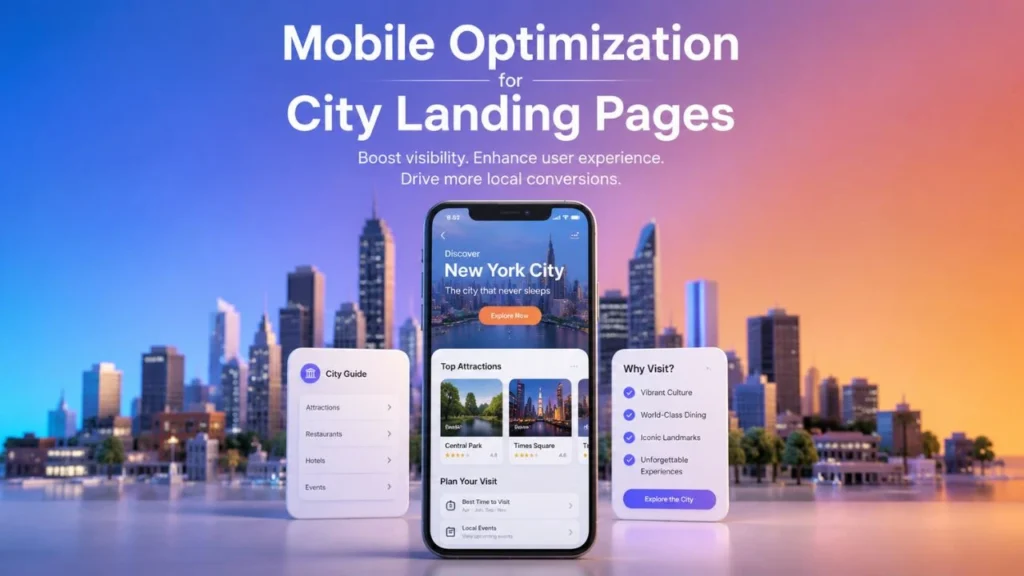
- Mobile users searching near me queries abandon pages three seconds faster than desktop visitors. City landing pages must deliver fast loading experiences to hold attention. Page speed optimization becomes essential when targeting local search intent in competitive markets.
- A local plumbing service in Austin noticed their mobile traffic dropping after Google rolled out mobile-first indexing updates. Visitors from near me searches would leave before seeing service options. The team identified that heavy images and poorly placed contact buttons caused the issue.
- After implementing targeted fixes, dwell time increased noticeably on their city landing page. The changes focused on image optimization, button placement adjustments, and adding mobile-specific local FAQs. These updates helped improve conversion optimization for mobile visitors searching for location specific services.
- Image files were compressed without losing quality, reducing load times across the Austin service area page. Contact buttons were moved to the top section for thumb-friendly access. Local FAQs addressed common questions about emergency response times and neighborhood coverage areas.
Measuring and Tracking City Ranking Performance
- Weekly rank snapshots capture noise while monthly trend analysis reveals whether city authority actually increased. Local serp monitoring dashboards help separate these patterns from random fluctuations that appear in search results.
- Start by selecting your target cities and service keywords in the dashboard setup screen. Enter each city name modifier separately to avoid mixing results from different locations during data collection.
- Next, configure filters to exclude branded traffic. Add your company name and common misspellings to the exclusion list so reports reflect only non-branded, location-specific queries.
- Set the reporting frequency to monthly and choose a date range that spans at least three months. This allows the system to calculate trend lines that show real movement in city rankings over time.
- Review the initial data pull for accuracy before saving the dashboard configuration. Check that each city appears as a separate row or tab and that branded terms do not appear in the results.
- Common error messages include location mismatch warnings and insufficient data alerts. Adjust the city radius or keyword list when these appear to ensure accurate tracking.
- Save the dashboard view and schedule automated exports. This creates consistent records that track progress across all geo-targeted landing pages without manual updates each week.
Common Mistakes to Avoid in Local SEO
Many teams implement location pages then accidentally block them from indexing through overly restrictive robots rules. Search engines cannot discover these geo-targeted landing pages when the directives prevent proper crawling. This mistake directly reduces visibility in city rankings and prevents location-specific keywords from appearing in results.
Teams often create multiple city landing pages with similar content across different locations. Search engines identify these as duplicate content issues and may choose not to rank any of them in local pack rankings. Without proper canonical tags or unique city-specific content, these pages compete against each other instead of ranking for their intended service area pages.
Many websites fail to optimize crawl budget when managing hundreds of location pages. Search engines allocate limited resources to scan each site, and unoptimized structures waste this budget on low-value pages. Proper crawl budget optimization ensures that important city pages receive attention while less critical sections do not consume unnecessary resources.
Teams frequently misconfigure hreflang tags across city pages intended for different geographic regions. When these tags point incorrectly, search engines cannot determine which version to display for specific locations. This error causes pages to lose visibility in relevant near me searches and prevents proper ranking for local search intent across multiple cities.
Common problems also include neglecting indexation issues that arise from JavaScript-heavy implementations on location pages. Search engines may struggle to render content properly when technical barriers exist. Regular audits help identify these problems before they impact organic search rankings and local visibility across service area pages.
Conclusion
Local landing page SEO is essential for businesses looking to improve visibility across multiple cities and capture location-based search traffic. By creating unique city-specific pages, targeting relevant local keywords, optimizing on-page elements, implementing structured data, and maintaining consistent citations, businesses can strengthen their local search presence and improve city rankings. Combined with an optimized Google Business Profile and ongoing performance tracking, these strategies help search engines better understand your service areas and connect your business with customers actively searching for solutions nearby. Consistent optimization and local relevance remain the foundation of long-term success in competitive local search results.
Frequently Asked Questions
What is Local Landing Page SEO for City Rankings?
Local Landing Page SEO for City Rankings is the practice of optimizing dedicated city-specific landing pages with targeted keywords, on-page elements, and local signals to improve visibility in search results for users searching within or for a particular city.
How does Local Landing Page SEO for City Rankings improve local search visibility?
Local Landing Page SEO for City Rankings improves local search visibility by aligning page content, meta data, schema markup, and internal linking with city-focused search intent, helping search engines understand relevance and rank the pages higher for location-based queries.
What are the key elements of Local Landing Page SEO for City Rankings?
The key elements of Local Landing Page SEO for City Rankings include unique city-specific content, localized title tags and meta descriptions, proper heading structure with city keywords, NAP consistency, local schema markup, high-quality backlinks from city directories, and mobile-friendly design.
Why should businesses create separate pages for Local Landing Page SEO for City Rankings?
Businesses should create separate pages for Local Landing Page SEO for City Rankings because a single generic page cannot effectively target multiple cities; dedicated pages allow for precise keyword optimization, unique content, and stronger local relevance signals that search engines reward.
How long does it take to see results from Local Landing Page SEO for City Rankings?
Results from Local Landing Page SEO for City Rankings typically appear within 3 to 6 months, depending on competition, existing domain authority, the quality of on-page optimization, and the strength of local citations and backlinks built for each city page.
What tools can help with Local Landing Page SEO for City Rankings?
Tools that help with Local Landing Page SEO for City Rankings include Google Search Console for performance tracking, Google Keyword Planner and Ahrefs for city-specific keyword research, BrightLocal or Whitespark for local citation building, and schema generators for proper structured data implementation.