Many local businesses do not serve customers from a fixed shop or office. They visit homes, offices, apartments, stores, and commercial spaces. For these businesses, visibility depends on how clearly Google understands where they work, what they offer, and why nearby customers should trust them. This is where service area SEO becomes useful.
A plumber may serve several nearby towns. An electrician may cover multiple neighbourhoods. A cleaning provider may work across different housing complexes. A digital agency may support clients across a city and nearby regions. In each case, the goal is not just traffic. The real goal is local business leads from people who are ready to call, enquire, book, or request a quote.
The purpose of this guide is to explain how service area SEO helps local businesses attract customers from the areas they serve without creating weak pages or stuffing keywords. You will learn how to plan service areas, improve Google Business Profile, build location pages, support Google Maps visibility, and measure real lead results.
Table of Contents
What Is Service Area SEO?
Service area SEO is the process of improving a business website and local presence so it can appear for searches in the locations it serves. It is especially useful for businesses that travel to customers instead of relying only on walk in visits.
For example, a home repair company may want to appear when someone searches for repair help in a nearby city. A cleaning company may want visibility for neighbourhood searches. A marketing agency may want enquiries from businesses across different local zones.
This approach combines website content, Google Business Profile, local citations, reviews, service pages, and location signals.
Why Service Area Businesses Need Local Search Visibility
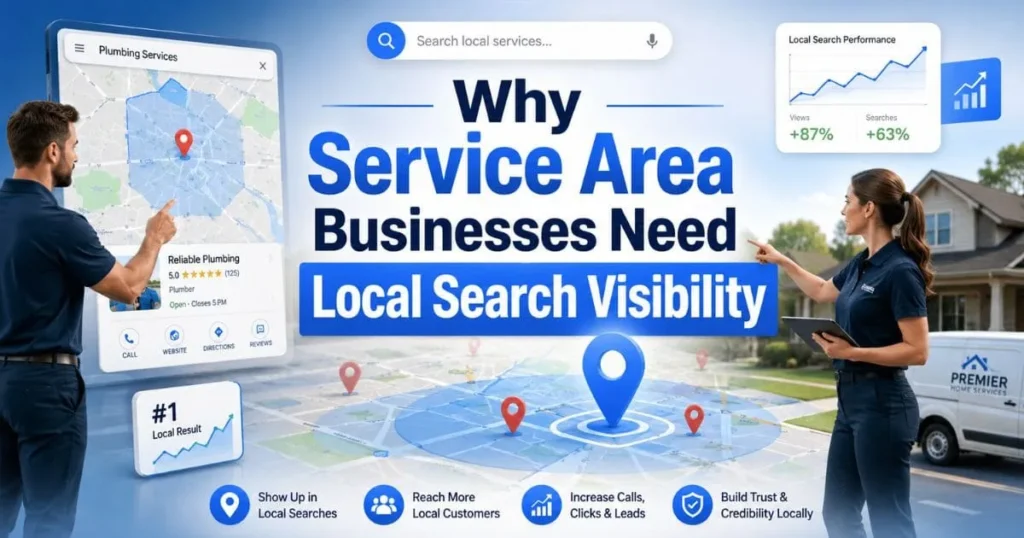
Customers searching for local services often have strong intent. They are not casually browsing. They may need fast help, a quote, a phone call, or a trusted provider nearby. That is why local SEO for service area businesses is important.
When someone searches for a service with a city, area, or “near me” phrase, Google tries to show results that match the service, location, and trust level. A business that clearly explains its coverage areas has a better chance of attracting qualified enquiries.
This is also where service area business SEO becomes different from normal website SEO. A normal business may focus on broad keywords, while a service provider must show relevance for both service and location.
How Service Area SEO Connects With Lead Generation
A good local search plan should not only increase impressions. It should increase calls, forms, WhatsApp messages, bookings, and quote requests. That is why businesses often connect this strategy with local lead generation SEO.
The strongest results usually come from combining:
- Helpful service pages
- Clear location coverage
- Google Business Profile accuracy
- Customer reviews
- Local citations
- Strong calls to action
- Useful FAQs
- Internal links
A proper setup supports local SEO for lead generation because the business appears for users who already need the service.
Keyword Mapping Table for the Article
| Keyword | Search Intent | Suggested Content Placement |
|---|---|---|
| local SEO strategy for service businesses | Informational | Strategy section |
| service area optimization | Informational | Planning section |
| local search visibility | Informational | Visibility section |
| Google Maps ranking | Informational | Maps section |
| local pack ranking | Informational | GBP section |
| location based SEO | Informational | Location page section |
| nearby customer searches | Voice and local intent | Voice search section |
| local service pages | Informational | Website structure section |
| city specific landing pages | Informational | Location page section |
| area specific SEO pages | Informational | Content quality section |
| local organic traffic | Informational | Measurement section |
| high intent local keywords | Informational | Keyword research section |
| local business ranking | Informational | Ranking factors section |
| customer calls from Google | Commercial | Lead tracking section |
| local service leads | Commercial | Lead generation section |
| lead generation for local businesses | Commercial | Strategy section |
How Google Business Profile Supports Service Area Businesses
Google Business Profile is one of the most important assets for a local company. It helps the business appear in Google Search and Maps, and it gives customers useful information such as phone number, services, photos, reviews, hours, and location details.
For a business that visits customers, the Google Business Profile service area tells Google and users where the business operates. This can include cities, postal codes, or nearby regions.
How to Set Up Service Areas Properly
A correct GBP service area setup should include only the places where the business can actually serve customers. Adding too many locations without real coverage can create poor user experience.
A strong profile should include:
- Accurate business name
- Correct primary category
- Relevant services
- Real service areas
- Updated business hours
- Fresh photos
- Clear description
- Honest reviews
- Correct phone number
- Website link
This is part of Google Business Profile optimization, and it directly supports customer trust.
Website Pages Needed for Service Area Growth
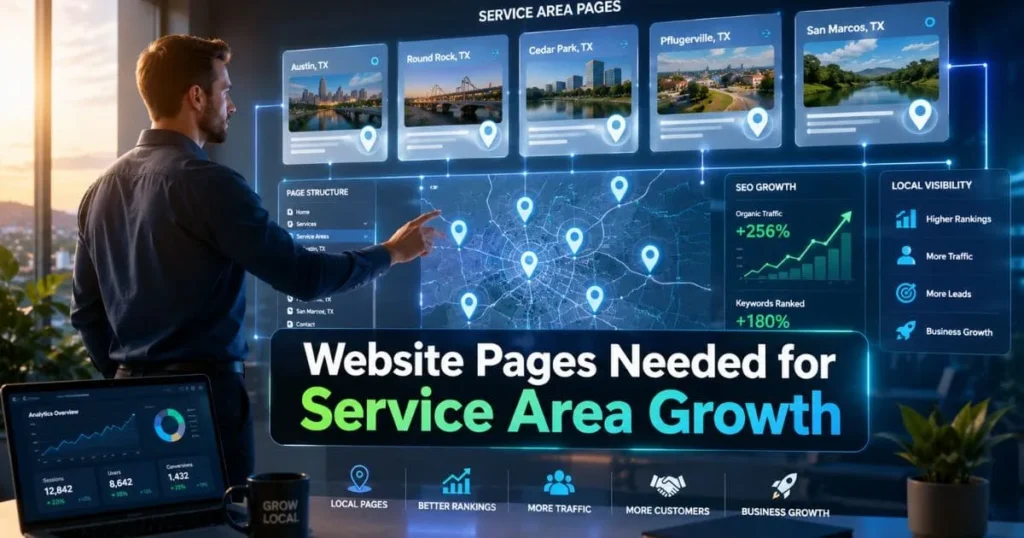
Google Business Profile alone is not enough. The website should also explain services clearly. A business may need a main service page, supporting blog posts, topical clustering content, and local pages for important areas.
This is where service area pages SEO becomes useful. These pages help Google understand which services are available in specific locations.
Main Service Page
The main service page should explain the core service in detail. It should answer what the service includes, who needs it, what problems it solves, and how customers can contact the business.
Local Service Pages
Local service pages focus on how a service is available in a specific area. They should not be copied versions of one another. Each page should provide unique details.
City and Area Pages
City specific landing pages can work well when each page has useful content. Businesses can also build area specific SEO pages for important neighbourhoods, suburbs, or service zones.
How to Create Useful Service Area Pages
Many businesses create weak pages by changing only the location name. This does not help users. A strong page should explain why the service matters in that area.
A useful page may include:
- Service introduction
- Local customer problem
- Areas covered
- Service process
- Reviews or trust signals
- Frequently asked questions
- Contact details
- Clear call to action
This answers the common question: how to create city pages for local SEO without making the content thin.
How to Choose the Right Local Keywords
Keyword research should focus on buyer intent, not only search volume. A small number of targeted searches can bring better leads than a large number of low intent visits.
Use phrases such as:
- Service plus city
- Service plus neighbourhood
- Service near me
- Best provider in city
- Emergency service in area
- Affordable service near me
These are known as high intent local keywords because users are closer to taking action.
This also helps explain how to target nearby customers with SEO in a practical way.
Local SEO Checklist Table
| Task | Why It Matters | Priority |
|---|---|---|
| Set accurate service areas | Helps Google understand business coverage | High |
| Create unique local pages | Supports location relevance | High |
| Add service details to GBP | Helps users compare options | High |
| Build local citations | Improves business consistency | Medium |
| Maintain NAP consistency | Builds trust across platforms | High |
| Collect honest reviews | Improves user confidence | High |
| Add FAQs | Supports AEO and voice search | Medium |
| Track calls and forms | Measures lead quality | High |
| Add internal links | Helps users and search engines | Medium |
| Review page quality | Prevents thin location content | High |
How to Improve Google Maps Visibility
Google Maps can be a major lead source for service businesses. A business that appears in map results can receive calls from people who are ready to act.
To improve Google Maps ranking and rank Google Maps in Kolkata, focus on relevance, distance, and prominence. Relevance means the profile matches the search. Distance relates to the user or searched place. Prominence reflects how trusted and known the business appears.
For better local pack ranking, improve the profile, website content, reviews, citations, and service clarity.
Businesses often ask how to rank in Google Maps for multiple service areas. The answer is not to add random locations. The better approach is to create strong local signals, useful pages, and accurate business information.
Importance of Citations and NAP
Citations are mentions of a business on directories, local platforms, social profiles, and listing sites. Local citation building helps search engines confirm that the business is real and consistent.
NAP consistency means the name, address, and phone number should stay the same across trusted platforms. If Google sees conflicting details, it can reduce confidence in the listing.
A strong service area business listing should match the website, social profiles, and Google Business Profile.
Reviews and Trust Signals
Here is the revised version with local citation building added naturally without repetition:
Reviews influence how customers choose a provider. A business with helpful, recent, and genuine reviews can gain more trust than a business with no customer feedback. Along with local citation building, reviews help strengthen a business’s online presence by showing both users and search engines that the business is active, reliable, and relevant to nearby searches.
Reviews can also support local business ranking because they add real world trust signals. Customers often read reviews before calling, especially for home services and professional support.
To get more reviews:
- Ask after service completion
- Share a simple review link
- Respond to every review
- Avoid fake or forced reviews
- Encourage customers to mention the service naturally
This can help increase customer calls from Google because users feel more confident before contacting the business.
Service Area SEO for Different Local Businesses
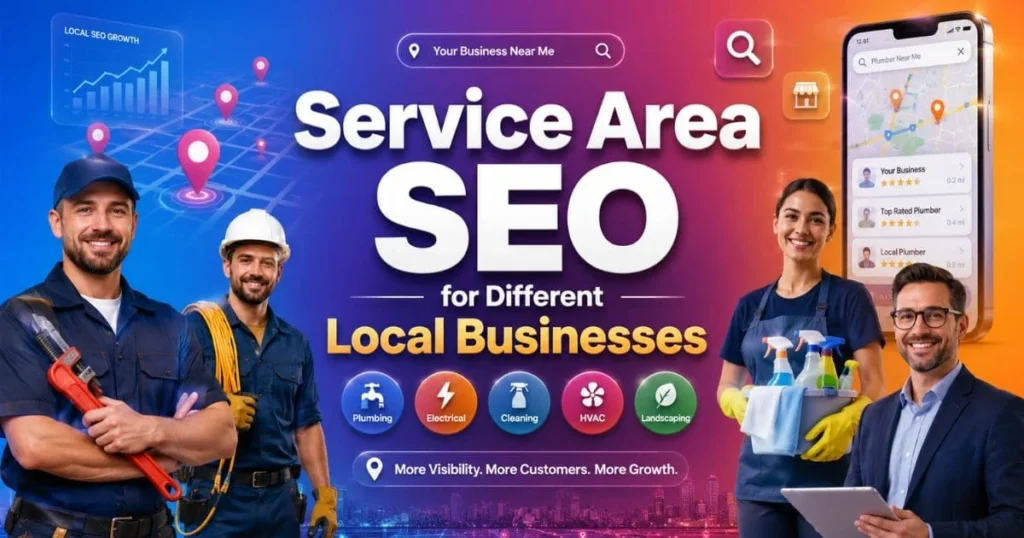
This strategy works well for many business types. For example, SEO for plumbers electricians roofers and home services usually requires strong location coverage, service clarity, emergency intent targeting, and map visibility.
It also works for:
- Cleaning providers
- Pest control businesses
- AC repair companies
- Interior designers
- Local consultants
- Digital marketing agencies
- Home improvement teams
- Appliance repair providers
The idea is simple. If customers search by service and location, the business needs a page and profile structure that matches that behaviour.
Local SEO for Businesses Without a Storefront
Many businesses do not want to show a public office address. That does not mean they cannot build visibility. Local SEO for businesses without a storefront focuses on service areas, real customer coverage, helpful content, and trust building.
These businesses should be extra careful with location claims. They should only target areas where they can genuinely serve customers.
This is also where service based business SEO becomes useful because the strategy is built around customer visits, service delivery, and lead conversion instead of walk in traffic.
How to Get More Local Leads From Google
Businesses often ask how to get more local leads from Google. The answer is to align search intent with clear conversion paths.
A strong local lead system should include:
- Clear phone number
- Fast loading pages
- Short enquiry form
- WhatsApp or booking option
- Trust signals near the call to action
- Location based FAQs
- Service proof
- Mobile friendly layout
This helps turn local organic traffic into actual enquiries.
If the business wants to know how to get more calls from Google Business Profile, it should improve service details, add photos, respond to reviews, keep hours updated, and connect the profile with a strong website page.

Best SEO Strategy for Service Area Businesses
The best SEO strategy for service area businesses is not to create hundreds of low quality location pages. The better method is to choose the most valuable areas and build useful content around real service coverage.
A good local SEO strategy for service businesses includes:
H4: Step 1: Identify Priority Locations
Choose areas based on demand, travel ability, competition, and lead value.
H4: Step 2: Match Services With Local Intent
Map each service to the areas where customers search most often.
H4: Step 3: Create Helpful Pages
Write unique content for each important location.
H4: Step 4: Improve Google Business Profile
Keep the profile complete, active, and accurate.
H4: Step 5: Track Leads
Measure calls, forms, and bookings from each location.
This also answers how local businesses can rank in nearby cities without using copied content.
Case Study
A local service provider was serving several nearby areas but had only one general service page. The website received some traffic, but most visitors did not contact the business. The Google profile also had limited service details, old photos, and unclear coverage areas.
The business improved its profile, added proper service areas, updated services, collected customer reviews, and created helpful pages for its most important locations. Each page explained the service, local customer needs, common questions, and contact options.
After the changes, the business saw better visibility for service plus location searches. Phone enquiries improved, form submissions became more relevant, and users spent more time on local pages. The biggest improvement came from matching content with real service coverage instead of targeting every possible city.
This shows how service area SEO helps local businesses get leads when the strategy is clear and user focused.
Common Mistakes to Avoid
Targeting Too Many Areas
Do not target areas where the business cannot provide service. This creates poor leads and weak trust.
Copying the Same Page
Changing only the city name is not enough. Each page needs unique value.
Ignoring Reviews
Customers trust reviews before calling. A weak review profile can reduce conversions.
Forgetting Mobile Users
Most local searches happen on phones. A slow or confusing mobile page can lose leads.
Not Measuring Leads
Traffic is useful, but leads matter more. Track calls, forms, and bookings.
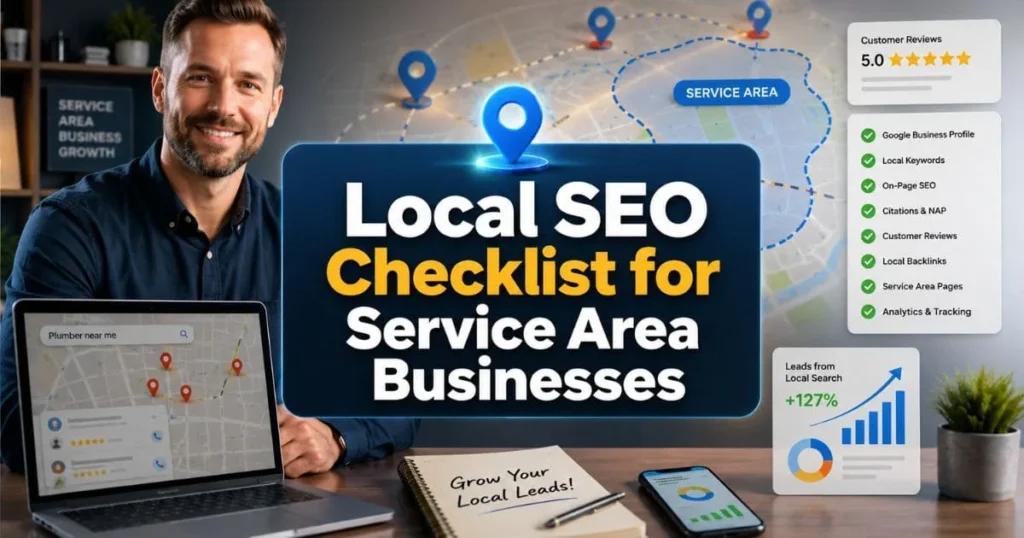
Local SEO Checklist for Service Area Businesses
A simple local SEO checklist for service area businesses should include:
- Complete Google profile
- Accurate services
- Real service areas
- Unique location pages
- Consistent NAP
- Local citations
- Reviews
- Internal links
- Schema markup
- Lead tracking
This checklist supports how to improve local visibility for service businesses while keeping the strategy practical.
Buyer Intent Keywords and When to Use Them
Some keywords are closer to conversion. They should be used carefully on service pages, not forced into every blog post.
Examples include:
- local SEO services for service area businesses
- service area SEO services
- local SEO company for small business leads
- hire local SEO expert for service business
- best local SEO agency for lead generation
These terms are useful when the page has commercial intent. A blog post can mention them lightly, but service pages should handle most of the sales focused language.
FAQ
What is service area optimization?
It means improving your website, Google profile, listings, and content so customers from your target service locations can find and contact your business.
Why is location based SEO important?
Location based SEO helps search engines connect your business with people searching in specific cities, neighbourhoods, or nearby areas.
How do service area pages help local businesses?
They explain where a service is available and help users find relevant information for their area.
How do I optimize Google Business Profile service areas?
To answer how to optimize Google Business Profile service areas, add only real locations, choose the right business category, list your services clearly, keep contact details accurate, and update the profile often.
How do I rank service area pages on Google?
To answer how to rank service area pages on Google, create original local content, add internal links, use clear headings, include FAQs, improve page speed, and connect the page with your main service structure.
Can service area SEO tips for small businesses help with low budgets?
Yes. Service area SEO tips for small businesses often start with simple actions such as fixing business details, improving the Google profile, creating a few useful local pages, and asking happy customers for reviews.
What are local service leads?
Local service leads are enquiries from nearby people who need a specific service and may contact the business by phone, form, message, or booking request.
Is lead generation for local businesses only about ranking?
No. Lead generation for local businesses also depends on trust, page clarity, reviews, mobile experience, and easy contact options.
Conclusion
Local service businesses need more than general SEO. They need clear service coverage, useful local pages, accurate listings, customer trust, and strong conversion paths. A business that explains where it works and what it provides can attract better enquiries from nearby customers.
The best results come from combining website quality, Google Business Profile, citations, reviews, and lead tracking. Instead of creating thin pages for every city, focus on real locations, real services, and real customer needs. That is how local search becomes a practical source of calls, enquiries, and long term growth.