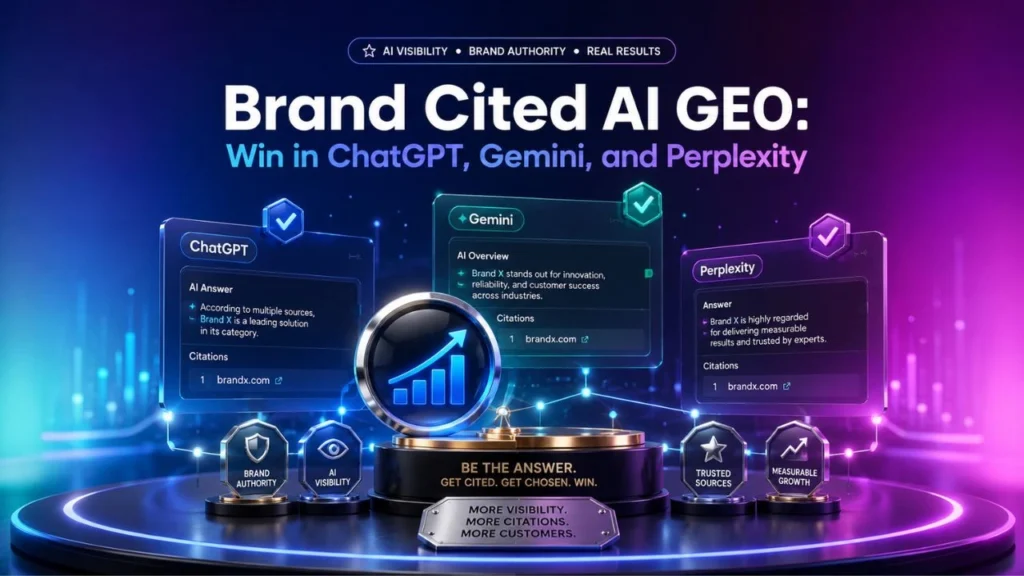
Search visibility has changed. A strong page still needs solid SEO, but that is no longer the full job. More people now ask full questions in AI powered environments, expect summarized answers, and decide what to read next based on which sources get cited inside those answers. Google says AI features in Search surface links to help people explore the web, OpenAI says ChatGPT Search provides timely answers with links to relevant sources, and Perplexity says every answer includes citations to original sources. That shift makes brand cited AI GEO an important topic for businesses that want visibility beyond classic rankings.
That is where brand cited AI GEO becomes useful. It sits at the meeting point of SEO, entity clarity, source trust, answer formatting, and content design. It is not a replacement for SEO. It is a practical way to make the content more usable for systems that summarize, compare, and cite information at speed. When done well, it supports classic rankings, AI visibility, voice discoverability, and stronger branded recall at the same time.
This article is built as a GEO guide for businesses that want to understand what citation visibility really involves. It also covers where answer engine optimization for AI citations fits, how generative engine optimization services are often positioned, and what content choices help a page become easier to surface across ChatGPT, Gemini, Perplexity, and Google’s AI experiences. The goal is not to chase shortcuts. The goal is to publish content that is useful enough, clear enough, and trustworthy enough to be chosen.
Table of Contents
What brand cited AI GEO really means?
At a simple level, brand cited AI GEO means shaping your digital presence so that AI systems are more likely to mention your brand, cite your page, or use your page as a supporting source in an answer. Traditional SEO often focuses on rank, crawlability, internal linking, topical relevance, and click through performance. Those still matter. But citation visibility adds another layer: whether the page can be easily extracted, summarized, attributed, and trusted.
OpenAI describes ChatGPT Search in a similar direction. It says users can ask in a more natural conversational way, continue with follow up questions, and receive answers with links to relevant web sources. Perplexity likewise emphasizes that its answers include citations to the original sources. Taken together, these signals point to a shared pattern: pages that are easy to interpret and easy to attribute have a better chance of being useful in AI generated answers.
So brand cited AI GEO is not about trying to force inclusion with a hidden trick. It is about improving the likelihood that your content can function as a reliable source. That means your brand identity should be clear, your page purpose should be obvious, your claims should be grounded, and your structure should support fast extraction.
Why citation visibility matters more than generic visibility?
A page can rank and still fail to shape the conversation if another source gets cited inside the answer layer first. That is the practical challenge many businesses now face. The first touchpoint may happen before a traditional click ever occurs. A user asks a question, receives a synthesized answer, scans the cited sources, and mentally remembers the names that appear trustworthy. In that environment, cited visibility becomes a brand discovery channel.
For ChatGPT, the opportunity is also explicit. OpenAI says ChatGPT Search connects people with original, high quality content from the web and includes links to sources, and its help documentation explains that cited sources can be viewed directly in search responses. Perplexity makes source transparency central to the product experience. When source visibility is built into the interface, being a cited source is not a side benefit. It becomes part of how users evaluate information quality.
That is why brand cited AI GEO deserves its own treatment. It is not only about traffic. It is also about authority signaling, memorability, and source level trust. When your brand appears as the cited source behind a clear answer, it gains a different kind of visibility than a simple rank position.
How AI systems are more likely to choose a source?
No outside publisher can control exactly what an AI system cites, but there are strong patterns in what makes a page usable as a source.
The fourth pattern is accessibility of meaning. OpenAI’s publisher FAQ says public websites can appear in ChatGPT Search if they are discoverable and not blocking OAI SearchBot for summaries and snippets. The same document notes that publishers can track referral traffic from ChatGPT via utm_source=chatgpt.com. That is a practical reminder that discoverability still matters at the technical level, while clarity and trust matter at the content level.
So the working question for brand cited AI GEO is not “How do I force a mention?” It is “How do I make this page easy to discover, easy to interpret, easy to trust, and easy to cite?”
The foundation of brand cited AI GEO
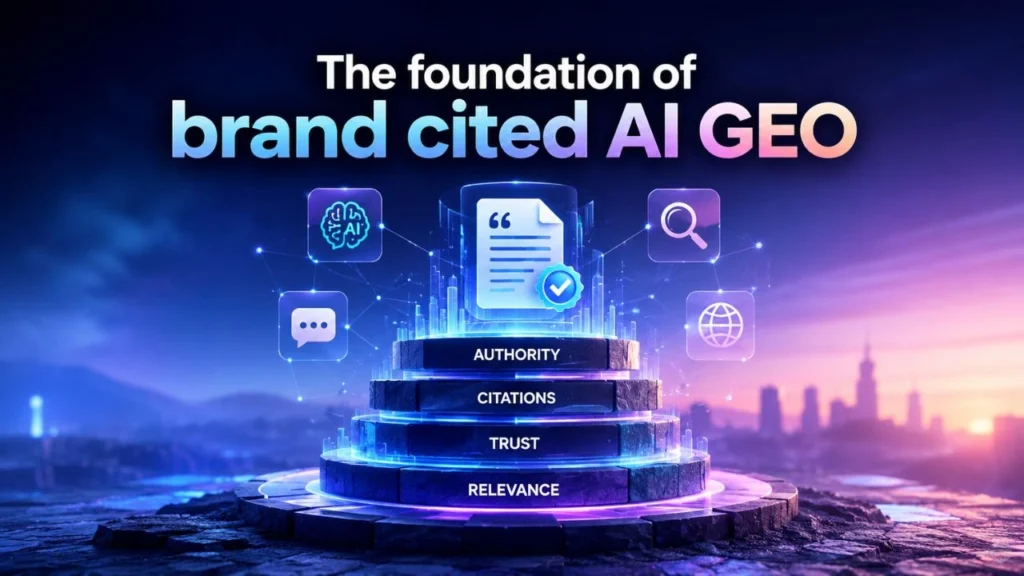
A strong brand cited AI GEO strategy starts with the brand itself, not just the article. If the website has weak entity signals, inconsistent naming, thin service pages, and no clear evidence of expertise, even good articles will have a weaker foundation.
Start with brand identity. The brand name should be consistent across the site. Service names should match the language used in the main navigation and relevant pages. The about page should clearly describe what the business does, who it serves, and what topics it genuinely covers. Contact information should be easy to find. Authors, editors, or responsible brand owners should be visible where appropriate. None of that is glamorous, but it helps systems and users connect content to a real entity.
Then move to topical identity. A site that publishes one article about AI visibility and then shifts into unrelated material sends a weaker signal than a site with a clear topic cluster. For a business trying to rank and get cited around AI search visibility, the site should build a connected cluster around search behavior, AI answers, content structure, entity optimization, source trust, schema, and conversational search. This gives the website a clearer center of gravity.
Why people first content still sits at the center?
There is a temptation in AI search conversations to treat everything as a formatting problem. Structure matters, but it is not enough. Google is very clear that its ranking systems prioritize helpful, reliable information created to benefit people, not content made mainly to manipulate rankings. It also says generative AI can help with research and structure, but publishing many pages without adding value may violate the spam policy on scaled content abuse.
That matters for businesses chasing AI visibility because citation worthy content is usually content that says something cleanly and usefully. Thin rewrites, shallow summaries, and pages created just to target a phrase rarely become memorable sources. Even if they get indexed, they often fail the harder test: whether a user or a system sees them as worth referencing.
For that reason, brand cited AI GEO should always begin with content quality questions. Does the page answer a real question? Does it define terms clearly? Does it offer a strong explanation without unnecessary noise? Does it help the reader move from confusion to understanding? If the answer is no, then no amount of keyword placement will fix the deeper issue.
Building pages that are easy to cite
If you want better odds of being cited, design pages with extraction in mind.
Start with direct introductions. The first paragraph should explain the topic in plain language. That opening should help both human readers and retrieval systems understand the exact subject quickly. It should not spend several paragraphs circling around the topic.
Use question driven headings. A heading that mirrors how users search has two benefits. It improves relevance for long tail search, and it makes the section easier to match with a prompt or follow up query. This is one of the most practical forms of answer engine optimization for AI citations because it aligns the page with how answers are retrieved.
Structured data, metadata, and machine readable context
Structured data should be treated as reinforcement, not decoration. Google says it uses structured data to understand page content and information about the web and the world more broadly, and that structured data can make pages eligible for rich results when it follows the rules and matches visible content. Google’s later AI search guidance adds that structured data is useful in a machine readable way that its systems consider.
For a business pursuing brand cited AI GEO, the point is not to add every schema type available. The point is to add the markup that supports real understanding. If the site has strong brand information, then organization markup can help reinforce it. If an article has a real author, then author related signals matter. Breadcrumbs can support hierarchy. FAQ structure can reinforce question answering content when used properly and honestly.
Metadata still matters too. Titles and descriptions help frame the page. Google’s guidance on generative AI content specifically notes that accuracy, quality, and relevance should extend to metadata like titles, descriptions, structured data, and alt text, because those elements can appear in Search results. That is a useful reminder that citation readiness starts before the body copy.
Technical access and citation eligibility

Even the best page needs technical eligibility.
Google says that to appear as a supporting link in AI Overviews or AI Mode, a page must be indexed and eligible to be shown in Search with a snippet. There are no additional technical requirements beyond the standard Search framework. That is a practical way to think about Gemini related visibility in Google’s search environment as well: if the page is weak on indexation, snippets, or technical basics, it is already limiting itself.
OpenAI’s documentation is similarly direct. OAI SearchBot is used to surface websites in ChatGPT search results, and sites opted out of OAI SearchBot will not be shown in ChatGPT search answers, though they may still appear as navigational links. The publisher FAQ adds that public websites can appear in ChatGPT Search if OAI SearchBot is not blocked, and that noindex can be used when a publisher does not want pages surfaced.
So a serious GEO guide for businesses should include a technical review of crawl access, index status, snippet controls, canonical alignment, and structured data validity. Citation strategy is not just a writing task. It is also a visibility eligibility task.
What answer engine optimization for AI citations looks like in practice?
The phrase answer engine optimization for AI citations can sound abstract until it is translated into page level actions.
It starts with question mapping. Identify what the page is answering, and then map primary, secondary, and follow up questions around that intent. A page about citation visibility should answer not only what it is, but why it matters, how it differs from SEO, what improves citation likelihood, what harms it, and how a business can act on it. Follow up questions are especially important because conversational search often expands a topic across multiple turns. Google and OpenAI both describe their AI search experiences as useful for deeper exploration and follow ups.
Next comes passage design. Important claims should be written in compact, quotable blocks. That does not mean flattening the writing. It means making key ideas clean enough to stand alone. A strong passage often defines a term, states a reason, or explains a distinction in one focused paragraph.
That is what answer engine optimization for AI citations looks like when it moves from jargon to workflow.
Voice search and natural language relevance
Voice optimization is often treated as a separate project, but it fits neatly inside brand cited AI GEO. Spoken queries tend to be longer, more natural, and more intent rich. AI search interfaces encourage the same style. Users ask full questions, compare options, request summaries, and continue with clarifying follow ups. Google’s AI search guidance and OpenAI’s search product messaging both reflect that conversational pattern.
To support voice style discovery, headings should mirror real language. Instead of only using compressed SEO labels, use headings that sound like questions a user might actually ask. The copy beneath those headings should answer in plain sentences before moving into depth.
Sentence rhythm matters too. Complex ideas can stay intelligent without sounding dense. A clear spoken style is often easier to read, easier to summarize, and easier to cite. It also supports assistive interfaces and faster comprehension.
Platform specific thinking for ChatGPT, Gemini, and Perplexity
It helps to tailor the mindset without assuming each system works in the exact same way.
For ChatGPT, discoverability and citation friendly structure matter. OpenAI says public websites can appear in ChatGPT Search, cites sources in search responses, and recommends allowing OAI SearchBot to ensure content can be discovered, surfaced, clearly cited, and linked. If a site blocks the search bot or makes the page hard to parse, it reduces its opportunity.
For Google’s AI features, the message is not to invent a separate optimization playbook detached from SEO. Google explicitly says the same SEO best practices remain relevant and that there are no special extra requirements for AI Overviews or AI Mode. It also reinforces structured data, snippet eligibility, and helpful reliable content. That suggests a disciplined search foundation is still the right starting point for Gemini aligned visibility within Google’s ecosystem.
Across all three, the practical overlap is strong: publish discoverable pages, make the meaning obvious, reinforce the brand entity, and write passages that are useful enough to cite.
Common mistakes that weaken citation potential
- The first mistake is writing pages that chase keywords but do not answer the question well. This often happens when the page is built around density targets instead of clarity. The result is copy that sounds repetitive, loses precision, and becomes less attractive as a source.
- The second mistake is creating too many similar pages with too little value added. Google’s guidance on generative AI content warns against using AI or similar tools to generate many pages without adding value, because that may violate spam policy around scaled content abuse. More pages do not automatically create more authority. Often they dilute it.
- The third mistake is weak brand attribution. If articles have no real author or responsible organization signals, unclear about information, and inconsistent naming, they are harder to trust. A source that cannot be clearly tied to a known entity is at a disadvantage.
- The fourth mistake is burying answers. Users and AI systems both benefit from directness. Long vague openings often reduce the usable value of a page.
- The fifth mistake is misusing technical controls. Google’s own documentation makes clear that nosnippet and restrictive max-snippet settings can affect how content appears in AI Overviews and AI Mode. Businesses sometimes limit previews without fully understanding the visibility tradeoff.
- The sixth mistake is treating brand cited AI GEO as if it exists outside normal search quality. It does not. Pages still need indexability, technical health, topical relevance, internal links, and clean information architecture.
A practical GEO guide for businesses
A useful GEO guide for businesses should begin with an audit, not with a rewrite frenzy.
- First, identify the pages that matter most. These are usually service pages, key commercial education pages, top traffic informational pages, and core topic cluster assets. Not every URL needs the same level of treatment.
- Second, check technical eligibility. Are the important pages indexed? Are snippets allowed? Is crawl access clean? Are there conflicting canonical signals? Is structured data valid and aligned with visible content? These checks create the baseline.
- Third, review page clarity. Does the first screen explain the topic? Are headings specific? Is there a clear definition or answer under each section? Are the strongest passages easy to quote?
- Fourth, review entity signals. Does the site clearly identify the brand, services, authors, and topical focus? Does the page connect logically to other related assets on the site?
- Fifth, improve internal linking around topic clusters. Internal links help search engines understand thematic relationships and help users move deeper into a subject. They also reduce isolation, which makes important pages feel more central to the site.
- Sixth, add FAQ coverage based on real user language. This helps with long tail search, voice style phrasing, and follow up answer patterns.
- Seventh, refresh rather than endlessly replace. Many pages improve more from restructuring and clarifying than from complete rewriting. Add stronger openings, sharper headings, cleaner definitions, and more useful summaries.
This is the kind of workflow businesses can actually sustain.
Where generative engine optimization services fit?
The market for generative engine optimization services has expanded quickly because businesses know that AI visibility matters, but they are not always sure what to do first. The problem is that the label can cover very different levels of quality.
Useful generative engine optimization services generally include content audits, entity clarity reviews, technical eligibility checks, answer formatting improvements, structured data review, internal linking refinement, FAQ expansion, and brand source consistency work. In other words, the work should look like strong search strategy adapted for answer driven environments, not like a mysterious promise to “hack” AI engines.
So generative engine optimization services can be useful, but only when the work is grounded in real content quality and search fundamentals.
How to write content that stays human while remaining optimized?
One of the biggest risks in this area is over optimization. Businesses sometimes hear phrases like brand cited AI GEO or answer engine optimization for AI citations and then start writing in a way that sounds mechanical. That approach usually harms the very thing the content is trying to improve.
A conversational tone does not mean being casual without structure. It means writing the way a thoughtful expert would explain something clearly. Sentences should be natural. Definitions should arrive early. Claims should be restrained and precise. Sections should build logically. Readers should feel guided, not sold to.
This matters because strong source candidates usually read well. They do not feel padded. They do not hide simple ideas behind complicated language. They do not repeat the same phrase every few lines. They sound confident because they are clear.
Measuring progress without guessing
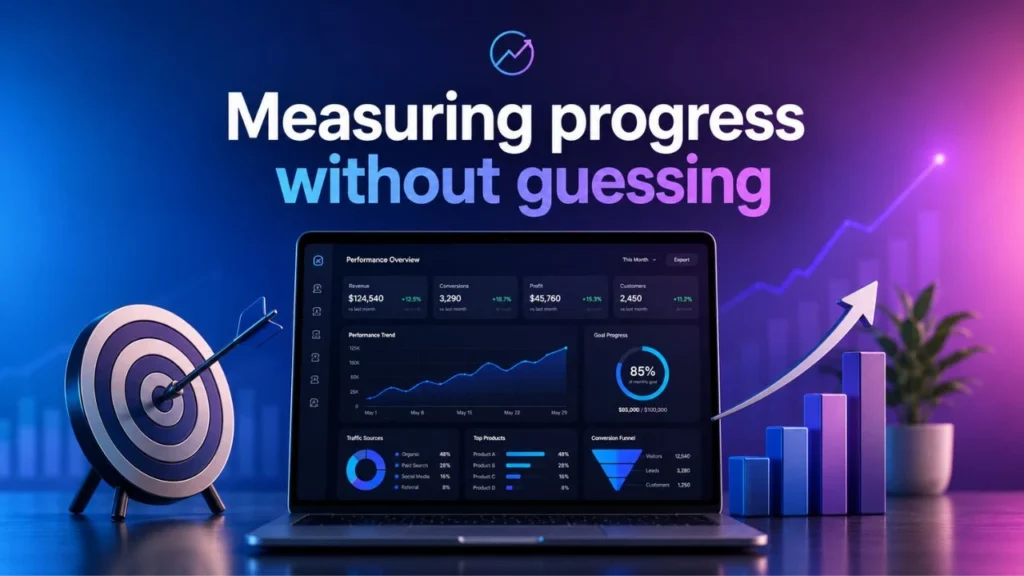
Businesses should avoid judging this work only by one metric. Traditional rankings still matter, but they do not tell the whole story.
Track organic visibility for the target topics. Track branded search interest where possible. Track engagement on refreshed informational pages. Review referrals that may come from AI search environments when available. OpenAI’s publisher FAQ notes that ChatGPT Search referrals include utm_source=chatgpt.com, which can help with measurement.
Also watch whether your pages become more useful. Are bounce patterns improving on educational pages? Are internal clicks increasing? Are more pages earning impressions for conversational queries? Are FAQs and deeper topic sections drawing long tail visibility? These are indirect but useful signals that the page is doing a better job of matching modern search behavior.
Measurement should stay grounded. A single AI mention is not a strategy. A healthier pattern is better discoverability, stronger page quality, better query coverage, and more consistent branded presence over time.
Final thoughts
The reason brand cited AI GEO matters is simple. Search is moving toward systems that summarize, compare, and cite. Businesses that want durable visibility need pages that can still rank, but they also need pages that can be selected as credible sources inside AI answers.
That does not require abandoning SEO. Google’s own guidance says the same SEO best practices remain relevant for AI features, and OpenAI and Perplexity both make source linking part of how their search experiences work. The opportunity is not to replace search fundamentals. It is to build on them with stronger structure, cleaner entities, clearer answers, and more citation ready content.
A strong page for this new environment is usually easy to describe. It is helpful, direct, well organized, technically accessible, and clearly tied to a real brand with a real topic focus. It gives users a useful answer and gives AI systems a reliable source.
That is the real value of brand cited AI GEO. It helps a business create content that is more likely to be found, understood, trusted, and cited across search engines, AI tools, and voice led discovery.
FAQs
What is brand cited AI GEO?
Brand cited AI GEO is the practice of improving a website and its content so the brand is more likely to be cited or linked as a source in AI generated answers. It builds on SEO, content clarity, entity signals, and answer friendly formatting.
Is brand cited AI GEO different from normal SEO?
Yes, but it is not separate from SEO. SEO helps pages become crawlable, understandable, and rankable. Brand cited AI GEO adds a source selection mindset, focusing on whether a page is easy to summarize, trust, and cite in AI answers. Google says the same SEO best practices still apply to AI features in Search.
What is answer engine optimization for AI citations?
Answer engine optimization for AI citations is the practice of structuring content so it directly answers questions, supports follow ups, and presents clean passages that can be surfaced or cited by answer engines and AI search interfaces.
Do generative engine optimization services really help?
Generative engine optimization services can help when they focus on strong content fundamentals, technical visibility, entity clarity, and answer friendly structure. They are less useful when they rely on keyword repetition, mass page production, or unrealistic promises.
How can a business improve its chances of appearing in ChatGPT Search?
OpenAI says public websites can appear in ChatGPT Search and recommends allowing OAI SearchBot if you want your content to be discovered, surfaced, clearly cited, and linked. Strong page structure and clear source quality still matter after that.
How does Google AI search treat website content?
Google says AI Overviews and AI Mode use the same foundational SEO best practices as Google Search overall, with no extra technical requirements beyond standard search eligibility. It also says pages need to be indexed and eligible to be shown with a snippet to appear as supporting links.
Why does structure matter for AI citations?
Structure matters because it helps both users and systems understand what each section is about. Clear headings, concise definitions, short paragraphs, and valid structured data all make content easier to interpret and use. Google says structured data provides explicit clues about page meaning and should match visible content.
Can content be blocked from AI search features?
In some cases, yes. Google’s documentation says nosnippet prevents content from being used as direct input for AI Overviews and AI Mode, while max-snippet can limit how much content is used. OpenAI also provides bot controls for search and training via OAI SearchBot and GPTBot.
Why is this a useful GEO guide for businesses?
This works as a GEO guide for businesses because it focuses on actions that are practical: better content structure, clearer entities, stronger technical access, improved internal linking, and more useful question based writing.