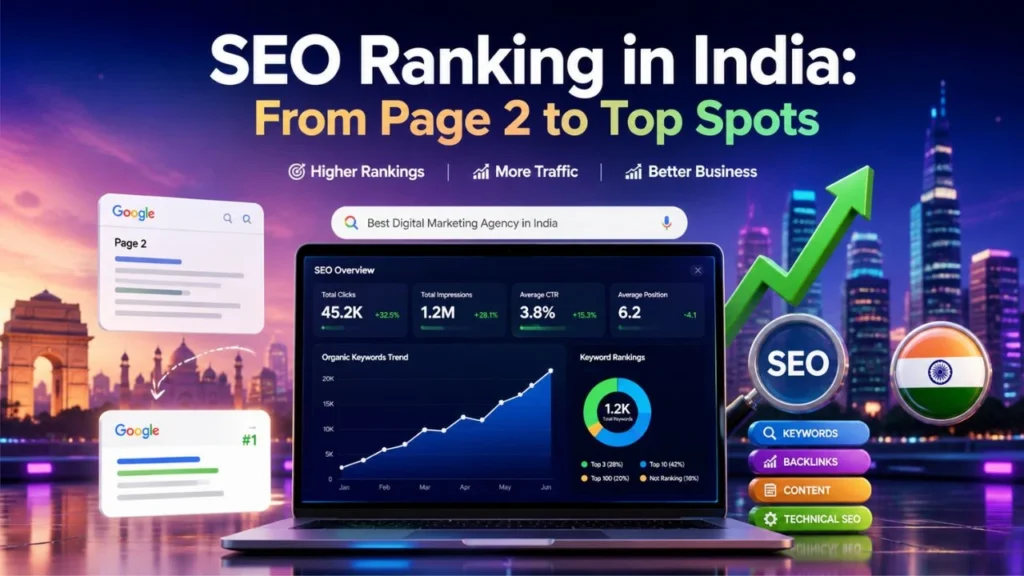
If your website is sitting on page 2, you are not alone. Many businesses invest time in content, update their pages, and still fail to reach the visibility they want. The frustrating part is that page 2 often means your site is close to winning, but not close enough to earn meaningful clicks. That is exactly why improving SEO ranking in India has become such a priority for brands that want real online growth.
The good news is that moving from page 2 to the top spots is possible when you stop chasing random SEO tips and start improving the signals that actually matter. Better intent matching, stronger authority, cleaner technical structure, and more helpful content can make a noticeable difference. When you build around these elements, SEO ranking in India starts becoming a process you can influence, not just a number you keep checking.
Today, search is no longer limited to traditional Google results. Your content also needs to work for AI summaries, voice assistants, answer engines, and people who want quick, reliable solutions. That is why this guide is not just about rankings in the old sense. It is about creating a page that performs across search engines, AI tools, and spoken search queries while giving readers a reason to trust you.
Table of Contents
Why So Many Websites Stay Stuck on Page 2
One of the biggest reasons websites fail to improve SEO ranking in India is weak alignment with search intent. A page may mention the right keyword, but if it does not answer what the user actually wants, search engines will not push it higher. In many cases, the content is either too broad, too shallow, or too focused on the business instead of the searcher.
Another common issue is average content. Many blog posts cover the same surface level points without offering anything more useful, more current, or easier to understand than competing pages. If your article does not help the reader solve a problem faster or better, it will struggle to stand out.
Technical issues also quietly hold websites back. Slow loading pages, poor mobile usability, messy internal linking, duplicate content, missing schema, and weak title tags can stop a page from reaching page 1 even if the topic itself is valuable. In competitive industries, small issues add up quickly.
Then there is the trust factor. Search engines want confidence that the content is reliable. If your page lacks strong author identity, clear expertise, updated information, and supporting trust signals, it becomes harder to compete. That is where E-E-A-T and Google ranking authority come into the picture.
What Actually Drives SEO Ranking in India Today
To improve SEO ranking in India, you need to understand that rankings are rarely influenced by one single factor. Search engines look at a collection of signals that work together.
The first is relevance. Your page has to match the intent behind the search. If someone wants a practical solution, they do not want vague theory. If they want an explanation, they do not want a sales pitch. Strong SEO ranking in India begins when your content matches the real purpose of the query.
The second is quality. Search engines reward content that is complete, clear, structured, and genuinely useful. That means your article should answer key questions, cover important subtopics, and stay readable from beginning to end.
The third is authority. Your site and your content need to look trustworthy. This is where brand presence, author clarity, quality references, consistent topic coverage, and industry relevance all matter.
The fourth is user experience. If your page is difficult to read, slow to load, or frustrating on mobile, it can limit performance. Modern search visibility depends on experience as much as content.
When these pieces work together, SEO ranking in India becomes much stronger over time.
SEO Checklist for Ranking on Google
If you want a practical starting point, this SEO checklist for ranking on Google can help you identify where your page is falling short.
1. Match the page with the right search intent
Before doing anything else, ask whether the page answers the actual query behind the keyword. If the searcher wants a guide, give them a guide. If they want comparison, give them comparison. If they want steps, show them steps.
2. Improve the title tag and meta description
Your title should be clear, relevant, and appealing enough to earn clicks. The meta description should support it with a strong value proposition.
3. Strengthen the introduction
Your opening matters more than many people realize. A clear introduction helps readers and search engines understand the page quickly. It also increases engagement.
4. Cover missing subtopics
Many pages on page 2 are incomplete. They mention the topic but skip related questions users care about. Expanding your content naturally can improve SEO ranking in India.
5. Update outdated information
Freshness matters when the topic changes often. If your article still sounds like it belongs to an earlier search landscape, it can slip behind more current pages.
6. Improve internal linking
Link relevant supporting pages to your target article. This helps search engines understand the importance of the page and improves navigation for users.
7. Fix technical issues
Check indexing, mobile usability, site speed, schema, broken links, and duplicate content. These details matter more than many site owners assume.
8. Add FAQ sections
Questions and answers help with featured snippets, AI summaries, and voice search. They also make the article more useful.
9. Build trust signals
Show who wrote the content, when it was updated, and why readers should trust it.
10. Track performance and refine
A page that almost ranks usually needs ongoing refinement, not a one-time update.
This SEO checklist for ranking on Google is especially useful when you want to move a page from near visibility to meaningful visibility.
How Better Content Improves SEO Ranking in India?
Content plays a major role in SEO ranking in India, but not all content helps equally. Publishing more articles alone will not solve the problem if those articles are repetitive, thin, or disconnected from what your readers actually need.
Useful content does three things well. First, it answers the main question directly. Second, it goes deeper into related concerns. Third, it makes the information easy to absorb. That is why strong articles use clear headings, short paragraphs, well-placed examples, and practical sections that guide the reader step by step.
You also need to think beyond one keyword. Search engines have become much better at understanding relationships between topics. So instead of forcing exact phrases repeatedly, build content that naturally includes related ideas, user questions, and entity-based context. That improves the quality of the page and supports SEO ranking in India in a more sustainable way.
Another important point is originality. You do not need to invent a new industry concept, but you do need to present the topic in a way that feels useful, organized, and worth reading. A page that sounds copied from ten similar posts will struggle to earn trust or engagement.
E-E-A-T and Google Ranking Authority Matter More Than Ever

If you are serious about stronger visibility, you cannot ignore E-E-A-T and Google ranking authority. These signals help search engines understand whether your content deserves to be trusted.
Experience means the content reflects practical understanding. Expertise means the subject is handled with clarity and depth. Authoritativeness comes from reputation, topic consistency, and recognition. Trust is built through accuracy, transparency, and credibility.
So how do you improve E-E-A-T and Google ranking authority on a blog post?
Start with the basics. Add a clear author identity. Show when the article was updated. Keep claims realistic and helpful. Avoid exaggerated promises. Make your site easy to verify with an about page, contact page, and consistent branding.
Then look at the content itself. Does it explain things clearly? Does it feel confident without sounding inflated? Does it guide the reader honestly? Pages that do this well are much more likely to earn stronger SEO ranking in India over time.
This is especially important in an age where AI tools summarize content quickly. If your page looks thin, generic, or unreliable, it becomes less likely to be surfaced in AI-driven answers.
Technical SEO Fixes That Support Higher Rankings
You can write an excellent article and still underperform if the technical foundation is weak. Technical SEO does not always create instant wins, but it often removes the friction stopping better SEO ranking in India.
Page speed is one of the first places to look. A slow page affects both user experience and search performance. Compress images, reduce unnecessary scripts, and improve loading behavior across devices.
Mobile usability is equally important. Since so much traffic comes from smartphones, your content should be easy to read, scroll, and interact with on smaller screens. If users struggle on mobile, rankings often reflect that.
Schema markup also deserves attention. Article schema, FAQ schema, and breadcrumb schema can improve how search engines interpret your content. They can also improve your chances of richer visibility in search results.
Indexing and crawlability matter too. Make sure important pages are accessible, not blocked unnecessarily, and not competing with duplicate versions. Canonical problems, weak internal architecture, and broken links can quietly reduce the impact of your SEO work.
When technical SEO supports content quality, SEO ranking in India becomes easier to improve.
Why Internal Linking Helps You Move Up Faster?
Internal linking is often underestimated, yet it is one of the most practical ways to strengthen SEO ranking in India. When you connect related pages thoughtfully, you make it easier for both users and search engines to understand your site structure.
Good internal links do more than pass value. They create topical relationships. If you have a main guide and several related supporting articles, linking them together builds relevance around the subject. Over time, this helps establish deeper authority.
Anchor text matters here. Use natural, descriptive phrases instead of vague wording. Help the reader understand where the link will take them. This improves usability and sends clearer signals to search engines.
If your site has useful pages sitting in isolation, you may be wasting ranking opportunities. A better internal linking strategy can support stronger SEO ranking in India without needing a completely new content push.
When Professional SEO Services in India Make Sense?
There comes a point when trial and error starts slowing you down. That is where professional SEO services in India can be valuable. Not because they can magically guarantee page 1 results, but because they can help you work with a clearer strategy.
Strong professional SEO services in India usually focus on technical audits, content optimization, competitor gap analysis, keyword mapping, internal linking, structured data, and performance tracking. They help you prioritize what matters instead of jumping between random tactics.
For businesses in competitive markets, that outside perspective can be useful. You may already have decent content but weak technical SEO. Or you may have a strong website but poor topic coverage. Identifying the real bottleneck is often what changes the outcome.
At the same time, you should stay realistic. No one can honestly promise instant domination of every search result. What good SEO can do is improve your odds by strengthening the signals that support SEO ranking in India in a lasting way.
A Simple 30 Day Plan to Improve SEO Ranking in India

If you want action instead of theory, here is a focused plan you can follow.
In the first week, audit your page. Review search intent, title tags, headings, content gaps, and current ranking position. Check whether the page truly deserves a better spot.
In the second week, improve the article itself. Rewrite weak sections, add missing subtopics, improve readability, and include stronger question-based answers.
In the third week, work on technical support. Improve speed, mobile experience, schema, internal links, and crawl clarity.
In the fourth week, strengthen trust and authority. Update the publication date, improve author details, refine the brand presentation, and link relevant supporting content.
After that, monitor impressions, clicks, average position, and user engagement. Better SEO ranking in India usually comes from continuous refinement, not one sudden fix.
Final Thoughts
Reaching top positions is not about gaming the system. It is about building a page that deserves to be found, understood, and trusted. If your content is stuck on page 2, that usually means you are closer than you think, but a few important pieces are still missing.
To improve SEO ranking in India, focus on relevance, content depth, technical health, internal linking, trust signals, and search-friendly structure. Make your article useful for humans first, while also making it easy for search engines and AI tools to interpret.
When you do that well, you are not just improving visibility. You are building a stronger digital asset that can perform across search engines, AI search tools, and voice-driven discovery.
Frequently Asked Questions
01. What is SEO ranking in India?
SEO ranking in India refers to the position your website or webpage holds in search engine results for users searching from India. A better ranking usually means more visibility, more clicks, and a higher chance of attracting relevant traffic.
02. Why is my website stuck on page 2?
A website often stays on page 2 because the content does not fully match search intent, lacks depth, has weak authority signals, or suffers from technical SEO issues. In many cases, improving structure, trust, and relevance can help.
03. What is the best SEO checklist for ranking on Google?
A strong SEO checklist for ranking on Google includes intent matching, title and meta optimization, content depth, internal linking, mobile usability, technical fixes, schema markup, and trust-building elements like author clarity and updated content.
04. How does E-E-A-T and Google ranking authority affect SEO?
E-E-A-T and Google ranking authority help search engines evaluate whether your content is trustworthy and useful. Pages that show real expertise, clear experience, and stronger brand credibility often perform better in competitive search results.
05. Should I hire professional SEO services in India?
If your website is growing slowly, facing strong competition, or struggling with technical and content issues, professional SEO services in India can help you identify priorities and build a better long-term strategy.
06. How can I improve SEO ranking in India for AI and voice search?
To improve SEO ranking in India for AI and voice search, use conversational headings, direct answers, FAQ sections, structured formatting, and clear topic coverage. Content that is easy to read and easy to extract performs better in these formats.