When people search for your business name online, the results they see can influence their perception of your brand within seconds. Before contacting your company, purchasing a product, or requesting a service, potential customers often perform a branded search to learn more about who you are and whether you can be trusted.
This is where branded search SEO becomes an essential part of a modern digital marketing strategy. While traditional SEO focuses on improving rankings for industry keywords, branded search SEO focuses on how your brand appears when users specifically search for your business, products, executives, or services.
Search engines have evolved significantly. Today, users receive information from search engines, AI search platforms, voice assistants, knowledge panels, review websites, social media profiles, and AI-generated summaries. Because of this shift, businesses must actively manage their branded search presence to ensure accurate and positive information appears across every digital touchpoint.
A strong branded search strategy supports reputation SEO, strengthens customer trust, improves click-through rates, and helps businesses maintain greater control over their online narrative. Combined with effective brand SERP optimization and ORM SEO, it creates a foundation for long-term brand authority and visibility.
In this guide, you will learn how branded search SEO works, why it matters for reputation control, and how to build a strategy that improves visibility across search engines, AI search tools, and voice search platforms.
Table of Contents
What Is Branded Search SEO?
Definition of Branded Search SEO
Branded search SEO is the process of optimizing the search results that appear when users search for a specific brand name, company name, product name, executive name, or other brand-related terms.
Unlike generic SEO campaigns that target informational or commercial keywords, branded search SEO focuses on strengthening visibility for searches directly connected to your brand identity.
Examples of branded searches include:
- Company name searches
- Product name searches
- Brand plus reviews searches
- Brand plus pricing searches
- Brand plus customer support searches
- Executive or founder searches
The primary goal is to ensure users find accurate, trustworthy, and positive information whenever they search for your brand.
Difference Between Branded and Non-Branded Searches
| Branded Searches | Non-Branded Searches |
| Include a specific brand name | Do not include a brand name |
| Show higher purchase intent | Often used during research |
| Focus on a known business | Focus on a category or topic |
| Support reputation management | Support customer acquisition |
| Usually generate higher conversion rates | Usually generate broader traffic |
Both types of searches are important, but branded search SEO directly influences how people perceive your business after they become aware of it.
Examples of Branded Search Queries
Users often search:
- Brand name
- Brand name reviews
- Brand name services
- Brand name pricing
- Brand name contact information
- Brand name complaints
- Brand name alternatives
- Brand name founder
Each search query represents a different stage in the customer journey and provides an opportunity to strengthen trust.
How Brand Searches Influence Purchase Decisions?
Consumers increasingly verify brands before making decisions. They search for reviews, company information, social proof, expertise, and customer experiences.
If branded search results display authoritative content, positive reviews, active social profiles, and useful resources, users are more likely to continue their journey with confidence.
Conversely, outdated content, negative articles, or incomplete brand information can create hesitation and reduce conversions.
Why Brands Should Monitor Search Visibility
Search results function as a digital storefront. They often create the first impression users have of a business.
Monitoring branded search visibility helps organizations:
- Protect brand reputation
- Improve customer trust
- Identify negative content
- Enhance brand authority
- Increase conversion opportunities
- Strengthen online visibility
A proactive approach ensures your brand remains visible and trustworthy across changing search environments.
Role of Search Intent in Brand Searches
Not all branded searches are the same. Understanding intent helps marketers create content that satisfies user needs.
Common branded search intents include:
Navigational Intent
Users want to find your website or specific pages.
Commercial Intent
Users want information before purchasing.
Reputation Intent
Users want to evaluate trustworthiness and credibility.
Support Intent
Users seek assistance, contact details, or troubleshooting information.
Optimizing content for each intent improves the effectiveness of branded search SEO efforts.
Why Branded Search SEO Matters for Reputation Control
First Impressions Begin on Search Engines
When someone searches for your company, the search results become a public representation of your brand.
Potential customers evaluate:
- Reviews
- News coverage
- Website quality
- Social media presence
- Industry authority
- Customer experiences
These elements collectively shape brand perception.
Because first impressions are often formed within seconds, businesses cannot afford to leave branded search visibility unmanaged.
Influence on Consumer Trust
Trust is one of the strongest drivers of online conversions.
Search users naturally look for evidence that a company is reliable. Positive signals across branded search results reinforce confidence and reduce uncertainty.
Strong branded search SEO helps establish:
- Credibility
- Expertise
- Transparency
- Professionalism
- Authority
These qualities directly influence customer decisions.
Impact on Lead Generation and Conversion Rates
High-quality branded search results often convert better than many traditional marketing channels.
People searching for your brand already possess some level of awareness. They may have:
- Seen an advertisement
- Received a referral
- Read your content
- Engaged on social media
At this stage, branded search results help confirm their decision.
The more positive and authoritative your search presence appears, the greater the likelihood of conversion.
Search Results as Digital Reputation Assets
Every result appearing on the first page contributes to your overall reputation.
Positive Brand Signals
Examples include:
- Official website pages
- Positive media mentions
- Industry publications
- Customer testimonials
- Educational resources
- Active social profiles
Negative Brand Signals
Examples include:
- Negative reviews
- Critical news coverage
- Complaint pages
- Outdated content
- Incorrect business information
Neutral Brand Signals
Examples include:
- Directory listings
- Business databases
- Reference websites
A comprehensive reputation SEO strategy seeks to maximize positive assets while reducing the impact of negative visibility.
Understanding Brand SERPs and User Intent
What Is a Brand SERP?
- A Brand SERP refers to the search engine results page displayed when users search for a brand-related query.
- Unlike generic search results, a Brand SERP often contains multiple brand-controlled and third-party assets.
- These results influence trust, authority, and conversion potential.
Components of a Brand SERP
Organic Listings
Organic results remain the foundation of brand visibility. These often include:
- Homepage
- Service pages
- Blog content
- Resource centers
- Contact pages
Knowledge Panels
Knowledge panels provide users with key information about a company, including:
- Business details
- Website links
- Social profiles
- Contact information
Social Profiles
Social media platforms often rank prominently for branded searches and help reinforce legitimacy.
Reviews and Ratings
Reviews strongly influence reputation perception and purchasing decisions.
News Mentions
Media coverage can enhance credibility when it highlights expertise and industry contributions.
Videos and Images
Visual assets improve search visibility and increase user engagement.
Core Elements of Brand SERP Optimization
Controlling the First Page of Search Results
- One of the primary goals of brand SERP optimization is increasing ownership of first-page results.
- The more authoritative assets your brand controls, the greater your ability to shape user perception.
Businesses should optimize:
- Homepage
- Service pages
- About pages
- Social profiles
- Press releases
- Educational resources
- Video content
Creating Authoritative Brand Assets
Authority is built through consistent, high-quality content.
Useful assets include:
- Industry guides
- Research reports
- Thought leadership articles
- Educational resources
- Expert commentary
These assets strengthen both branded search SEO and reputation SEO.
Optimizing Social Media Profiles
Search engines frequently display social profiles for branded searches.
To maximize visibility:
- Maintain consistent branding
- Complete profile information
- Publish regularly
- Link profiles to your website
- Use accurate business details
Consistency improves entity recognition and trust signals.
Enhancing Entity Recognition
Modern search engines increasingly rely on entities rather than keywords alone.
Brands should establish clear connections between:
- Company names
- Products
- Services
- Executives
- Industry expertise
- Digital properties
Strong entity signals improve search understanding and support long-term visibility.
Managing Search Features
Search features often attract significant user attention.
Featured Snippets
Provide concise answers to common questions.
Knowledge Panels
Strengthen brand credibility and visibility.
People Also Ask Results
Expand search coverage and user engagement.
Image Packs
Support visual branding opportunities.
Video Results
- Improve visibility across traditional and AI-powered search experiences.
- Effective brand SERP optimization ensures these features work in favor of your brand rather than competitors.
How Branded Search SEO Supports Reputation SEO?
As search engines become more sophisticated, reputation management is no longer limited to public relations or customer service. Search visibility itself has become a reputation asset. This is where reputation SEO plays a vital role.
Reputation SEO focuses on influencing how a brand is perceived through search results. It involves creating, optimizing, and promoting positive digital assets that strengthen trust and authority while ensuring accurate information is easily accessible.
When combined with branded search SEO, reputation SEO helps businesses gain greater control over their online image.
What Is Reputation SEO?
Reputation SEO is the practice of improving the visibility of positive, relevant, and trustworthy content associated with a brand across search engines.
Its objectives typically include:
- Increasing positive search visibility
- Strengthening trust signals
- Promoting authoritative content
- Managing online sentiment
- Supporting customer confidence
- Enhancing brand credibility
A successful reputation SEO strategy ensures that searchers find useful and trustworthy information when researching a business.
Search Visibility and Reputation Management
Many consumers conduct extensive online research before engaging with a company.
They often search for:
- Reviews
- Testimonials
- Service quality
- Industry reputation
- Customer experiences
- Company leadership
- Media mentions
Every search result contributes to overall brand perception.
If positive assets dominate search results, users are more likely to trust the organization. If negative or outdated information appears prominently, confidence may decline.
This makes search visibility an important component of reputation management.
Positive Content Amplification
One of the most effective reputation SEO tactics is amplifying positive content.
Examples include:
- Educational blog posts
- Industry resources
- Expert interviews
- Awards and recognitions
- Company achievements
- Customer success content
- Thought leadership articles
Publishing and promoting these assets helps strengthen brand authority while expanding control over branded search results.
Reputation Monitoring Through Search Data
Reputation management should be data-driven.
Businesses should regularly monitor:
| Metric | Why It Matters |
| Brand search volume | Measures brand awareness |
| Review sentiment | Reveals customer perception |
| Brand SERP ownership | Indicates visibility control |
| Click-through rate | Shows user engagement |
| Search rankings | Measures visibility performance |
| Mentions across the web | Tracks reputation growth |
Monitoring helps identify emerging opportunities and potential reputation risks before they escalate.
Suppressing Negative Search Visibility Through Optimization
The goal of reputation SEO is not to hide legitimate information. Instead, it focuses on improving the visibility of stronger, more authoritative assets.
Businesses can achieve this by:
- Publishing high-quality content consistently
- Strengthening internal linking
- Building authoritative backlinks
- Optimizing social profiles
- Creating additional branded assets
- Improving entity authority
Over time, stronger content can naturally earn greater visibility within search results.
The Connection Between ORM SEO and Branded Search SEO
What Is ORM SEO?
ORM SEO stands for Online Reputation Management SEO.
It combines reputation management principles with search optimization techniques to influence how a brand appears online.
ORM SEO focuses on:
- Search result visibility
- Brand sentiment
- Review management
- Authority building
- Trust enhancement
- Reputation monitoring
Because users often evaluate brands through search results, ORM SEO has become an important part of digital marketing.
Similarities Between ORM SEO and Branded Search SEO
Both strategies share several objectives:
- Improve trust
- Strengthen brand authority
- Increase visibility
- Support customer acquisition
- Manage online perception
- Enhance search presence
They frequently work together as part of a comprehensive reputation strategy.
Key Differences
| Branded Search SEO | ORM SEO |
| Focuses on brand-related searches | Focuses on overall reputation |
| Optimizes branded search results | Manages public perception |
| Increases brand visibility | Improves brand sentiment |
| Supports search performance | Supports reputation management |
| Targets branded keywords | Targets reputation-related signals |
Although different, both strategies complement each other.
When Businesses Need Both Strategies
Most businesses benefit from combining branded search SEO and ORM SEO.
This is especially true when:
- Brand awareness is growing
- Competition is increasing
- Reviews influence conversions
- Customers perform extensive research
- AI search tools summarize brand information
- Voice search adoption increases
Together, they create a stronger and more resilient digital presence.
How Search Engines Evaluate Brand Reputation
- Search engines attempt to provide users with trustworthy and accurate information.
- To achieve this, they evaluate a variety of reputation-related signals.
Brand Mentions Across the Web
Mentions help search engines understand how frequently a brand is discussed online.
These mentions can come from:
- Industry publications
- News websites
- Blogs
- Forums
- Directories
- Social media platforms
Consistent, high-quality mentions strengthen authority signals.
User Engagement Signals
Engagement metrics help search engines understand how users interact with branded content.
Important signals include:
- Click-through rate
- Time on page
- Return visits
- Navigation behavior
- User interactions
Positive engagement often indicates content quality and relevance.
Review Signals
Reviews play an important role in reputation assessment.
Search engines may evaluate:
- Review volume
- Review consistency
- Review recency
- Average ratings
- Response activity
Authentic reviews contribute to trust and visibility.
Authority and Expertise Signals
Search engines increasingly prioritize expertise and credibility.
Important authority indicators include:
- Expert content
- Author information
- Industry recognition
- Media mentions
- Educational resources
- High-quality backlinks
These signals support both reputation SEO and branded search SEO efforts.
Entity-Based Search Evaluation
Modern search algorithms increasingly rely on entities rather than simple keyword matching.
Brand Entity Recognition
Search engines identify brands as unique entities.
Strong entity recognition helps search engines understand:
- Who you are
- What you offer
- Your expertise
- Your relationships with other entities
Knowledge Graph Connections
Knowledge graphs connect brands with related information.
These relationships may include:
- Products
- Services
- Executives
- Industry categories
- Locations
- Digital properties
Strong connections improve visibility and authority.
Trust Signals
Trust signals help search engines evaluate credibility.
Examples include:
- Consistent business information
- Verified profiles
- Secure websites
- Positive reviews
- Quality content
Trust is increasingly important for both traditional and AI-driven search systems.
Building a Strong Branded Search SEO Framework
A successful branded search SEO strategy requires structure, consistency, and long-term planning.
Brand Keyword Research
Every strategy begins with understanding how people search for your brand.
Important keyword categories include:
- Brand name searches
- Brand plus reviews searches
- Brand plus pricing searches
- Brand plus services searches
- Brand plus contact searches
- Executive name searches
Research helps uncover opportunities and reputation-related concerns.
Competitor Brand Analysis
Competitor analysis reveals how other brands manage their search visibility.
Areas to evaluate include:
- Brand SERP ownership
- Review presence
- Content quality
- Social visibility
- Knowledge panel visibility
- Media coverage
These insights can help improve your own strategy.
Reputation Audit
A reputation audit provides a clear view of current brand visibility.
Review:
- Search results
- Reviews
- Social profiles
- Brand mentions
- News coverage
- Directory listings
This process helps identify strengths and weaknesses.
SERP Ownership Strategy
The goal is to maximize the number of high-quality branded assets appearing on page one.
Potential assets include:
- Homepage
- About page
- Service pages
- Blog content
- Social profiles
- Video channels
- Industry listings
- Media mentions
The more quality assets you control, the stronger your reputation management capabilities become.
Content Mapping for Brand Searches
Content should align with branded search intent.
Homepage Optimization
Your homepage often receives the highest visibility for branded searches.
It should clearly communicate:
- Expertise
- Services
- Trust signals
- Brand positioning
About Page Optimization
The About page helps establish credibility and transparency.
Service Pages
Service pages reinforce expertise and support commercial search intent.
Leadership Pages
Executive and leadership profiles contribute to authority and entity recognition.
Media Coverage Pages
Press mentions and industry recognition strengthen trust and visibility.
Content Types That Improve Brand Search Visibility
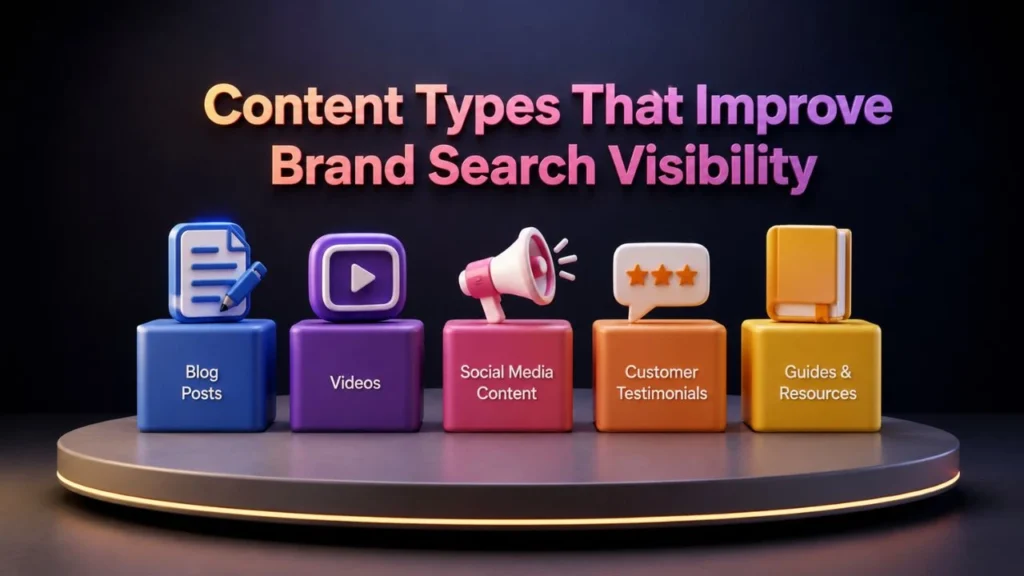
Content remains one of the strongest tools for improving branded search SEO.
Brand Story Content
Brand story content explains:
- Mission
- Values
- Vision
- Industry expertise
It helps humanize the organization while strengthening brand identity.
Thought Leadership Content
Thought leadership establishes expertise.
Examples include:
- Industry analysis
- Research articles
- Trend reports
- Strategic insights
This content often attracts backlinks and citations.
Industry Guides
- Comprehensive educational content helps brands demonstrate expertise while supporting organic visibility.
- Long-form guides frequently perform well in both traditional and AI search environments.
FAQ Content
Frequently asked questions help satisfy user intent while improving voice search visibility.
Benefits include:
- Better user experience
- Improved search coverage
- Increased AI search relevance
- Enhanced featured snippet opportunities
Customer Education Content
Educational content supports users throughout their decision-making process.
Examples include:
- Tutorials
- How-to guides
- Resource libraries
- Industry explainers
Video Content
Video content often appears prominently within branded search results.
Videos can improve:
- Engagement
- Visibility
- Trust
- Search coverage
Reputation-Focused Content
Specific content can strengthen brand reputation.
Awards and Recognition Pages
Showcase achievements and industry recognition.
Company Updates
Keep users informed with accurate and current information.
Corporate Responsibility Content
Demonstrate commitment to ethical and responsible business practices.
Technical SEO Factors That Strengthen Reputation Control
Technical SEO provides the foundation that supports visibility, authority, and trust.
Structured Data Implementation
Structured data helps search engines understand your brand.
Benefits include:
- Improved entity recognition
- Enhanced search features
- Better information accuracy
Organization Schema
Organization schema helps search engines identify:
- Company name
- Website
- Logo
- Contact information
- Social profiles
This contributes to stronger brand understanding.
Person Schema
- Person schema supports executive visibility and authority.
- It can help connect leaders with their expertise and professional accomplishments.
Review Schema
- Review schema provides search engines with additional review-related information.
- When implemented correctly, it can enhance visibility and improve trust signals.
Website Architecture
A clear website structure improves crawlability and user experience.
Best practices include:
- Logical navigation
- Organized categories
- Clear internal linking
- Consistent URL structures
Crawlability and Indexability
Search engines must be able to access and understand your content.
Regular technical audits help identify:
- Crawl errors
- Indexing issues
- Redirect problems
- Duplicate content
Internal Linking Strategy
Internal links help distribute authority across important branded assets.
Strong internal linking supports:
- Better crawling
- Improved user navigation
- Stronger topical relevance
- Greater visibility for key pages
An effective internal linking strategy strengthens both reputation SEO and branded search SEO while improving overall site authority.
Local SEO and Branded Search SEO
Many branded searches contain local intent. Users frequently search for businesses along with a city, region, or nearby location before making a purchasing decision.
Examples include:
- Brand name near me
- Brand name location
- Brand name city
- Brand name reviews in city
- Brand name contact information
Because local searches often occur during the decision-making stage, they can significantly influence conversions and customer trust.
A strong local presence strengthens branded search SEO by ensuring accurate and trustworthy information appears when users search for your brand within a specific geographic area.
Local Brand Searches
Local brand searches typically indicate strong intent.
Users conducting these searches may want to:
- Visit a physical location
- Contact the business
- Verify legitimacy
- Read local reviews
- Compare nearby options
Optimizing for these searches improves visibility while supporting reputation management goals.
Business Profile Optimization
An optimized business profile can become one of the most visible assets within branded search results.
Important optimization elements include:
- Accurate business name
- Updated contact information
- Correct website URL
- Business categories
- Service descriptions
- High-quality images
- Updated operating hours
Consistency across all platforms helps reinforce trust and entity recognition.
Review Management
Reviews play a major role in both reputation SEO and local visibility.
A review management strategy should focus on:
- Encouraging authentic feedback
- Monitoring review platforms
- Responding professionally
- Addressing customer concerns
- Maintaining information accuracy
Review activity sends strong trust signals to both users and search engines.
Local Citations
- Local citations are references to your business information across directories and industry websites.
- Consistency is critical.
Business information should remain uniform across:
- Business directories
- Industry portals
- Professional associations
- Local listings
- Review platforms
Consistent citations help strengthen credibility and support branded search performance.
Location-Based Reputation Signals
Search engines evaluate various local reputation indicators.
Examples include:
- Review quality
- Review quantity
- Citation consistency
- Business profile completeness
- Local mentions
- Customer engagement
These signals contribute to both local visibility and broader brand reputation.
Optimizing Branded Search SEO for AI Search and Voice Search
Search behavior is evolving rapidly. Users increasingly rely on AI-powered search experiences and voice assistants to discover information.
As a result, businesses must adapt their branded search SEO strategy to remain visible across these emerging channels.
How AI Search Engines Interpret Brands?
AI search systems often summarize information gathered from multiple sources.
They evaluate:
- Brand authority
- Content quality
- Entity relationships
- User trust signals
- Reputation indicators
- Website expertise
Unlike traditional search engines, AI systems frequently provide direct answers rather than a list of links.
This makes reputation management even more important.
Entity Optimization Strategies
Entity optimization helps search engines and AI systems understand your brand more effectively.
Key strategies include:
Creating Consistent Brand Information
Maintain consistency across:
- Website content
- Social profiles
- Business directories
- Press mentions
Establishing Clear Brand Relationships
Help search engines understand connections between:
- Products
- Services
- Executives
- Locations
- Industry expertise
Building Topical Authority
Publishing comprehensive content within your niche strengthens entity recognition and authority.
E-E-A-T and Brand Authority
Search engines increasingly evaluate content using Experience, Expertise, Authoritativeness, and Trustworthiness principles.
Brands can strengthen E-E-A-T by:
- Publishing expert content
- Displaying author credentials
- Maintaining transparent business information
- Demonstrating industry knowledge
- Earning authoritative mentions
These signals contribute to stronger visibility in both traditional and AI search environments.
Conversational Search Optimization
AI search and voice search often use natural language queries.
Examples include:
- Is this company trustworthy?
- What services does this company provide?
- What are customers saying about this brand?
- Is this brand recommended?
Content should answer these questions clearly and naturally.
Voice Search Query Patterns
Voice searches are often longer and more conversational.
Question-Based Searches
Users commonly ask:
- What is this company?
- How does this service work?
- Is this business reliable?
Reputation-Based Searches
Voice assistants frequently process:
- Brand reviews
- Customer experiences
- Ratings
- Reputation-related questions
Recommendation Searches
Many users ask:
- Which company is best?
- Which brand should I choose?
- What do customers recommend?
Optimizing content around these conversational patterns improves discoverability.
Preparing Brand Content for AI Overviews
AI-generated summaries often prioritize:
- Structured content
- Clear answers
- Expert insights
- Accurate information
- Well-organized pages
To improve visibility:
- Create comprehensive content
- Use logical heading structures
- Include FAQs
- Publish original insights
- Demonstrate expertise
These practices support both AI search visibility and branded search SEO performance.
Measuring Success in Branded Search SEO
- Without measurement, it is difficult to determine whether a strategy is producing results.
- Tracking key performance indicators helps businesses understand the impact of their efforts.
Brand Search Volume
Brand search volume measures how often users search for your brand.
Increasing branded search volume often indicates:
- Growing awareness
- Stronger recognition
- Improved marketing effectiveness
SERP Ownership Percentage
SERP ownership refers to the percentage of page-one results controlled directly or indirectly by your brand.
The goal is to maximize visibility through:
- Website pages
- Social profiles
- Videos
- Press mentions
- Industry listings
Greater ownership provides stronger reputation control.
Reputation Metrics
Important reputation indicators include:
| Metric | Purpose |
| Average review rating | Measures customer satisfaction |
| Review volume | Indicates market engagement |
| Sentiment analysis | Evaluates public perception |
| Brand mentions | Measures visibility |
| Media coverage | Assesses authority |
| Social engagement | Reflects audience interaction |
Sentiment Analysis
Sentiment analysis evaluates whether online discussions are:
- Positive
- Neutral
- Negative
Monitoring sentiment helps identify reputation trends and potential issues.
Click-Through Rate
A strong branded search presence often improves click-through rates.
Higher CTR may indicate:
- Effective titles
- Strong trust signals
- Relevant content
- Positive brand perception
Conversion Metrics
Ultimately, reputation efforts should support business objectives.
Track:
- Leads
- Sales
- Contact form submissions
- Consultation requests
- Customer inquiries
These metrics reveal the business impact of branded search SEO.
AI Search Visibility Metrics
As AI search adoption grows, businesses should also monitor:
- AI citation frequency
- AI overview appearances
- Entity visibility
- Brand mention accuracy
- AI-generated recommendation presence
These emerging metrics will become increasingly valuable.
Common Reputation Risks That Affect Brand Search Results
- Even strong brands can encounter reputation challenges.
- Understanding common risks allows businesses to respond proactively.
Negative Reviews
Negative reviews can influence purchasing decisions and trust.
Strategies include:
- Monitoring review platforms
- Responding professionally
- Addressing customer concerns
- Improving customer experience
Outdated Information
Outdated information may create confusion and reduce credibility.
Regularly update:
- Contact information
- Service descriptions
- Team information
- Company announcements
Competitor Comparison Pages
Competitor content may rank for branded searches.
To strengthen visibility:
- Publish comprehensive branded content
- Improve authority signals
- Expand search asset ownership
Misinformation
- Incorrect information can damage trust.
- Monitor search results regularly and update official sources whenever necessary.
Low Authority Brand Assets
Weak content may struggle to compete for visibility.
Focus on creating:
- Helpful resources
- Expert content
- Authoritative pages
- Valuable educational material
Lack of Search Result Diversity
Relying on a single branded asset increases risk.
Diversify visibility through:
- Blogs
- Videos
- Social profiles
- Press mentions
- Resource centers
- Industry publications
A diversified presence improves resilience and reputation control.
Future Trends in Branded Search SEO
- Search technology continues to evolve, creating new opportunities and challenges.
- Businesses that adapt early often gain a competitive advantage.
AI-Driven Search Experiences
AI-generated answers are becoming more common.
Brands will increasingly compete for inclusion within:
- AI summaries
- AI recommendations
- AI citations
- AI-generated overviews
This makes authority and trust signals more important than ever.
Entity-First SEO
- Search engines are moving toward understanding entities rather than individual keywords.
- Brands that establish strong entity relationships may experience better visibility across multiple search platforms.
Predictive Search Behavior
- Search systems are becoming better at anticipating user needs.
- Brands should create content that addresses questions before users explicitly ask them.
Reputation Signals as Ranking Factors
- Trust, credibility, and reputation are likely to play a larger role in future search algorithms.
- Strong reputation SEO practices may become increasingly valuable.
Multi-Platform Brand Visibility
Brand visibility now extends beyond traditional search engines.
Businesses should optimize for:
- Search engines
- AI search tools
- Social platforms
- Voice assistants
- Video platforms
- Industry communities
A multi-platform strategy strengthens overall brand authority.
Search Beyond Traditional Search Engines
Consumers increasingly discover brands through:
- AI assistants
- Video platforms
- Social search
- Community forums
Future branded search SEO strategies must account for these evolving discovery channels.
Conclusion
A strong reputation is no longer built solely through advertising or public relations. Today, it is shaped by what users see when they search for your brand.
Effective branded search SEO helps businesses take greater control of their online presence by ensuring users encounter accurate, trustworthy, and authoritative information across search engines, AI search tools, and voice search platforms.
When combined with reputation SEO, businesses can strengthen trust, improve visibility, and create a more positive perception among prospective customers. Incorporating brand SERP optimization allows organizations to expand ownership of valuable search assets, while ORM SEO supports long-term reputation management and customer confidence.
As search technology continues to evolve, brands that invest in visibility, authority, and trust will be better positioned to succeed. By focusing on reputation signals, entity optimization, quality content, and technical excellence, businesses can build a durable search presence that supports growth for years to come.
Frequently Asked Questions
What is branded search SEO?
Branded search SEO is the process of optimizing search results that appear when users search for a specific brand, company, product, or executive name. It focuses on improving visibility, trust, and reputation across branded search queries.
How does branded search SEO improve reputation control?
Branded search SEO helps businesses influence the information users see when researching a brand. By optimizing search assets and promoting authoritative content, companies can strengthen trust and improve perception.
What is the difference between reputation SEO and ORM SEO?
Reputation SEO focuses on improving search visibility and authority, while ORM SEO focuses on managing overall online reputation, sentiment, reviews, and public perception.
Why is brand SERP optimization important?
Brand SERP optimization helps businesses control more of the search results associated with their brand. This improves trust, visibility, and customer confidence while reducing the influence of competing or inaccurate content.
How can businesses improve branded search visibility?
Businesses can improve branded search visibility through content creation, technical SEO improvements, entity optimization, reputation management, review monitoring, and strategic brand asset development.
Does branded search SEO help AI search rankings?
Yes. Strong branded search SEO improves authority, trustworthiness, and entity recognition, which can increase visibility within AI-generated search results and summaries.
How do voice searches affect branded search SEO?
Voice searches often use conversational language and reputation-focused questions. Optimizing content for natural language queries and FAQs can improve visibility in voice search results.
Which metrics should be tracked for branded search SEO?
Important metrics include brand search volume, SERP ownership, click-through rate, review sentiment, conversion rate, media mentions, and AI search visibility indicators.