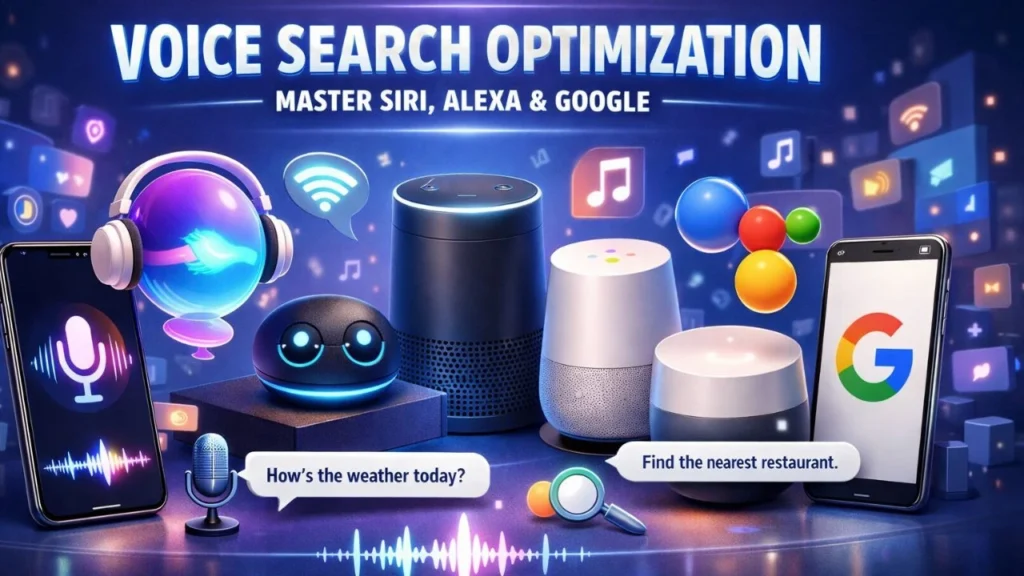
Voice search optimization is the process of improving your website and content so digital assistants can understand, trust, and surface your answers when people use spoken queries. It blends technical SEO, conversational content, semantic relevance, and answer focused formatting to help your brand stay visible in search, AI tools, and voice enabled devices.
Table of Contents
Why Voice Search Matters More Than Ever?
Search has changed. People no longer rely only on short typed keywords. They now ask full questions into smartphones, smart speakers, cars, wearables, and AI powered interfaces. Instead of typing “best SEO agency,” they may ask, “Who can help my business improve online visibility with answer focused SEO?” That shift is exactly why voice search optimization deserves serious attention.
When users speak, their intent is often more specific, more natural, and closer to action. They want direct answers, fast recommendations, local results, and trustworthy information. Siri, Alexa, and Google are all designed to reduce friction. They do not want to send users through a maze of vague pages. They want to deliver the clearest answer quickly.
That is where voice search optimization becomes a major growth lever. It helps your pages match real speech patterns, capture long tail intent, and align with the way modern assistants interpret meaning. If you want your content to perform not only in traditional search but also in AI search and answer engines, voice search optimization can no longer be treated as optional.
If your business wants a stronger presence in modern search ecosystems, Request AEO Audit and identify where your content is ready for spoken search and where it still needs improvement.
What Is Voice Search Optimization?
At its core, voice search optimization is about making your content easier to retrieve when users ask spoken questions. Unlike older SEO models that focused heavily on short keywords, voice search optimization prioritizes natural language, conversational phrasing, concise answers, and structured information.
A strong voice search optimization strategy usually includes:
- question based headings
- direct answer paragraphs
- semantically connected subtopics
- clear entity references
- schema support
- mobile friendly performance
- local relevance where needed
This matters because voice assistants do not read pages the way humans do. They look for clarity, confidence, and relevance. They evaluate whether your content appears to answer the exact question being asked. That means voice search optimization is closely connected with answer engine performance, featured snippets, and AI generated summaries.
How Siri, Alexa, and Google Interpret Spoken Queries?
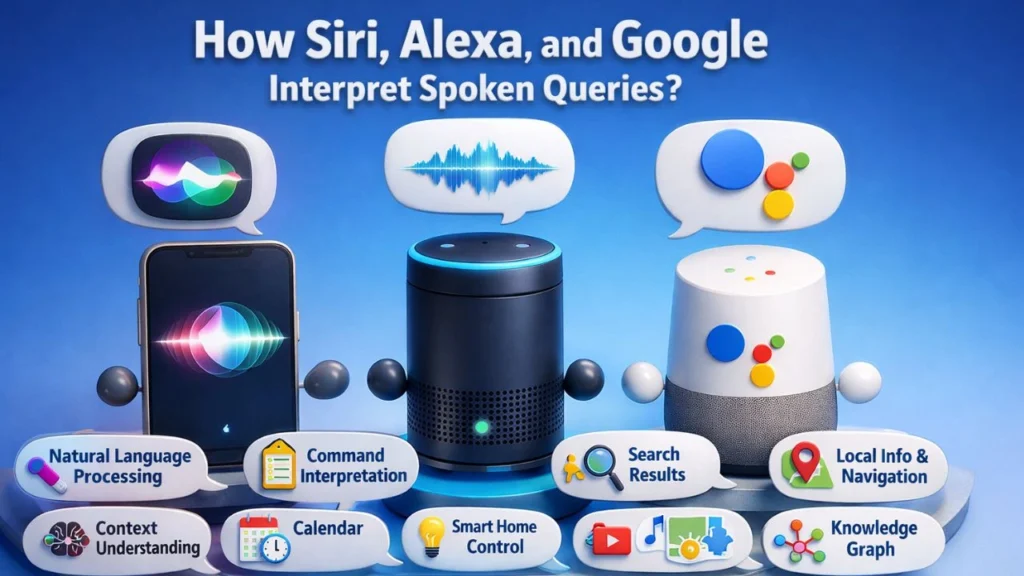
One reason voice search optimization works so well is that it aligns your content with the way assistants process language.
Siri often handles mobile intent, location based needs, and immediate utility. Users may ask for directions, nearby services, working hours, or quick answers while on the move. Google Assistant pulls heavily from Google’s search ecosystem, business listings, structured content, and topical relevance signals. Alexa often responds to conversational question patterns and tends to reward content that is simple, structured, and easy to extract.
Even though each assistant has its own ecosystem, they all depend on understanding intent. They try to identify the topic, determine the likely need behind the question, and match the answer with a credible source. That is why advanced voice search optimization increasingly overlaps with LLM Semantic Entity Recognition. In practical terms, this means your content should clearly connect topics, services, places, and intent signals so machines can interpret what your page is really about.
If your article mentions a service, audience type, location, and user problem in a disconnected way, it becomes harder for systems to match your page to a spoken query. If your page is semantically organized and answer focused, voice search optimization becomes much more effective.
Why Voice Search Optimization and AEO Belong Together?
Search is moving toward direct answers. That is why voice search optimization and AEO Services now support the same visibility goals. You are not only trying to rank. You are trying to become the answer.
When a user asks a question aloud, the assistant often reads out one answer or shows a limited set of results. That makes answer quality even more important than traditional blue link competition. With the right answer engine optimization, your content can be reshaped to improve clarity, structure, and relevance across voice queries, AI summaries, and zero click search experiences.
AEO and voice search optimization work together because both focus on:
- direct, concise responses
- intent matched content
- trust and topical depth
- semantic relevance
- scannable page structure
- question and answer patterns
If your current pages are informative but slow to reach the point, you may already have valuable content that simply needs restructuring. Sometimes the difference between page two visibility and answer box visibility is not a brand new article. It is better voice search optimization paired with stronger AEO Services.
If you want to know whether your pages are answer ready, Request AEO Audit and review how your content performs across spoken and AI driven queries.
The Core Elements of a Winning Voice Search Strategy
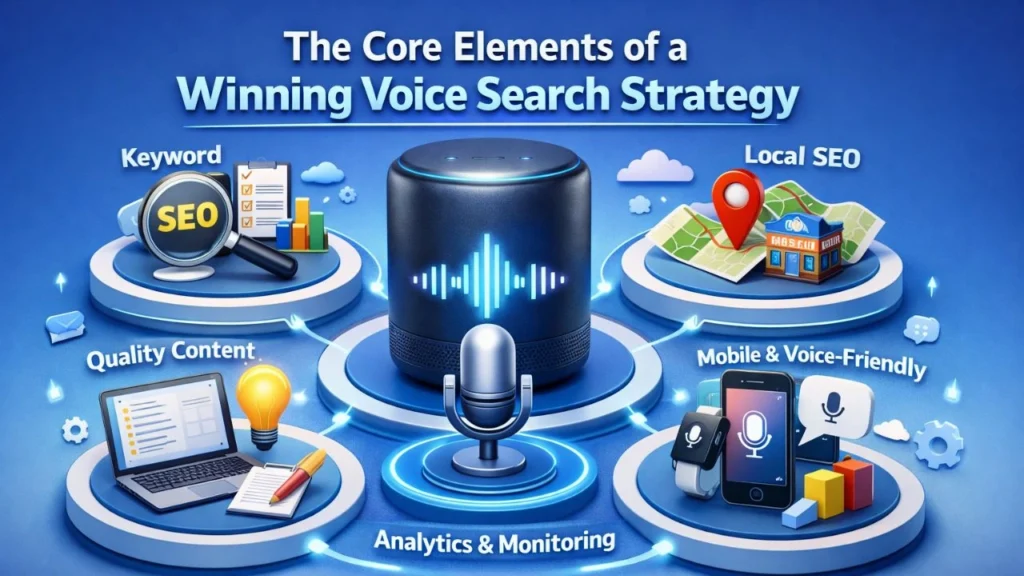
A good voice search optimization plan is not built on keywords alone. It is built on how people speak, how assistants interpret, and how search systems choose what to trust.
1. Conversational Keyword Targeting
People speak differently from how they type. Spoken search is often longer, more natural, and more specific. That means voice search optimization should target questions such as:
- what is voice search optimization
- how can I improve rankings for Siri and Alexa
- who offers AEO support for my business
- which local SEO strategy works best for voice search
This conversational approach helps you align with real world intent instead of relying only on short phrases.
2. Direct Answers Near the Top
Your page should not take too long to answer the main question. Effective voice search optimization places a clean answer near the beginning of the page or section. This improves readability for users and retrievability for machines.
3. Strong Semantic Context
Assistants do not just match words. They interpret meaning. This is where LLM Semantic Entity Recognition plays a growing role. If your content clearly relates services, use cases, audiences, and outcomes, it becomes easier for AI systems to identify relevance.
4. Technical Readiness
No matter how strong your copy is, weak technical foundations will hold you back. Voice search optimization depends on fast load times, mobile usability, crawlability, HTTPS, internal linking, and schema. These factors help search engines access and trust your content.
5. Authority and Trust
Voice assistants prefer reliable sources. That means accurate claims, updated content, clean structure, and helpful explanations all support voice search optimization.
How to Structure Content for Voice Search Optimization?
To improve voice search optimization, you need to write in a format that mirrors how users ask and how assistants answer.
Start with a clear heading that reflects a real question or a strong search intent. Follow it with a brief answer paragraph. Then expand with supporting detail. This pattern helps your content serve both humans and machines.
A practical page structure for voice search optimization looks like this:
- a direct introduction
- a concise featured snippet style answer
- logical H2 and H3 sections
- short paragraphs
- natural question based phrasing
- FAQ sections
- clear CTAs
- semantic depth after simple definitions
This structure also supports GEO and AEO goals because it makes your content easier to quote, summarize, and retrieve in AI led interfaces.
Local Voice Search vs Broader Audience Targeting
Not every business needs the same voice search optimization strategy. Some brands depend heavily on nearby intent. Others serve a wider audience and need scalable visibility.
If you are a location based business, local relevance matters a great deal. People ask for nearby services, operating hours, trusted providers, and immediate help. In that case, voice search optimization should include your business profile, location pages, review signals, consistent contact details, and locally framed service content. Working with a local SEO agency can help you improve map relevance, local entity consistency, and voice discoverability for “near me” style searches.
But not every company is focused on nearby intent. A brand that targets global or national audiences needs a broader content architecture. In that case, voice search optimization should support educational search, category level search, high intent problem solving, and topic clusters that scale across regions. A business that targets global or national audiences should focus on entity clarity, strong informational pages, comparative content, and structured answers that serve a wider user base.
In both cases, the goal is the same. You want your content to be the answer that devices trust. The difference is how you organize the supporting signals.
The Role of AI Query Testing in Modern Search
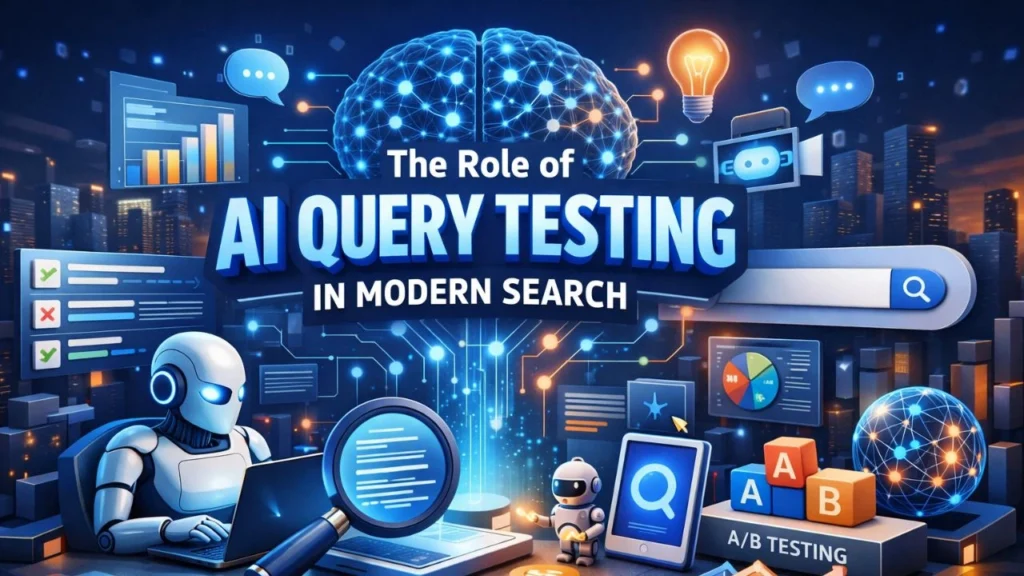
One of the smartest ways to improve voice search optimization is through AI Query Testing. This means checking how your content performs when real world spoken prompts are simulated across different styles of questioning.
For example, a typed search may be short and fragmented, but spoken search is usually complete and context rich. AI Query Testing helps you identify whether your pages answer natural prompts such as:
“Which strategy improves voice search visibility for a service business?”
“How do I optimize my website for Siri and Google Assistant?”
“Who provides AEO support and voice focused SEO services?”
“What should I look for in SEO packages and pricing for voice search growth?”
By running AI Query Testing, you can uncover missed intent patterns, weak question coverage, vague answer blocks, and semantic gaps. This allows you to refine your voice search optimization strategy with real query behavior in mind rather than assumptions.
Why Full-Stack A/B Testing Matters?
Optimization should not stop after publishing. Full-Stack A/B Testing helps you refine what actually improves results.
In the context of voice search optimization, Full-Stack A/B Testing can help you compare:
- question style headings vs statement style headings
- shorter answer summaries vs longer intros
- FAQ placement high on the page vs low on the page
- different schema implementations
- CTA placement around answer sections
- local trust signals vs broader authority cues
This matters because search behavior is not static. Assistants evolve. User language changes. Intent patterns shift. With Full-Stack A/B Testing, you can improve conversion pathways while also making your content more discoverable and usable in voice environments.
Technical SEO Still Powers Voice Search Success
Many people assume voice search optimization is only about writing. It is not. Technical SEO still plays a major role.
Your content needs to be:
- mobile friendly
- fast loading
- secure
- easy to crawl
- clearly structured
- internally linked
- supported by schema
These signals make it easier for search systems to interpret your content correctly. A slow or poorly structured page may contain a great answer but still lose visibility because it creates friction.
Schema also supports voice search optimization by helping search engines identify page purpose, FAQs, business details, and content relationships. Combined with clean UX and concise copy, technical improvements can significantly strengthen your answer visibility.
Common Mistakes That Hurt Voice Search Performance
Many websites create content but still miss the mark because they are not truly built for voice search optimization.
| Issue | Why it hurts search performance (voice, AI, & traditional) | Quick Fix / Best Practice |
|---|---|---|
| Focusing only on short typed keywords | Modern engines look for natural‐language queries and semantic breadth; relying on 1- to 2-word phrases limits topical coverage and intent matching. | Map target topics to long-tail, question-style, and intent-driven phrases; weave them in naturally instead of keyword stuffing. |
| Hiding the answer beneath long introductions | Voice assistants and featured snippets surface concise, high-relevance answers first. Burying them forces crawlers to dig and reduces snippet eligibility. | Lead with a clear, 1-2 sentence summary or answer (“inverted pyramid” style), then expand with detail. |
| Ignoring conversational phrasing | Voice queries are spoken as full sentences (“How do I…?”). Content written only for terse text queries sounds robotic and may miss intent signals. | Write headers and body copy in the same Q&A language people speak to Alexa, Siri, or Google Assistant. |
| Failing to build topic & entity relationships | Search algorithms use entity graphs to judge expertise and relevance. Fragmented pages without contextual links weaken that signal. | Use internal links, schema, and related sub-topics (people, places, concepts) to show depth and authority. |
| Skipping FAQs | FAQ blocks answer the “People Also Ask” carousel and voice follow-ups; omitting them forfeits extra SERP real estate. | Add structured FAQ sections with succinct, conversational Q&A pairs marked-up with FAQPage schema. |
| Neglecting local signals | For near-me and geo-specific searches, missing NAP data, local keywords, and region schema lowers visibility. | Include city/region terms, embed Google Map, and keep NAP (Name-Address-Phone) consistent across pages. |
| Using vague headings | Crawlers and screen readers rely on headings to understand page hierarchy. Generic H2s (“Introduction”) add no semantic value. | Craft descriptive, keyword-rich H2/H3 tags that preview the answer and include action verbs or entities. |
| Publishing content without AI Query Testing | You can’t see how large language models actually surface or summarize your page; blind spots remain undiscovered. | Run prompts in ChatGPT, Gemini, etc., to test if your page is quoted or summarized correctly; adjust wording until it is. |
| Never validating improvements with Full-Stack A/B Testing | Changes that “look good” may hurt engagement, Core Web Vitals, or conversions. Without data, optimization stalls. | Deploy controlled experiments (copy, layout, schema) across the full funnel—impressions to conversions—and iterate based on lift. |
Another common mistake is treating voice search as separate from broader search strategy. In reality, voice search optimization, AEO, semantic SEO, and modern content architecture all support one another.
How SEO Packages and Pricing Fit Into Voice Search Strategy?
Businesses often ask whether voice related work should sit outside their existing SEO investment. In most cases, the answer is no. It should be integrated. That is why understanding SEO packages and pricing matters.
When you evaluate SEO packages and pricing, look beyond keyword tracking and backlink activity. A modern strategy should also include:
- answer focused content improvements
- technical SEO
- schema support
- FAQ design
- intent mapping
- AI Query Testing
- semantic optimization
- local or national audience alignment
- ongoing performance review
The best SEO packages and pricing models are not based on volume alone. They are based on what your business actually needs to win visibility across search engines, answer engines, and voice interfaces.
If your provider ignores voice behavior, AI answer systems, or semantic structuring, the service may already be behind where search is heading.
Why Businesses Should Think Beyond Rankings
The real value of voice search optimization is not just better rankings. It is stronger discoverability across multiple search experiences. A well optimized page can support traditional organic visibility, featured snippets, AI generated summaries, and spoken assistant responses.
That is why businesses are increasingly investing in AEO Services alongside SEO. These services help shape content for machine understanding, answer retrieval, and conversational relevance. They also make your pages more helpful to real people, which supports engagement and conversions.
Whether you work with an internal team, a consultant, or a local SEO agency, the goal should be the same. Build content that answers clearly, performs technically, and reflects how people actually search now.
A Practical Framework You Can Use
If you want to improve your own voice search optimization, follow this framework:
- First, identify the real questions your audience asks aloud.
- Second, restructure your content so the answer appears quickly.
- Third, improve semantic clarity using topic relationships and LLM Semantic Entity Recognition principles.
- Fourth, strengthen technical SEO and schema.
- Fifth, decide whether your business needs local intent targeting or content for a brand that targets global or national audiences.
- Sixth, run AI Query Testing to evaluate how your pages respond to natural prompts.
- Seventh, validate improvements through Full-Stack A/B Testing.
- Finally, refine pages continuously based on visibility and engagement data.
This is how voice search optimization becomes a sustained strategy rather than a one time tweak.
Conclusion
Search is becoming more conversational, more immediate, and more answer driven. Siri, Alexa, and Google are not just responding to keywords. They are interpreting intent, extracting meaning, and choosing the clearest response. That is exactly why voice search optimization matters so much right now.
If you want to stay competitive, your content should do more than rank. It should answer. It should be easy to interpret, easy to trust, and easy to surface across search engines, AI tools, and voice enabled devices. When you combine voice search optimization with semantic clarity, technical SEO, AEO Services, AI Query Testing, and Full-Stack A/B Testing, you give your business a stronger chance of becoming the result users hear first.
If you are ready to improve visibility across voice and AI search, Request AEO Audit and take the next step with a strategy built for how people search today.
FAQs
What is voice search optimization?
Voice search optimization is the process of improving website content and technical SEO so digital assistants and search engines can understand, select, and present your pages for spoken queries.
Why is voice search optimization important?
It helps your brand appear in conversational searches, answer based search experiences, and smart assistant responses. It also supports broader AI and answer engine visibility.
How do AEO Services support voice search?
AEO Services improve how your content is structured, phrased, and formatted so it can be selected as a direct answer in voice and AI driven search environments.
Can a local SEO agency help with voice search?
Yes. A local SEO agency can help improve nearby intent visibility, map relevance, business listing consistency, and local answer performance for voice driven searches.
What is AI Query Testing?
AI Query Testing is the process of simulating natural prompts and spoken questions to see whether your content is discoverable, accurate, and aligned with real user intent.
Why does LLM Semantic Entity Recognition matter?
LLM Semantic Entity Recognition helps systems understand the relationships between topics, places, services, and user needs. This improves content relevance in voice and AI search.
What role does Full-Stack A/B Testing play?
Full-Stack A/B Testing helps you compare content structures, answer lengths, page layouts, and other elements to determine what improves visibility and engagement.
How should brands that target global or national audiences approach voice search?
A brand that targets global or national audiences should focus on scalable content clusters, strong semantic structure, intent mapping, and broad informational coverage rather than relying only on local signals.
How do SEO packages and pricing affect voice search strategy?
Good SEO packages and pricing should include answer focused content work, technical SEO, semantic optimization, and testing methods that support modern search behavior.