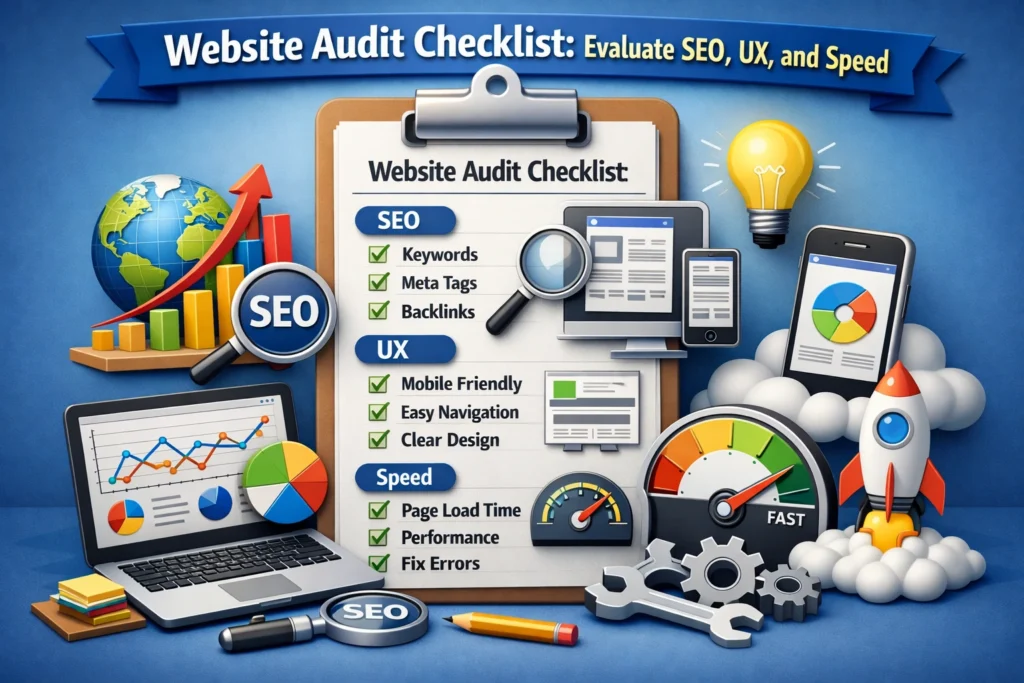
Your website can look polished on the surface and still underperform where it matters most. It may miss ranking opportunities, frustrate visitors on mobile, or lose conversions because pages load too slowly. That is why a strong website audit checklist matters. It helps you review what is working, what is hurting visibility, and what needs attention before performance starts slipping.
Today, a website review is not only about search engine basics. It is about your entire Online Presence. Search engines evaluate technical strength, users judge experience within seconds, and AI driven systems look for clear, structured, trustworthy information. If your site is hard to crawl, hard to use, or slow to load, you lose visibility and trust at the same time.
A modern website audit should help you evaluate SEO, UX, speed, AI readability, and answer focused content structure. It should also support voice search, local visibility, and content clarity. When you use the right website audit guide, you are not just fixing errors. You are building a site that performs better for users, search engines, and AI powered discovery.
If you want stronger rankings, better engagement, and a site that supports real business growth, this guide will walk you through a complete technical website audit you can actually use.
Table of Contents
What Is a Website Audit Checklist?
A website audit checklist is a structured review of your website’s health. It helps you examine how well your site performs in search, how easy it is for people to use, and how efficiently it loads across devices. Instead of checking issues randomly, a technical website audit gives you a clear framework so nothing important gets missed.
A good website audit checklist usually covers:
- technical SEO
- on page optimisation
- internal linking
- mobile usability
- navigation and content flow
- page speed and performance
- conversion paths
- AI and voice search readiness
That is why a website audit is useful for businesses of every size. Whether you run a service site, an ecommerce store, or a local business website, this process helps you find gaps that affect growth.
Why Your Website Audit Should Cover More Than SEO
Many site owners still think audits are only about keywords, metadata, and backlinks. Those parts still matter, but search visibility now depends on more than classic SEO signals. Your website must also deliver a clean experience, fast load times, easy navigation, and content that is understandable for both people and machines.
A complete SEO website audit should look at three core pillars together:
| Core Pillar | What It Examines | Key Questions Answered | Value for Growth |
|---|---|---|---|
| SEO performance | Crawlability, indexation, structured data, on-page optimisation, backlink health | Can search engines find every important page? Do they understand its topic and context? Is authority strong enough to earn rankings? | Strong technical SEO ensures your content can actually appear in search results, unlocking organic traffic potential. |
| UX quality | Information architecture, navigation paths, accessibility, visual clarity, engagement signals | • Can visitors locate what they need in ≤ 3 clicks? Is design inclusive and mobile-friendly? Do users stay, interact, and convert? | Smooth, intuitive journeys build trust, reduce bounce rates, and translate traffic into leads or sales. |
| Speed & technical performance | Core Web Vitals (INP, LCP, CLS), server response, code efficiency, security | Do pages render in under 2 s on 4G? Is interactivity snappy and stable? Are HTTPS, CDN, and caching configured? | Faster sites rank higher, keep users engaged, and lower abandonment—crucial for revenue and SEO alike. |
| Synergy of all three | Integrated reporting that maps how SEO, UX, and speed interact | Where do technical bottlenecks hurt UX? Which UX gaps block SEO crawl paths? How do speed wins lift both? | Auditing these pillars together turns a routine check-up into a strategic growth tool, strengthening overall online presence and search visibility. |
Website Audit Checklist for SEO Performance
SEO is still the foundation of discoverability. If search engines cannot properly crawl and interpret your website, your content may never reach the right audience. A solid website audit checklist should begin here.
Check crawlability and indexability
Start with the basics. Review whether search engines can access your important pages.
Look at:
- robots.txt settings
- XML sitemap quality
- index coverage
- noindex tags
- canonical tags
- redirect chains
- broken pages
- orphan pages
If these technical pieces are not properly managed, even strong content can stay invisible. A site audit checklist should always identify pages that are blocked, duplicated, or not indexed as intended.
Review on page SEO elements
On page optimisation helps search engines understand page purpose and relevance.
Check whether each important page has:
- a unique title tag
- a clear meta description
- one focused H1
- logical heading structure
- descriptive image alt text
- keyword aligned copy
- clean URLs
- meaningful anchor text
This is where your website audit checklist helps you separate pages that are well optimised from pages that are wasting ranking potential.
Audit content quality and intent match
Content should not just exist. It should solve a real search need. One of the most important parts of a site audit checklist is checking whether content aligns with search intent.
Ask questions like:
- Does the page answer the main query quickly?
- Is the information complete and useful?
- Is the content fresh and relevant?
- Does it go deeper than competing pages?
- Does it cover related terms and entities naturally?
Thin or outdated content weakens your authority. A strong website audit checklist helps you spot where content needs to be expanded, improved, merged, or removed.
Evaluate internal linking and topical authority
Internal links do more than connect pages. They help search engines understand relationships between topics and guide users toward the next step.
Your website audit checklist should review:
- whether key service pages receive enough internal links
- whether blog posts support commercial pages
- whether anchor text is descriptive
- whether topic clusters are logically connected
When your site shows clear topical depth, it becomes easier to rank for competitive themes. That is why a proper website review checklist should assess content relationships, not just standalone pages.
Review local SEO strength
If you want local visibility, your audit should include local optimisation signals too. This matters especially if you offer SEO Services in Kolkata or similar location based services.
Check whether your site includes:
- clear NAP details
- service area targeting
- location relevant landing pages
- local intent keywords
- embedded map or location signals
- trust building business information
A location aware website review checklist helps you strengthen local discovery and support better results in map based and city specific searches.
Website Audit Checklist for UX and Conversion Experience

SEO may bring people to your site, but UX decides whether they stay, trust you, and convert. That is why UX should be a major part of every website analysis checklist.
Review navigation and site structure
People should not feel lost when they land on your site. Your menu, layout, and internal structure should help them move naturally.
Check for:
- clear top navigation
- logical page grouping
- shallow click depth
- visible contact pathways
- easy access to key services
- clean breadcrumbs where relevant
A practical website analysis checklist should identify menus that are cluttered, confusing, or poorly prioritised.
Audit mobile usability
Most users visit from mobile devices, so poor mobile UX can damage performance fast. Your website audit checklist should evaluate whether pages are truly usable on smaller screens.
Look for:
- responsive layout
- readable text without zooming
- buttons with enough spacing
- easy scrolling
- stable design blocks
- forms that work smoothly on mobile
A site may appear functional on desktop and still perform badly in real world mobile use. That is why this section of a website audit checklist cannot be skipped.
Review UI/UX Architecture
Good design is not just visual. It is structural. Strong UI/UX Architecture helps users understand page flow, hierarchy, and action points without confusion.
Review whether your pages have:
- a clear visual hierarchy
- proper spacing between sections
- balanced content blocks
- prominent calls to action
- scan friendly formatting
- consistent design patterns
When UI/UX Architecture is weak, users feel friction even if they cannot explain why. A detailed website audit checklist reveals where structure is hurting trust or usability.
Check forms and conversion paths
Traffic alone does not create results. Your site should make it easy for users to take action. That is why a conversion review belongs in every website audit checklist.
Ask:
- Are contact forms too long?
- Are call to action buttons clear enough?
- Does each page guide the user toward a next step?
- Are trust signals visible near action areas?
- Is the conversion path simple and obvious?
If a user wants to contact you and the process feels tedious, you lose leads. A conversion focused website audit checklist helps fix these leaks before they become expensive.
Website Audit Checklist for Speed and Technical Performance
Speed affects rankings, usability, and conversions at the same time. Slow pages create frustration, higher bounce rates, and lower trust. That is why speed is a critical section in any website audit checklist.
Measure Core Web Vitals
Core Web Vitals help you understand real user page experience. Your website audit checklist should include a close review of:
- Largest Contentful Paint
- Interaction to Next Paint
- Cumulative Layout Shift
These metrics show whether your page loads quickly, responds smoothly, and stays visually stable. Businesses that need deeper optimisation often look for Core Web Vitals services in Kolkata to resolve persistent technical issues.
Identify performance bottlenecks
A site can slow down for many reasons. Your website audit checklist should review common performance blockers such as:
- heavy images
- unused CSS
- render blocking scripts
- too many third party tools
- poor hosting response time
- excessive plugins
- bloated templates
Even small fixes can improve load speed and user satisfaction. A complete website audit checklist helps you prioritise these issues based on impact.
Review performance on mobile separately
Desktop speed is not enough. Mobile conditions are different, and real visitors often use weaker connections.
Audit:
- mobile load behaviour
- image compression
- lazy loading
- layout stability
- tap response
- lightweight page design
This is where many websites underperform. A mobile first website audit checklist gives you a more realistic picture of user experience.
Website Audit Checklist for AI Search, GEO, and AEO Readiness

Search is changing. AI systems increasingly evaluate content for clarity, structure, usefulness, and answer quality. That means your website audit checklist should also consider how your content appears in AI driven discovery.
Use an AI Checker for clarity review
An AI Checker can help you review readability, structure, and content flow. It can highlight whether your pages are too vague, too dense, or not direct enough.
You should use an AI Checker to evaluate:
- clarity of main answers
- sentence simplicity
- content structure
- redundancy
- relevance of headings
- directness of explanations
An AI Checker should support your review process, not replace human judgement. Still, it can improve how your website audit checklist measures content quality.
Apply a GEO Strategy Framework
A GEO Strategy Framework helps your content become more visible in generative search environments. It focuses on structured information, topical depth, and contextual clarity.
In your website audit checklist, use a GEO Strategy Framework to assess:
- entity clarity
- topic coverage
- content depth
- supporting context
- reliable structure
- useful summaries
- scannable information blocks
A smart GEO Strategy Framework ensures your pages are not just optimised for old ranking models but also for AI driven retrieval and summarisation.
Apply an AEO Engineering Framework
An AEO Engineering Framework focuses on answer readiness. It helps your content serve direct, useful, well organised responses that fit answer engines and voice assistants.
Your website audit checklist should use an AEO Engineering Framework to review whether pages include:
- clear answer first sections
- question based headings
- concise definitions
- step based explanations
- FAQ style formatting
- schema friendly content blocks
A good AEO Engineering Framework helps your site perform better when users ask conversational or question based queries.
Website Audit Checklist for Voice Search Optimisation
Voice search queries sound different from typed searches. They are usually longer, more natural, and more intent driven. That is why your website audit checklist should include voice search signals.
Review whether your content:
- answers who, what, why, when, and how questions
- uses natural language
- includes concise answer paragraphs
- targets local and service intent
- supports featured snippet style formatting
- includes FAQ sections with clear wording
Voice search performs best when pages are direct and structured. A future ready website audit checklist should make space for that.
Common Issues a Website Audit Checklist Can Reveal
A thorough website audit checklist often uncovers patterns that silently hurt performance. These may include:
- duplicate titles and metadata
- thin service pages
- slow mobile pages
- weak internal linking
- unclear navigation
- poor content hierarchy
- confusing forms
- missing trust signals
- weak local relevance
- incomplete answer style content
The value of a website audit checklist is not just in identifying problems. It is in helping you fix the issues in the right order.
How to Prioritise Fixes After the Audit?
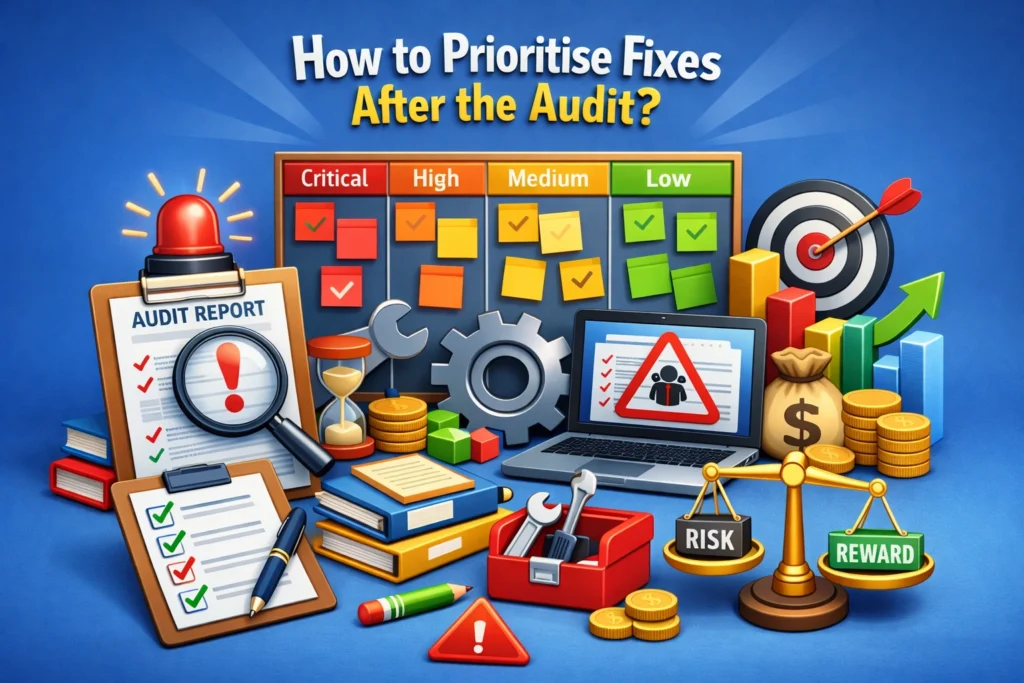
Once you complete a website audit checklist, do not try to fix everything at once. Prioritise by impact.
Fix high impact SEO issues first
Resolve indexing errors, broken pages, and duplicate SEO elements before moving to smaller adjustments.
Improve UX friction next
Simplify navigation, strengthen CTAs, and make key service pages easier to understand.
Resolve speed bottlenecks
Compress images, remove heavy scripts, and improve page stability where needed.
Strengthen AI and answer readiness
Add FAQs, improve summaries, and organise content more clearly using your GEO Strategy Framework and AEO Engineering Framework.
This approach makes your website audit checklist practical instead of overwhelming.
Why This Matters for Your Online Presence?
Your website is often the first strong impression your business makes. If it is slow, confusing, or poorly structured, your Online Presence suffers long before a user contacts you. On the other hand, when your site is optimised through a reliable website audit checklist, you build trust faster, support better rankings, and create more opportunities for conversion.
For service businesses, especially competitive local brands, investing in audit driven improvement can make a major difference. Whether you provide SEO Services in Kolkata, design solutions, development support, or Core Web Vitals services in Kolkata, your site should reflect expertise at every touchpoint.
Final Thoughts
A modern website audit checklist is not just a technical document. It is a roadmap for better visibility, stronger user experience, and more consistent digital growth. When you evaluate SEO, UX, speed, AI readiness, and answer structure together, your website becomes more useful to both people and platforms.
If you want your site to perform better in search engines, AI search tools, voice search systems, and real user journeys, start with a complete website audit checklist and act on what it reveals. That is how you move from a website that simply exists to one that actually supports business growth.
Use this website audit checklist to review your site, improve weak areas, and strengthen every part of your digital performance.
Frequently Asked Questions
What is a website audit checklist?
A website audit checklist is a step by step framework used to evaluate a website’s SEO, UX, speed, technical health, and content quality so performance issues can be identified and fixed.
Why is a website audit checklist important?
A website audit checklist helps you find problems that affect rankings, user experience, conversions, and your overall Online Presence before those issues cause bigger losses.
How often should you use a website audit checklist?
You should review your website audit checklist at regular intervals, especially after redesigns, traffic drops, content expansion, or technical changes.
Does a website audit checklist help with AI search visibility?
Yes. A modern website audit checklist can improve AI search visibility by reviewing content clarity, structured answers, and frameworks such as a GEO Strategy Framework and an AEO Engineering Framework.
Can an AI Checker improve audit quality?
An AI Checker can help assess readability, structure, and answer clarity. It works best when combined with manual review and a complete website audit checklist.
Why should UX be part of a website audit checklist?
Because strong UX improves engagement, trust, and conversions. Without good UI/UX Architecture, even a well ranked page may fail to perform.
How do Core Web Vitals fit into a website audit checklist?
They show how real users experience loading speed, interactivity, and visual stability. That is why they are a key part of every serious website audit checklist.
When should a business seek professional audit support?
If your site has persistent technical issues, poor rankings, slow mobile performance, or weak conversions, professional help may be useful, especially for advanced SEO and Core Web Vitals services in Kolkata.
How long does a full website audit usually take?
A full website audit can take anywhere from a few hours to several days depending on the size of the site, the number of pages, and the depth of the review.
What tools are commonly used for a website audit?
Website audits often use tools for crawling, speed analysis, technical checks, UX review, and content evaluation to identify gaps across SEO, performance, and usability.
Can a website audit help improve lead generation?
Yes, a website audit can reveal conversion blockers such as weak CTAs, confusing navigation, poor landing page flow, and form issues that reduce lead generation.