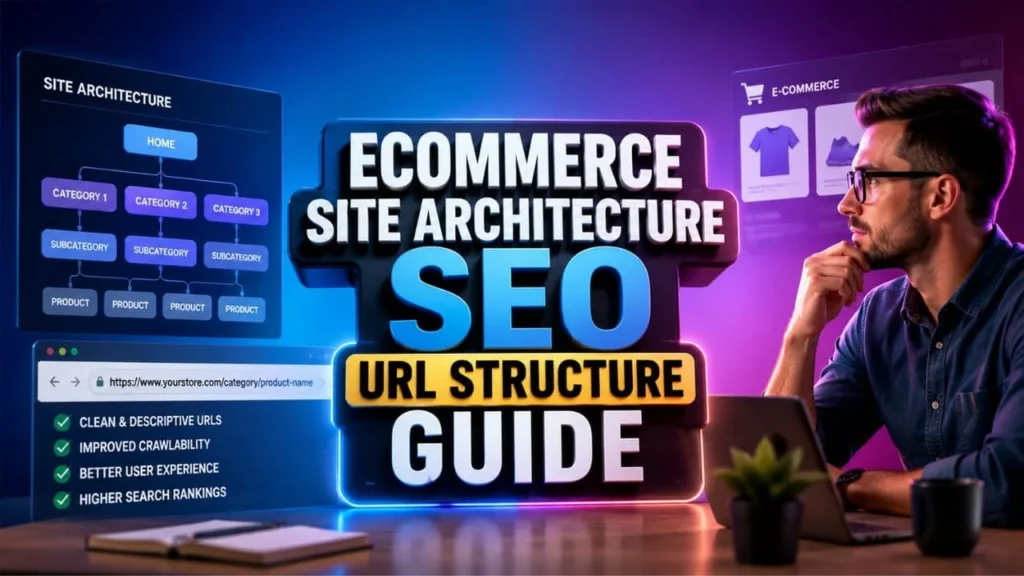
A strong ecommerce website needs more than product pages and attractive design. It needs a clear structure that helps shoppers find products quickly and helps search engines understand which pages should rank. When your URLs, categories, product pages, breadcrumbs, filters, and internal links work together, your online store becomes easier to crawl, easier to index, and easier to trust.
That is where ecommerce site architecture SEO becomes important. It helps you organise your store in a way that supports rankings, user experience, AI search visibility, and voice search answers. A clean structure also reduces duplicate pages, weak category signals, and unnecessary crawl waste.
For ecommerce brands, URL structure is not only a technical setting. It affects how your products appear in search, how users move through your website, and how search engines connect your pages with buyer intent.
Table of Contents
What Is Ecommerce Site Architecture SEO?
Ecommerce site architecture SEO means planning the structure of an online store so that search engines, AI tools, and users can understand the relationship between your homepage, categories, subcategories, product pages, filters, and blog content.
A good structure answers three simple questions:
- What does this page sell or explain?
- Where does this page sit inside the website?
- Which other pages are connected to it?
When these answers are clear, ecommerce site architecture SEO helps search engines crawl the website with less confusion. Users can also move from broad product categories to specific products without friction.

Why URL Structure Matters for Ecommerce Websites
URL structure gives search engines context and plays an important role in ecommerce site architecture SEO. A clean URL can explain the topic of a page before the page is even opened. A confusing URL with random numbers, tracking codes, and unnecessary parameters gives less value.
A clear ecommerce URL structure can support:
- Better crawl discovery
- Stronger category relevance
- Improved user trust
- Cleaner internal linking
- Lower duplicate content risk
- Better indexing control
- Stronger AI and voice search understanding
For ecommerce websites with hundreds or thousands of products, ecommerce site architecture SEO becomes even more important. Without a clear structure, search engines may spend time crawling low value filter URLs instead of your important category and product pages.
Why Ecommerce URL Structure Affects Rankings
Search engines crawl URLs to understand pages. If your website has a logical structure, search engines can identify your most valuable pages more easily. If your structure is messy, important pages may get buried, which can affect visibility, traffic, and SEO ranking in India.
A weak ecommerce setup can create problems such as:
- Product pages placed too deep inside the site
- Multiple URLs showing similar products
- Category pages with no supporting content
- Filter pages getting indexed without search demand
- Internal links pointing to redirected or outdated URLs
- Duplicate product variants competing with each other
A strong ecommerce site architecture SEO structure helps solve these problems. It gives search engines a cleaner path to follow and gives users a smoother browsing experience.
Best Ecommerce Website Structure for SEO
An ecommerce website should usually follow a simple hierarchy:
Home
Main category
Subcategory
Product page
Supporting blog content
This structure helps search engines understand page relationships. It also helps users know where they are on the site.
For instance, a clothing store may use this structure:
Home
Men fashion
Men shoes
Running shoes
Product page
The goal is to keep the path simple. Important category and product pages should not be buried too far from the homepage. A clear ecommerce SEO strategy helps organise these paths so users can reach products faster and search engines can understand page importance more easily.
Flat Structure vs Deep Structure
A flat structure keeps important pages close to the homepage. A deep structure places pages under too many folders or levels.
A flat structure is usually better for ecommerce SEO because it:
- Helps search engines discover pages faster
- Sends stronger internal link value to important pages
- Makes navigation easier for users
- Reduces the risk of orphan pages
- Helps product pages receive more attention
A deep structure may still be useful for very large stores, but it must be planned carefully. Too many levels can make URLs long, reduce clarity, and weaken the impact of ecommerce site architecture SEO.

SEO Friendly Ecommerce URL Structure
SEO friendly ecommerce URLs should be short, readable, and descriptive. In ecommerce site architecture SEO, every URL should clearly describe the page without stuffing keywords.
A good URL structure should:
- Use simple words
- Match the page topic
- Avoid unnecessary numbers
- Avoid session IDs
- Avoid long parameter strings
- Stay stable over time
- Support breadcrumbs and internal links
A product URL does not need to include every category level. In ecommerce site architecture SEO, it only needs enough context to make the page understandable for users and search engines.
Ecommerce URL Structure Comparison
| Page Type | Weak URL Example | SEO Friendly URL Example | Why It Works |
|---|---|---|---|
| Category Page | /cat?id=25 | /mens-shoes/ | Clear category intent |
| Subcategory Page | /products/filter=running | /mens-shoes/running-shoes/ | Better hierarchy |
| Product Page | /item/45892 | /mens-shoes/running-shoes/nike-air-zoom/ | Descriptive and readable |
| Blog Page | /post?id=seo123 | /blog/ecommerce-url-structure-seo/ | Better topic clarity |
| Sale Page | /deal?page=summer | /sale/summer-shoes/ | Easier to understand |
Core Benefits of Ecommerce Site Architecture SEO
A well planned ecommerce structure brings several ranking and usability benefits.
Better Crawl Efficiency
Search engines have limited time to crawl a website. If your site has clean navigation and controlled URLs, crawlers can find important pages faster.
This is especially useful for large ecommerce websites where product filters, sorting options, and pagination can create many extra URLs. A strong ecommerce site architecture SEO plan helps search engines focus on your most valuable category, subcategory, and product pages.
Stronger Category Rankings
Category pages often target commercial search queries. These pages can rank for terms that product pages may not capture. A strong category structure supports ecommerce site architecture SEO by helping search engines understand what each section of your store is about.
Better User Navigation
Users should be able to move from category to product without confusion. A clean structure makes the buying journey easier and reduces friction.
Reduced Duplicate Content
Ecommerce websites often create duplicate content through filters, variants, sorting pages, and tracking parameters. A planned URL strategy helps reduce this problem.
Better AI Search and Voice Search Visibility
AI search tools need clear page relationships and structured information. Voice search also needs direct answers. Clean architecture, FAQs, breadcrumbs, and schema markup help search systems understand your content faster.

Ecommerce URL Structure Best Practices
Keep URLs Short and Clear
A clean URL should give users a clear idea of the page topic. It should not look like a system generated code. While reviewing an SEO comparison of ecommerce platforms, also check how each platform handles URL structure, redirects, category paths, and product page formatting.
Use Lowercase URLs
Lowercase URLs help maintain consistency. Mixed uppercase and lowercase URLs can sometimes create duplicate URL issues depending on server settings.
Avoid Keyword Stuffing
Keywords help when used naturally. Repeating the same keyword in the URL, title, headings, and body too many times can make the page look forced.
Use descriptive terms, but keep the URL readable.
Keep Product URLs Stable
Product names, stock status, and category placement may change. The product URL should remain stable as much as possible. Frequent URL changes can create redirects, broken links, and ranking loss.
Avoid Too Many Folder Levels
Too many folders can make URLs long and hard to read. It can also weaken the importance of deep pages.
A simple product URL is often better than a long path with every category, subcategory, colour, size, and variant.

Faceted Navigation and Filter URL Strategy
Faceted navigation helps users filter products by size, colour, price, brand, material, rating, and availability. It improves shopping experience, but it can create serious SEO problems when not managed correctly. This is why ecommerce SEO and site architecture services should include a clear filter URL strategy from the beginning.
Filter URLs can create thousands of similar pages. Many of these pages have little search value. If search engines crawl and index them, your website may suffer from index bloat and duplicate content.
Common Filter URL Problems
Poor filter handling can lead to:
- Too many similar pages
- Crawl waste
- Duplicate product listings
- Keyword cannibalisation
- Weak category authority
- Confusing indexation signals
Which Filter Pages Should Be Indexed?
Not every filter page deserves indexing. Only pages with clear search demand should be considered for indexation.
Filter pages may deserve indexing when they target real search queries, such as brand plus product type or colour plus product type. Thin filter combinations with no search value should usually stay out of the index.
How to Control Filter URLs
You can control filter URLs with:
- Canonical tags
- Noindex tags
- Internal linking rules
- Parameter handling
- XML sitemap control
- Robots rules where suitable
The right setup depends on the website platform, product size, and SEO goals.
Architecture Elements and SEO Value
| Architecture Element | SEO Benefit | User Benefit |
|---|---|---|
| Clear Categories | Helps search engines understand topical groups | Easier product browsing |
| Breadcrumbs | Builds hierarchy and internal links | Helps users go back easily |
| Clean URLs | Improves crawl clarity | Builds trust before click |
| Canonical Tags | Reduces duplicate URL issues | Sends users to the right page |
| XML Sitemap | Helps discovery of indexable pages | No direct user impact |
| Internal Links | Passes authority to key pages | Helps users find related pages |
| FAQ Section | Supports AEO and voice search | Answers buying questions faster |
Internal Linking Strategy for Ecommerce Structure
Internal linking helps search engines understand which pages matter most. It also helps users discover related content and services.
For ecommerce websites, internal links should connect:
- Blog posts to service pages
- Category pages to subcategories
- Subcategories to related products
- Product pages to related products
- Buying guides to category pages
- FAQs to important service pages
If your online store needs better crawling, cleaner URLs, and stronger category visibility, a planned ecommerce site architecture SEO approach can help search engines understand your website more clearly.
A store owner comparing platforms can also learn from an ecommerce SEO strategy to drive 10x organic traffic before choosing the right website setup.

Ecommerce Site Architecture Strategy for Better Rankings
Step 1: Audit Your Existing URLs
Start by checking how your current URLs are structured. Look for pages that are too deep, too long, duplicated, or created by filters.
Your audit should review:
- Indexed pages
- Non indexed pages
- Duplicate URLs
- Product variants
- Filter combinations
- Pagination
- Redirect chains
- Broken internal links
- Orphan pages
This step helps you understand what search engines are currently seeing.
Step 2: Map Categories by Search Intent
Every category should have a clear purpose. Do not create categories only because products can be grouped that way. Create them when users actually search for them.
Map pages based on:
- Main product type
- Subcategory demand
- Brand demand
- Attribute demand
- Buyer questions
- Informational search intent
This helps your store avoid unnecessary pages and focus on URLs that can bring qualified visitors.
Step 3: Decide Which Pages Should Be Indexed
Not every page needs to appear in search results. Your index should include pages that provide clear value.
Pages usually worth indexing include:
- Main categories
- Important subcategories
- Search demand based filter pages
- High value product pages
- Brand plus category pages
- Buying guides
- Supportive blog posts
Pages that should usually stay out of the index include thin filters, duplicate sort URLs, internal search result pages, and parameter based tracking URLs, because poor index control can weaken ecommerce site architecture SEO.
Step 4: Improve Breadcrumbs
Breadcrumbs help users and search engines understand where a page sits inside the website. They also create useful internal links across your ecommerce structure.
A product page breadcrumb may follow this path:
Home
Category
Subcategory
Product
Breadcrumbs also support structured data, which can help search engines display page hierarchy more clearly.
Step 5: Strengthen Category Pages
Category pages should not be empty product grids. They need useful content that helps users make better decisions.
A strong ecommerce category page may include:
- Clear H1
- Short introduction
- Product grid
- Subcategory links
- Buying guidance
- FAQs
- Related category links
- Breadcrumbs
- Product schema where suitable
This improves topical depth and gives search engines more context.
Step 6: Build Supporting Blog Content
Blog content can support ecommerce category and service pages by answering informational queries. This is useful for SEO, AEO, GEO, and voice search.
A blog post can explain how to choose products, compare options, solve problems, or understand buying factors. These pages can then link to relevant category or service pages.
For a business that also offers Digital marketing services, blog content can connect informational searches with useful service pages in a natural way.
Product Page URL Structure for Ecommerce SEO
Product URLs should be simple and stable. A product page should clearly tell users what the product is without adding too much unnecessary detail.
Good product URL planning includes:
- Clear product name
- Product type where useful
- No unnecessary codes
- Stable structure
- Canonical handling for variants
- Related product links
- Clear breadcrumb path
If product variants have separate URLs, you need a clear canonical strategy as part of ecommerce site architecture SEO. Size, colour, and material variants can create duplicate content if they are not handled properly.
Handling Out of Stock Products
Out of stock pages should not always be removed. If the product will return, keep the page live and add helpful options.
You can improve the page with:
- Availability message
- Related products
- Similar category links
- Email alert option
- Updated product information
If the product is permanently discontinued, redirect it to the most relevant alternative page or category page where suitable.

Common Ecommerce Site Architecture Mistakes
Many ecommerce websites lose search visibility because of structure problems that grow over time, and a proper duplicate content fix SEO plan can help prevent similar pages from competing with each other.
Creating Too Many Similar Pages
Multiple pages targeting the same keyword can confuse search engines. When pages compete with each other, rankings may become unstable.
Allowing Every Filter URL to Index
Filters are useful for users, but not every filter page is useful for search. Indexing all filter combinations can create thousands of thin pages.
Ignoring Internal Links
Without internal links, search engines may not understand which pages are important. Users may also miss useful products or guides.
Using Long and Confusing URLs
Long URLs with unnecessary words, numbers, and parameters reduce clarity. Simple URLs are easier for users and search systems.
Changing URLs Without Planning
URL changes should be handled carefully. Poor changes can create broken links, redirect chains, and lost rankings.
Role of Technical SEO in Ecommerce Architecture
Technical SEO supports ecommerce structure by improving crawlability, indexation, speed, schema, canonical signals, site health, and crawl budget SEO for large websites. Even a well written product page may struggle if technical signals are weak.
Technical SEO work may include:
- Fixing crawl errors
- Improving XML sitemaps
- Managing canonical tags
- Reducing duplicate URLs
- Improving page speed
- Adding structured data
- Fixing redirect chains
- Checking mobile usability
For ecommerce websites, Technical SEO should work closely with content, design, and product teams. A small structural issue can affect many URLs when the store has a large product catalogue.

How SEO Services Support Ecommerce Growth
Professional SEO services can help ecommerce businesses plan cleaner structures, better category pages, improved internal linking, and stronger technical foundations.
SEO services are useful when an ecommerce website has:
- Low category visibility
- Poor product indexing
- Duplicate content issues
- Weak organic traffic
- Poor URL planning
- Crawl budget problems
- Confusing navigation
- Low AI search visibility
A strong SEO process does not focus on one page alone. It connects site structure, content, technical health, and user intent.
Why Local Seo Services Can Help Ecommerce Brands
Some ecommerce businesses also serve specific cities, regions, or service areas. In that case, Local Seo services can support product discovery for local searches.
Local signals may help when users search for products or services near them. Local landing pages, Google Business Profile optimisation, NAP consistency, and local content can support visibility across maps, organic search, and voice search.
This is useful for ecommerce brands that also have physical stores, local delivery zones, or city based service pages.
Social Media Marketing Services and Ecommerce Visibility
Search visibility is important, but ecommerce growth also benefits from brand discovery across social platforms. A strong ecommerce site architecture SEO plan improves how search engines understand your store, while social media marketing services can help ecommerce brands present products, share educational content, improve engagement, and support repeat visits.
Social content does not replace SEO, but it can support brand awareness and traffic. When users recognise a brand from social platforms, they may be more likely to click search results later.

Ecommerce Site Architecture for AI Search, GEO, AEO, and Voice Search
Modern search is not limited to traditional results. AI search tools, answer engines, and voice assistants need clear content structure, while structured data AI AEO helps search systems understand page meaning more accurately.
To improve visibility, your content should include:
- Clear headings
- Short direct answers
- FAQ sections
- Schema markup
- Clean internal links
- Entity focused language
- Descriptive URLs
- Breadcrumb structure
AEO needs direct answers. GEO needs clear brand and topic signals. Voice search needs natural question based content. Ecommerce site architecture SEO supports all three because it helps machines understand the purpose and relationship of pages.
Recommended Schema for Ecommerce Websites
Schema markup helps search systems understand your content better. It does not guarantee rich results, but it improves clarity.
Useful schema types include:
- Product schema
- BreadcrumbList schema
- FAQPage schema
- Article schema
- Organization schema
- ItemList schema
- LocalBusiness schema where relevant
Schema should match visible page content. Do not add structured data that does not reflect what users can see.
Final Checklist for Ecommerce URL Structure
Before publishing or updating ecommerce pages, use an SEO checklist for new websites and check these points:
- Is the URL short and readable?
- Does the page have one clear purpose?
- Is the page connected through internal links?
- Does the breadcrumb path make sense?
- Are duplicate filter URLs controlled?
- Are important pages included in the XML sitemap?
- Are product variants handled correctly?
- Does the category page include useful content?
- Are FAQs added where users need answers?
- Is schema markup added correctly?
- Does the page support SEO, AEO, GEO, and voice search?
FAQ
What is ecommerce site architecture SEO?
Ecommerce site architecture SEO is the process of organising an online store so search engines and users can understand its pages clearly. It includes URL structure, categories, subcategories, product pages, breadcrumbs, internal links, indexation rules, and supporting content.
What is the best URL structure for an ecommerce website?
The best ecommerce URL structure is short, descriptive, stable, and easy to understand. It should show page meaning clearly without unnecessary parameters, repeated keywords, or too many folder levels.
Should ecommerce product URLs include category names?
Product URLs can include category names if the structure is stable and useful. However, if products often move between categories, a shorter product URL may be easier to manage.
How does faceted navigation affect ecommerce SEO?
Faceted navigation can create many filter based URLs. If these pages are not controlled, they can cause duplicate content, crawl waste, and index bloat.
Are breadcrumbs important for ecommerce SEO?
Yes. Breadcrumbs help users move through the website and help search engines understand page hierarchy. They also support internal linking and structured data.
How can ecommerce architecture help voice search?
Voice search works better when a website has clear headings, direct answers, FAQ content, structured data, and logical page relationships. Clean ecommerce architecture makes it easier for voice assistants to understand your content.
How often should ecommerce URL structure be reviewed?
Ecommerce URL structure should be reviewed whenever new categories, product lines, filters, or platform changes are added. A regular technical audit also helps detect duplicate URLs, broken links, and crawl issues.
Conclusion
A strong ecommerce website is built on clear structure. Clean URLs, logical categories, useful breadcrumbs, controlled filters, and strong internal links help search engines understand your store and help users find products with less effort.
Ecommerce site architecture SEO also supports AI search, answer engines, and voice search because it gives clear signals about page purpose, product relationships, and user intent.
If your store has weak category rankings, duplicate URLs, crawl issues, or confusing product paths, improving structure should be a priority. With the right planning, your ecommerce website can become easier to crawl, easier to use, and better prepared for organic search growth.